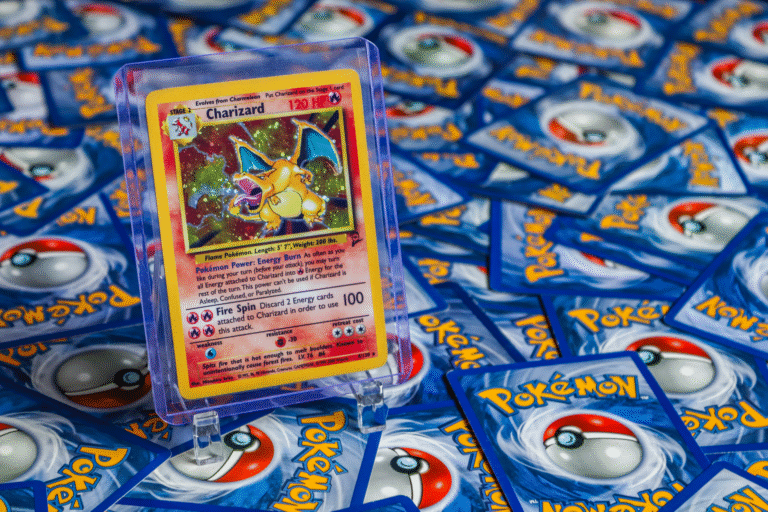
First Edition Charmander has all the structural elements needed to become a long-term collector favorite: it represents the genesis of the Pokémon Trading Card Game, carries genuine scarcity in high grades, and sits at an accessible price point compared to other pivotal 1st Edition cards. Unlike the more expensive rare holos from the same era, a well-preserved First Edition Charmander offers collectors exposure to early Pokémon cardboard without requiring five figures. A PSA 8 specimen might cost $800–$1,500, while comparable rare holos from Base Set exceed $3,000, making it an entry point to serious collecting that doesn’t demand deep pockets.
The card benefits from multiple tailwinds that typically lock in long-term appreciation. Charmander is iconic across generations of players—it appears in the anime’s first episode and remains a gateway Pokémon for new fans decades later. The 1999 Base Set ceiling has largely stabilized in terms of new supply (unopened packs are effectively gone), while demand from both nostalgia-driven adults and younger collectors discovering vintage cards continues to rise. This combination of limited inventory and persistent demand creates the environment where previously dismissed commons become subtle collectibles.
Table of Contents
- What Makes First Edition Pokémon Cards Hold Value Over Time?
- Market Signals and the Grading Economy’s Impact on Base Set Commons
- Provenance, Condition Consistency, and What Separates a Keeper from a Flip
- How Charmander Compares to Sibling Cards and Other Entry Points
- Authenticity Risks and the Counterfeiting Landscape
- The Nostalgia Factor and Generational Demand Stability
- Market Maturity and the Path Forward for Early Pokémon Cards
- Conclusion
What Makes First Edition Pokémon Cards Hold Value Over Time?
First Edition cards carry a technical scarcity that newer printings simply don’t. The first print run of base Set was limited compared to subsequent unlimited reprints—Wizards of the Coast didn’t anticipate the pokémon explosion, so early inventory was constrained. Charmander wasn’t a rare in the 1st Edition release, but low pull rates and the reality that most cards from that era were either played heavily or discarded means finding well-centered, clean specimens is genuinely difficult. A PSA 9 or higher Charmander is rare enough that prices spike noticeably at each grade tier.
Scarcity alone doesn’t guarantee value; condition and holder prestige matter enormously. A raw, moderately played Charmander might sell for $20–$50, while the same card in a PSA 8 holder commands 15–20 times that price. This grading premium incentivizes collectors to preserve cards carefully and encourages the idea that the highest-grade examples will compound in value. Compare this to a chaotic card like Blastoise or Venusaur from the same set—those rares are inherently rarer in top condition, so the price separation between grades is less dramatic and the collector base is more fragmented between raw and graded.

Market Signals and the Grading Economy’s Impact on Base Set Commons
The Pokémon card market has become increasingly dominated by graded inventory, especially for cards from the ’90s. Third-party grading (PSA, BGS, CGC) added a authentication and condition assurance layer that transformed collecting from a trust-and-hope game into a standardized one. For Charmander, this means that high-grade examples are now catalogued, priced, and tracked more reliably than they were five years ago. An ungraded PSA 9-quality Charmander is virtually invisible in the secondary market because collectors and dealers assume any high-quality example would already be slabbed.
However, the grading bubble presents a genuine downside risk. If third-party grading prices rise substantially, or if market demand for slabbing weakens, the premium commanded by graded cards could compress. A Charmander slab that cost $12–$15 to grade in 2020 might cost $25–$30 today, eating into the margin between purchase price and resale value for smaller holdings. Additionally, older slabs (those from 2010–2015) have experienced some regrade inflation where the same card receives higher marks under today’s standards, creating a subtle long-term pressure on original slab values as collectors upgrade to newer holders.
Provenance, Condition Consistency, and What Separates a Keeper from a Flip
Charmander’s appeal rests partly on condition stability. Unlike cards with foil textures or prone to print defects (where condition can seem arbitrary), Charmander’s flat surface and clean artwork mean that two PSA 8 examples grade consistently—collectors can compare historical sales and feel reasonably confident that their own example will hold its mark. A first Edition Charmander graded 8 in 2015 is likely still a 7 or 8 today, whereas cards with holo issues or centering variance might have drifted.
Real-world example: A collector who purchased a PSA 8 1st Edition Charmander in 2016 for roughly $350 and listed it for sale today would realistically expect $900–$1,100 depending on slab condition and current market sentiment. That’s approximately 6–7% annual appreciation, which outpaces most equity indices but is less spectacular than the gains seen in true rares. The lesson is that Charmander rewards patience but isn’t a moonshot asset. Buyers chasing 50% annual gains will be disappointed; those seeking reliable, inflation-beating returns over a decade-plus horizon should find it compelling.

How Charmander Compares to Sibling Cards and Other Entry Points
The Pokémon Company printed Base Set in three tiers of scarcity: commons, uncommons, and rares. Within the rare category, certain holos (Charizard, Blastoise, Venusaur) were significantly scarcer than others, and all were rarer than non-holo rares. Charmander is a common—one of the most printed cards in the entire set. Yet as a common with decades of attrition and a recognizable cultural identity, it’s become more valuable in high grades than many unloved uncommons.
The tradeoff is that Charmander’s upside is capped by its common-card status. It will never reach the valuations of 1st Edition Charizard (a four-figure card at PSA 8+) because the collector base implicitly understands that one is rarer than the other. For someone with a budget of $1,000, the decision tree is: purchase one high-grade Charmander, or spread the capital across four–five lower-grade rare holos, or allocate toward a PSA 7 or lower Charizard. Charmander makes sense only if the collector’s goal is to build a Pokédex-style collection of the core trio in excellent condition, or if they’re drawn to the card’s specific cultural weight.
Authenticity Risks and the Counterfeiting Landscape
Counterfeit cards are a persistent threat in Pokémon collecting, though Charmander’s status as a common means it’s a lower-priority target for counterfeiters compared to high-value rares. A fake 1st Edition Charizard can net thousands; a fake Charmander might only sell for $200–$300 before detection. Still, certain print batches from the original 1999 run do exhibit minor variations in cardstock or ink that can trigger misidentification. The main defense is grading.
A PSA-slabbed Charmander represents authentication plus a permanent record of condition, making it functionally irrelevant whether the card was sourced from a sealed pack or estate sale. For raw cards, buyers assume proportional risk—a card offered for $400 without grading is cheaper because it’s unverified. If the goal is long-term holding, slabbing is a one-time cost that essentially purchases permanent insurance. The warning: never purchase an expensive 1st Edition Pokémon card raw unless you can personally verify its authenticity through print techniques and have significant expertise in the era.
The Nostalgia Factor and Generational Demand Stability
Charmander’s cultural footprint is nearly unmatched in the Pokémon universe. It was the first frame-by-frame animation seen in Pokémon’s anime pilot; it’s Ash Ketchum’s iconic first capture. Every person who watched Pokémon in the late 1990s or early 2000s has an emotional anchor to Charmander. This nostalgia is economically non-trivial—it ensures that even as the modern Pokémon TCG churns out new cards, demand from adults seeking artifacts from their childhoods remains constant.
The flip side: nostalgia is a generational asset. Millennials’ attachment to 1999 Base Set is at peak intensity now (in 2026). By 2050, if Pokémon remains culturally relevant, Gen Z and Gen Alpha may be indifferent to 1st Edition cardboard and more invested in later-era rarities or entirely new collectible categories. Charmander will likely retain some value as a proto-collectible, akin to how 1960s comics are still valuable today despite being out of cultural favor. But the assumption that nostalgia pricing will compound forever is flawed.
Market Maturity and the Path Forward for Early Pokémon Cards
The 1999 Base Set market has matured significantly since 2015. Prices for all First Edition commons, uncommons, and rares have tripled or quadrupled in real terms, and much of that expansion was driven by initial acceptance of grading and a shift in collecting habits. The market is less likely to experience the same explosive growth in the next decade as it did in the past ten years.
Instead, expect a steady appreciation matching inflation plus a modest premium for scarcity and cultural persistence. New generations of collectors will enter the hobby, but they may prefer cards from their own era (2010s–2020s sets) rather than hunting for 25-year-old cardboard. However, the proven scarcity and authentication infrastructure around Base Set cards suggest they’ll remain a floor price floor—a First Edition Charmander in PSA 8 is unlikely to drop significantly below $700 unless the entire Pokémon card market collapses, an event that would devastate all vintage cards equally. The most likely scenario is gradual appreciation in the 3–5% annual range, with high-grade examples slightly outperforming due to continued supply attrition.
Conclusion
First Edition Charmander is a legitimate long-term collectible for investors willing to accept moderate, inflation-beating returns rather than spectacular gains. The card benefits from genuine scarcity in top grades, consistent collector demand rooted in cultural nostalgia, and a proven track record of price stability and appreciation over the past decade. The main risks—grading inflation, generational shifts in collecting preferences, and the possibility of market saturation if sealed packs are discovered—are real but not existential.
For collectors deciding where to allocate capital, Charmander represents a reliable entry point to the 1999 Base Set ecosystem. It requires careful grading and authentication, rewards patience, and sits comfortably between commodity-like accessibility and true rarity. If your goal is to hold a piece of Pokémon history that will retain purchasing power for decades, a PSA 8 or 9 specimen is a defensible choice. If you’re seeking a life-changing investment, allocate the same budget toward a higher-grade rare instead, and accept the additional price volatility.