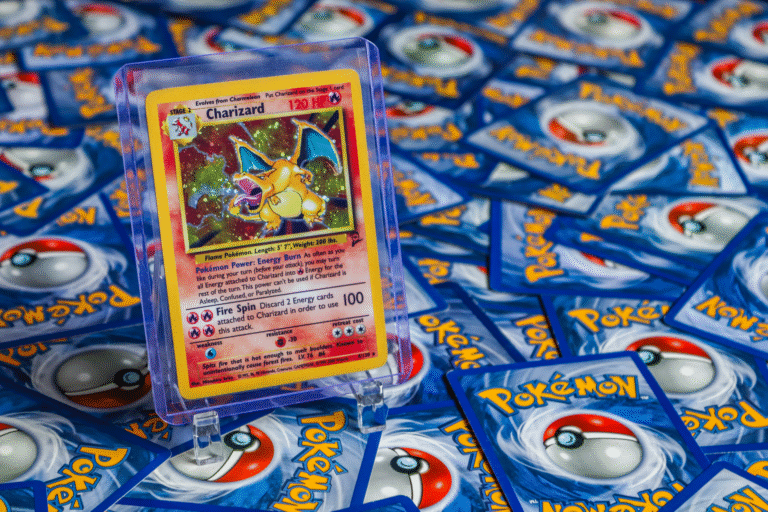
The truth about Base Set 1st Edition Charizard cards graded PSA 5 is straightforward: there is no transparent market data for them. Current pricing guides and auction records focus almost exclusively on PSA 6 and higher grades, leaving PSA 5 Charizards in a curious blind spot. This absence of public sales history doesn’t mean PSA 5 copies don’t exist or aren’t valuable—it means the market for them operates quietly, with deals struck between private collectors rather than through visible auction channels. What we can determine about PSA 5 values comes from understanding the broader grade spectrum and the dramatic price multipliers that define the 1st Edition Charizard market.
The lack of specific PSA 5 data is itself a market signal. Unlike PSA 6 cards, which regularly appear in auctions and command $5,000–$10,000, PSA 5 copies rarely if ever surface publicly. This scarcity of transparency suggests either two things: there are very few PSA 5 graded examples in circulation, or collectors with them are holding them without intent to sell. For buyers or sellers of a PSA 5 example, understanding the price context of adjacent grades becomes essential.
Table of Contents
- Why PSA 5 Data Disappeared From Public Market Records
- Pricing Across the Grade Spectrum and What It Reveals
- The Record $550,000 Sale and Its Impact on Grade Perception
- Estimating PSA 5 Value from Grade Multipliers and Historical Patterns
- Supply Scarcity and Why PSA 5 Numbers Remain Unknown
- Collector Preferences and the Psychological Grade Premium
- Future Market Trends for Lower-Grade 1st Edition Charizards
- Conclusion
Why PSA 5 Data Disappeared From Public Market Records
The Pokemon card market has become increasingly professional and transparent over the past five years, with Heritage Auctions, Goldin Auctions, and specialized card dealers publishing extensive sales data. Yet PSA 5 base set 1st Edition Charizards rarely appear in these records. The gap likely stems from collector preference for higher grades. Since 2020, the market shifted away from lower grades toward PSA 8, PSA 9, and PSA 10 copies as investment vehicles.
Collectors with PSA 5 examples—cards showing light play, possible corner wear, or very light surface wear—tend to hold them for personal collections rather than liquidate them on the secondary market. This creates a feedback loop: fewer sales mean fewer price comparables, which means less public information about value, which may discourage sellers from listing them. A PSA 5 card is still a 1st Edition Charizard, still genuinely rare, and still worth substantial money, but it operates in a market segment that’s largely invisible to price trackers. For context, in 2020 and earlier, PSA 5 copies were occasionally documented selling in the $300–$800 range, but more recent transactions have not been publicly recorded.

Pricing Across the Grade Spectrum and What It Reveals
The documented prices for higher grades tell us about market dynamics that affect lower grades indirectly. A PSA 6 copy commands $5,000–$10,000, while a PSA 7 jumps to $15,000–$25,000. PSA 8 examples range from $15,000 to $80,000 depending on centering and surface quality, and PSA 9 copies sit in the $30,000–$60,000 range, with one recorded sale at $183,812. At the absolute top, the December 2025 Heritage Auctions PSA 10 sale at $550,000 set a new record. The progression reveals a non-linear multiplier system: each grade increase doesn’t double the price—it often multiplies it by anywhere from 1.5x to 4x depending on the market conditions at the time of sale.
Working backward from these figures, a PSA 5 copy would theoretically sit substantially below the $5,000–$10,000 range of PSA 6. Conservative estimates suggest PSA 5 examples, if regularly sold, might range from $800–$3,500 depending on specific attributes like centering and surface quality. However, this is extrapolation based on historical patterns, not current market transactions. The critical limitation here is that lower-grade cards carry higher variance in value. A PSA 5 Charizard with exceptional centering might approach $3,000, while one with visible centering issues might settle at $1,200. Without transaction data, collectors pricing a PSA 5 sale face genuine uncertainty.
The Record $550,000 Sale and Its Impact on Grade Perception
The December 2025 Heritage Auctions PSA 10 charizard sale at $550,000 dominated news and social media in the collecting community. This record reinforced a critical market psychology: only the highest grades matter. The sale demonstrated that a perfect or near-perfect 1st Edition Charizard commands an extraordinary premium—approximately 55x to 110x the value of a PSA 6 copy. This winner-take-most dynamic has inadvertently devalued lower grades in the collector’s imagination. When a PSA 10 Charizard can sell for half a million dollars, a PSA 5 card can feel disappointing by comparison, even though the PSA 5 represents an intact, original card from the 1990s.
The maturity phase that the market has now entered—characterized by organic rather than speculative demand—means record-breaking sales are becoming less common. The $550,000 sale was exceptional even by recent standards. For PSA 5 collectors, this market environment is actually stabilizing. Speculators chasing grade premiums have largely exited the market, leaving behind collectors who buy because they genuinely want the card. A PSA 5 Charizard purchased for a reasonable price is likely more defensible than one bought at the peak of 2020–2021 speculation.

Estimating PSA 5 Value from Grade Multipliers and Historical Patterns
The most useful tool for estimating PSA 5 value is the documented 6x to 10x multiplier between PSA 9 and PSA 10. Working in the opposite direction, we can apply a comparable multiplier framework to PSA 5. If PSA 6 ranges from $5,000–$10,000, and the jump to PSA 7 represents roughly a 2–3x increase, then PSA 5 might represent a 50–60% decrease from PSA 6 baseline. This suggests a PSA 5 range of approximately $2,000–$6,000 in the current market, with cards in excellent condition for their grade trending toward the higher end and cards with visible wear toward the lower end.
For practical sellers, this creates a dilemma: without comparable sales, you cannot definitively price a PSA 5 copy. The solution is to look at regional card dealers and eBay’s sold listings for reference, though these sources often lack the professional verification of graded cards. A collector selling a PSA 5 should expect a longer time-to-sale than with a PSA 7 or PSA 8, and should price accordingly to reflect the reduced demand pool. Buyers of PSA 5 copies should view them as personal collections investments or long-term holds rather than liquid assets.
Supply Scarcity and Why PSA 5 Numbers Remain Unknown
Approximately 122–124 PSA 10 copies of the 1st Edition Base Set Charizard exist across all PSA holdings. This represents an incredibly tight supply at the top end. While PSA grade distribution data is not public, industry estimates suggest tens of thousands of 1st Edition Charizards have been graded overall, spread across all grades from PSA 1 to PSA 10. The distribution likely follows a pyramid: many lower grades, progressively fewer cards as you climb toward PSA 10.
The key limitation is that the middle grades—PSA 5 through PSA 7—have never been comprehensively tracked. PSA publishes set registry information that shows the distribution for rare cards, but this data has significant gaps for older cards and is not always fully transparent. In practical terms, a PSA 5 1st Edition Charizard is extremely scarce compared to unlimited or later editions, but we cannot confidently state whether 50 or 500 exist. This uncertainty undercuts pricing confidence for anyone dealing in the grade.

Collector Preferences and the Psychological Grade Premium
The shift in collector psychology away from lower grades has been dramatic. In 2015, a PSA 5 Charizard was considered an aspirational, affordable entry point for serious collectors. By 2025, many collectors view anything below PSA 7 as “damaged” or “worn,” even though PSA 5 is a light play grade in the professional grading scale. This perception gap means that seller expectations for PSA 5 cards often exceed actual market willingness to pay.
A seller expecting $4,000 for a PSA 5 may find buyers offering $1,500–$2,000. The warning here is critical: do not assume a PSA 5 Charizard retains a fixed percentage of PSA 10 value. The market is not linear. A PSA 10 might be worth 55x a PSA 5, but this multiplier is based on scarcity, demand concentration, and psychological desirability, not intrinsic condition. Collectors should validate their valuations with multiple dealers before committing to a sale price.
Future Market Trends for Lower-Grade 1st Edition Charizards
As the 1st Edition Charizard market matures and price records stabilize, there’s potential for modest reevaluation of lower grades. If high-grade copies remain locked in collections and rarely surface, demand may gradually shift toward PSA 7 and PSA 8 alternatives. Similarly, younger collectors entering the hobby may find PSA 5 and PSA 6 copies more accessible entry points than $200,000+ PSA 9 cards.
The maturity phase of the market—characterized by collected studies and declining speculation—suggests that PSA 5 values may eventually stabilize at a transparent, repeatable level, perhaps through more active dealer networks focusing on this grade. For now, the PSA 5 market remains in transition. Collectors holding these cards should view them as long-term portfolio pieces rather than flip vehicles. The absence of transparent pricing is both a risk and an opportunity: it means uncertainty, but it also means potential upside if the market eventually recognizes that a PSA 5 1st Edition Charizard is still an extraordinary piece of Pokemon history.
Conclusion
Recent sales data for Base Set 1st Edition Charizard cards focuses almost entirely on PSA 6 and higher grades, leaving PSA 5 copies in an information vacuum. What we know is that the market has reached maturity, with the December 2025 Heritage Auctions record of $550,000 for a PSA 10 serving as a ceiling for extraordinary examples. Working from documented prices across grades, a PSA 5 copy likely trades in the $2,000–$6,000 range, though no reliable current comps exist to confirm this.
For anyone dealing in PSA 5 Charizards—whether buying or selling—expect limited transparency, longer transaction times, and the need to negotiate values based on condition specifics. The good news is that the end of speculation-driven pricing means lower grades are no longer losing value due to market crashes. A PSA 5 1st Edition Charizard is still an iconic, rare card worth real money; it simply requires patience and realistic pricing expectations to find the right buyer.