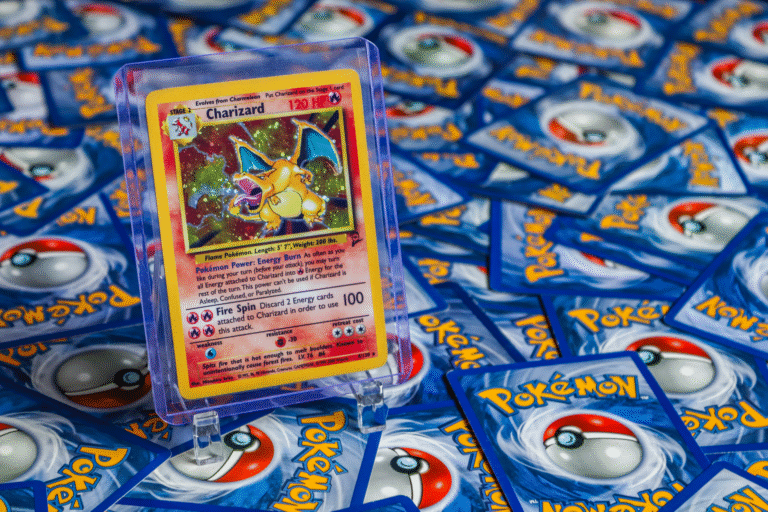
Recent sales data reveals that Base Set 1st Edition Charizard in PSA 4 grade is trading at considerably lower prices than the higher grades dominating the market, with the most recent verified sale occurring on eBay Auction on September 8, 2025, where a copy sold for $6,561. This price point offers important insight into the market’s valuation of lower-graded specimens of one of Pokémon’s most iconic cards. While this represents a substantial sum for most collectors, it’s worth understanding that PSA 4 grades are significantly less common in recent auction results compared to gem-quality cards in PSA 9 or PSA 10 condition.
The $6,561 sale price tells us that there is still meaningful demand for PSA 4 Charizards, but the relative scarcity of recent comparable sales in this grade suggests that these cards move through the market differently than their higher-graded counterparts. This is less about the card losing appeal and more about market segmentation—collectors seeking investment-grade Charizards typically target PSA 9 or higher, while PSA 4 represents a different collector demographic with different expectations. Understanding what this single recent sale means requires context about how dramatically prices escalate as grades improve, and what limitations exist in evaluating a market where PSA 4 sales are sparse compared to higher grades.
Table of Contents
- What Does the Market Tell Us About PSA 4 Charizard Values?
- Understanding the Grade-to-Price Multiplier
- Why PSA 4 Grades Are Underrepresented in Recent Sales
- Evaluating PSA 4 as a Collector’s Entry Point
- The Risks of Low-Grade Charizard Investments
- Comparing PSA 4 to Other Holo Pokémon Cards
- What the Future May Hold for PSA 4 Base Set Charizards
- Conclusion
What Does the Market Tell Us About PSA 4 Charizard Values?
The $6,561 price from the September 2025 sale establishes a concrete floor for where Base Set 1st Edition Charizard in PSA 4 condition is currently valued. This price is meaningful—it’s still a five-figure investment in absolute terms—but it’s crucial to understand how dramatic the price divergence becomes as you move up the grade scale. A PSA 8 Charizard from the same era sells in the $10,000 to $18,000 range, meaning a single grade improvement (PSA 4 to PSA 5 or 6, eventually reaching PSA 8) can result in a 50% to 175% premium.
The $6,561 price also reflects market reality: collectors who want a Base Set 1st Edition Charizard at an “entry” price point (if six thousand dollars can be called entry-level) don’t have many options beyond PSA 4 or PSA 5 grades. This creates distinct market tiers—affordability-conscious collectors in the PSA 4-5 range, mid-tier collectors targeting PSA 6-8, and luxury buyers pursuing PSA 9-10 specimens. The limitation here is that a single sale doesn’t establish a robust market trend. Because PSA 4 Charizards appear infrequently in auction results, a second comparable sale even six months later might deviate from the $6,561 benchmark, whereas PSA 10 sales are consistent enough to track meaningful trends.

Understanding the Grade-to-Price Multiplier
The jump in value between grades becomes exponential rather than linear as you move higher. A PSA 8 Charizard costs roughly 50% more than PSA 4, but the jump from PSA 9 (€30,000–€50,000, roughly $30,000–$50,000 USD) to PSA 10 ($171,000–$264,000+) represents a 6 to 10 times price increase. This non-linear pricing structure is why so much market attention focuses on gem grades—the perceived scarcity and eye appeal difference between PSA 9 and PSA 10 is relatively small visually, but the price difference is staggering. For PSA 4 specifically, this means the card in question may have visible wear—surface scratches, corner wear, edge wear, or centering issues—that prevent it from being graded higher.
From a practical standpoint, improving a PSA 4 to a PSA 5 or 6 through any means is nearly impossible; you can’t improve a card’s condition retroactively. This creates a real ceiling on value for cards stuck at lower grades. The warning here is significant: if you’re considering purchasing a PSA 4 Charizard as an investment, understand that improvement through grade bumps is off the table. Your returns would depend on overall market appreciation for the card, not on the condition improving with time.
Why PSA 4 Grades Are Underrepresented in Recent Sales
PSA 4 Charizards are notably less common in recent auction results compared to PSA 9 or PSA 10 specimens, and there’s a logical reason: most base Set 1st Edition Charizards that have survived in excellent condition were already graded and sold years ago. The pool of high-grade examples is finite, and many are now in collector hands, occasionally appearing at auction. But lower grades like PSA 4 represent cards that were played with, stored poorly, or experienced damage over the past 25 years—and far fewer people are motivated to send a worn Charizard to PSA for grading if they don’t expect a high return. This creates a measurement problem: you can’t meaningfully track price trends for PSA 4 Charizards when only a handful of sales occur annually.
The $6,561 sale may be anomalously high or low relative to what the “true” market rate is, simply because the sample size is so small. Compare this to PSA 10 Charizards, where multiple sales per year allow collectors and dealers to establish confidence in valuation. The practical implication is that PSA 4 prices are harder to predict and verify. If you’re considering selling a PSA 4 Charizard, you may struggle to find recent comps, and you might need to accept a wider range of acceptable offers than a seller of a PSA 8 or PSA 9 would.

Evaluating PSA 4 as a Collector’s Entry Point
For collectors without $30,000 or $171,000 to spend on a pristine Charizard, PSA 4 represents a legitimate way to own the card. The $6,561 price is still substantial, but it’s measurably more accessible than the PSA 8 ($10,000–$18,000) or PSA 9+ ($30,000+) options. If you’re a Pokémon collector primarily seeking the card for the set rather than as a financial instrument, the grade might matter less than actually holding an authentic 1st Edition. The tradeoff is that a PSA 4 card shows its age. You’ll see surface wear, potential print lines, or corner dings that a PSA 8 or PSA 9 wouldn’t have.
Some collectors find this character—evidence that the card is vintage—appealing. Others prefer the eye appeal of higher grades. The decision depends on your collecting philosophy and budget constraints, not on whether PSA 4 is objectively “good” or “bad.” From an investment standpoint, PSA 4 is the riskier choice. You’re betting on general Pokémon card market appreciation rather than on the specific cache of owning a gem-quality card. That said, if Pokémon cards continue to appreciate as a collectible asset class, a $6,561 investment today might return 20%, 50%, or more over a decade—just don’t expect the astronomical gains that a PSA 10 might deliver.
The Risks of Low-Grade Charizard Investments
Purchasing a PSA 4 Charizard as an investment carries several specific risks worth acknowledging. First, the condition is fixed and cannot improve. If your investment thesis depends on the card gaining value through condition appreciation, you’re looking at the wrong grade. Second, the market for PSA 4 is thinner, meaning liquidity is lower—selling might require more patience or accepting a lower price than you’d see with a higher-graded example. A critical limitation is that even as the overall Pokémon market appreciates, lower grades don’t always appreciate at the same rate as higher grades.
If PSA 10 Charizards appreciate 10% annually and PSA 4 appreciates 5%, you’re gradually falling behind in relative value. There’s no guarantee this happens, but the pattern has been observed in collectible markets where condition premiums widen over time. The final risk is authentication and market saturation. While PSA grading is reliable, fake Charizards exist. Even with a PSA slab, you should verify the integrity of the encasement and the card itself if you’re purchasing from an unfamiliar seller. Additionally, if the Pokémon market cools significantly, lower-graded cards are often the first to see price pressure, as buyers with limited budgets retreat entirely.

Comparing PSA 4 to Other Holo Pokémon Cards
Context matters when evaluating whether $6,561 for a PSA 4 Charizard makes sense. Other iconic Base Set holos in similar condition sell for significantly less. A PSA 4 Blastoise or Venusaur from Base Set 1st Edition, also holographic and rare, typically commands $800–$2,000, a fraction of the Charizard’s price.
This reflects Charizard’s unique cultural status in Pokémon—it’s the card that drives prices in this set, not just one star among many. Even comparing within Charizard printings, a Base Set Unlimited (non-1st Edition) Charizard in PSA 4 would sell for roughly $400–$800, making the 1st Edition premium substantial. This tells you that the price gap is tied to the specific card’s scarcity and desirability, not inflated grading or market anomalies. The takeaway is that Charizard is a category unto itself in Pokémon collecting, so direct price comparisons to other holos may mislead you about whether the PSA 4 price is reasonable.
What the Future May Hold for PSA 4 Base Set Charizards
If current trends continue, PSA 4 Charizards will likely remain relatively stable in the $6,000–$8,000 range in the near term, with upside potential if the broader Pokémon collectibles market appreciates. However, the relative rarity of sales data makes long-term prediction difficult. Markets for low-grade specimens of iconic cards can surprise collectors—either appreciating steadily if demand from entry-level collectors grows, or stagnating if the trend shifts toward high-grade-only collecting.
One forward-looking consideration is that as older Pokémon collectors pass away, their collections may include PSA 4 Charizards, potentially flooding the market with supply in that grade. Conversely, if Pokémon nostalgia continues strengthening and more collectors seek these cards, even low-grade examples may see demand increases. The market for PSA 4 is ultimately dependent on broader trends in collectible Pokémon cards and the appetite among collectors who prioritize ownership over condition.
Conclusion
Recent sales reveal that a Base Set 1st Edition Charizard in PSA 4 is valued at approximately $6,561 based on the September 2025 eBay sale, establishing a meaningful floor for this grade. This price reflects real demand from collectors seeking entry-level access to one of Pokémon’s most legendary cards, even if the condition is well-worn.
However, the relative scarcity of PSA 4 sales compared to higher grades means this data point represents more of a snapshot than a robust trend. If you’re considering a PSA 4 Charizard, approach it as a collector’s item rather than a high-growth investment, understand that the card’s condition cannot improve, and recognize that your returns depend on the broader appreciation of Pokémon cards rather than on grade-based premiums. The $6,561 price is substantial but accessible compared to higher grades—making PSA 4 a legitimate entry point for serious collectors working within realistic budgets.