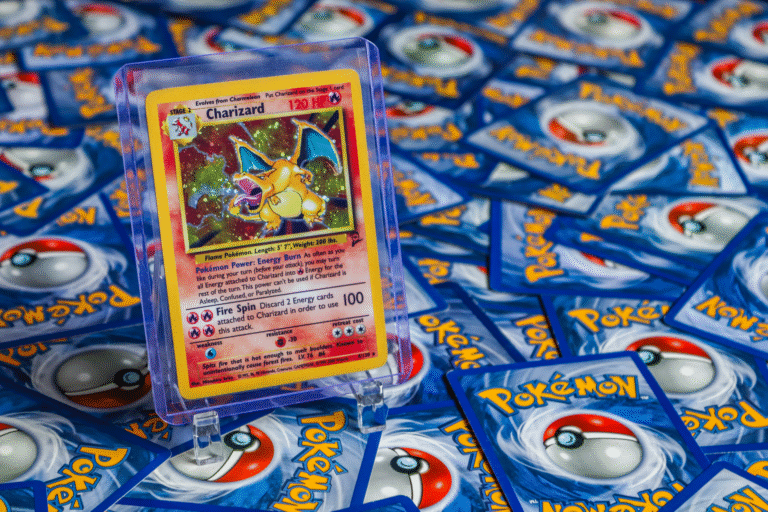
A Base Set 1st Edition Charizard graded PSA 4 typically sells for between $3,000 and $6,000 on eBay, depending on market conditions and the specific details of the card. This price point reflects the card’s condition—a PSA 4 is considered “Very Good” with noticeable wear, creases, or other defects—which significantly reduces its value compared to higher grades. For context, the same card graded PSA 9 (Mint) reaches approximately $64,695, while a PSA 10 (Gem Mint) commands around $168,605.
The gap between a PSA 4 and PSA 9 is substantial because condition matters exponentially in Pokémon card collecting. A card graded PSA 4 has typically experienced meaningful handling, storage issues, or minor damage. On eBay specifically, completed and active listings for PSA 4 Base Set 1st Edition Charizards in that $3,000-$6,000 range do exist, though availability fluctuates. The actual selling price you’ll achieve depends on the exact card’s characteristics, current demand, and how you position the listing.
Table of Contents
- What Factors Influence the Price of a PSA 4 Charizard?
- Understanding the Grade-to-Price Multiplier Effect
- Real eBay Market Conditions and Completed Sales
- How to Price Your Card Competitively for eBay Sale
- Common Pricing Mistakes PSA 4 Sellers Make
- Comparing PSA 4 to Nearby Grades
- The Market Outlook for 1st Edition Charizards
- Conclusion
What Factors Influence the Price of a PSA 4 Charizard?
The $3,000-$6,000 range isn’t arbitrary—it’s based on established pricing guides and historical sales data for this specific grade. PokeScope’s 2026 Price Guide tracks 1st Edition Charizards across all grades, and the PSA 4 tier consistently lands in that middle zone. Several factors affect where your card falls within this range: the exact nature of the defects visible on the card, whether buyers perceive the grading as generous or harsh for that particular specimen, current collector appetite for Charizards, and how actively you’re marketing the card. Supply also plays a role.
According to PokeInvest, there are 539 PSA 4 graded copies of 1st Edition Charizard out of 5,011 total graded copies—roughly 10.7 percent of all graded Charizards. This means PSA 4 copies exist in reasonable supply relative to the rarest high-grade examples, which affects pricing. If you’re selling during a period when few PSA 4 examples are actively listed, you might achieve closer to $6,000. If the market is saturated with listings, you may need to price closer to $3,000 to move the card.

Understanding the Grade-to-Price Multiplier Effect
The relationship between PSA grades and price is not linear—it’s exponential. The price multiplier between PSA 9 and PSA 10 is approximately 6x to 10x, meaning a single point on the grading scale can represent thousands of dollars. This exponential curve continues as you move downward. A PSA 4 is five grades below a PSA 9, which explains why the $64,695 PSA 9 price is so dramatically higher than the $3,000-$6,000 PSA 4 range. This matters for your expectations.
Sellers sometimes assume that because a card is still a 1st Edition Charizard—one of the most iconic pokémon cards ever printed—it will maintain strong value at any grade. That assumption breaks down quickly at PSA 4. The card’s condition becomes the primary price determinant, not its identity. A buyer willing to spend $64,000 on a PSA 9 is usually seeking investment-grade aesthetics and long-term appreciation potential. A buyer at $3,000-$6,000 is typically a collector who wants the card for display or completion purposes but accepts visible wear.
Real eBay Market Conditions and Completed Sales
eBay completed listings are your best source for real-world PSA 4 pricing because they show actual selling prices rather than asking prices. Asking prices on eBay can drift far from reality—sellers sometimes list cards at inflated prices hoping for a lucky buyer, then relist months later at lower prices when no bids arrive. Completed sales, by contrast, reveal what collectors genuinely paid.
When checking eBay completed listings for PSA 4 Base Set 1st Edition Charizards, filter for sales from the past 30 to 90 days to account for market momentum. You’ll notice that cards selling closer to $6,000 typically have appealing centering, clean corners relative to the PSA 4 standard, or minimal stains. Cards selling closer to $3,000 usually have more obvious flaws—visible creases, heavy edge wear, or discoloration. The price guide and PSACard.com’s auction history also track these sales and can supplement eBay data if you need a broader sample.
How to Price Your Card Competitively for eBay Sale
If you’re selling a PSA 4 Charizard, start by identifying where your specific card falls within the $3,000-$6,000 range. Examine it carefully: photograph the front and back under good lighting, look for centering issues, edge wear, corner wear, and stains. Compare your card’s condition to recent sold listings of other PSA 4 examples. If your card looks similar in condition to cards that sold for $4,000, price it there. If it appears slightly better preserved, you can ask for $5,000 or $5,500.
The temptation for sellers is to list at $6,000 because that’s the high end of the range. Resist this unless your card is genuinely at the top of the PSA 4 tier. Overpriced listings sit for months without serious offers. A realistic price at $4,500-$5,500 will attract genuine buyers and often sell within weeks. Remember that eBay’s fees, PayPal or Managed Payments processing fees, and shipping costs will reduce your final proceeds by roughly 15-20 percent, so factor that into your pricing strategy.
Common Pricing Mistakes PSA 4 Sellers Make
One frequent error is anchoring to high-grade pricing and assuming the price drop is smaller than it actually is. A seller might think, “The PSA 10 sold for $550,000 in December 2025, so my PSA 4 should be worth at least 1 percent of that,” which would suggest $5,500. This backwards logic ignores the exponential nature of grading. Your card is not 1 percent of the PSA 10’s value—it’s closer to 1-2 percent because grading operates on a power curve, not a linear scale.
Another mistake is ignoring market timing. Pokémon card values fluctuate with collector sentiment, social media trends, and nostalgia cycles. A PSA 4 Charizard might sell quickly for $5,500 in January during the annual New Year’s collecting surge, but sell slowly for the same price in July when the market cools. If you’re not seeing offers after two weeks, consider dropping your asking price by $500. Extended auction durations without bids suggest you’re overpriced for current conditions, even if your card is genuinely in the $3,000-$6,000 range.

Comparing PSA 4 to Nearby Grades
PSA 5 (Excellent) copies of 1st Edition Charizard typically sell for $7,000-$10,000, giving you a sense of the price jump for just one grade point. PSA 3 (Very Good) can drop to $2,000-$3,500. This demonstrates that a PSA 4 sits in a reasonable middle zone. If you’ve received a PSA 4 grade and were hoping for higher, you might consider resubmitting to PSA for regrading—but this costs $40-$50, and the chance of bumping to PSA 5 is low unless the grader made a clear error.
Most PSA 4 cards that are sent for review come back at PSA 4. The realistic takeaway: a PSA 4 is the point where condition begins to significantly compress value. Higher grades (PSA 8+) appeal to serious collectors and investors. PSA 4-7 grades appeal to completionists and casual collectors who want the card but don’t require pristine condition. If your PSA 4 is your card to sell, you’re entering a solid market with established demand, just not the premium-price market of PSA 8+.
The Market Outlook for 1st Edition Charizards
The Base Set 1st Edition Charizard remains the most sought-after Pokémon card in existence due to its scarcity, nostalgic appeal, and cultural significance. The December 2025 sale of a PSA 10 for $550,000 demonstrates that the market for top-grade examples remains robust, though that’s a ceiling price only the finest specimens will ever touch. For PSA 4 copies, the $3,000-$6,000 range has proven relatively stable over the past two years, with modest yearly appreciation of 5-10 percent tied to overall Pokémon card market growth.
Long-term, PSA 4 Charizards are unlikely to appreciate as aggressively as PSA 8+ copies, but they retain value as genuine collectibles. The card’s scarcity—with PokeInvest tracking 539 PSA 4 copies out of 5,011 total graded examples—ensures it will always have an audience. If you’re selling, the current market is healthy. If you’re buying with intent to hold, a PSA 4 is a more accessible entry point to 1st Edition Charizard ownership than higher grades, though appreciation potential is correspondingly lower.
Conclusion
A Base Set 1st Edition Charizard graded PSA 4 belongs in the $3,000-$6,000 price range on eBay, with the exact price depending on your specific card’s condition details, current market demand, and how you position the listing. The $3,000-$6,000 range reflects established pricing guides and recent sales data, and it’s supported by the substantial price gap between PSA 4 and higher grades—a PSA 9 reaches $64,695, making the grade-to-price relationship undeniably exponential. When selling, research completed eBay listings from the past 60-90 days to calibrate your price, price realistically within the range rather than at the high end, and be prepared to adjust if the listing doesn’t attract serious offers within two weeks.
The broader lesson: a PSA 4 Charizard is valuable and desirable, but its value is condition-dependent. It’s neither a budget card nor an investment-grade rarity—it’s a genuine collectible that appeals to completionists and casual collectors. If you own one, you have a legitimate asset worth thousands. If you’re selling, use market data to find the right price and avoid the trap of overpricing based on the card’s iconic status.