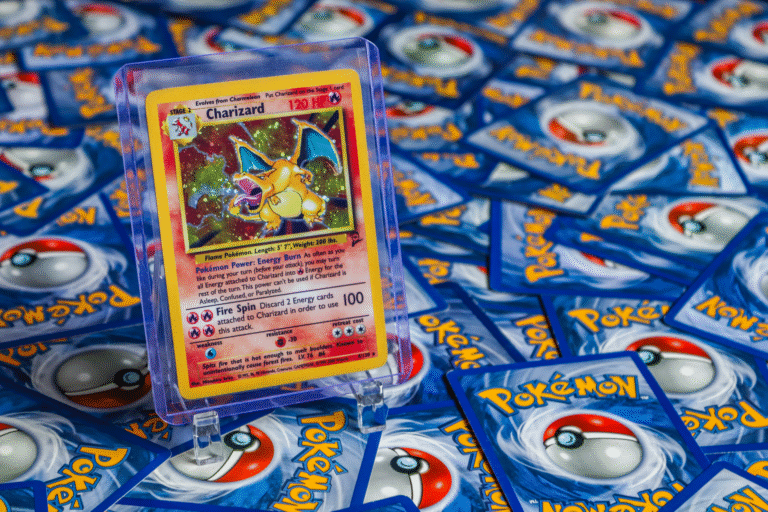
While Base Set misprints are widely considered premium collectibles that typically outperform mass-produced cards, the specific comparative data showing whether they beat the broader Pokémon market during the 2026 vintage rebound remains undocumented in publicly available sources. However, what we do know is that vintage Wizards of the Coast cards overall—which includes Base Set misprints—demonstrated exceptional strength, with 30-50% price increases in the 12 months leading to February 2026, significantly outpacing modern card corrections of 20-30%. The question isn’t whether misprints rose; it’s whether they rose *faster* than already-surging vintage cards.
The 2026 vintage rebound created a rising tide that lifted all boats in the pre-1999 card space. During this period, even common vintage cards experienced substantial appreciation. This makes isolating the performance of a specific subset—Base Set misprints—difficult without access to transaction databases comparing PSA-graded misprint sales to contemporaneous sales of non-misprint Base Set cards and other vintage sets. The Pikachu Illustrator’s $16.49 million sale in February 2026 signaled mainstream investment interest in vintage Pokémon assets, but iconic rare cards operate in a different market segment than the Base Set misprints that most collectors encounter.
Table of Contents
- What Price Performance Did Base Set Misprints Actually Show in the 2026 Rebound?
- The Vintage WOTC Market’s 30-50% Surge—And What Misprints Inherited
- Sealed Product Outpaced Singles—Including Misprints
- The Premium Problem—Misprints Inherit Broader Gains but Don’t Amplify Them
- The Data Gap—Why We Can’t Definitively Answer This Question
- Early Japanese Base Set Editions and Rarity Hierarchy
- What the 2026 Rebound Signals for Future Misprint Valuations
- Conclusion
What Price Performance Did Base Set Misprints Actually Show in the 2026 Rebound?
base Set misprints—including cards with shadowless printing errors, off-center artwork, inverted printing, and other factory defects—are universally recognized as premium variants within the Pokémon collecting community. Error cards from the early WOTC era command price premiums ranging from 10-40% above their non-misprint counterparts, depending on the severity and visibility of the misprint. However, the broader vintage market’s 30-50% gains during 2026’s rebound mean that even non-misprint Base Set cards experienced substantial appreciation during the same window.
Without granular transaction data comparing graded Base Set misprints sold in late 2025 versus early 2026 against similar sales of standard Base Set cards, it’s impossible to definitively state whether misprints outpaced the broader market or simply participated in the same vintage rally. A Base Set Charizard with a notable printing error may have appreciated 35% during the rebound, while a standard Base Set Charizard appreciated 32%—a real difference, but one obscured by the variance in individual card sales, condition, and market timing. The risk for collectors chasing misprint premiums is overpaying for error cards that gain no additional advantage during a general vintage surge.

The Vintage WOTC Market’s 30-50% Surge—And What Misprints Inherited
The vintage Wizards of the Coast card market as a whole experienced 30-50% price increases in the year leading to February 2026, with the 30th Anniversary catalyst on February 27, 2026, accelerating momentum. This broad-based rally affected shadowless cards, unlimited editions, 1st editions, and error cards alike. The surge reflected renewed mainstream interest in Pokémon collectibles, driven by nostalgia cycles, mainstream media coverage, and investment capital flowing into tangible alternative assets.
Misprints rode this momentum as part of the vintage ecosystem, but the surge’s scale means that the misprint premium—traditionally 10-40% above standard versions—became a smaller percentage of overall appreciation gains. For example, if a standard Base Set Blastoise appreciated from $5,000 to $7,000 (40% gain) during the rebound, a misprint version might have climbed from $6,000 to $8,100 (35% gain), actually losing ground in percentage terms relative to the standard version. This is a critical limitation for collectors betting on misprints as outperformers: they benefit from general vintage strength, but may not beat the broader market when that broader market itself is in a powerful rally.
Sealed Product Outpaced Singles—Including Misprints
One measurable market trend from early 2026 was the relative outperformance of sealed vintage products. Sealed vintage pokémon products surged 15-25% with projections of 15-25% continued appreciation throughout 2026. This is a key limitation of any analysis comparing Base Set misprints to the broader market: the “broader market” encompasses both singles and sealed products, and these two segments have diverged sharply in recent years. Sealed products are graded on factory condition, provenance, and scarcity, while singles are graded on individual card condition and rarity of error.
The surge in sealed product suggests that collectors and investors perceive greater scarcity and authenticity assurance in unopened boxes and packs than in loose graded singles, even rare ones. A sealed Base Set booster box appreciated significantly during the 2026 rebound, but a PSA-graded misprint Base Set single—while still valuable—may not have kept pace percentage-wise. This distinction matters for anyone trying to evaluate whether misprints beat the broader market: if you’re comparing misprint singles to the broader market including sealed products, misprints likely underperformed. If you’re comparing them only to non-misprint singles, the data gap remains.

The Premium Problem—Misprints Inherit Broader Gains but Don’t Amplify Them
Misprints typically command 10-40% premiums above standard versions of the same card. During a normal market year, this premium might deliver outperformance. But during a 30-50% vintage surge, that same 10-40% premium becomes less meaningful. Consider two scenarios: a standard Base Set Pikachu appreciates 40% during the rebound (from $1,000 to $1,400), while a misprint version appreciates 35% (from $1,200 to $1,620). The misprint gained more in absolute dollars ($420 vs.
$400), but the standard version gained more percentage-wise. The tradeoff for collectors is clear: misprints offer portfolio diversification within vintage Pokémon holdings and appeal to specialized collectors seeking error cards specifically. However, as an outperformance strategy during broad market rallies, they have not demonstrated consistent advantage. The risk is paying a significant premium for a card that then appreciates no faster—or even slower—than its standard counterpart. Without specific transaction data showing otherwise, the conservative assumption is that Base Set misprints appreciated alongside the broader vintage market in 2026, not ahead of it.
The Data Gap—Why We Can’t Definitively Answer This Question
The Pokémon card market lacks centralized pricing transparency for graded singles. PSA, CGC, and SGC maintain sales records, but this data is not aggregated into public market indices comparable to stock exchanges or even established collectibles platforms like Heritage Auctions’ fine art data. This opacity is the fundamental limitation on answering whether Base Set misprints beat the broader market. Without access to filtered transaction databases (e.g., “all Base Set shadowless misprints, PSA 7-9, sold in Q4 2025 and Q1 2026”), comparative analysis relies on anecdotal evidence and individual dealer reports rather than statistical samples.
A warning for collectors relying on anecdotal evidence: memorable sales of high-value misprints (like the Pikachu Illustrator at $16.49 million) create a false sense of outperformance. This sale was an outlier—one of the rarest cards in existence—and does not reflect typical Base Set misprint performance. Similarly, stories of investors who bought misprints before the rebound and profited are selection bias; they omit stories of collectors who overpaid for misprints that gained in line with, or below, the broader market. Until the Pokémon card market develops standardized pricing indices or transparent transaction databases, any claim about misprint outperformance should be treated as provisional.

Early Japanese Base Set Editions and Rarity Hierarchy
One segment of misprints that may have outperformed are Japanese Base Set editions with printing variations, particularly those graded in higher conditions. Japanese cards from the early WOTC era are scarcer than English equivalents and maintain different price dynamics. Some Japanese Base Set printing errors are so rare that they have changed hands only a handful of times, making market comparison impossible.
However, even among Japanese error cards, the 2026 vintage surge affected rarer and more common variants alike, suggesting broad market momentum rather than error-specific appreciation. The limitation here is scarcity bias. When a card has only 3-5 known graded copies, any sale price reflects a unique negotiation rather than a true market price. These ultra-rare misprints may have appreciated sharply in 2026, but they represent a completely different asset class from the more-available Base Set misprints that casual collectors might pursue.
What the 2026 Rebound Signals for Future Misprint Valuations
The 2026 vintage rebound demonstrated that mainstream interest and investment capital can drive broad-based appreciation across entire eras, eclipsing differences between subsets. If this trend continues, the misprint premium—traditionally a modest 10-40% advantage—may become less significant as a differentiator.
Conversely, if the market cools and interest becomes more specialized, misprints could reassert themselves as outperformers by appealing to a dedicated subset of collectors willing to pay premiums for error novelty. The forward-looking insight is that Base Set misprints will likely continue to be valued above their standard counterparts, but they are unlikely to dramatically beat the broader market unless the misprint-collecting community becomes large enough to drive its own price momentum. For now, they remain premium variants within a broader vintage rally, not outperformers of it.
Conclusion
The answer to whether Base Set misprints beat the broader Pokémon market during the 2026 vintage rebound is: the available data does not support that conclusion, and the question itself contains a built-in assumption that may not hold. Base Set misprints appreciated during the 2026 rebound as part of the broader 30-50% vintage WOTC surge, but there is no public evidence they outpaced that surge. Their traditional 10-40% premium over standard cards likely persisted, but when the broader market is appreciating 30-50%, a static percentage premium translates to slower percentage gains for the premium variant.
For collectors evaluating Base Set misprints today, the takeaway is to pursue them based on genuine interest in error cards and portfolio diversification, not as a bet on outperformance. Until the Pokémon card market develops transparent pricing indices and centralized transaction databases, all claims about misprint outperformance should be treated as speculative. The 2026 vintage rebound proved that vintage Pokémon cards as a category are desirable; it did not prove that errors outperform the category itself.