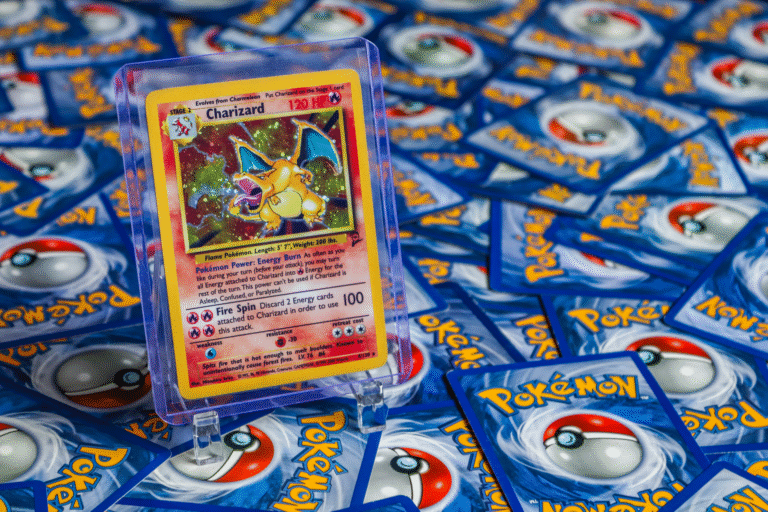
Reverse holo Charizards from specific sets, particularly the 2002 Pokémon Legendary Collection, command valuations in the hundreds—and sometimes hundreds of thousands—of dollars because of a uniquely desirable holographic pattern combined with the card’s cultural significance in the Pokémon trading card game. A raw Legendary Collection Charizard Reverse Holo #3 in lightly played condition sold for $2,099.00, while graded PSA 10 examples have reached approximately $85,000 as of early 2026. This dramatic price gap exists for very specific reasons rooted in production design, collector demand, and scarcity.
The primary driver of these prices is the Legendary Collection’s distinctive “firework” starburst refraction pattern—a reverse holofoil design where the holographic shine appears everywhere on the card except the artwork area. This creates a striking visual contrast that collectors find far more desirable than standard holofoil versions. Combined with Charizard’s status as Pokémon’s secondary mascot and its consistent demand on the secondary market since the late 1990s, this particular card became one of the most pursued reverse holos in the entire TCG hobby.
Table of Contents
- What Makes Reverse Holo Charizards From Certain Sets Worth Hundreds?
- The Legendary Collection’s Defining Refraction Pattern
- Grading Matters: Why Condition Dramatically Impacts Value
- The Charizard Premium: Why This Card Specifically Commands High Prices
- Market Reality: Understanding Price Volatility and Risk
- Comparing Reverse Holos to Regular Holos and Other Variations
- What Collectors Should Know Before Buying or Investing
- Conclusion
- Frequently Asked Questions
What Makes Reverse Holo Charizards From Certain Sets Worth Hundreds?
Not all reverse holo Charizards command three-figure prices. The premium valuations are concentrated in specific sets from the early 2000s, with the Legendary Collection edition standing out as the most valuable. The Legendary Collection’s reverse holofoil process created a radically different visual appearance compared to other sets—the starburst pattern made the card shimmer in a way that felt genuinely unique at the time and remains highly sought today. A raw 2002 Legendary Collection Charizard might fetch anywhere from $1,000 to $2,500 depending on condition, while modern reverse holos rarely exceed $50 in most cases.
The PSA auction market provides clear evidence of sustained demand. With 466 total sales recording a combined auction value of $797,747.15, the 2002 Legendary Collection Charizard Reverse Foil demonstrates that this isn’t a niche market—it’s a consistent area of collector interest spanning decades. However, this valuation applies almost exclusively to the Legendary Collection version. Other sets containing reverse holo Charizards (such as EX Dragon Frontiers or later sets) command significantly lower prices, often in the single or low double-digit dollar range, showing that set rarity and design distinctiveness matter enormously.

The Legendary Collection’s Defining Refraction Pattern
The Legendary Collection’s distinctive reverse holofoil design is the primary reason why this card towers above other reverse holo Charizards in value. Unlike standard reverse holos that became common in later sets, the Legendary Collection’s firework starburst pattern created an almost three-dimensional quality to the card. The holographic refraction appears across the entire card surface except where the Charizard artwork sits, creating a sharp visual boundary that makes the card feel premium and intentionally designed rather than a default variation. Collectors specifically seek out this pattern because it represents a moment when Pokémon’s production team experimented with reverse holofoil technology. Once this design was phased out in favor of more uniform reverse holo patterns, the Legendary Collection cards became historical artifacts.
A card that would have retailed for $3-4 in 2002 now commands prices that reflect both its age and its visual distinctiveness. This is a crucial distinction: the card is valuable not because it’s rare in the absolute sense, but because the design itself became iconic to collectors and is no longer produced. One limitation to understand is that condition assessment becomes critical with this design. The starburst pattern is prone to wear, and even small scratches on the holographic surface become visible. A Legendary Collection Charizard in Near Mint condition might be worth $3,000-5,000, while the same card in Lightly Played condition could drop to $1,000-2,000. This means buyers need to carefully evaluate the card’s surface before committing to these price points.
Grading Matters: Why Condition Dramatically Impacts Value
Condition is perhaps the single most important variable in understanding why some Reverse Holo Charizards reach extreme price points while others stall at moderate values. The PSA 10 graded versions reaching approximately $85,000 represent the absolute ceiling of the market—cards in pristine condition that have maintained their refraction pattern without wear or imperfection over more than two decades. These aren’t just better versions of the same card; they exist in an entirely different market segment. Raw cards (ungraded) and lower-graded versions (PSA 7-9) sell for a fraction of the PSA 10 price. A PSA 8 example might command $10,000-20,000, while PSA 6-7 versions often stabilize around $3,000-8,000.
The jump from PSA 7 to PSA 10 is exponential rather than linear, reflecting the extreme scarcity of cards that have survived three decades without visible wear on a holographic surface. For Charizard specifically, the cultural demand means high-grade copies attract multiple serious bidders, driving prices upward. It’s essential to recognize that grading costs money—typically $30-100 per card depending on the service—and the financial return only makes sense if the card grades PSA 8 or higher. Submitting a Legendary Collection Charizard in Lightly Played condition for grading might return a PSA 6-7, but after paying grading fees, the net value could actually be lower than selling the raw card. This is a common trap for collectors who assume grading always improves their financial position.

The Charizard Premium: Why This Card Specifically Commands High Prices
Charizard occupies a unique position in Pokémon culture and economy. As the franchise’s secondary mascot behind Pikachu, Charizard has consistently appeared in high-profile media, competitive formats, and collector consciousness since the late 1990s. Unlike many Pokémon whose popularity fluctuated, Charizard maintained cultural relevance across generations, which directly translated to sustained economic demand for its cards. When multiple collectors are bidding for the same limited card, prices necessarily escalate. The 2002 Legendary Collection Charizard specifically became a gateway card for collectors seeking to own a piece of Pokémon’s golden era.
It bridges the original Base Set era (which carries even higher premiums) with the more abundant cards from mid-2000s sets. For collectors with budgets in the $500-2,000 range, the Legendary Collection Reverse Holo represented achievable access to a historically important card. This positioning made it simultaneously a prestige purchase and a realistic target, creating consistent market demand across three decades. Comparing the regular holo Legendary Collection Charizard to the reverse holo illustrates this premium clearly. Standard holofoil versions retail around $350 in Near Mint condition, while reverse holos command upwards of $1,000—a 3-4x price difference for essentially the same card with different holographic treatment. This comparison demonstrates that the reverse holofoil design alone drives the majority of the value uplift, though Charizard’s underlying popularity provides the foundation for why both versions hold such high prices relative to other Pokémon from the set.
Market Reality: Understanding Price Volatility and Risk
The high prices documented for Reverse Holo Charizards shouldn’t be interpreted as stable, guaranteed valuations. The PSA auction data showing $797,747.15 across 466 sales is averages and historical records, not predictions of future value. Pokémon card markets fluctuate based on broader collector sentiment, hobby trends, and the appearance of previously unknown high-grade examples. A major discovery of graded PSA 10 copies sitting in a warehouse, for instance, could materially depress market prices by increasing supply. There’s also the distinction between what a card sells for at auction (where multiple motivated buyers drive prices upward) versus what dealers will pay for it outright. A Legendary Collection Charizard might fetch $2,000 at auction, but a local card shop might offer $900-1,200 as a buyback price, reflecting their need to resell it at a margin.
Collectors expecting to convert these cards into cash should anticipate a 20-40% discount between the highest auction price and dealer buyback prices. This spread is particularly important for newer collectors treating cards as investment vehicles rather than items for personal collection. The market’s reliance on grading services also creates a hidden risk. If PSA or similar grading companies were to face operational issues or lose collector trust, the graded card market could contract sharply. Historically, grading company scandals have temporarily depressed prices. Additionally, newer grading standards and authentication methods could theoretically impact the valuations assigned to older grades, particularly for cards graded decades ago when standards differed. These tail risks are unlikely but worth acknowledging when making six-figure purchasing decisions.

Comparing Reverse Holos to Regular Holos and Other Variations
The value gap between reverse holo and regular holo versions of the same card demonstrates how specific design choices can dramatically alter market value. For the Legendary Collection Charizard, the reverse holo commands 3-4x the price of the regular holofoil version, a gap that simply doesn’t exist in most modern sets where reverse holos and regular holos trade within 20-30% of each other. This dramatic differential is unusual and reflects the specific desirability of the Legendary Collection’s starburst pattern rather than a universal rule about reverse holos.
The Legendary Collection also included non-holo and shadowless variations, all of which command lower prices than the reverse holo. These alternatives remind collectors that rarity alone doesn’t drive value—design distinctiveness and collector perception matter equally. A shadowless Charizard from the same set might be objectively scarcer in high grades, but the reverse holo remains more expensive because collectors find it visually more appealing and distinctive. This is a crucial reality check: scarcity metrics don’t always align with market prices.
What Collectors Should Know Before Buying or Investing
Anyone considering purchasing a Legendary Collection Reverse Holo Charizard should recognize that this isn’t a commodity with transparent pricing—the market involves auction house premiums, grading service fees, and condition-based variability that can create significant price differences between seemingly identical cards. A realistic budget for a PSA 7-8 example runs $5,000-15,000, while lower grades or raw cards in Lightly Played condition might be found for $1,000-3,000. Being clear about condition tolerances and grading expectations prevents overpaying relative to market comparables. The broader hobby trajectory also matters.
Pokémon TCG collecting has experienced significant growth from 2020 onwards, which elevated prices across the board. Whether that trajectory continues depends on generational interest in the franchise and the broader collectibles market. Collectors purchasing these cards purely for investment should understand that Pokémon’s popularity with Gen Z and younger audiences remains strong, but investment-grade decisions should be made with realistic expectations about market volatility rather than assuming consistent appreciation. Personal collecting enjoyment provides a more defensible reason to own a $2,000+ card than speculative investment returns.
Conclusion
Reverse holo Charizards from the Legendary Collection are worth hundreds—and often much more—because of a convergence of factors: a visually distinctive starburst holographic design that collectors find uniquely appealing, Charizard’s iconic status as Pokémon’s secondary mascot, limited original production quantities, and three decades of consistent demand from an expanding collector base. The documented market data showing raw sales at $2,099 and graded PSA 10 copies reaching $85,000 reflects genuine, sustained economic interest in this specific card from this specific set.
For collectors considering these cards, the key is understanding that valuation depends heavily on condition, grading, and market timing. These are not fungible commodities with fixed prices, but rather collectibles whose value reflects what motivated buyers will pay at auction. Whether you’re building a collection or exploring the hobby, the Legendary Collection Reverse Holo Charizard represents a historically significant card that bridges accessible pricing (for raw, played copies) with aspirational value (for high-grade examples) in a way few other cards in the hobby achieve.
Frequently Asked Questions
Why is the Legendary Collection Charizard more valuable than reverse holos from other sets?
The Legendary Collection’s distinctive firework starburst holographic pattern creates a unique visual appearance that’s no longer produced. Combined with its 2002 release date during Pokémon’s golden era and Charizard’s iconic status, this creates significantly higher demand than reverse holos from later sets with standard holographic patterns.
What’s the difference between raw and graded prices?
Raw cards are ungraded, while graded cards have been authenticated and condition-assessed by professional services like PSA. Graded cards command premiums—sometimes 2-3x higher—particularly in PSA 8-10 grades. However, grading costs $30-100 per card, so submitting lower-grade cards can reduce net value after fees.
Can I expect the price to increase if I buy a Legendary Collection Reverse Holo Charizard today?
The Pokémon TCG market has grown significantly since 2020, but past performance doesn’t guarantee future appreciation. Prices can fluctuate based on collector sentiment, market supply, and broader economic conditions. These cards should be purchased primarily for collection value rather than investment speculation.
How much does condition matter for these cards?
Condition is critical. A PSA 10 can reach $85,000, while PSA 6-7 versions might be $3,000-8,000, and raw Lightly Played copies $1,000-2,000. Even small wear on the holographic surface reduces value significantly, so careful assessment before purchase is essential.
Where can I verify the prices mentioned in articles about these cards?
PSA Card’s auction price database provides historical sales data. Sports Card Investor, Misprint, and other price guides offer current market analysis. Always cross-reference multiple sources and understand that auction prices often exceed dealer buyback prices by 20-40%.
Is there a risk that these cards could lose value?
Yes. Market values can fluctuate based on grading company reliability, broader hobby trends, and supply shocks if previously unknown high-grade copies surface. Treating these as speculative investments carries significant risk; owning them for personal collection enjoyment is more financially defensible.