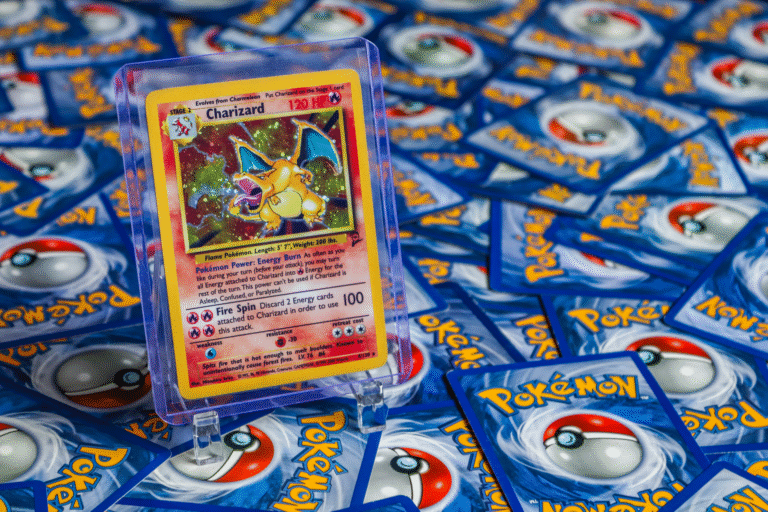
The short answer is that most reverse holo Charizard reprints are not actually worth $100 or more. The 2016 XY Evolutions reverse holo Charizard (#11/108), the most common reprint, trades for around $51 in near mint condition as of April 2026. However, the title of this article reflects a real phenomenon in the Charizard market: original releases, particularly the 2002 Legendary Collection reverse holo Charizard (#3), have sold for over $1,000 in pristine condition. For collectors asking why some Charizard reprints command premium prices, the answer lies in understanding the critical distinction between modern reprints and vintage originals.
The confusion around Charizard pricing stems from treating all reverse holo Charizard cards as if they belong in the same market tier. They don’t. A lightly played 2002 Legendary Collection reverse holo Charizard recently sold for $2,099, while the identical-looking 2016 Evolutions version costs roughly one-fortieth as much. Understanding what drives these massive valuation gaps is essential for anyone collecting or investing in Charizard cards, because buying the wrong version can mean the difference between a smart acquisition and significant financial regret.
Table of Contents
- Why Reprints Don’t Command Reprint Prices: The $51 Reality of 2016 XY Evolutions
- The Veteran Card Paradox: Why 2002 Legendary Collection Breaks the Reprint Price Pattern
- Condition Grading: The Invisible Price Multiplier Nobody Talks About
- Market Volatility and the Charizard Decline in 2026
- Counterfeits and Authentication: A Growing Risk at Every Price Point
- The Investment Thesis for Charizard: Reality Check
- The Future of Reprints and the Evergreen Charizard Question
- Conclusion
Why Reprints Don’t Command Reprint Prices: The $51 Reality of 2016 XY Evolutions
The 2016 XY Evolutions set reintroduced Charizard to modern players and collectors, but reprints carry an inherent market ceiling. The reverse holo version from this set regularly sells in the $45 to $60 range, with recent sales data showing $51.32 for near mint copies. This isn’t because the card is ugly or undesirable; it’s because reprints are common by definition. A reprint exists precisely because the original sold well enough to justify reproducing it, which floods the market with copies and erodes scarcity value. Compare this to what happened in the secondary market over the past month: the 2016 Evolutions reverse holo Charizard actually lost 14.4% of its value in 30 days.
This downward pressure reflects something important about reprints—they don’t age like wine. Instead, they trade like commodities, susceptible to broader market sentiment and supply fluctuations. Collectors hunting for “expensive Charizard” often make the mistake of assuming rarity and value are linked in a straight line. They’re not. Availability crushes price regardless of how iconic the card is.

The Veteran Card Paradox: Why 2002 Legendary Collection Breaks the Reprint Price Pattern
The 2002 Legendary collection reverse holo Charizard occupies an entirely different market universe. Near mint copies of this card have fetched over $1,000, with one raw (ungraded) lightly played copy selling for $2,099 just recently. The same card design, released 14 years earlier than the Evolutions reprint, trades at roughly 20 to 40 times the price. What changed? Everything except the art.
The 2002 Legendary Collection set is now 24 years old. Charizard was already a powerhouse in the original 1999 Base Set, and the Legendary Collection reprinting him made sense commercially but inadvertently created a print run that was massive compared to modern standards. Yet decades of play, storage mishaps, and casual collection abandonment have thinned the pool of pristine specimens to a fraction of what once existed. Near mint copies are genuinely scarce, while 2016 reprints are still relatively abundant because they’re only a decade old and many collectors stored them properly. Time and attrition are doing what the market never could: making the older card rare.
Condition Grading: The Invisible Price Multiplier Nobody Talks About
Condition is not a minor detail in Charizard pricing—it’s the primary price driver. A 2002 Legendary Collection reverse holo Charizard in near mint condition can exceed $1,000, while the same card in lightly played condition might sell for $500 to $800. The 2016 Evolutions version follows a similar pattern, though at a lower absolute price floor. The difference between a mint 2016 Evolutions Charizard and a played copy could be $30 versus $15, illustrating how the condition multiplier compounds with age.
Grading services like PSA add another layer of complexity and cost. A graded PSA 8 (near mint/mint) 2002 Legendary Collection Charizard commands a premium over raw cards, but the grading fee ($20 to $100 depending on turnaround) affects the math for lower-priced cards. For a $51 reprint, the cost of grading might consume 40% of the card’s value, making professional grading economically irrational. For a $1,000+ vintage card, that same fee is noise. This explains why you’ll see raw 2016 reprints selling steadily but graded vintage cards commanding auction-house attention.

Market Volatility and the Charizard Decline in 2026
Charizard prices have been softening throughout 2025 and into 2026. The 2016 Evolutions reverse holo Charizard lost over 14% of its value in a single month before publication, a sign of declining collector interest and increased supply. The broader Pokemon card market has cooled considerably since the pandemic boom of 2020-2022, when any Charizard variant could command inflated prices. Buyers who purchased at peak prices have watched their investments flatten or decline.
This volatility matters because it reveals a hard truth: reprints are leveraged plays on hype, not on actual scarcity. When the collector base shrinks or demand shifts, reprints collapse in price. Vintage cards like the 2002 Legendary Collection version decline too, but from a much higher base and with less dramatic percentage swings, because their scarcity is structural rather than demand-dependent. A collector holding a 2016 Evolutions reverse holo Charizard bought at $60 three years ago might now face a $9 loss. Someone who bought a 2002 Legendary Collection copy at $800 five years ago likely broke even or came out ahead, despite the softening market.
Counterfeits and Authentication: A Growing Risk at Every Price Point
The Charizard market’s status as the most iconic Pokemon card makes it the primary target for counterfeiters. This is not theoretical—counterfeit 2016 Evolutions Charizards exist and circulate through unvetted channels. The financial damage from a fake is often larger than you’d expect, because discovering you own a counterfeit doesn’t just cost you the card’s value; it damages trust in your collection and creates resale complications.
Protecting yourself requires scrutiny even at the reprint price point. Legitimate 2016 XY Evolutions cards have specific printing characteristics: the card stock weight, the texture of the reverse holo pattern, and the ink saturation around the border are all difficult to replicate convincingly, but it’s possible with industrial equipment. Buying from established sellers with return policies, requesting detailed photos of potential purchases, and understanding the subtle printing differences between sets are non-negotiable. For high-value vintage cards like the 2002 Legendary Collection Charizard, professional grading services offer some protection through their authentication process, though grading itself adds 10-15% to your overall acquisition cost.
The Investment Thesis for Charizard: Reality Check
If you’re buying Charizard cards as an investment, reprints are the wrong vehicle. The 2016 Evolutions reverse holo lost 14.4% in value in a month and has been declining for years. A more honest framing: reprints serve players and collectors who want a specific card for a specific reason—deck building, completing a collection, or nostalgia—not appreciation. Treat them like commodities with an expected lifespan of relevance, not assets.
Vintage Charizards (pre-2000 or early 2000s releases like Legendary Collection) present a different investment profile, though even these come with caveats. They’ve held value better than reprints, but they’re not immune to market shifts. The real returns in vintage cards come from finding undervalued specimens in decent condition, not from buying high-price examples and hoping they appreciate. If you spend $1,000 on a 2002 Legendary Collection Charizard at current market rates, you’re buying at an equilibrium price, not a discount, and future appreciation is neither guaranteed nor likely to be dramatic.
The Future of Reprints and the Evergreen Charizard Question
Pokemon continues to reprint Charizard regularly, which mathematically guarantees that each new version will be more abundant than the last. As of 2026, the reprints from the 2016-2022 era are the “old reprints,” making them marginally less abundant than the newest releases. But this advantage is temporary and modest. The next major Charizard reprint will pull collector attention and spending power away from the 2016 Evolutions version, further suppressing its price.
Vintage cards, by contrast, benefit from the finality of their production windows. There will never be another 2002 Legendary Collection print run. For collectors with a long time horizon, this dynamic suggests a strategic approach: reprints are toys to enjoy and dispose of, while vintage cards are the only Charizards worth storing with preservation in mind. The 2016 Evolutions reverse holo Charizard at $51 is an acceptable price for a player or casual collector but a poor long-term hold. The 2002 Legendary Collection version at $1,000+ is expensive but represents actual scarcity in a way reprints simply cannot replicate.
Conclusion
The title of this article asks why reprints are worth $100 or more, but the direct answer is that most aren’t. The 2016 XY Evolutions reverse holo Charizard trades for roughly $51 and has been declining in value. The only Charizard reprints commanding triple-digit or four-figure prices are the originals from decades past, particularly the 2002 Legendary Collection version, which routinely exceeds $1,000 in near mint condition. The distinction is critical: rarity, not recency, drives Charizard valuation.
If you’re buying Charizard cards, be clear about your purpose. Reprints are for gameplay and casual collecting, not appreciation. Vintage cards require significant capital but offer genuine scarcity and more stable value retention. Understand condition requirements, authenticate carefully regardless of price point, and recognize that the Pokemon card market is subject to the same boom-and-bust cycles as any speculative asset. A Charizard in your collection should be there because you want to own it, not because you expect it to fund your retirement.