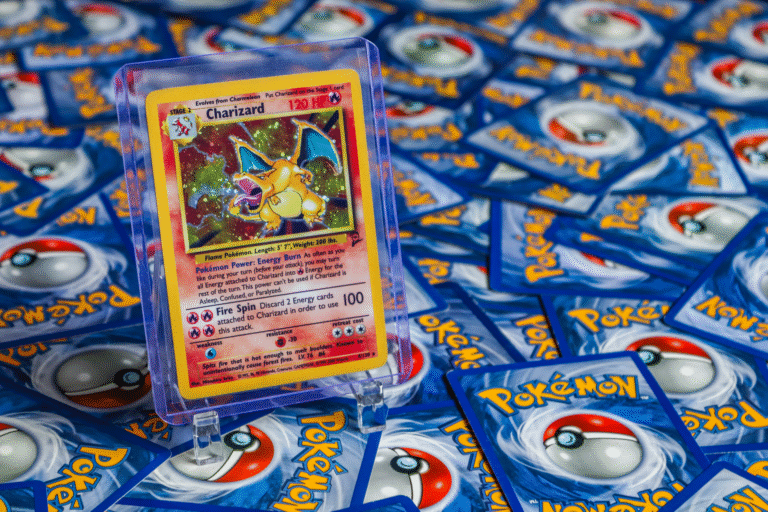
A reverse holo and a regular holo are distinguished by where the holographic foil pattern appears on the card. In a regular holo, the holographic material covers the character artwork itself while the background remains matte, creating a shiny portrait against a flat cardboard surface. A reverse holo inverts this entirely—the background receives the holographic treatment, showing a reflective pattern across the borders and empty space, while the character artwork stays matte and flat.
For example, a regular holo Charizard from the 1999 Base Set displays a glittering Charizard illustration against a plain yellow background, whereas a reverse holo version of the same Charizard would have a shimmering background with a non-reflective dragon in the center. Understanding this distinction matters because the two treatments look dramatically different in hand and in collection display. They appeal to different collectors, command different prices, and even photograph differently under light. Though both are technically “holographic” cards, the reversed placement creates an entirely different visual experience that has shaped Pokemon card collecting preferences for over two decades.
Table of Contents
- How Do Reverse Holos and Regular Holos Create Different Visual Effects?
- The Manufacturing Challenge Behind Reverse Holos and Print Consistency Issues
- Rarity Differences Between Reverse Holos and Regular Holos in Card Sets
- How Reverse Holos and Regular Holos Affect Card Display and Photography
- Grading and Authentication Problems Specific to Reverse Holos
- How Light, Angle, and Condition Reveal Differences in Reverse Holos
- Market Trends and Future Collector Preferences for Reverse Holos
- Conclusion
- Frequently Asked Questions
How Do Reverse Holos and Regular Holos Create Different Visual Effects?
The visual difference stems from which layer receives the reflective foil treatment during printing. When you hold a regular holo card under light, the artwork itself catches and reflects that light, making the character shimmer and sparkle as you move the card. The holographic pattern—often a geometric or radial design—sits directly on top of the illustration, so the shiny effect enhances the subject. A reverse holo performs the opposite action: as you tilt the card, the background creates movement and reflection instead of the creature or person depicted.
This creates distinct aesthetic preferences among collectors. Some prefer regular holos because the shimmering artwork draws the eye to the main subject and creates a “pop” effect that makes high-profile cards feel more premium. Reverse holos offer a subtler appeal—the matte artwork remains crisp and clear while the surrounding space creates depth through its reflective quality. If you compare a regular holo Blastoise to a reverse holo Blastoise side by side under identical lighting, the regular holo will appear more vibrant and attention-grabbing, while the reverse holo creates a more sophisticated, understated finish that some collectors actually prefer for display purposes.

The Manufacturing Challenge Behind Reverse Holos and Print Consistency Issues
Creating reverse holos requires a different printing sequence than regular holos, which introduces its own set of complications in the manufacturing process. Rather than applying foil to the illustration layer, the printer must apply holographic material to the background and borders while ensuring the artwork underneath stays completely protected and matte. This means the registration—the precise alignment of layers—must be nearly perfect, or collectors end up with holos that have foil bleeding into the artwork or incomplete background coverage. A significant limitation with reverse holos is that they are more prone to misalignment defects than regular holos.
Cards printed in earlier sets, particularly from the 1999-2003 era, show numerous reverse holos with foil bleeding partially onto the character’s edges or with patches of the background missing holographic material. This manufacturing variance means that finding a well-centered, evenly foiled reverse holo in high grade becomes genuinely challenging. By contrast, regular holos have fewer registration problems because the foil naturally stays on the artwork area—there’s less risk of it wandering onto unintended surfaces. This manufacturing reality has direct implications for grading: a reverse holo with any foil inconsistency across its background will lose points more noticeably than a regular holo with minor flaws.
Rarity Differences Between Reverse Holos and Regular Holos in Card Sets
For many decades, reverse holos were actually rarer than regular holos within the same set, making them initially more sought-after and valuable. In earlier Pokemon TCG sets like Base Set through Neo Genesis, pulling a reverse holo was noticeably less common than pulling a regular holo of the same card. This scarcity drove up prices, and some collectors specifically hunted reverse holos because they were statistically harder to obtain. A reverse holo Base Set Venusaur, for instance, commanded a premium over its regular holo counterpart during the early 2000s, sometimes selling for 20-40% more depending on condition.
However, this rarity dynamic shifted as Pokemon Company adjusted print runs and production strategies. Modern sets have more balanced pull rates between reverse and regular holos, and in some recent sets, reverse holos are printed in similar quantities to regular holos. This means the historical price premium that reverse holos enjoyed no longer applies universally—a 2020s reverse holo typically costs roughly the same as a regular holo of equal condition, whereas a 1999 reverse holo may still carry that rarity markup. Understanding which era a card comes from becomes crucial when evaluating whether you should pay more for a reverse holo version. Collectors new to the hobby sometimes assume reverse holos are always rarer and more valuable, which can lead to overpaying for newer cards where this simply isn’t true.

How Reverse Holos and Regular Holos Affect Card Display and Photography
From a collector’s practical standpoint, reverse holos and regular holos present different challenges when displaying and photographing cards. Regular holos photograph beautifully in most indoor lighting because the shiny artwork stands out clearly and creates that immediately recognizable “pop” that makes cards look premium in binders, cases, and online listings. The light reflects directly off the subject, making color and detail jump off the page. Reverse holos, conversely, require more deliberate lighting angles to showcase their appeal—the background foil looks best under angled light sources where the reflective pattern becomes visible, but under flat or direct lighting, they can appear darker and less vibrant than regular holos of the same card. For collection display purposes, this becomes a meaningful consideration.
If you’re building a binder of your favorite cards and plan to look at them under standard indoor light, regular holos will generally appear more impressive and easier to appreciate at a glance. If you prefer to display cards in UV-lit display cases or under accent lighting where you can appreciate the background’s reflective qualities, reverse holos may actually be the superior choice. Photography-wise, regular holos are more forgiving—they look good in most photos without special equipment. Reverse holos often require adjusted lighting, better camera equipment, or photo editing to capture what your eye sees in person. This practical difference influences collector behavior: high-profile graded cards shown in online sales typically skew toward regular holos because they photograph better and attract more initial interest.
Grading and Authentication Problems Specific to Reverse Holos
Professional grading companies have consistently noted that reverse holos present more authentication and grading challenges than regular holos, primarily due to the foil inconsistencies mentioned earlier. Counterfeiters have found it easier to produce convincing fake regular holos because the foil placement is simpler to replicate accurately. Reverse holos, with their complex background foil patterns that must avoid the artwork entirely, are harder to counterfeit convincingly—but when counterfeits do exist, they’re often easier to spot because the background foil looks obviously wrong, either too uniform, not reflective enough, or bleeding into the character illustration. Another grading complication involves foil wear and damage.
On a regular holo, minor foil scratches or wear concentrate on the artwork and may be tolerated at lower grades if the overall card is otherwise pristine. On a reverse holo, the same damage becomes more visible because it appears across a large, flat background surface. A single long scratch across a reverse holo’s background is far more obvious than the same scratch on a regular holo’s artwork, where detail can obscure minor defects. Graders are consequently stricter with reverse holo surface quality, which means reverse holos with any visible foil wear often receive lower grades than regular holos with similar or even slightly worse overall condition. This strictness can make high-grade reverse holos genuinely rare and desirable—a PSA 9 reverse holo may be harder to find than a PSA 9 regular holo simply due to the foil’s vulnerability on the open background.

How Light, Angle, and Condition Reveal Differences in Reverse Holos
When held under natural light or bright LED lighting, the differences between reverse and regular holos become fully apparent, but so do condition issues that are otherwise hidden. Holding a reverse holo up to a light source at various angles reveals the background’s entire holographic pattern—geometric shapes, radial spreads, or parallel lines depending on the set and card age. This visibility also means any foil scratches, wear, cloudiness, or surface damage shows immediately. A reverse holo that appears mint under casual inspection might reveal light foil wear patterns when examined under a light source at the correct angle, whereas the same wear on a regular holo’s artwork could be masked by the illustration’s colors and details.
A concrete example: examining a reverse holo Mew from the Jungle set under direct angled light will often reveal microscopic foil scratches that are completely invisible in normal viewing. These same scratches wouldn’t necessarily reduce a regular holo’s apparent value because the artwork details naturally conceal such minor surface flaws. This means reverse holos require more careful handling and storage to maintain appearance—exposure to dust, fingerprints, or minor surface contact affects visibility far more dramatically. Collectors of high-value reverse holos typically invest in better sleeve protection and storage conditions specifically because the large flat foil surface is inherently more vulnerable to visible wear than artwork-only foil.
Market Trends and Future Collector Preferences for Reverse Holos
Over the past decade, collector preferences have genuinely shifted toward reverse holos in ways that surprise casual observers. What was once considered the “less desirable” version of a card is now increasingly valued for its subtlety and different aesthetic appeal. This shift reflects maturing collector tastes—early Pokemon enthusiasm favored the flashy, attention-grabbing regular holos, but as the hobby professionalized and aesthetics became a factor beyond rarity, reverse holos gained ground. The rise of social media and high-quality card photography also emphasized how striking reverse holos can look under proper lighting, changing the visual narrative around these cards.
Modern Pokemon sets continue to print both versions, and recent released data suggests that in newer sets, the historical price gap between reverse and regular holos has narrowed to essentially zero for current-condition modern cards. However, the collectibility conversation has shifted—reverse holos are no longer dismissed as “less desirable,” but rather appreciated as stylistically distinct. As Pokemon TCG enters its fourth decade, reverse holos represent an important part of collecting diversity. Newer collectors building collections should be aware that reverse holos are not automatically “better” or “worse,” but rather offer a different visual experience that can matter significantly for personal preference and long-term collection satisfaction.
Conclusion
The core distinction between reverse holos and regular holos is straightforward: where the holographic foil appears on the card. Regular holos place foil on the artwork, creating a shimmering subject against a matte background, while reverse holos invert this with a reflective background and matte artwork. This fundamental difference cascades into impacts on manufacturing consistency, rarity by era, display preferences, grading standards, and collector psychology. Neither version is objectively “better”—they simply offer different visual and collecting experiences.
When evaluating these cards for your collection, consider the specific era and your personal aesthetic preferences. Older reverse holos may carry genuine rarity premiums, while modern reverse holos typically align in price with regular holos. Think about how you’ll display the card, how it photographs, and what appeals to you visually. Both regular holos and reverse holos deserve space in a serious collection, and understanding their distinct characteristics ensures you make informed purchasing decisions rather than assuming one version is inherently superior. The best reverse holo or regular holo is ultimately the one that brings you satisfaction in your collection.
Frequently Asked Questions
Are reverse holos worth more money than regular holos?
It depends on the card’s age and era. Pre-2005 reverse holos were genuinely rarer and commanded premiums of 20-40% above regular holos. Modern reverse holos typically cost the same as regular holos of equal condition. Always check recent sold listings for your specific card to determine current market value rather than assuming reverse holos are automatically more expensive.
Why do reverse holos look duller in photographs?
The foil sits on the background rather than on the colorful artwork, so under flat or direct lighting, reverse holos can appear darker. They require angled or accent lighting to showcase the background’s holographic pattern effectively. Regular holos photograph more easily because the foil directly reflects light off the illustrated subject, which naturally stands out in photos.
Can counterfeiters make convincing reverse holos?
Reverse holos are actually harder to counterfeit convincingly because the foil must cover the background while avoiding the artwork entirely. Successful counterfeits exist but are rarer than fake regular holos. Most fake reverse holos show obvious flaws—foil that looks too uniform, lacks proper reflectivity, or bleeds onto the character artwork.
Do reverse holos get lower grades than regular holos?
Reverse holos with the same surface condition often receive lower grades than regular holos because foil defects on a large flat background are more visible. Graders evaluate these cards more strictly for foil wear and scratches. This means a graded reverse holo in high condition can actually be rarer and more valuable than a regular holo of the same grade.
Which version should I buy for my collection?
Choose based on personal preference and how you plan to display the card. Regular holos look better under casual lighting and photograph more easily. Reverse holos offer subtler aesthetics that shine under accent lighting and appeal to collectors who prefer understated design. Budget should also factor in rarity—older reverse holos may cost more, while modern versions cost the same.