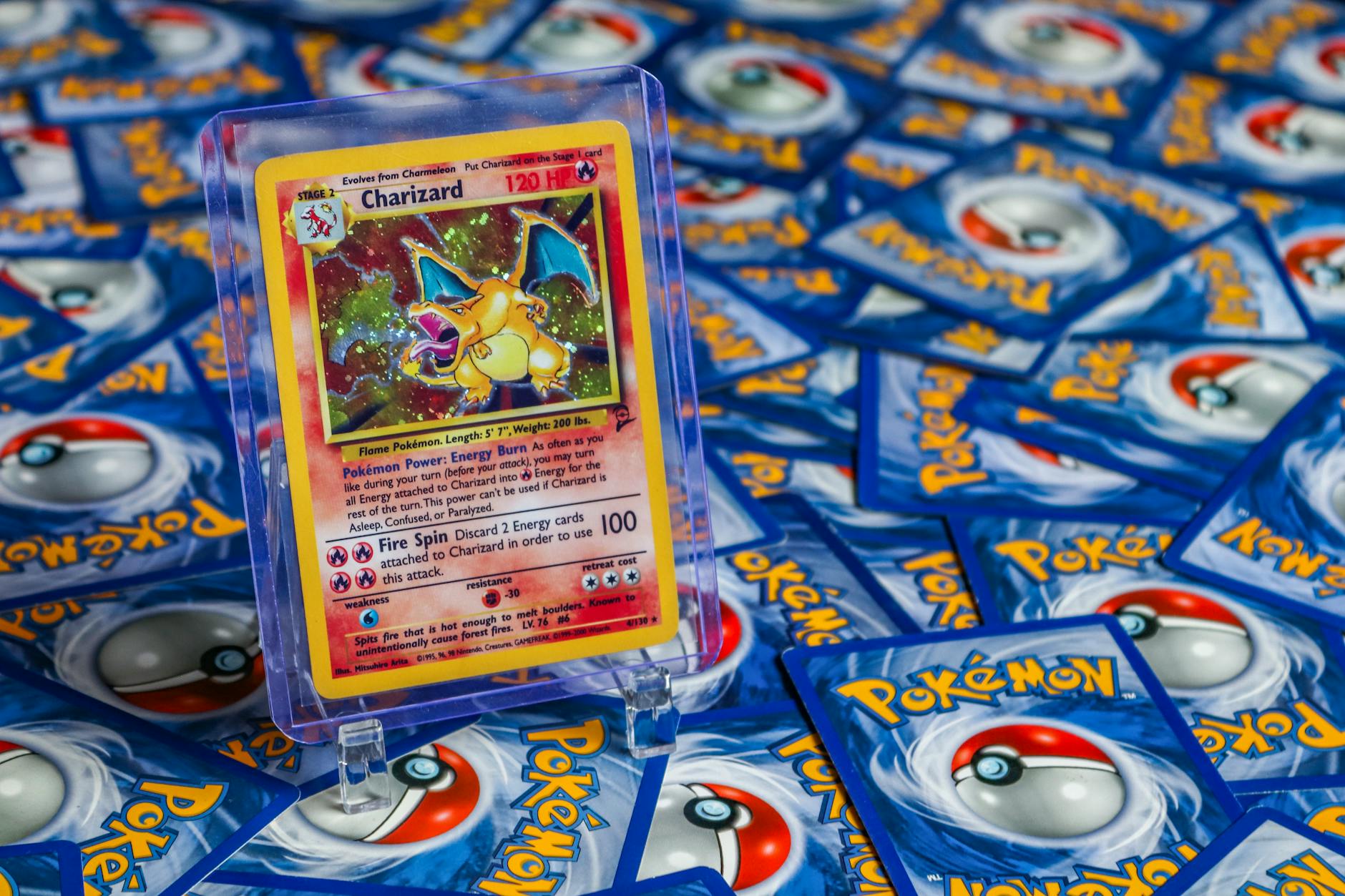
Rare Base Set Pokémon cards are becoming harder to buy every year because the supply is absolutely fixed and finite—these cards will never be reprinted, while demand continues to grow and the available inventory naturally shrinks through damage, loss, and collector turnover. This creates a simple but powerful dynamic: each year that passes means fewer Base Set cards remain in circulation, while more collectors compete for them. A card like the Charizard has already become nearly impossible to acquire in top condition, with only 489 gem-mint PSA 10 copies known to exist out of nearly 93,000 graded Unlimited versions—that’s just 0.5% in pristine condition.
This scarcity is reflected directly in prices. Vintage WOTC Base Set cards documented 30-50% price increases through early 2026, driven entirely by this fixed and declining supply. When a 1999 Base Set 1st Edition Charizard in gem mint grade sold for $550,000 at Heritage Auctions in late 2025, it wasn’t driven by speculation or hype—it was a market reflecting genuine rarity and the knowledge that no new copies will ever be created. The challenge for collectors is straightforward: as years pass, the scarcity only deepens, making these cards progressively harder to locate at any price point, let alone at reasonable ones.
Table of Contents
- Why Base Set Cards Will Never Return to Print
- The Extreme Rarity of High-Grade Examples
- Market Valuations Show the Price Pressure Mounting
- Grading and Certification Intensify the Scarcity Problem
- Collector Demand Continues to Rise While Supply Shrinks
- The Problem of Locating Cards for Sale
- What This Means for the Future of Base Set Collecting
- Conclusion
- Frequently Asked Questions
Why Base Set Cards Will Never Return to Print
The pokémon Company made a deliberate decision in the late 1990s to produce Base Set as a limited release, and that decision has become permanently locked into the hobby’s DNA. Base Set cards from 1999 will never be produced again, creating a genuinely fixed and finite supply that only decreases over time. This is fundamentally different from modern Pokémon cards, which remain in print and continue to flood the market annually. Every year, some portion of the Base Set inventory disappears. Cards get damaged through handling, exposure, or poor storage conditions.
collectors lose interest and sell off their holdings without care for preservation. Binders are discarded, cards are destroyed in house fires, water damage, or simply degradation over time. This natural attrition is relentless and irreversible. Unlike printed books or digital media, there is no way to restore lost or damaged cards—once a Base Set copy is compromised, it exits the collector market permanently. The implication for buyers is stark: the pool of available cards only gets smaller. The 30-50% price increases documented through early 2026 aren’t anomalies—they’re the market’s way of adjusting to a declining supply in a hobby where new buyers join every year.

The Extreme Rarity of High-Grade Examples
The challenge becomes even more acute when you focus on cards graded at the highest condition levels. The charizard provides a clear example: approximately 489 psa 10 gem-mint copies exist out of 92,856 total graded Charizard Unlimited Holos. This translates to just 0.5% of all graded Charizards existing in flawless condition. Blastoise fares slightly better at 0.8%, with roughly 382 PSA 10 copies out of 46,290 total graded, but it’s still an extremely tight scarcity.
First Edition Base Set cards are exponentially rarer. Only 124 known PSA 10 copies of the Base Set 1st Edition Charizard exist in gem mint grade—a card that has become the most coveted in the entire hobby. This creates a practical reality: for serious collectors seeking the absolute best examples, the supply isn’t just limited, it’s essentially nonexistent on any given day. You may wait months or years for one to come available at auction, and when it does, the prices reflect that rarity directly. This population scarcity means that acquiring a high-grade Base Set card is no longer just about having money—it’s about having the patience to wait for the rare moment when one becomes available, and the willingness to pay whatever the market demands in that moment.
Market Valuations Show the Price Pressure Mounting
Current market data reveals how dramatically Base Set cards have appreciated. The Charizard averages $377.50 based on 2,426 recent sales, while the Blastoise sits at $81.11 with 1,652 sales, and the Alakazam trades at $29.99 from 953 sales. These are raw market averages across all graded and ungraded copies, which means many premium examples trade significantly higher. The premium for gem-mint condition is staggering.
PSA 10 certified cards routinely sell for 10-50 times the price of raw, ungraded copies of the same card. For truly rare population cards, the gap is even larger—a PSA 10 can command 500-1000% premiums over a PSA 9, meaning the difference between “excellent” and “gem-mint” can represent a 6-10 times multiplier in real dollars. A base Charizard graded PSA 10 operates in an entirely different price universe than its PSA 9 equivalent. The record sale at Heritage Auctions in late 2025, where a Base Set 1st edition Charizard PSA 10 fetched $550,000, demonstrates the market’s willingness to price in extreme scarcity. When only 124 copies exist at the highest grade level and demand continues to expand, the market will price them as if they’re museum pieces—because increasingly, that’s what they are.

Grading and Certification Intensify the Scarcity Problem
As the hobby has matured, grading and certification have become central to how high-end cards are valued and traded. A raw, ungraded Base Set card—even if it’s in perfect condition—faces skepticism in the market. Only graded and certified copies command premium prices. This creates an unintended consequence: the grading bottleneck.
When Pokémon Scoring Services (PSA) receives thousands of submissions monthly, there are delays and backlogs. A collector who holds an ungraded gem-mint Charizard may wait months to get it graded, during which time they cannot confidently sell it at premium prices. Meanwhile, they know only a handful of certified high-grade copies exist in the market at any given moment. This creates a psychological pressure: the scarcity feels even more acute because certified copies are the only ones actively traded, and that certified pool is tiny. The limitation here is real: if you’re holding a rare Base Set card and want to sell it quickly, you may need to accept a significant discount, or you may need to navigate the lengthy grading process, which costs money and involves risk (cards can be damaged during shipping to graders).
Collector Demand Continues to Rise While Supply Shrinks
The contradiction that makes Base Set cards progressively harder to buy is that demand isn’t static—it’s growing. Each year, new collectors discover the hobby. International markets, particularly Asia, have become major buyers of vintage WOTC cards. Investment interest from outside the traditional hobby has increased. Meanwhile, the Base Set supply is not growing; it’s only shrinking. This mismatch between expanding demand and contracting supply is the fundamental engine pushing prices higher. The 30-50% gains through early 2026 reflect this pressure.
But the danger for newer collectors is that chasing these cards becomes a game of diminishing returns. As prices rise, fewer people can afford entry-level examples, reducing the active buyer pool for lower-grade cards. Yet demand at the top—for first editions and high-grade unlimited copies—remains fierce. The warning here is important: Base Set cards are not infinitely appreciating assets. Eventually, prices will reach a ceiling where demand simply cannot support higher prices. When that happens, the hardest cards to sell won’t be the legendary first editions; they’ll be the mid-tier rares that represented the bulk of the market. The base set market benefits from narrative hype around rarity, but hype eventually runs out.
The Problem of Locating Cards for Sale
Beyond pricing, there’s a practical availability problem. On any given day, how many PSA 10 Charizards are actually for sale? The answer is often zero. These cards trade through specialized auction houses like Heritage Auctions or dealers with established high-end inventory. A collector wanting to acquire one cannot simply go to a marketplace and buy it—they must either place a want ad and wait, or attend auctions and hope the card they seek comes to market.
This illiquidity is real and growing. As the population of high-grade cards shrinks and their value increases, sellers hold them longer, treating them more like art or investments than tradeable commodities. A collector who buys a PSA 10 Charizard at $25,000 in 2024 and wants to sell it in 2026 will find the process far more difficult than selling a common stock or even a rare comic book. The buyer pool is small, the transaction costs are high, and timing matters enormously.
What This Means for the Future of Base Set Collecting
The trajectory is clear: Base Set cards will continue to become scarcer and harder to acquire each year. As population reports shrink due to natural attrition, high-grade examples will migrate further out of reach for average collectors. The market will increasingly bifurcate into two categories: legendary ultra-rare cards (first editions, PSA 10s) that trade as art and collectible investment pieces, and everything else, which becomes progressively harder to move at reasonable prices.
Looking forward, collectors who want to own Base Set cards should recognize that window-closing dynamic. Waiting another five years will mean higher prices, fewer available copies at any given price point, and a smaller pool of sellers willing to part with their holdings. The relative difficulty of acquiring a Base Set rare card in 2026 will seem easy compared to 2031 or 2035.
Conclusion
Rare Base Set Pokémon cards become harder to buy every year because their supply is permanently fixed and finite, while demand grows and the available inventory shrinks through damage, loss, and collector turnover. The math is inescapable: with only 489 gem-mint Charizards, 382 gem-mint Blastoise copies, and just 124 first-edition Charizards in the highest grade existing in the entire world, and no reprints ever coming, each year that passes means these cards genuinely become rarer. Prices have already reflected this reality, with 30-50% gains documented through early 2026.
For collectors, the practical takeaway is straightforward: if you want a rare Base Set card, the time to acquire it is now rather than later. The combination of fixed supply, natural attrition, and growing demand will only make these cards harder to locate and more expensive to buy. The $550,000 first-edition Charizard that sold in late 2025 wasn’t an anomaly—it was a market pricing in genuine scarcity in a way that will only intensify as the years pass.
Frequently Asked Questions
Will the Pokémon Company ever reprint Base Set cards?
No. Base Set was a limited release from 1999, and the Pokémon Company has been explicit that these cards will never be reprinted. Modern Pokémon cards remain in print, but Base Set is closed and final.
Why are PSA 10 cards so much more expensive than PSA 9?
Gem-mint PSA 10 cards command 500-1000% premiums over excellent PSA 9 copies because they represent flawless condition—no wear, no defects, museum-quality preservation. With only 489 gem-mint Charizards known to exist out of nearly 93,000 graded copies, the rarity is extreme.
How much has the Base Set Charizard appreciated?
Base Set Charizards have seen 30-50% price gains through early 2026. A 1st Edition PSA 10 sold for $550,000 at Heritage Auctions in late 2025. Current market averages for raw Charizards sit around $377.50, but high-grade certified copies trade in the thousands to hundreds of thousands.
Is there any way to get more Base Set cards into circulation?
No. The only source of Base Set cards is existing collectors and dealers. Every card that’s lost, damaged, or removed from circulation reduces the total supply permanently. There is no mechanism to increase the supply.
Should I buy Base Set cards as an investment?
Base Set cards are appreciating due to genuine scarcity, but they’re also illiquid. High-grade copies can take months to sell, and the buyer pool is small. They should be approached as collectibles you genuinely want to own, not as liquid investments.
Why don’t dealers have more Base Set cards in stock?
Dealers stock what’s available. With only 489 gem-mint Charizards known to exist globally, and many held by long-term collectors, there simply aren’t many copies available for sale at any given time. High-end Base Set cards trade through auctions and private sales, not retail inventory.
You Might Also Like
- Why Vintage Pokémon Base Set Cards Could Become the Next Big Generational Collectible
- Why Future Collectors May Chase Base Set Pokémon Cards Like Historic Artifacts
- Why Base Set Pokémon Cards May Be Worth Far More by the Time Pokémon Turns 50