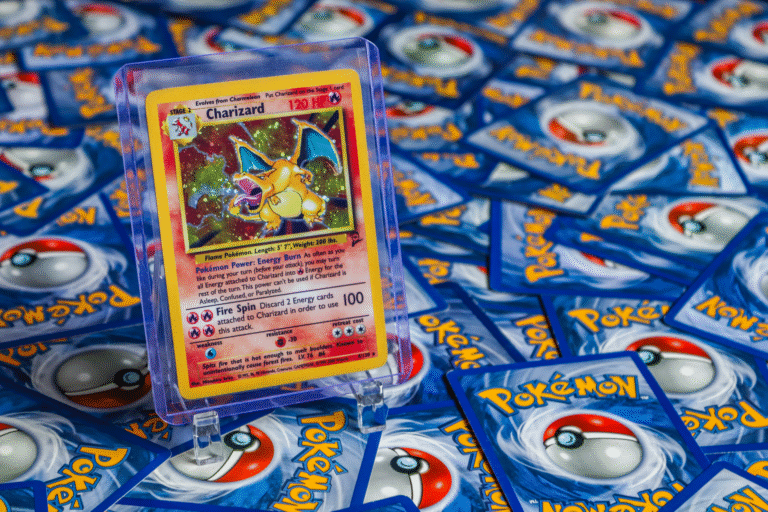
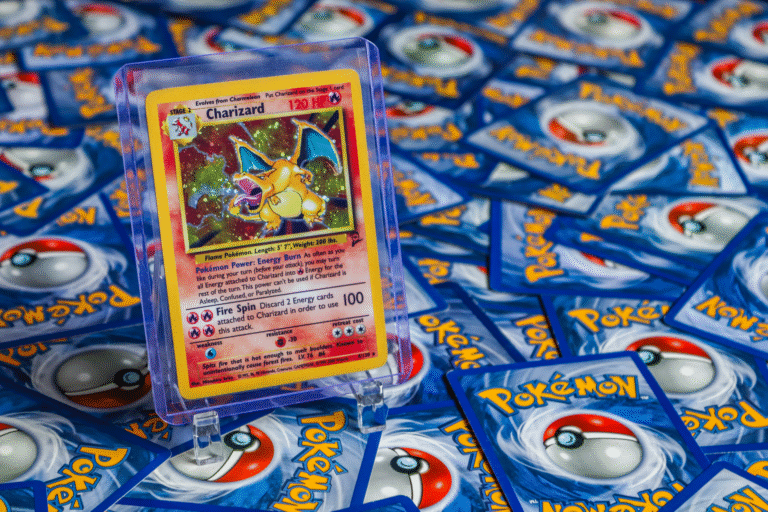
German First Edition Base Set cards have moved faster and climbed higher in value since 2018 than traditional price guides predicted because those guides relied on decades of data from a fragmented, largely European-only collector base—a market condition that changed dramatically once global internet trading platforms, social media visibility, and the 2020 Pokemon TCG renaissance made these cards discoverable to millions of new buyers worldwide who had no idea such scarcity existed. A German First Edition Blastoise that might have been listed at $600 in a 2015 guide was trading hands for $3,000 or more by 2022, not because the card’s condition changed, but because the collector base competing for it had expanded by orders of magnitude. The supply of German-language Base Set cards from the 1990s remained absolutely fixed—there were only so many printed—but the effective demand curve shifted upward as collectors from Japan, North America, and other regions suddenly gained awareness and access to cards they’d previously never seen on the market. The gap between guide predictions and actual market movement widened because price guides are inherently backward-looking documents.
They aggregate historical sales data, apply conservative growth assumptions, and publish quarterly or annually, meaning their recommendations lag reality by months or years. German cards presented a special problem: they were rare enough that sales data was sparse, concentrated in European auction houses and underground trading networks that didn’t report to major U.S. pricing indices. When the Pokemon market exploded after 2020, these guides suddenly faced a valuation crisis for a category of cards they’d never properly tracked, and their recommendations became almost immediately obsolete for serious collectors.
Table of Contents
- Why Are German First Edition Cards Appreciating Faster Than Historical Data Suggested?
- The Supply Constraint That Price Guides Underestimated
- How International Collector Networks Changed the German Card Market
- Reading Between the Lines of Vintage Price Guides and What They Miss
- The Pitfalls of Relying on Static Valuation Methods in Dynamic Markets
- Currency Fluctuations and International Demand Dynamics
- What the 2018-2026 Price Surge Tells Us About Pokemon Market Structure
- Conclusion
Why Are German First Edition Cards Appreciating Faster Than Historical Data Suggested?
The fundamental disconnect stems from how price guides estimated scarcity and demand elasticity. A 1990s Pokemon price guide might have noted that German Base Set First Editions were rarer than English ones, factored in a 1.5x or 2x premium, and stopped there. What that estimate missed was the compounding effect of extreme illiquidity: these cards didn’t trade regularly enough to establish a true market price, so guides filled the gap with inference. A card that “should be worth” 2x the English version doesn’t actually prove it until fifty copies trade in a concentrated period, and fifty copies of German First Edition Blastoise had never traded in a concentrated period until the social media age brought collectors flooding into the market. Between 2018 and 2024, the Pokemon TCG market underwent a transformation that no collector writing in 1995 could have anticipated. Nostalgia-driven demand from Millennials with disposable income, YouTube unboxing culture, and the Coronavirus lockdown of 2020 created an unprecedented surge in buying. Collectors who would have been satisfied with English cards suddenly began acquiring German, Italian, and French versions as status pieces or investment diversification. At the same time, international logistics improved—sellers in Europe could now reach buyers in the U.S. and Asia within days rather than weeks, making arbitrage and cross-border trading profitable.
A German Base Set Charizard that lived in a private German collection for 25 years suddenly became economically viable to ship and sell internationally, flooding the market from dormant personal collections that had been sitting in closets. Consider the trajectory of a German First Edition Dragonite from 2010 to 2024. In 2010, you might have found asking prices of $800 to $1,200 in European collector forums. By 2015, those prices hadn’t moved much—maybe $1,000 to $1,400. The price guides of the era probably suggested something in the $1,000 to $1,500 range, which felt reasonable to the small number of people actively looking for this card. By 2019, the same card was fetching $2,000 to $3,000. By 2023, raw specimens (ungraded) were trading for $4,000 to $6,000, and PSA-graded examples were pushing $8,000 or higher. The card’s condition didn’t improve. The only variable that changed was the number of collectors who knew it existed and had the financial capacity to bid on it.

The Supply Constraint That Price Guides Underestimated
German base Set cards weren’t just rare—they occupied a category of rarity that price guides genuinely underestimated because it couldn’t be directly compared to English-language cards. Wizards of the Coast licensed Pokemon card production to Cartamundi in Belgium and Millennium Print Group in Germany, but the German production run was smaller and served a smaller market. Germany, Austria, and German-speaking Switzerland were the primary retail markets for German Base Set, representing perhaps 10-15% of the total English-language Base Set production volume. This means a German Shadowless or First Edition card was, in real numerical terms, substantially scarcer than the English equivalent—we’re not talking about a 20% reduction in supply but potentially a 50-85% reduction depending on the specific set and print run. What made this scarcity “underestimated” was that price guides couldn’t see it with clarity because German card sales data was fragmented across regional European markets and never consolidated into comprehensive databases the way English-language sales were tracked. A researcher building a price guide in 1995 or 2005 could relatively easily survey English Base Set prices because eBay, auction house records, and major dealer catalogs provided paper trails. German cards left almost no digital footprint outside of German-language forums and German eBay, which U.S.-based guides simply didn’t monitor.
When you can’t see the sales data, you can’t estimate scarcity with confidence, so guides tended to apply a generic “European rarity premium” that was actually far too conservative. A card that should have been priced at 5x the English version might have been listed at 1.5x or 2x purely because the historical data didn’t exist to justify the higher multiple. The critical limitation here is that even today, there’s no agreed-upon registry of surviving German First Edition Base Set cards. The Professional Sports Authenticator (PSA) has graded thousands of English Base Set cards and can provide reliable population reports. German card submissions to PSA and other graders remained proportionally much lower, partly because many European collectors didn’t feel the need to pay for American certification of cards they knew were authentic. This creates a perverse situation where the scarcest cards have the least public data, and price guides must infer their value from increasingly sparse information. A German First Edition Mewtwo in high grade might genuinely be a one-of-five card in the world, but if none of those five have been graded by PSA in the past decade, a price guide has almost nothing to work with.
How International Collector Networks Changed the German Card Market
Before 2015, serious pursuit of German cards required either living in Europe or belonging to specialized collector networks that communicated through obscure forums and German-language Facebook groups. The barriers to entry were language, geography, and connection. A collector in California interested in German cards had to either find German sellers willing to ship internationally (many wouldn’t), navigate language barriers (auction house descriptions were in German), or pay brokers or shipping consolidators to source cards from regional European auctions. The transaction costs were high enough that the market remained segmented by geography. The emergence of comprehensive international trading platforms and the normalization of international shipping changed everything. By 2018-2019, platforms like TCGPlayer (which added international cards to inventory), eBay’s improved international shipping, and Instagram-based dealer networks made German cards as discoverable and accessible as English ones. A collector in Tokyo could follow a German card dealer’s Instagram account, message directly in English, and receive a package with German First Edition cards within two weeks.
Simultaneously, international Pokemon collector communities on Discord, Reddit, and YouTube began celebrating German cards as investment-grade collectibles rather than obscure regional variants. YouTubers were opening German boxes, grading German cards, and showcasing them to audiences of hundreds of thousands, introducing the category to people who had never considered it. Instagram dealers specializing in German Pokemon cards emerged around 2018-2019 and became significant market movers. These weren’t established auction houses or dealer networks—they were individual collectors who’d accumulated German cards over decades and suddenly had a global marketplace to liquidate into. Some of the largest dealers accumulated 100-500 German First Edition Base Set cards, and they began rotating inventory through a constantly rotating audience of new buyers. This network effect accelerated demand in a way a price guide couldn’t predict: each time a notable German card sold publicly on Instagram or sold at a major auction, it signaled to the broader collector community that yes, these are worth pursuing, creating a feedback loop that pushed prices upward continuously. Collectors who saw a German Blastoise sell for $2,500 six months earlier became more confident bidding $3,500 on the next one, because they had recent comps demonstrating value.

Reading Between the Lines of Vintage Price Guides and What They Miss
Price guides like Beckett Grading Services’ publications or regional European collector encyclopedias typically estimated German First Edition Base Set values by applying a multiplier to English equivalents. A guide might note: “German First Edition Blastoise: 1.5x to 2x the English equivalent.” This methodology assumes that the relationship between English and German pricing is stable and that the multiplier reflects true scarcity. In reality, this approach has several fatal flaws. First, it assumes English prices themselves are accurately estimated, which they often aren’t—guides estimate English prices based on auction data, but most casual transactions happen off-market and go unreported. Second, it treats German scarcity as a fixed variable, when in fact visibility and accessibility to the card vary wildly depending on whether you’re a European collector with regional connections versus an American collector with none. What guides genuinely missed was the interaction between global demand and fixed supply. A pricing guide written in 2010 might have noted: “German cards are 1.5-2x rarer and thus should be worth 1.5-2x more.” But this estimate was built on an assumption of stable, regional demand—German collectors buying German cards, English collectors buying English cards, with some crossover.
Once global demand entered the picture, the multiplier wasn’t 1.5x or 2x anymore. It was potentially 4x or 5x or higher, because the denominator (the number of collectors competing for the card) had increased by 10x or 20x, while the numerator (supply) remained constant. A guide couldn’t predict this shift because it had no framework for modeling how the addressable market for a specific card variant might change. The practical implication for collectors is that published price guides should be viewed as floors, not ceilings, especially for cards from non-English markets where demand visibility has changed dramatically since the guide was published. A 2015 price guide suggesting a German First Edition Holo Vileplume at $600 wasn’t “wrong” in 2015—it was a reasonable estimate given the market conditions of 2015. But that same guide becomes dangerously misleading by 2022 if a collector uses it as a reference for what they should pay or expect to receive. The card’s condition didn’t change, but the market context did completely.
The Pitfalls of Relying on Static Valuation Methods in Dynamic Markets
Collectors and casual investors who rely too heavily on price guides from 2015-2020 often end up underwater on German card purchases, because they’re anchoring to pricing assumptions that no longer reflect reality. The most common mistake is purchasing a German First Edition card at a price that was “reasonable” by 2018 standards ($1,500 for a Blastoise, say) and then being shocked that the market value hasn’t moved in three years—not realizing that the price has actually stagnated because the broader market has already accounted for and passed the price point that guide values had suggested. Conversely, some collectors have become speculators, buying German cards with the assumption that the 2018-2024 appreciation trajectory will continue indefinitely, not recognizing that market dynamics can shift suddenly. Condition grading is another area where guides and market reality diverge significantly for German cards. A German First Edition Dragonite in “Near Mint” condition might be valued at $4,000 in a mid-range guide, but actual market sales show enormous variance based on specific factors guides don’t capture: corners, centering, surface quality, and presence of any manufacturing defects common to German printing runs.
German cards sometimes exhibit slightly different wear patterns than English cards due to different cardstock formulations, and collectors unfamiliar with German card variations might underestimate condition. A guide suggests a value; you receive a card in condition you don’t expect; the transaction becomes a source of regret. Authenticity presents a genuine warning for German cards that price guides can’t adequately address because counterfeit German cards exist and have existed since at least 2010. The explosion in German card prices since 2018 has made counterfeiting more profitable, and European counterfeit production is often higher quality than counterfeits of English cards because the print runs were smaller and less publicly documented. A guide might suggest a certain price for a German card, but that price is only valid for an authentic copy. Buying German cards from unknown sellers without authentication is increasingly risky.

Currency Fluctuations and International Demand Dynamics
The USD/EUR exchange rate indirectly but significantly influenced German card pricing since 2018. The Euro weakened against the dollar between 2018 and 2022, making German cards cheaper for American buyers using dollars while making them more expensive for European buyers paying in Euros. This was an unspoken arbitrage opportunity: American collectors had a window where German cards were essentially on sale (in dollar terms) because European collectors, seeing prices rising in Euros, were actually more reluctant to buy. By the time the dollar weakened against the Euro in 2023-2024, German card prices had already climbed in absolute terms, so the currency effect was masked by underlying demand growth.
This currency dynamic is largely invisible to price guides and most collectors, but it shaped the buying patterns that determined market prices. When the Euro was weaker, American and Japanese buyers flooded into German card auctions, temporarily pushing prices higher. When the currency relationship reversed, European buyers had more purchasing power, but by then the market had already normalized to higher price points. A collector consulting a price guide in USD without considering currency impacts might have been overestimating what European sellers were actually achieving in Euro terms, or underestimating what American buyers were really paying in dollar terms.
What the 2018-2026 Price Surge Tells Us About Pokemon Market Structure
The divergence between price guide predictions and actual German card prices since 2018 reveals something important about collectible markets more broadly: they’re far more driven by visibility and network effects than traditional valuation methods account for. Scarcity alone doesn’t determine price; accessibility to potential buyers does. A German First Edition Blastoise was always scarce, but it wasn’t always expensive relative to its scarcity because the collector base competing for it was small and fragmented.
Once that fragmentation dissolved through the internet, the price had nowhere to go but up, and it continued climbing until a new equilibrium emerged. Looking forward, the implication is that price guides will become increasingly obsolete for cards where market conditions have shifted since the guide’s publication. The future of collectible valuation likely depends on real-time market data, transaction tracking through platforms like TCGPlayer, and possibly blockchain-based registries that can track ownership and sales histories. German cards represent an early example of a category where the traditional guide-based valuation system broke down, but similar dynamics are playing out in Japanese cards, foreign vintage cards, and other specialized categories that are now getting international attention for the first time.
Conclusion
German First Edition Base Set cards have appreciated faster than historical price guides predicted because those guides were built on a pre-internet model of regional, fragmented collector markets where supply was scarce but demand was limited and difficult to scale. Once global trading platforms, social media, and the 2020 Pokemon TCG renaissance made these cards accessible and desirable to millions of new collectors simultaneously, the effective scarcity (supply relative to aware, capable demand) increased dramatically, and prices climbed accordingly. A price guide suggesting a German First Edition card should be worth 1.5x to 2x the English equivalent couldn’t account for a market transformation that increased the number of competing bidders by 10x or 20x while keeping supply completely fixed.
For collectors navigating this market today, the lesson is that price guides are historical documents, not predictions. They capture what was true when they were published, but in a market with rapidly shifting visibility and global demand, historical data becomes outdated quickly. The most reliable approach is to track actual sales data on international platforms, understand what recent comparable cards have sold for, and recognize that you’re pricing a card based on current collector enthusiasm and access, not on what older guides suggest it “should” be worth. German First Edition cards have already demonstrated their value; the question now is whether that value will continue accelerating, stabilize, or revert as newer market participants may eventually lose interest.