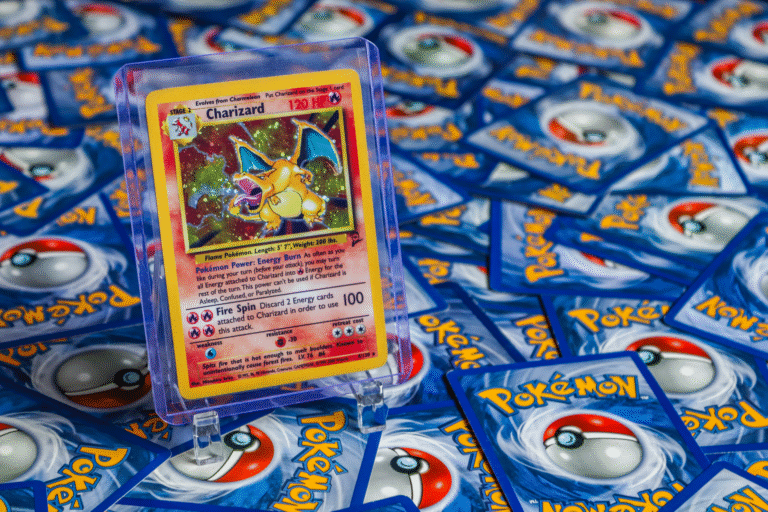
Yes, Japanese No Rarity Pokémon cards have significantly outperformed the broader Pokémon market since Spring 2024. While the overall Pokémon card market experienced a respectable 46% average annual growth rate from 2024 to 2025, Japanese rare cards—including No Rarity variants—surged 300% in value since early 2024, dramatically outpacing the market baseline. This disparity was evident even at the highest end of the market: a BGS 8 graded No Rarity Venusaur sold for $82,546 in February 2024, establishing a new public benchmark that reflected broader momentum in the Japanese rarity segment.
The outperformance of Japanese No Rarity cards becomes even more striking when you account for broader market dynamics. During the same period when Japanese cards were climbing 300%, the retail trading card market experienced retail surges—including a 200% surge in Walmart trading card sales from February 2024 to June 2025—yet the average Pokémon card still only grew 46% annually. Japanese premium variants simply moved faster and higher than the general population of cards, indicating that rarity, condition, and origin all played outsized roles in determining value trajectory.
Table of Contents
- How Much Did Japanese No Rarity Cards Outperform the General Market?
- The Price Premium: Why Japanese Cards Command Higher Values
- Notable Sales and Market Benchmarks
- Investment Performance and Risk Considerations
- Market Corrections and Volatility
- Comparing Japanese vs English No Rarity Cards
- Future Market Outlook for Japanese Rare Cards
- Conclusion
How Much Did Japanese No Rarity Cards Outperform the General Market?
The numerical gap between Japanese No Rarity performance and the broader market is substantial. A 300% surge in Japanese rare cards versus a 46% annual average for all Pokémon cards represents roughly a 6.5x performance multiplier. This isn’t a small margin—it reflects genuine scarcity dynamics and collector appetite that exceeded even the growth in retail accessibility. When Pokémon card sales increased tenfold year-over-year at major retailers like Walmart, the supply of new modern cards surged, yet Japanese No Rarity cards—fixed in supply from decades ago—became relatively scarcer and more valuable.
The comparison also reveals how niche categories behave differently from mass-market segments. The 46% average annual growth includes entry-level cards, bulk lots, and common modern releases that have much lower price floors. Japanese No Rarity cards exist at the opposite end of the spectrum: they are graded, vintage, and inherently scarce. This explains why they dramatically outperformed the median card even as overall trading card interest boomed. A collector buying modern booster packs at Walmart was participating in the 46% average growth; someone acquiring a PSA-graded Japanese No Rarity Venusaur was tapping into an entirely different market segment with different supply dynamics.

The Price Premium: Why Japanese Cards Command Higher Values
Japanese Pokémon cards maintain a structural 15-40% price premium over English equivalents, with certain categories commanding even steeper premiums. Special Art Rares (SARs) and Master Ultra Rares (MURs) specifically demand 30-40% premiums, and this pricing structure held steady through 2024-2025 market corrections. For No Rarity cards specifically, the premium is rooted in several factors: lower original print runs in Japan, collectibility across Asian markets, and established reputation among serious collectors. These cards appreciated faster than English versions partly because they started from a higher baseline premium and benefited from concentrated demand.
However, the premium can create a trap for investors. A 300% surge sounds exceptional, but that surge is measured from a 2024 baseline—meaning substantial appreciation had already occurred before the measured period. Additionally, while the 15-40% premium held through corrections, this doesn’t mean it will expand indefinitely. Future market saturation, increased grading services availability, or shifting collector preferences could compress the premium. The July 2024 auction price of $55,000 for a PSA Gem Mint 10 No Rarity Venusaur, while impressive, was lower than the February 2024 price of $82,546 for a lower-grade BGS 8 version—a signal that even within the No Rarity segment, prices can contract for reasons including grade-specific demand, auction timing, and buyer availability.
Notable Sales and Market Benchmarks
The February 2024 sale of a BGS 8 No Rarity Venusaur at Rare Candy for $82,546 set a critical reference point for the market. This single transaction became a benchmark that collectors and investors referenced throughout 2024, validating the category’s value tier. Just five months later, the July 2024 PSA Gem Mint 10 No Rarity Venusaur reached $55,000, demonstrating that even high-grade examples were achieving five-figure valuations consistently. The fact that a PSA 10 (typically commanding premiums over lower grades) sold for less than a BGS 8 earlier in the year suggests grade compression, auction dynamics, or seasonal buying patterns all influence individual sale prices. These benchmarks matter because they anchor collector expectations and establish credibility for the category.
Before February 2024, No Rarity cards lacked clear public valuation data. The $82,546 sale changed that narrative, making No Rarity Pokémon legitimate investment-grade cards in the eyes of serious collectors. However, relying on individual high-profile sales to predict future prices is risky. Most No Rarity cards trade in the $10,000-$40,000 range depending on grade and specific card. The ultra-premium sales ($55,000+) represent outliers driven by specific buyer interest, not consistent market behavior. A collector expecting their No Rarity card to replicate the $82,546 benchmark without understanding grade, condition variance, and auction-specific factors will likely be disappointed.

Investment Performance and Risk Considerations
From a pure investment standpoint, Japanese No Rarity cards delivered returns that far exceeded traditional market benchmarks and the broader Pokémon market. A 300% surge represents exceptional performance in any asset class. However, comparing that surge to the 46% average Pokémon card growth illuminates the risk profile: concentration in ultra-rare, vintage assets creates high volatility. The broader 46% market growth is distributed across millions of cards with different grades, conditions, and print runs; the 300% surge in Japanese rares is concentrated in a much smaller pool where individual collector preferences and large buyer moves can disproportionately influence pricing.
The tradeoff is illiquidity versus upside. A modern Pokémon card in good condition might sell quickly at local card shops, online marketplaces, or at reasonable comps to recent sales. A $50,000 No Rarity card requires finding a qualified buyer with both capital and interest in that specific card—a process that might take months or years, and the final price may vary significantly depending on buyer appetite and broader market sentiment. Investors who purchased Japanese No Rarity cards at the peak of the early 2024 surge and needed to exit during the subsequent 2024-2025 market corrections faced potential losses. The 300% surge is exceptional, but it’s not immune to reversion, and the illiquidity means exiting during downturns is difficult.
Market Corrections and Volatility
The Pokémon card market experienced corrections of 20-50% during 2024-2025, and Japanese premium cards were not entirely insulated from this volatility. While Japanese cards maintained their 15-40% premium over English equivalents through these corrections, the premium holding doesn’t mean prices didn’t fall—only that they fell less steeply than English equivalents. A Japanese No Rarity card trading at $80,000 at market peak might have dropped to $50,000-$60,000 during the correction, still maintaining the premium but experiencing a 25-37% haircut. This volatility is important for investors to understand: outperforming the broader market doesn’t mean avoiding downside entirely.
The correction also highlighted that the 300% surge was not linear. Japanese rare cards likely experienced substantial gains in 2024, then faced headwinds in 2025 as market corrections took hold. This pattern is typical in collectible markets during speculative upswings. Early buyers benefit most; late buyers caught near peak valuations face unfavorable entry points. For prospective buyers considering Japanese No Rarity cards today, the relevant question is not whether they outperformed historically—they clearly did—but whether current valuations represent fair value after the correction, and whether the 15-40% premium over English equivalents will persist or compress.

Comparing Japanese vs English No Rarity Cards
Japanese and English No Rarity cards exist in fundamentally different supply contexts. English cards were printed in larger volumes historically, meaning supply is higher and collector base is more fragmented. Japanese cards maintain scarcity advantages and are coveted by collectors worldwide, not just in Japan and North America. This explains why Japanese No Rarity cards command the 15-40% premium. However, the premium also means entry barriers are higher: acquiring a Japanese No Rarity card requires substantially more capital than acquiring an English equivalent.
For collectors with limited budgets, English No Rarity cards offered a more accessible way to participate in the category’s appreciation. While they didn’t outperform Japanese variants, they still benefited from broader market growth and category validation. The Japanese premium held through market corrections, suggesting it’s structural rather than speculative. However, this doesn’t guarantee the premium will widen further. If grading standards become more consistent, market inefficiencies close, or English cards improve in grade quality and rarity perception, the premium could compress. Collectors prioritizing upside potential over capital efficiency should favor Japanese; those seeking broader exposure with lower capital requirements might consider English variants.
Future Market Outlook for Japanese Rare Cards
The Japanese Pokémon card market is maturing. Early 2024 featured discovery and validation of pricing benchmarks; by late 2025, the market has more established baselines and less room for explosive growth. Future appreciation will likely be more gradual and dependent on specific factors: scarcity discoveries (respecifying or underestimating remaining inventory), major collector exits or entries (institutional or whale-level buyers), and shifts in global collector sentiment. The 300% surge represented a window of opportunity; future investors should assume more modest returns and higher volatility rather than extrapolating past performance.
Looking ahead, Japanese No Rarity cards remain positioned above the broader market—not because they’ll continue surging 300%, but because structural factors (fixed supply, international demand, premium prestige) should sustain the 15-40% premium. However, this assumes the market doesn’t experience major corrections or fundamental shifts in collector preferences. The broader Pokémon market is expanding at the retail level (200% surge at Walmart, tenfold sales increases), which could either strengthen demand for vintage Japanese cards as a differentiation play or dilute interest by offering more accessible modern alternatives. Serious collectors should monitor both segments: Japanese rarity for maximum scarcity and prestige, and modern Japanese releases for growth potential with lower entry barriers.
Conclusion
Japanese No Rarity Pokémon cards did beat the broader market substantially between Spring 2024 and mid-2025, with a 300% surge in Japanese rares outpacing the 46% average annual growth of the overall Pokémon card market. This outperformance was driven by scarcity, international demand, and the structural 15-40% premium Japanese cards maintain over English equivalents. Benchmark sales like the $82,546 BGS 8 No Rarity Venusaur (February 2024) and $55,000 PSA 10 version (July 2024) demonstrated that the category had achieved credibility and consistency at the five-figure level. However, prospective buyers should approach current valuations with caution.
The market experienced corrections of 20-50% in 2024-2025, and while Japanese cards held their premiums better than English variants, they were not entirely insulated from downside. The 300% surge represents exceptional historical performance, not a guarantee of future appreciation. Japanese No Rarity cards remain positioned above the broader market due to structural factors, but future investors should expect more measured returns and plan for volatility rather than another explosive surge. For collectors, these cards offer prestige and scarcity; for investors, they require capital commitment, patience with illiquidity, and realistic expectations about market maturation.