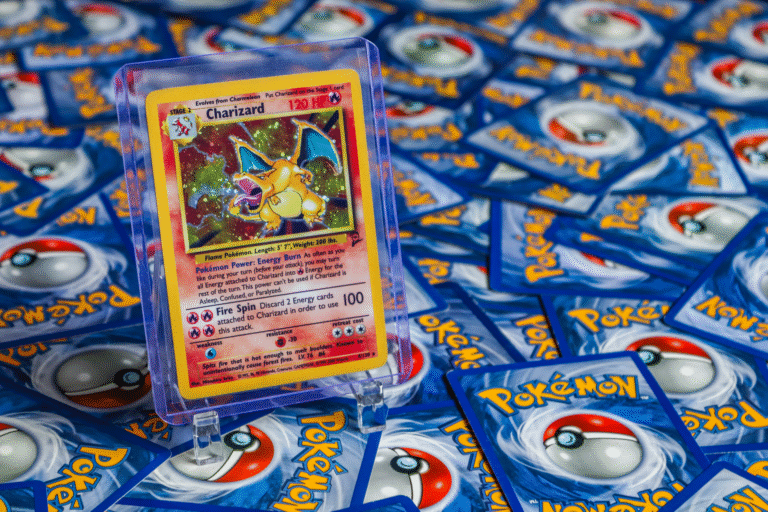
The Pokémon Cosmos Holo pattern is a holographic design composed of pixelated orbs, dots, and circles of varying sizes spread across the card image, often mixed with subtle swirls that resemble planets and stars scattered through space. This distinctive visual effect was the standard holographic pattern used on Pokémon trading cards from 1999 until April 2011, making it one of the most recognizable finishes in the entire hobby. A near-mint Base Set Charizard with a well-placed Cosmos swirl can command significantly higher prices than the same card without prominent swirls, demonstrating how deeply collectors value this classic aesthetic.
Collectors love Cosmos Holo cards for multiple interconnected reasons: nostalgic appeal rooted in the early years of the Pokémon TCG, the inherent rarity of attractive swirl placements, and the sheer visual beauty of the pattern itself. Because swirls appear randomly during the printing process, even duplicate cards from the same set can look completely different from one another, making the hunt for the perfect version a rewarding aspect of collection building. The pattern’s iconic status, combined with its historical significance as the original standard holo design, has kept demand consistently high across both casual collectors and serious investors.
Table of Contents
- WHAT MAKES COSMOS HOLO VISUALLY DISTINCT?
- THE EVOLUTION FROM PIXEL TO HD AND WHAT THAT MEANS FOR COLLECTORS
- UNDERSTANDING HOLO SWIRLS AND THEIR IMPACT ON VALUE
- COLLECTING COSMOS HOLO CARDS IN TODAY’S MARKET
- RARITY CONSIDERATIONS AND THE EXTREME END OF THE MARKET
- IDENTIFYING AUTHENTIC COSMOS HOLO AND DISTINGUISHING FROM REPRODUCTION ATTEMPTS
- THE MODERN RENAISSANCE OF COSMOS HOLO AND FUTURE COLLECTING TRENDS
- Conclusion
WHAT MAKES COSMOS HOLO VISUALLY DISTINCT?
The Cosmos holo pattern stands out from modern holographic designs through its characteristic pixelated composition. Rather than the smooth, consistent linear patterns found on cards printed after 2011, Cosmos holo features small circular and spherical elements of different sizes—some as tiny pinpoints, others as larger orbs—distributed across the card’s image in what appears to be an organized yet organic arrangement. The pixel-based aesthetic gives the pattern a nostalgic quality that players and collectors immediately recognize, even when comparing a Base Set card to a recent promotional release featuring the same finish.
The design’s space-themed visual metaphor plays a significant role in its lasting appeal. The arrangement of varying-sized circles and orbs creates an impression of celestial bodies and cosmic phenomena, which pairs elegantly with many Pokémon card illustrations. Unlike Tinsel Holo, which emphasizes horizontal movement and flow, or other modern patterns that use geometric shapes and linear designs, Cosmos manages to feel both structured and dynamic. A base set Blastoise with well-distributed Cosmos holo looks substantively different from a Base Set Mewtwo with the same pattern, yet both cards instantly communicate that they share the same iconic holographic finish.

THE EVOLUTION FROM PIXEL TO HD AND WHAT THAT MEANS FOR COLLECTORS
In late 2013, The pokémon Company made a subtle but significant change to the Cosmos Holo pattern, transitioning from a lower-resolution “pixel” version to a smoother, high-definition design. This evolution created two distinct variants that collectors actively seek and compare: the original pixelated version from 1999-2013 with rougher edges and more pronounced individual dot definition, and the later HD version with cleaner lines and refined visual presentation. For collectors building comprehensive sets, this distinction matters considerably—some prefer the authentic roughness of the original pixel design, while others favor the visual refinement of the HD version.
The timing of this design shift is important to understand. While Cosmos had already been phased out as the standard holofoil pattern in April 2011 (replaced by Tinsel Holo during the Black & White series), it continued to appear sporadically on promotional cards and special releases. The 2013 update meant that any Cosmos Holo cards printed between 2013 and today represent a distinctly different visual product from their earlier counterparts. A collector seeking examples of both variants needs to specifically target cards from before and after this transition point, adding another layer of nuance to the hobby.
UNDERSTANDING HOLO SWIRLS AND THEIR IMPACT ON VALUE
Swirls are the most important factor determining Cosmos Holo card value and desirability. During the printing process, the holographic layer is applied through a mechanical system that naturally introduces slight variations in placement and intensity. Swirls—concentrated areas where the holographic pattern becomes more pronounced or creates a distinctive curved or directional flow—appear randomly as a byproduct of this manufacturing process. A well-placed swirl, particularly one that frames or enhances the Pokémon’s illustration, can increase a card’s value by 25 to 50 percent or more compared to an identical card with minimal swirl.
The variation in swirls means that true duplicate cards—same set, same card number, same condition grading—can have dramatically different market values depending on swirl placement and prominence. Some cards feature single elegant swirls positioned perfectly across the character, while others display multiple smaller swirls scattered throughout, and still others show minimal to no swirl at all. This natural variation makes the hunt for the “perfect” version of a card an engaging long-term goal for serious collectors. However, swirl appeal remains subjective; what one collector considers an ideal swirl placement, another might view as distracting, meaning swirl values fluctuate based on current market preferences and individual buyer preferences.

COLLECTING COSMOS HOLO CARDS IN TODAY’S MARKET
The market for Cosmos Holo cards operates differently from early-era base set cards primarily because of rarity and nostalgia compounding effects. Original Base Set Cosmos Holo cards from 1999-2000 consistently fetch premium prices relative to their non-holographic counterparts and even relative to later holofoil patterns released during the same era. A lightly played Base Set Pikachu Holo can easily sell for three to five times the value of the same card in near-mint condition from a set printed just five years later, illustrating how strongly Cosmos Holo status drives collector demand and willingness to pay.
Modern promotional releases featuring Cosmos Holo—including recent cards from sets like Temporal Forces and Pokémon 151—represent a contemporary way to acquire new Cosmos Holo examples without the expense of vintage cards. These promotional versions typically retail for $10 to $30 per card and offer collectors a chance to experience the pattern firsthand without financial risk. However, these modern promotional versions lack the historical significance and rarity of vintage Cosmos cards, so they appreciate much more slowly and serve primarily as visual additions to collections rather than investment pieces. The trade-off is clear: buy a modern Cosmos promotional for affordable access and the chance at attractive swirls, or commit significant capital to vintage versions for true scarcity and historical pedigree.
RARITY CONSIDERATIONS AND THE EXTREME END OF THE MARKET
At the highest end, Cosmos Holofoil test print sheets represent some of the rarest Pokémon TCG artifacts in existence. One holofoil test print sheet sold for approximately $250,000 at Heritage Auctions, illustrating just how scarce certain pre-production materials are. These test prints were produced in extremely limited quantities for quality assurance and development purposes—most were likely destroyed after use, making survivors exceptionally uncommon. This level of rarity exists far beyond what typical collectors will ever encounter or afford, but it underscores the profound historical and collectible value attached to Cosmos Holofoil in the broader market context.
For practical collectors, the rarity consideration centers on condition-graded vintage cards from the early 2000s rather than test materials. A first-edition Base Set card graded at PSA 8 or higher in Cosmos Holo condition is substantially rarer than its unlimited counterpart at the same grade, and both are far rarer than any card printed after the 2011 transition. The scarcity of high-grade vintage Cosmos cards means prices can move unpredictably when quality examples become available, especially when particularly attractive swirls are present. Collectors should be aware that pursuing high-grade vintage Cosmos cards requires patience, substantial budget allocation, and realistic expectations about finding perfect or near-perfect examples.

IDENTIFYING AUTHENTIC COSMOS HOLO AND DISTINGUISHING FROM REPRODUCTION ATTEMPTS
Authenticating Cosmos Holo cards relies on visual inspection, set knowledge, and professional grading service evaluation in cases where significant value is at stake. Genuine Cosmos Holo from the early era exhibits specific visual characteristics: the pixelated dot pattern remains consistent under magnification, swirls appear as natural variation rather than painted-on elements, and the overall depth and dimension of the holographic effect matches known authentic examples. Counterfeits or misrepresentations sometimes emerge in the market—particularly on high-value cards—where the holo pattern may be printed incorrectly, lack appropriate depth, or exhibit too-uniform swirl patterns that never naturally occur.
For cards valued above $100, submitting to a professional grading service like PSA, BGS, or CGC provides definitive authentication alongside condition assessment and a tamper-evident holder. These services maintain extensive databases of known fakes and legitimate variations, enabling them to identify suspicious copies that might deceive casual collectors. For lower-value Cosmos cards being acquired purely for visual appeal rather than investment, authentication primarily depends on purchasing from reputable sellers with clear return policies and transaction history. The warning here is straightforward: extraordinary deals on high-grade vintage Cosmos Holo cards should raise skepticism, as sellers with authentic inventory typically price accordingly based on market comps.
THE MODERN RENAISSANCE OF COSMOS HOLO AND FUTURE COLLECTING TRENDS
The Pokémon Company’s decision to reintroduce Cosmos Holo on promotional cards and special products in recent years signals a deliberate effort to reconnect with collector nostalgia and introduce the pattern to newer generations unfamiliar with it. Temporal Forces, Pokémon 151, and other recent releases have featured Cosmos Holo cards available through special decks and products, renewing interest in the pattern’s visual appeal. This modern reappearance suggests that the company recognizes Cosmos Holo’s unique place in the hobby’s heritage and believes there remains significant collector appetite for it, even after a decade-long absence from standard releases.
Looking forward, Cosmos Holo cards—particularly high-graded vintage examples and cards with exceptional swirls—are likely to maintain their premium positioning in the collector market. The pattern’s historical significance as the original standard holofoil will only deepen with time, similar to how collectors today value the earliest vintage trading cards in other hobbies. Newer promotional releases featuring Cosmos Holo serve a different market segment, providing affordable access points while simultaneously reminding the broader collecting community of the pattern’s enduring visual appeal. For serious collectors, Cosmos Holo represents one of the most aesthetically cohesive and historically meaningful design choices in the Pokémon TCG’s history.
Conclusion
The Pokémon Cosmos Holo pattern represents far more than a simple holographic finish; it embodies the visual identity of the Pokémon TCG’s foundational era and continues to captivate collectors across all experience levels. The pattern’s composition of pixelated orbs and swirls creates a distinctive space-themed aesthetic that remains instantly recognizable and widely considered among the most visually appealing holo designs ever produced. The random nature of swirl placement ensures that each card is unique, making the hunt for the perfect version a meaningful collecting goal that drives both engagement and market value.
For anyone seriously interested in collecting Pokémon cards, understanding Cosmos Holo’s historical significance, design evolution, and value drivers is essential. Whether acquiring affordable modern promotional versions or investing in vintage base set cards, collectors benefit from recognizing the difference between pixel and HD variants, understanding how swirl placement affects pricing, and knowing where to source authentic examples. Start by examining promotional Cosmos Holo cards to develop an eye for the pattern’s visual characteristics, then gradually pursue vintage examples as budget and interest allow. The pattern’s enduring popularity suggests it will remain a cornerstone of serious Pokémon card collections for decades to come.