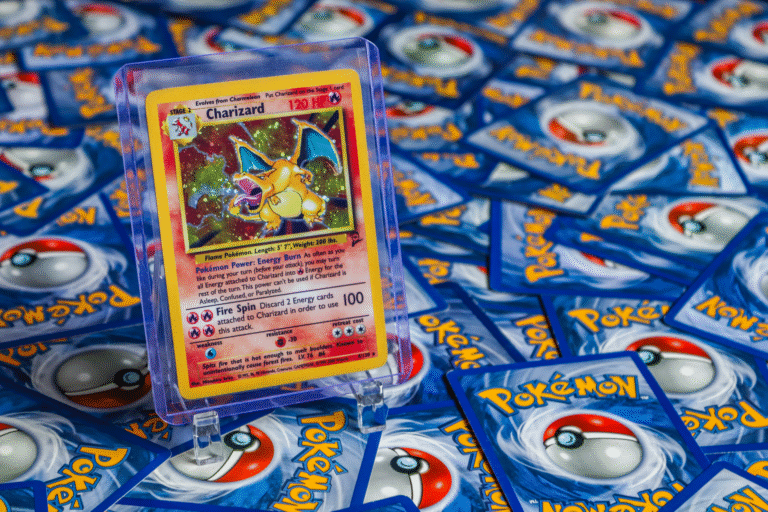
Celebrations singles cannot consistently keep up with vintage Pokémon cards in terms of long-term value appreciation or collector demand. While Celebrations cards have seen strong initial market performance since their 2021 release, they lack the scarcity, historical significance, and proven track record that drive sustained growth in the vintage market. A Celebrations Charizard VMAX, one of the set’s chase cards, may sell for $150-300 in near-mint condition, whereas a first-edition Base Set Charizard from 1999 regularly commands $5,000-15,000 or more depending on grading.
The gap between these two markets reflects fundamental differences in supply and demand dynamics. Celebrations was a widely printed modern set designed for casual collectors and investors, meaning millions of copies entered circulation. Vintage cards, particularly those from the original Base Set through Expedition era, had far more limited print runs and have experienced decades of natural attrition through wear, loss, and disposal. This scarcity differential is the primary reason vintage cards maintain price floors that Celebrations singles have yet to approach, even for the most desirable cards from the set.
Table of Contents
- Why Do Vintage Cards Command Higher Prices Than Celebrations Singles?
- Market Supply and Print Run Realities
- Grading and Condition Standards Across Eras
- Investment Strategy: Vintage vs. Celebrations for Different Collector Goals
- The Reprinting Risk and Its Impact on Long-Term Value
- Condition and Preservation Differences
- Future Market Outlook for Celebrations
- Conclusion
- Frequently Asked Questions
Why Do Vintage Cards Command Higher Prices Than Celebrations Singles?
The price disparity comes down to scarcity and irreplaceability. When The Pokémon Company printed Base Set cards in 1999-2000, they had no way to predict that certain cards would become cultural icons. Print runs were more conservative by today’s standards, and many cards were damaged through play or discarded. A well-maintained Base Set Blastoise in PSA 8 condition might be worth $2,000-4,000 because only a handful exist in that condition grade. celebrations, by contrast, was printed with modern production capabilities and explicit knowledge of collector demand, resulting in vastly higher quantities of cards meeting gem-mint criteria.
The vintage premium also reflects something marketing cannot manufacture: time-tested collector sentiment and historical importance. Base Set cards represent the birth of the Pokémon TCG as a mainstream phenomenon. Owning them carries cultural weight that modern release cards, no matter how well-designed, cannot replicate. A collector might buy a Celebrations Pikachu for $50, but a Base Set Shadowless Pikachu in good condition can sell for $1,000-3,000. The historical narrative of the first-edition run simply carries more weight in the long-term market than a commemorative reprint, regardless of how attractively Celebrations cards are designed.

Market Supply and Print Run Realities
Celebrations was released as a special set timed to the Pokémon TCG’s 25th anniversary, meaning The Pokémon Company knew demand would be exceptionally high. They printed accordingly, with millions of booster boxes distributed across retail channels worldwide. This was not an accident of production—it was deliberate. The set was accessible, affordable, and marketed to capture both nostalgic veteran collectors and new investors entering the market. As a result, the supply of well-preserved celebrations cards far exceeds the supply of vintage alternatives.
A critical limitation to understand: Celebrations cards can be reprinted. The company can release Celebrations 2 or another commemorative set featuring the same iconic artwork and similar card designs. This reprinting risk fundamentally constrains the long-term price floor for Celebrations singles. In contrast, Pokémon has made a deliberate business decision to never reprint original Base Set cards in their original form, making first editions and unlimited printings increasingly precious. A collector purchasing a Celebrations Mewtwo for $200 faces the realistic possibility that The Pokémon Company could release a similar card at a fraction of that price within a few years. That uncertainty keeps Celebrations valuations tempered compared to vintage cards, where reprinting is off the table.
Grading and Condition Standards Across Eras
Celebrations singles benefit from modern grading standards that make high-quality copies easier to authenticate and value. Most Celebrations cards in circulation entered collection immediately upon purchase, meaning gem-mint copies (PSA 10, BGS 10) are far more common than equivalent vintage examples. A PSA 10 Celebrations Umbreon VMAX might cost $400-600, whereas a PSA 10 Base Set Umbreon (not even the most desirable set for Umbreon) would cost significantly more if such a copy existed. However, this abundance of high-graded modern cards has an important downside: graded card populations are inflated relative to actual scarcity.
When you see that 2,000 copies of a Celebrations card have been graded PSA 9 or higher, you understand why prices remain relatively modest. Compare that to many vintage cards where the graded population in high tiers numbers in the dozens or low hundreds. A Base Set Nidoking in PSA 9 might only have 50-100 certified copies worldwide, creating genuine scarcity. This population difference directly explains why vintage cards often appreciate despite broader economic conditions, while Celebrations singles can languish if collector interest shifts.

Investment Strategy: Vintage vs. Celebrations for Different Collector Goals
If your goal is short-term appreciation or participating in current market trends, Celebrations singles offer lower barrier to entry and reasonable upside. An investor with $1,000 can acquire multiple high-quality Celebrations chase cards and potentially see 10-30% gains if the set gains secondary momentum. The cards are liquid, widely listed on major platforms, and easy to trade or sell. They also carry less risk because even in a worst-case scenario, the reprinting risk means they’ll rarely drop below 30-40% of peak value.
For long-term wealth building and true scarcity appreciation, vintage cards represent a fundamentally different asset class despite higher initial costs. A $5,000 investment in a PSA 8 Base Set Charizard carries no reprinting risk and competes directly with a limited pool of other copies. Vintage cards have appreciated consistently over 10-20 year periods regardless of collector sentiment fluctuations. The tradeoff is clear: Celebrations offers accessibility and lower risk, while vintage cards offer scarcity, historical significance, and a longer track record of appreciation. Most collectors who become serious eventually split their collection between both categories, using Celebrations as a liquid trading portfolio and vintage as a long-term hold.
The Reprinting Risk and Its Impact on Long-Term Value
The single biggest risk factor distinguishing Celebrations from vintage is reprinting. Pokémon has shown willingness to rerelease popular artwork across multiple sets and formats. Full Art trainers, secret rares, and special alternate arts from older sets have been reimagined and reprinted. If The Pokémon Company decides Celebrations artwork deserves a second run—whether as a 30th anniversary set or another commemorative release—it could significantly undermine current Celebrations pricing. This isn’t speculation; it’s a documented business practice.
Vintage cards face no such threat because original Base Set, Jungle, and Fossil cards exist in a special category. The Pokémon Company has publicly stated these sets represent the authentic release era. Reprints exist (notably the Evolutions set in 2016), but originals are always distinguishable and valued separately. A collector holding a vintage card has certainty about reprinting risk; a Celebrations collector faces ongoing uncertainty. This uncertainty alone explains why seasoned investors often view Celebrations as a trading tool rather than a long-term store of value. The card could drop 50% if a new reprinted version is announced and nobody wants the older “version” anymore, even if the gameplay functionality remains identical.

Condition and Preservation Differences
Vintage cards have an advantage in that extreme rarity of perfect specimens drives disproportionate premiums. A raw Base Set Charizard in excellent condition might be worth $8,000-12,000 before grading, and grading it could add $3,000+ if it achieves a 9 or 10. These multipliers reflect how few perfect copies exist. Celebrations cards, even in flawless condition, don’t see equivalent multipliers because perfection is common rather than exceptional.
The practical implication: storing and preserving Celebrations cards offers minimal financial benefit beyond basic protection. A Celebrations card in a penny sleeve holds 95% of the value of the same card graded PSA 10 in many cases. Vintage cards reward preservation efforts with meaningful premium appreciation. This changes the economics of collecting. You don’t necessarily need to invest in professional grading, storage, and insurance for Celebrations cards the way serious vintage collectors do.
Future Market Outlook for Celebrations
The Celebrations set matured as a collector asset around 2022-2023, roughly 2-3 years after release. Initial nostalgia hype faded, secondary market stabilized, and prices found equilibrium. Current pricing likely represents a sustainable level unless major market shifts occur. Unlike vintage cards, which can suddenly appreciate due to cultural moments or tournament dominance from professional players, Celebrations doesn’t have a mechanism for surprise appreciation.
The set’s value was largely determined at release and has gradually consolidated. Looking forward, Celebrations cards may serve as the “gateway vintage” for future collectors. Children who open Celebrations boosters today might develop nostalgia for the set in 15-20 years, creating a vintage market for these cards by 2040-2045. However, even in that scenario, they would be appreciating from a much lower base and with far higher population numbers than today’s vintage cards. The trajectory is different: vintage cards are already at peak scarcity and appreciate from there; Celebrations cards are at peak supply and only become “vintage” if supply ceases and time passes.
Conclusion
Celebrations singles cannot keep pace with vintage Pokémon cards when measured by long-term value appreciation, scarcity, or investment security. The fundamental differences—print volume, reprinting risk, historical significance, and rarity—all favor vintage cards. A collector comparing the two should understand they’re comparing different asset classes: Celebrations is a liquid, accessible modern collectible; vintage is a scarce, irreplaceable historical artifact. For most collectors, the practical answer involves owning both: Celebrations cards as accessible entry points and trading tools, and vintage cards as the serious long-term investment tier.
The choice ultimately depends on your goals. If you want to own Pokémon cards you enjoy and are willing to accept modest appreciation potential, Celebrations delivers exactly that. If you’re building a collection for long-term wealth storage and scarcity appreciation, vintage cards offer far superior fundamentals despite higher barriers to entry. The most successful collectors recognize this distinction and allocate accordingly, rather than treating the two markets as interchangeable.
Frequently Asked Questions
Can a Celebrations card ever be worth as much as a vintage card?
Extremely unlikely for identical artwork or designs. A Celebrations Charizard might theoretically reach $1,000-2,000 as a high-graded rarity, but Base Set Charizards routinely exceed $5,000-15,000. The supply difference is simply too vast.
Should I grade my Celebrations cards?
Only if you own multiple chase cards or plan to resell at scale. Most Celebrations cards in near-mint condition sell for 80-90% of PSA 10 prices without grading, making professional grading economically inefficient for casual holdings.
Will Celebrations cards become vintage someday?
Technically yes, but that would require 20-30 years of time passage. By then, they’ll have appreciated from a much higher population baseline, and the vintage market will be driven by 50-year-old nostalgia factors that currently don’t apply.
What’s the reprinting risk for Celebrations specifically?
Moderate to high. The company could release Celebrations 2.0 or similar sets using the same artwork. Original Celebrations ownership carries no guarantee of uniqueness or long-term scarcity.
Is buying Celebrations a waste of money compared to vintage?
Not if you enjoy the cards and appreciate reasonable near-term price stability. Celebrations offers better liquidity and lower barrier to entry than vintage. The “waste” framing assumes everyone should prioritize appreciation, which isn’t realistic for all collectors.
Which Celebrations cards hold value best?
The Charizard, Umbreon, and Pikachu cards tend to maintain prices better than others because these are universally popular Pokémon. Lesser-known characters see sharper secondary market drops as initial hype fades.