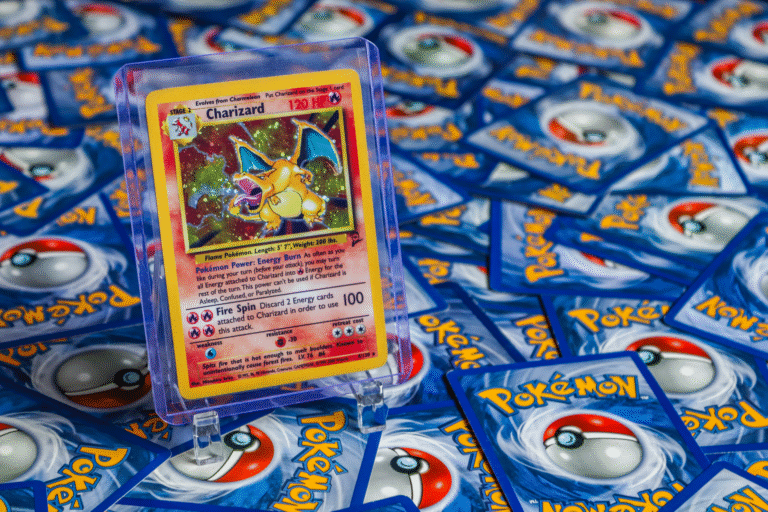
Evolving Skies singles cannot realistically keep up with vintage Pokemon cards in terms of long-term value appreciation and collectibility. Released in August 2021, Evolving Skies was printed in vastly larger quantities than the limited runs of Base Set, Jungle, and Fossil cards from the 1990s. A Shadowless Base Set Charizard consistently trades in the thousands or tens of thousands of dollars depending on condition, while even the most coveted Evolving Skies holos like Umbreon VMAX typically plateau in the $100-500 range, and that’s for premium editions. The fundamental difference isn’t quality—Evolving Skies contains beautiful cards and legitimate chase holos—but rather supply, age, and the accumulated nostalgia that drives vintage pricing.
The pricing gap widens dramatically when you compare rarity tiers. A pack-fresh Base Set Charizard from a sealed 1st Edition booster is scarcer by orders of magnitude than any Evolving Skies card. Modern production numbers mean that virtually any Evolving Skies single, no matter how desirable, will never reach the artificial scarcity that naturally emerged from 1990s print runs. New collectors often underestimate how much time and market aging contribute to a card’s value trajectory.
Table of Contents
- How Print Volume Determines Long-Term Pokemon Card Value
- The Nostalgia and Generational Premium Embedded in Vintage Card Prices
- Investment Potential and Market Cycles in Modern Versus Vintage Cards
- Practical Collecting Strategy for Building a Diverse Portfolio
- Supply Chain Complications and the Risk of Reprints Eroding Modern Card Values
- Grading, Authentication, and the Quality Control Shift Between Eras
- The Uncertain Future of Vintage Card Markets and Digital Alternatives
- Conclusion
- Frequently Asked Questions
How Print Volume Determines Long-Term Pokemon Card Value
Print runs for evolving Skies were among the largest in Pokemon TCG history, meant to meet unprecedented demand during the 2020-2021 boom. The Pokémon Company learned from previous years’ shortages and ramped production to near-capacity, flooding the market with billions of cards. Vintage sets, by contrast, had print runs measured in hundreds of millions for base Set, but that was 25+ years ago with zero reprints. The cumulative scarcity is incomparable. A Base Set booster box is a finite artifact; the supply will only decrease as sealed product is opened or lost.
Evolving Skies booster boxes still sit in warehouses and will gradually release into the market for years, suppressing ceiling prices. The secondary market reflects this reality immediately. Evolving Skies maintained relatively stable prices because new supply constantly enters circulation. A Dragonite VMAX or Leafeon VMAX from Evolving Skies is easy to acquire now and will likely remain accessible. By contrast, a NM-Mint Base Set Blastoise has become harder to find each year, pushing its price up in a way that modern printings simply cannot replicate. Collectors new to the hobby sometimes expect Evolving Skies to follow the same trajectory, but they’re missing the critical window—that window closed decades ago for vintage cards and will not reopen for modern sets in the same way.

The Nostalgia and Generational Premium Embedded in Vintage Card Prices
much of what vintage Pokemon cards command reflects a nostalgia premium that Evolving Skies cannot manufacture overnight. A player who opened Base Set boosters at age 8 in 1999 has emotional investment in those cards; a collector who never experienced the original Pokémon Trading Card Game firsthand cannot create that attachment retroactively. Prices for Shadowless and 1st Edition base Set cards remain inflated partly because fewer collectors are willing to sell at any price, even when offered significant sums. This isn’t irrational—it’s the premium placed on a formative childhood memory.
Evolving Skies will never have that origin story for players who grew up in the ’90s. A critical limitation is that by the time Evolving skies cards become “vintage” (in 20-30 years), newer sets will have replaced them as the modern chase cards, and the collector psychology that drives vintage prices may shift entirely. Digital cards and alternative trading formats could diminish physical card collecting altogether. There is no guarantee that Evolving Skies cards today will appreciate like Base Set cards did, because the conditions that created that appreciation—market indifference followed by a sudden resurgence—are unlikely to repeat identically. Investors who buy Evolving Skies expecting vintage-equivalent returns often end up disappointed when the set ages without gaining traction.
Investment Potential and Market Cycles in Modern Versus Vintage Cards
Modern cards like Evolving Skies entered the market during peak hype and high prices, meaning the investment window for buyers was narrow and timing-dependent. If you purchased Umbreon VMAX in summer 2021 when it was first released, you likely overpaid relative to where the price settled months later. Vintage cards, by contrast, were purchased cheaply by original collectors and early investors who got in before the 2017-2018 renewed interest in the hobby. The best investment gains for vintage cards came during that period, and buying them now means accepting that most appreciation may already be baked in—though rare, graded examples continue to climb. Modern cards entered the market at inflated prices, which is poor investment structure.
One specific example: a sealed Evolving Skies booster box sold for $150-200 at launch; today it’s worth roughly $80-120. That’s a loss for buyers who purchased at peak hype. A sealed Base Set booster box purchased in 2010 for $2,000-3,000 would now be worth $5,000-8,000+. The trajectories are fundamentally different because modern sets absorb massive capital upfront, while vintage products sat dormant in basements and are now being recovered and resold as collectibles. New investors should expect modern sets to follow the arc of the modern market—steady depreciation toward pack EV—rather than the arc of vintage cards.

Practical Collecting Strategy for Building a Diverse Portfolio
For collectors aiming to build lasting value, a mixed approach combining modest vintage purchases with selective modern cards makes more sense than choosing one category exclusively. Budget allocation matters here: vintage Base Set commons and uncommons in fair condition can be acquired for $5-30 each and form the backbone of a collection without massive capital outlay, while simultaneously targeting one or two modern chase cards (Evolving Skies Umbreon VMAX, Leafeon VMAX) that you enjoy playing with or displaying. This strategy hedges against modern card depreciation while maintaining exposure to future growth. The tradeoff is that vintage cards require more due diligence on authentication and grading.
A $200 vintage card could be counterfeited or misrepresented in condition; you must learn to evaluate cards carefully or purchase from established graders. Evolving Skies cards are almost never counterfeited because the profit margin is too thin, making them a lower-risk purchase from random sellers. For a collector prioritizing simplicity and lower stakes, modern cards are the better choice. For someone with capital and patience, vintage cards offer both historical significance and superior long-term value storage.
Supply Chain Complications and the Risk of Reprints Eroding Modern Card Values
One often-overlooked threat to Evolving Skies value is the possibility of reprints. The Pokémon Company has reprinted popular cards and artworks multiple times in special collections, promotional products, and anniversary sets. A card you own today could be reprinted in a special tin or collection box tomorrow, flooding the market with fresh copies and depressing resale prices. This has happened repeatedly—cards from early Sun & Moon sets dropped 20-40% in value after reprints. Vintage cards never face this risk; a Base Set Charizard cannot be reprinted without destroying its legitimacy.
Another limitation is that Evolving Skies was printed during a period of plastic shortages and extreme demand, leading to multiple print runs and variations (reverse holos, alternate arts, secret rares). This complexity can confuse new collectors about which version to target and why prices vary. Vintage sets have simpler taxonomies: Shadowless, 1st Edition, or Unlimited. The surfeit of modern variants actually suppresses single-card prices because the collector base fractures across dozens of targets. A collector chasing the crown jewel Umbreon VMAX discovers multiple versions and can’t easily compare values across them, whereas targeting a single Base Set Charizard is straightforward.

Grading, Authentication, and the Quality Control Shift Between Eras
Modern cards from Evolving Skies benefit from improved manufacturing standards and consistent centering, which means high-graded specimens (PSA 9, 10) exist in higher frequency than vintage cards. This abundance of perfect-grade modern cards paradoxically works against value appreciation—a PSA 10 Evolving Skies card is less precious when multiple copies exist. A PSA 10 Shadowless Base Set Charizard is so rare that it commands a premium measured in six figures, partly because even high-grade examples are scarce.
Grading companies understand this dynamic: they grade modern cards more liberally on the bell curve, and even “gem mint” modern cards are commercially available in multiples. Conversely, modern cards benefit from the existence of third-party authentication and grading, which was unavailable in the 1990s. Buying a graded and slabbed Evolving Skies card eliminates counterfeiting risk entirely, whereas buying a raw vintage card requires expertise. For beginner collectors uncomfortable with authentication, modern graded cards offer peace of mind.
The Uncertain Future of Vintage Card Markets and Digital Alternatives
Over the next 10-15 years, the Pokemon Company’s shift toward digital trading cards and online play could reshape physical collectibles markets fundamentally. If younger generations prefer digital formats, demand for physical Evolving Skies cards may decline, dragging prices down further. Vintage cards will likely retain some baseline collector value because their scarcity is geological (they cannot be recreated), but modern cards lack that protection. A digital Pokemon trading card game could cannibalize the physical TCG hobby, leaving Evolving Skies vulnerable.
Conversely, a well-documented shortage or a significant cultural moment (a major player using Evolving Skies in a tournament, celebrity endorsement, or media coverage) could suddenly boost prices. The vintage market proved that interest can reignite decades later, but only for the original, most historically significant cards. Evolving Skies sits in an awkward middle ground—too new to have nostalgia, too old to be the latest hype. Its future is genuinely uncertain, which is the most important distinction from vintage cards, whose value proposition has already been validated by 25+ years of market behavior.
Conclusion
Evolving Skies singles can keep up with vintage Pokemon cards only in the short term, and only for the most chase holos and rare variants—and even then, the gap widens annually. Vintage cards have benefited from decades of natural scarcity, generational nostalgia, and repeated market validation, while Evolving Skies entered the market at peak hype and will likely depreciate toward pack expected value. The print volume, reprinting risk, and lack of historical significance make modern cards a weaker long-term store of value.
If you’re collecting Evolving Skies, do so because you enjoy the artwork and gameplay, not because you expect them to rival Base Set pricing trajectories. For collectors looking to allocate limited capital, a diversified approach—buying selectively from both eras based on personal interest and available budget—is more practical than trying to time either market. Vintage cards offer historical relevance and scarcity protection, while modern cards offer simplicity, authenticity guarantees, and lower entry costs. Understanding that these are fundamentally different products serving different collector psychology is the key to making informed purchasing decisions and managing expectations realistically.
Frequently Asked Questions
Will Evolving Skies cards ever reach vintage pricing levels?
Unlikely for the bulk of the set. Only the rarest special editions or error cards might appreciate significantly, but even then they’d need decades of market aging and restricted supply to approach Base Set comparables. The print run alone works against it.
What Evolving Skies cards have the best investment potential?
Alternate art Umbreon VMAX, Leafeon VMAX, and sealed booster boxes have the highest floors, but even these face reprinting risk. Treat them as collectibles first, investments second.
Should I sell my Evolving Skies cards to buy vintage instead?
If you don’t have emotional attachment to them, selling now locks in whatever resale value remains before depreciation continues. Vintage cards are a more defensible long-term position, but timing and personal preference matter.
How do I know if a vintage card is worth the premium price?
Authentication via PSA or BGS (formerly Beckett) is essential. Buy from reputable dealers or platforms with buyer protection. Steep prices on vintage cards are justified only by rarity, age, and condition—verify all three before spending.
Can modern cards ever become vintage?
Technically yes, but they’ll need to clear multiple hurdles: surviving in collectible condition, avoiding reprints, retaining collector interest, and benefiting from market nostalgia. Most modern cards won’t clear these bars.
Is there any Evolving Skies card worth more than $1,000?
In exceptional circumstances, yes—a PSA 10 alternate art card or an extraordinarily rare print variation might cross that threshold. But prices will rarely sustain that level, and liquidity suffers at the high end.