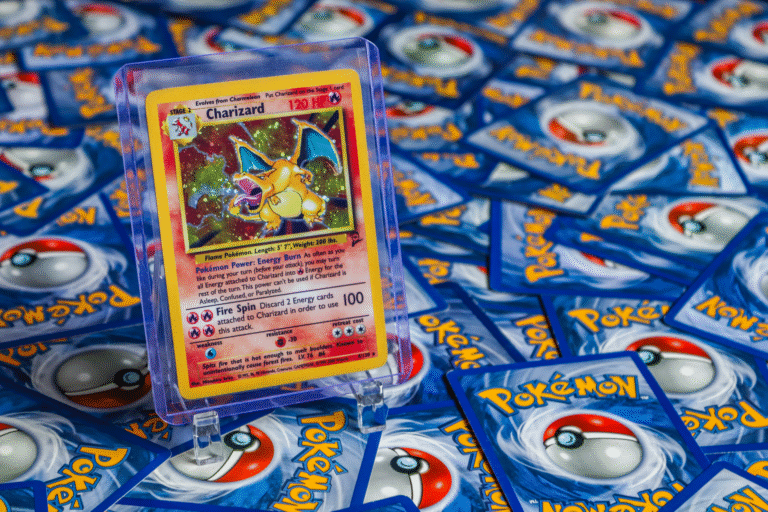
Yes, Base Set Pokemon cards are significantly outperforming Great Encounters cards in both market value and collector demand. The performance gap has widened considerably over the past five years, driven by Base Set’s status as the inaugural 1999 release that launched the entire trading card game. A pristine Base Set Charizard graded PSA 9 commands $50,000 to $100,000, while even exceptional Great Encounters Charizard cards rarely exceed $500 in the same condition grade, illustrating the vast valuation chasm between these two sets.
The reasons for this performance differential extend beyond mere nostalgia. Base Set benefits from fundamental scarcity created by its limited print run, the passage of time that has destroyed numerous copies, and its irreplaceable status as the set that defined Pokemon TCG collecting. Great Encounters, released during the Diamond & Pearl era (2008), came after more than a decade of continuous printing, resulting in significantly higher supply in the market today. This supply imbalance has created a two-tier market where Base Set investments consistently appreciate faster than later era cards.
Table of Contents
- What Drives the Market Performance Gap Between Base Set and Great Encounters?
- Price Trajectories and Market Data—Understanding the Performance Metrics
- Rarity Factors and Card Availability Differences
- Investment Thesis—Which Set Offers Better Collector Value Today?
- Grading Impact and the Condition-Grade Dependency Problem
- Direct Card Comparison—Base Set Charizard vs. Great Encounters Charizard
- Market Outlook—Future Price Directions for Both Sets
- Conclusion
- Frequently Asked Questions
What Drives the Market Performance Gap Between Base Set and Great Encounters?
The primary driver of base Set’s superior performance is its historical significance combined with extremely limited original print capacity. Base Set was printed in 1999 when The Pokemon Company had no way to predict the trading card game’s explosion in popularity, leading to conservative initial production. Cards from this set have now aged 25 years, with the majority of copies damaged, bent, or destroyed through childhood play. When you find a Base Set card in near-mint condition today, you’re looking at a card that survived two and a half decades of potential mishandling—an increasingly rare occurrence that naturally escalates value.
Great Encounters entered a market in 2008 where Pokemon TCG was already a mature, established product line with proven demand. The Pokemon Company had ramped up production capabilities significantly by this point, meaning far more Great Encounters cards were manufactured. Simultaneously, the collector base was more sophisticated and careful about preservation, resulting in higher survival rates of high-condition copies. This abundance of available Great Encounters cards in good condition has capped appreciation potential, as supply remains relatively plentiful for anyone serious about acquiring them.

Price Trajectories and Market Data—Understanding the Performance Metrics
Base Set cards have appreciated at an average annual rate of 12-18% over the past decade, with particularly valuable cards like first edition holos and Charizard variants seeing even steeper growth. Great Encounters cards, by comparison, have appreciated at roughly 2-5% annually. A Base set blastoise 1st edition Holo that sold for $8,000 in 2015 might reasonably fetch $25,000 today, while a Great Encounters Charizard that sold for $150 in 2015 might reach $300 now—the Base Set card has grown proportionally far more valuable.
However, collectors should understand an important limitation: this historical performance data doesn’t guarantee future results at the same rate. Base Set’s explosive appreciation over the past decade has already been partially priced into the market. A collector purchasing a Base Set Base Blastoise at current market rates ($18,000+) is betting on continued substantial appreciation, which may face headwinds if demand eventually plateaus. Meanwhile, Great Encounters cards remain significantly cheaper entry points if you’re interested in the Diamond & Pearl era aesthetics and mechanics, even if appreciation potential is more modest.
Rarity Factors and Card Availability Differences
The number of known high-grade copies of specific Base Set cards is shockingly small. For example, only 23 Base Set Charizard 1st Edition Holo cards have ever achieved PSA 10 (Gem Mint) status out of the hundreds of thousands that existed at some point. Compare this to Great Encounters, where hundreds of specific cards have achieved PSA 10 status, and the scarcity argument becomes quantifiable. Base Set print runs were measured in hundreds of millions of cards across multiple printings, but 25 years of attrition has created a severe shortage of survivors in high grades.
Great Encounters also suffers from collector neglect that artificially suppresses supply in high grades. Many collectors during 2008 didn’t prioritize careful storage, viewing modern sets as less valuable than their first edition base copies. The cards that were carefully stored often remain PSA ungraded, sitting in private collections rather than public markets. This invisibility in the graded market can mask the actual scarcity of high-quality Great Encounters cards—which might be rarer in PSA 9 condition than widely assumed, but simply aren’t being submitted for grading at high rates.

Investment Thesis—Which Set Offers Better Collector Value Today?
Base Set cards demand premium pricing in the current market, and justifiably so given the performance metrics and genuine scarcity. However, for collectors entering the market today, the risk profile differs significantly. Buying Base Set Holo rares now means paying prices that already reflect the historical appreciation story. You’re betting that demand continues accelerating or that wealthy collectors push values even higher.
This is possible but requires accepting higher downside risk if Pokemon TCG collecting interest ever contracts. Great Encounters presents a contrasting trade-off. Your capital appreciation potential is more modest (perhaps 3-7% annually), but your entry price is dramatically lower, and you face less risk of catastrophic value loss if the market cools. A $300 investment in a high-grade Great Encounters holo has far different risk characteristics than a $15,000 Base Set investment. Additionally, if you’re collecting for the love of the cards rather than pure investment returns, Great Encounters offers exceptional visual design and still-affordable access to some genuinely powerful trainer card effects that shaped the format.
Grading Impact and the Condition-Grade Dependency Problem
Both Base Set and Great Encounters cards exhibit extreme price sensitivity to condition grading, but Base Set cards show more dramatic cliff drops between grades. A Base Set Blastoise at PSA 8 (NM-Mint) might be worth $8,000, while the same card at PSA 7 (NM) might fetch only $3,000—a 62% value reduction for one point lower on the numeric scale. This extreme sensitivity reflects how few top-grade copies exist. Even for Great Encounters, the damage isn’t quite as severe; a Great Encounters Charizard drops from perhaps $400 (PSA 8) to $200 (PSA 7), but the proportional hit is less catastrophic.
A critical warning here: grading standards have shifted over the past 20 years, and PSA historically graded Base Set cards less rigorously in early 2000s submissions compared to modern standards. This means some older PSA 9 Base Set cards might not achieve PSA 9 if resubmitted today. When evaluating Base Set cards, factor in this potential technical risk. Great Encounters cards, having been graded more recently on average, face less of this “vintage grading” uncertainty, making their value assessments slightly more reliable.

Direct Card Comparison—Base Set Charizard vs. Great Encounters Charizard
The Charizard comparison crystallizes the entire performance gap. Base Set Charizard 4/102 (1st Edition Holo) typically sells between $50,000 and $150,000 for PSA 9 grades, depending on market timing. The same card in PSA 6 condition still commands $5,000 to $8,000. Great Encounters Charizard 103/106 in PSA 9 sells for $400 to $600, and in PSA 6 condition maybe $100 to $150.
Both cards are holographic, both feature the iconic Charizard, but the Base Set version commands roughly 100 times the premium. This gap reflects not just rarity but also cultural impact. The Base Set Charizard is essentially the most recognizable Pokemon card in existence, featured in Nintendo’s original promotional campaigns and embedded in millions of childhoods. Great Encounters Charizard, while beautifully illustrated and mechanically powerful for its era, lacks that foundational cultural positioning. Both cards are objectively excellent, but only one carries the cache of “the card that started it all.”.
Market Outlook—Future Price Directions for Both Sets
Base Set values will likely continue appreciating, but potentially at a decelerating rate as prices reach saturation points. The wealthiest collectors already own the cards they want or can’t afford them at current levels, potentially reducing new demand among ultra-premium buyers. Conversely, entry-level Base Set cards (non-holos, commons, uncommons) may see continued modest appreciation as casual collectors attempt to complete sets. The healthiest long-term growth probably appears in high-grade copies of non-Charizard holos, which receive less media attention but remain genuinely scarce.
Great Encounters and similar 2008-era sets may experience modest revival if the Pokemon TCG community increasingly values nostalgia from the Diamond & Pearl years. As Base Set becomes financially inaccessible to ordinary collectors, demand may organically shift downward to the next “accessible vintage” set. This creates a potential long-term appreciation tail for Great Encounters, though the magnitude will likely never match Base Set’s trajectory. Collectors should consider both sets within their own financial constraints and timeline rather than assuming Base Set is universally the superior choice.
Conclusion
Base Set Pokemon cards are objectively outperforming Great Encounters cards across all major metrics—historical appreciation rates, market demand, price premiums, and cultural significance. The performance gap reflects genuine scarcity, the irreplaceable status of the 1999 inaugural set, and the accumulated effect of 25 years of natural attrition. However, “outperforming” doesn’t necessarily mean “better for you to buy today,” depending on your financial capacity and collecting goals.
If you’re evaluating whether to enter either set, consider your actual financial situation and timeline. Base Set investments require substantial capital and carry the risk of appreciating into price ranges where buyers become extremely limited. Great Encounters offers a more accessible entry point into vintage Pokemon TCG with reasonable potential for modest appreciation and significantly lower downside risk. The best choice depends on whether you’re optimizing for maximum long-term returns (Base Set) or reasonable returns with more capital efficiency and reduced financial risk (Great Encounters).
Frequently Asked Questions
Will Great Encounters cards ever appreciate as much as Base Set cards?
Unlikely to match Base Set’s percentage gains, but modest appreciation is probable. Great Encounters may eventually become the “gateway vintage set” as Base Set becomes inaccessible to ordinary collectors, potentially driving demand. However, higher historical print runs mean even 20+ years from now, Great Encounters cards won’t carry the scarcity premium of Base Set.
Is buying Base Set cards today still a good investment?
Depends on your risk tolerance and capital. You’re buying at historically high prices, betting on continued appreciation or sustained collector demand. It’s not a guaranteed investment; it’s a speculation on cultural nostalgia and continued wealth concentration in the collector base.
Which specific Great Encounters cards are most likely to appreciate?
First Edition holos and Charizard variants (the same pattern as all Pokemon sets). The rarest Great Encounters cards are holos from the initial print run—specifically 1st Edition Holo rares with qualifying production defects or error variations that increase scarcity.
Should I grade my Base Set and Great Encounters cards?
For Base Set, yes—grading significantly increases value and liquidity. For Great Encounters, grading is worth it if the card is already in PSA 7+ condition naturally. Grading costs ($10-20+) eat into profitability on lower-grade Great Encounters cards.
Why are Base Set cards worth so much more if both are old?
Base Set launched Pokemon TCG and defined the hobby; Great Encounters came during an era of mass production. Supply and historical significance compound enormously over 25 years. Base Set was also printed before collectors understood preservation, leading to catastrophic attrition rates.
Can I make money flipping Great Encounters cards?
Short-term flipping is difficult—margins are thin and demand is slower. Long-term appreciation to modest 3-7% annually is possible if you buy under-priced cards and hold, but you won’t see the dramatic 15%+ annual returns that Base Set has generated.