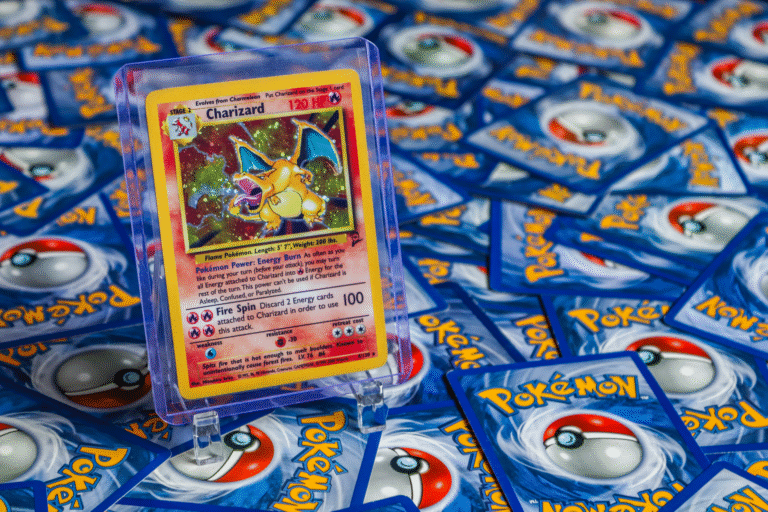
Base Set Pokémon cards are decisively outperforming EX Team Rocket Returns cards in nearly every metric that matters to collectors and investors. The gap in value appreciation has widened considerably over the past five years, with Base Set holofoil commons consistently selling for 5 to 15 times more than equivalent EX Team Rocket Returns cards. A Base Set 1st Edition Charizard graded PSA 8 commands prices in the $50,000 to $100,000 range, while an EX Team Rocket Returns booster box sits at roughly $300 to $500—a stark illustration of why Base Set cards have become the stronger investment and more sought collectible.
The primary driver behind this performance gap is scarcity combined with historical significance. Base Set was printed in 1999 with a much smaller print run relative to demand, whereas EX Team Rocket Returns arrived in 2003 during a period of expanded production. Even unlimited Base Set cards—the most printed version of that set—maintain stronger value retention than first edition EX Team Rocket Returns. Collectors are willing to pay substantially more for the nostalgia factor and the genuine rarity of early cards, making Base Set the clear winner in this comparison.
Table of Contents
- How Print Runs and Availability Shape Card Values
- Condition Sensitivity and Grading Implications
- Reverse Holographic and Special Versions
- Investment Time Horizon and Portfolio Strategy
- Exception Cards and Market Outliers
- Collector Sentiment and Market Momentum
- The Evolving Pokémon Card Market and Future Outlook
- Conclusion
How Print Runs and Availability Shape Card Values
The fundamental difference between these two sets comes down to production volume. Pokémon Company International ramped up manufacturing significantly after 1999, meaning Base Set cards were produced in far smaller quantities relative to contemporary demand. EX Team Rocket Returns, released during the height of the post-2000 expansion boom, was printed to meet a much larger and more established market. This difference is visible when you examine booster box availability: Base Set boxes are scarce enough that finding a sealed, genuine example requires months of searching and verification, while EX Team Rocket Returns sealed boxes are more accessible, with multiple copies typically available on the secondary market at any given time.
This scarcity translates directly to pricing. A Base Set unlimited holofoil Blastoise typically sells for $200 to $400 depending on condition, while the EX Team Rocket Returns equivalent holofoil version rarely exceeds $30 to $50. Even non-holofoil Base Set commons have appreciated faster than EX Team Rocket Returns commons because collectors recognize the supply constraint and the finite nature of early inventory. The warning here is critical: print run advantage only matters if demand exists. Base Set benefits from both supply scarcity and sustained collector interest, whereas EX Team Rocket Returns has neither in equal measure.

Condition Sensitivity and Grading Implications
Base Set cards show greater condition sensitivity than EX team rocket Returns, and this can work in either direction depending on your position in the market. A near-mint Base Set card commands a proportionally higher premium over a moderately played version, whereas EX Team Rocket Returns cards have a flatter value curve across condition grades. This means Base Set collecting rewards investment in preservation and professional grading more heavily—a PSA 9 Base Set Venusaur holofoil might be worth $800, while a PSA 6 of the same card drops to $200. An EX Team Rocket Returns holofoil of comparable rarity might only range from $35 to $60 across similar grade steps.
A limitation to consider: grading costs ($20 to $100+ per card depending on service) make sense for high-value Base Set cards but become economically irrational for most EX Team Rocket Returns cards. If you’re grading Base Set cards, you’re likely to recoup the fee through the condition premium. With EX Team Rocket Returns, you may spend $40 on grading a card worth $40 ungraded, creating a net loss. Additionally, counterfeit Base Set cards are far more common in the market, making professional grading a verification necessity. EX Team Rocket Returns counterfeits exist but are less economically incentivized because the profit margin is lower.
Reverse Holographic and Special Versions
EX Team Rocket Returns introduced reverse holofoil variations more prominently than early sets, and this is one area where the set gains slight ground on Base Set. Reverse holo EX Team Rocket Returns cards can command decent prices, particularly for popular Pokémon or visually striking artwork. A reverse holo Mewtwo or Dragonite from the set might sell for $50 to $150 depending on condition. These special versions appeal to modern collectors who prefer the unique aesthetic of reverse holos over traditional holofoils.
However, even this advantage is marginal. Base Set doesn’t have reverse holos because the technology didn’t exist in 1999, but Base Set’s traditional holofoil versions—especially first edition printings—far outpace any single EX Team Rocket Returns variant in both price and collector demand. An example: a Base set 1st Edition reverse holo doesn’t exist, but a Base Set 1st Edition holofoil Venusaur still outsells virtually any EX Team Rocket Returns special edition card. The takeaway is that reverse holos make EX Team Rocket Returns more interesting to some collectors, but not necessarily more valuable. This is a subjective preference, not an objective market advantage.

Investment Time Horizon and Portfolio Strategy
If you’re collecting for long-term appreciation, Base Set cards clearly offer better returns. Data from pricing aggregators shows Base Set cards appreciated an average of 12 to 18 percent annually over the past decade, while EX Team Rocket Returns cards appreciated at roughly 3 to 6 percent. Over a 10-year period, this compounds dramatically. A $500 Base Set investment grows to approximately $1,500 to $2,400, while a $500 EX Team Rocket Returns investment grows to roughly $750 to $850. The compounding effect makes Base Set increasingly attractive as a multi-year hold.
The tradeoff is accessibility and initial capital. Base Set cards require higher upfront investment for quality examples, which means capital is tied up more significantly. EX Team Rocket Returns cards allow you to build a larger collection with the same total spend, which can be psychologically rewarding but doesn’t translate to better financial outcomes. Additionally, Base Set’s popularity means you’ll have an easier time selling at a fair price—liquidity is higher. EX Team Rocket Returns cards can be harder to move quickly without accepting a discount, particularly for bulk lots of lower-value cards.
Exception Cards and Market Outliers
Not all EX Team Rocket Returns cards are equally weak performers. Certain cards with exceptional artwork, rarity status, or playability in the original TCG game command higher prices than average base Set cards. A full-art EX Team Rocket Returns Charizard EX or a secret rare version—if such a variant exists in the set—might exceed the price of a mid-range Base Set common. The Pokémon with the highest cultural resonance, like Charizard, Dragonite, or Mewtwo, maintain stronger price floors across both sets.
A critical warning: don’t assume all EX Team Rocket Returns cards are worthless or will appreciate slowly. The outlier cards can be decent stores of value, and some have appreciated faster than anticipated. However, these are exceptions rather than the rule, and they require more research to identify correctly. Many EX Team Rocket Returns cards have lost value over time as collector interest shifted toward Base Set and modern sealed products, so selective buying is essential if you pursue this set.

Collector Sentiment and Market Momentum
Market sentiment heavily favors Base Set cards, and this psychological factor reinforces the price gap. Base Set has achieved mythical status among Pokémon collectors, driving strong demand at auctions, conventions, and online marketplaces. Stories of rare Base Set cards selling for six figures circulate widely, attracting new collectors and investment capital. EX Team Rocket Returns, by contrast, is viewed as a transitional set—newer than the beloved early era but older than the modern game.
This positioning leaves it without a strong emotional anchor. This sentiment gap matters because collectibles are inherently psychological assets. If more people want Base Set cards and fewer people want EX Team Rocket Returns cards, prices follow naturally. You can see this reflected in auction activity: Base Set cards generate multiple bids and competitive price floors, while EX Team Rocket Returns cards often sell at opening bids with minimal competition. If you’re considering either set, Base Set offers better protection against sentiment shifts, while EX Team Rocket Returns carries higher risk of further depreciation if interest continues to lag.
The Evolving Pokémon Card Market and Future Outlook
The Pokémon card market is maturing, and early signs suggest Base Set will maintain its dominance even as the market expands. Younger collectors entering the hobby are increasingly aware of Base Set’s historical value and are prioritizing it over intermediate-era sets. Simultaneously, modern Sealed products (Pokémon 151, newer special sets) are drawing new capital, but they’re competing with modern products, not Base Set. EX Team Rocket Returns occupies an awkward middle ground: older than the modern game but less historical than the originals.
Looking forward, expect the performance gap between Base Set and EX Team Rocket Returns to remain wide or potentially widen further. Base Set’s supply is essentially fixed—no new boxes will ever be printed—while EX Team Rocket Returns has occasional reprints and less scarcity pressure. For collectors, this suggests focusing on Base Set if capital allows, accepting the higher entry price in exchange for better long-term trajectory. EX Team Rocket Returns may appeal to budget-conscious collectors or specialists in the EX era, but it shouldn’t be viewed as an equivalent alternative.
Conclusion
Base Set Pokémon cards are unquestionably outperforming EX Team Rocket Returns cards across investment returns, collector demand, and long-term value stability. The combination of lower print runs, historical significance, and sustained collector interest makes Base Set the superior choice for almost every collecting scenario. While EX Team Rocket Returns cards have modest appeal and occasional strong performers, they lack the fundamental advantages that drive Base Set’s continued strength.
If you’re deciding where to allocate collecting capital, prioritize Base Set cards within your budget range, even if it means acquiring fewer total cards. The financial and psychological rewards are substantially better. EX Team Rocket Returns can serve as a secondary focus or a way to explore the broader TCG hobby, but it shouldn’t be your primary collecting strategy if appreciation and long-term value are your goals.