Several Base Set cards are positioned to surprise collectors in 2026, with the most significant surprises already emerging in recent years. The standout example is the 1999 Chansey Base Set 1st Edition, which unexpectedly climbed to around $55,000 for PSA 10 copies in 2024, driven by the scarcity of gem-mint examples—only approximately 48 PSA 10 copies exist. This card demonstrates how underrated Base Set holographics can suddenly capture collector attention and command prices that rival or exceed more obvious choices. Beyond Chansey, cards like the Shadowless Charizard variant have proven that even within the canon of famous Base Set cards, specific editions and conditions can unlock dramatically higher values than initially anticipated.
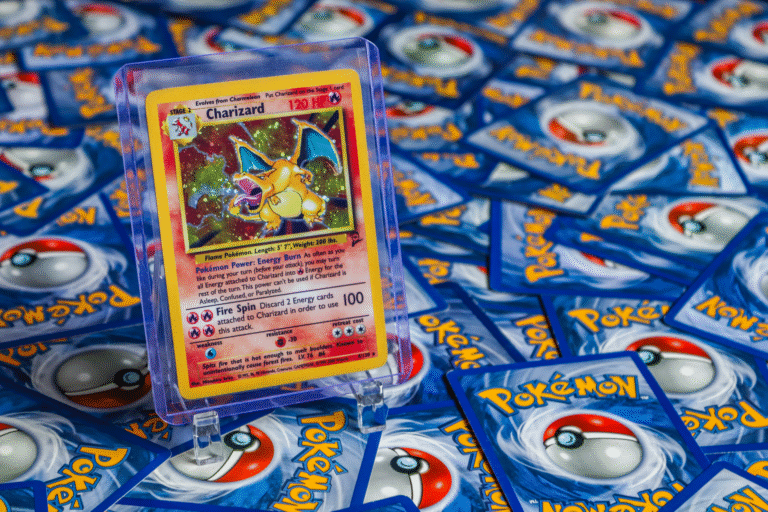
The 2026 market reinforces this lesson: Base Set cards remain far from fully priced in. A 1999 Charizard Base Set Shadowless PSA 10 sold for $954,800 at Goldin Auctions in February 2026, while the standard 1st Edition Charizard PSA 10 trades in the $168,000–$170,000 range after selling for $550,000 at Heritage Auctions in late 2025. These variations and price points show that collectors who look beyond obvious “chase cards” and instead focus on scarcity, condition, and variant differences may uncover the real surprises in 2026. Understanding which cards possess the least supply, particularly in high grades, is the key to identifying which Base Set cards will surprise the market.
Table of Contents
- Which Base Set Cards Are Overdue for Collector Attention?
- The Shadowless Variant Premium That Collectors Often Underestimate
- Non-Charizard Holos That Represent Hidden Value in Base Set
- Building a Base Set Collection Strategy for 2026 and Beyond
- Grading Challenges and Condition Problems Specific to Base Set
- Complete Set Costs and Master Set Decisions
- What Could Trigger Surprise Appreciation in Base Set Cards During 2026 and Beyond
- Conclusion
Which Base Set Cards Are Overdue for Collector Attention?
Chansey’s trajectory offers the clearest playbook for surprise appreciation in Base Set. Historically overshadowed by Charizard, Blastoise, and Venusaur, Chansey’s 1st Edition holographic version commanded minimal attention until serious collectors recognized a critical bottleneck: the card’s coloring and print quality made achieving gem-mint grades extraordinarily difficult. Unlike Charizard, which had marketing hype pushing it to prominence, Chansey silently became one of the scarcest Base Set holos in PSA 10—a rarity that drove values upward without the fanfare of traditional chase card demand. This pattern suggests that other Base Set holos with comparable supply constraints but less collector visibility could be next.
The lesson here is important for 2026 buyers: not all valuable cards are famous, and not all famous cards are scarce. Machamp, Magneton, and Poliwrath represent other holographic Base Set cards that have received less attention than their scarcity might suggest, particularly in first edition and shadowless versions. A collector hunting for surprises should cross-reference PSA population reports against current market prices. If a card has fewer PSA 10 or PSA 9 copies than Chansey but trades for a fraction of Chansey’s price, it may represent a meaningful opportunity—or it may indicate genuine lack of collector demand, which is the distinction every investor must carefully evaluate before purchasing.

The Shadowless Variant Premium That Collectors Often Underestimate
Shadowless Base Set cards command dramatically higher premiums than their unlimited or 1st edition counterparts, yet many casual collectors remain unfamiliar with this distinction. The February 2026 sale of a 1999 Charizard Base Set Shadowless PSA 10 for $954,800 illustrates the value gap: this card sells for approximately 5.7 times the price of a 1st Edition PSA 10 in the $168,000–$170,000 range. The reason is supply-side: shadowless cards were printed in the smallest quantity during the earliest production run, making them inherently scarcer even in lower grades. A collector holding a shadowless holo in PSA 8 or PSA 9 condition may be sitting on significantly more value than they realize, particularly if they acquired the card before the market fully understood the variant hierarchy.
However, a critical caveat applies: shadowless cards are prone to authentication and grading challenges. Shadowless printings showed variations in card stock, centering, and image quality that can make conditional assessment difficult, even for professional graders. This unpredictability means that purchasing shadowless cards sight-unseen carries higher risk than buying more standardized 1st editions. Additionally, the extreme price ceiling for shadowless cards has created a bifurcated market where lower-grade shadowless copies (PSA 6 and below) can languish in sales listings because collectors balking at $900,000+ prices simply drop out of the market entirely. In 2026, expect shadowless card collectors to become even more specialized and selective, focusing on the rarest characters rather than attempting complete shadowless sets.
Non-Charizard Holos That Represent Hidden Value in Base Set
While Charizard dominates conversation, collectors who diversify into other high-value Base Set holos may find more stable and less speculative appreciation. Blastoise, Venusaur, and the Mewtwo holographic all command substantial prices, but they are also more frequently encountered in gem-mint condition than Chansey—making their recent prices more defensible as grounded in genuine supply-demand equilibrium rather than boom-cycle enthusiasm. Cards like Alakazam (Base Set), Arcanine, and the Holo Machamp occupy a middle tier: valuable enough to merit serious collection interest, but under-discussed compared to the trio of Charizard, Blastoise, and Venusaur, creating potential for surprises among informed buyers. The practical implication for 2026 is straightforward: if you are building a Base Set portfolio, scrutinize the PSA population reports for the specific grade tier you’re targeting.
A 1st Edition Alakazam PSA 9 might have a population of 30–50 copies, making it meaningfully scarcer than a Blastoise PSA 9 with 150+ copies. If both cards trade in the $8,000–$12,000 range, the Alakazam represents better relative value and a higher probability of appreciation if market attention eventually reaches the second-tier holos. Alternatively, such cards might simply remain relatively flat because collector preference for the iconic three starters is genuine and durable rather than an exploitable market inefficiency. This uncertainty is the tradeoff: diversifying into less-famous Base Set holos broadens your surface area for surprises, but also increases the risk that you’re holding cards that simply will not appreciate as quickly as the proven chase cards.

Building a Base Set Collection Strategy for 2026 and Beyond
Prospective collectors in 2026 face a fundamental choice: pursue a complete set (shadowless, 1st edition unlimited, or unlimited-unlimited) or cherry-pick individual high-value holos. A complete 1st edition shadowless Base Set costs $8,000–$25,000+ and requires years of patient acquisition, particularly in gem-mint condition. By contrast, a complete unlimited set can be assembled for $800–$2,500, offering immediate diversification and the satisfaction of set completion without the equity requirement of shadowless collecting. The tradeoff is immediate: shadowless sets carry higher appreciation potential due to scarcity, but unlimited sets offer liquidity and lower financial friction for collectors entering the space.
For individual holo collectors, the 2026 strategy should emphasize cards with documented scarcity in the grades available to you. Rather than overpaying for a Charizard PSA 8 in a heated market, consider building a portfolio of five to eight lower-tier holos in PSA 8 or PSA 9 condition, where price-per-card is lower and population bottlenecks are more pronounced. This approach distributes risk across multiple cards and leaves room for one or two positions to surprise upward without the entire portfolio becoming dependent on a single card’s appreciation. Monitor pricing resources like PokInvest, CardGrading.app, and TCGplayer regularly to identify cards whose prices are disconnected from their population scarcity. If a card has fewer PSA 10 examples than another but trades at a lower price, that disconnect may signal an opportunity—or it may simply indicate that the card’s condition difficulty makes the grade meaningful.
Grading Challenges and Condition Problems Specific to Base Set
Base Set cards manufactured in 1999 and early 2000 present authentic collectors with a set of condition realities that modern-era cards largely avoid. The print quality was inconsistent, centering issues are commonplace, and certain holos like Chansey had notoriously light coloring that makes PSA 10 achievement extraordinarily rare. Collectors purchasing Base Set cards must understand that “gem-mint” grades are not simply rare—they are genuinely difficult to achieve for many cards in the set, and an expectation of PSA 10 as the “perfect” grade is often unrealistic. A PSA 9 Base Set Charizard 1st Edition, for example, is a legitimate treasure that many collectors will never own, yet the market still prices PSA 10 at such a premium that the question becomes whether the incremental condition improvement justifies the exponential price leap.
A practical warning for 2026: verify all Base Set card grades independently before committing to high-value purchases. Even reputable auction houses occasionally encounter regraded cards or disputed PSA slabs, and the age of Base Set means that grading standards have evolved significantly since original submissions. If purchasing directly from dealers or private sales, request raw card inspection or independent regrading by a trusted service. Additionally, recognize that Base Set holo wear—particularly centering and light surface wear—is normal and should not disqualify a card from serious collection consideration. Some of the most profitable Base Set positions in 2026 will likely be high-quality PSA 8 and PSA 9 cards, not PSA 10 examples, simply because the price-to-scarcity ratio is more rational at those grades.

Complete Set Costs and Master Set Decisions
Assembling a complete Base Set requires a clear decision on edition target. Shadowless master sets, comprising all 102 unique cards in shadowless form (holos and non-holos), typically cost $8,000–$25,000+ for sets in mixed-grade conditions, with gem-mint complete sets reaching $50,000–$100,000+. First edition unlimited sets (non-shadowless) fall significantly lower, in the $2,000–$5,000 range for mixed-condition completions, while pure unlimited sets can be finished for $800–$2,500. The financial commitment differs by an order of magnitude, making the edition choice pivotal.
For collectors with limited capital, the unlimited set represents an achievable entry point into Base Set completion that still delivers legitimacy and historical significance. The holos in an unlimited set are identical in artwork to shadowless versions and 1st editions—the only difference is production quantity and print run identification. Owning a complete unlimited set (including all four non-holo error cards and regional variants) is a legitimate credential in the collecting community and positions you for future appreciation as more advanced collectors recognize the production scarcity of even “common” unlimited cards. The hidden advantage: if you build an unlimited set now for $1,500–$2,000 and the market revalues Base Set supply in 2027–2028, even a 50% appreciation in average card values yields meaningful gains on total portfolio value.
What Could Trigger Surprise Appreciation in Base Set Cards During 2026 and Beyond
The Base Set market in 2026 remains sensitive to a handful of specific catalysts that could trigger rapid appreciation in overlooked cards. First, major auction sales at record prices (like the $954,800 Shadowless Charizard in February 2026) often inspire retail ripple effects—collectors see the headline and suddenly begin searching for their own Base Set cards, driving secondary market activity and price discovery in previously dormant corners of the market. Second, cultural moments tied to Pokémon (anniversary milestones, film releases, nostalgia peaks) can redirect collector enthusiasm toward the original set, potentially raising valuations of cards that benefit from expanded collector visibility. Third, population scarcity discoveries—instances where collectors recognize a card is far scarcer in gem-mint condition than price history suggests—can unlock rapid revaluations.
The cards most positioned to surprise in 2026 are those combining three factors: documented scarcity in high grades (PSA 10 or PSA 9 populations under 100), prices that have not yet reflected that scarcity, and sufficient collector demand to support eventual appreciation. Chansey already fits this profile and has appreciated accordingly. Other candidates require deeper due diligence but may exist within the current market. As 2026 progresses, monitor PSA population updates quarterly and cross-reference them against price movements on trading platforms. The next Chansey-style surprise will likely be discovered not through hype, but through the unglamorous work of comparing population reports to market prices and recognizing a disconnect that suggests genuine opportunity.
Conclusion
The Base Set cards most likely to surprise collectors in 2026 are not the obvious choices of Charizard or Blastoise, but rather the overlooked holos with authentic supply bottlenecks in gem-mint condition. Chansey demonstrated that recognition of this pattern can drive substantial gains, climbing from relative obscurity to $55,000 for PSA 10 copies. The Shadowless Charizard’s $954,800 sale in February 2026 further illustrated that even famous cards can surprise when specific variants and condition factors are properly weighted.
For collectors entering Base Set in 2026, the strategy should balance aspiration—pursuing the cards you genuinely love—with analytical discipline, using PSA population data and price history to identify cards whose current valuations may underestimate their true scarcity. Whether assembling a complete set, cherry-picking individual holos, or building a diversified portfolio, success in 2026 will reward collectors who educate themselves on variant differences, grading realities, and the distinction between hype-driven appreciation and supply-constrained value. The Base Set market has matured significantly since 1999, but it remains far from saturated. Meaningful surprises await those who look beyond the headlines and instead focus on the fundamentals that drive long-term value: scarcity, condition, and authentic collector demand.