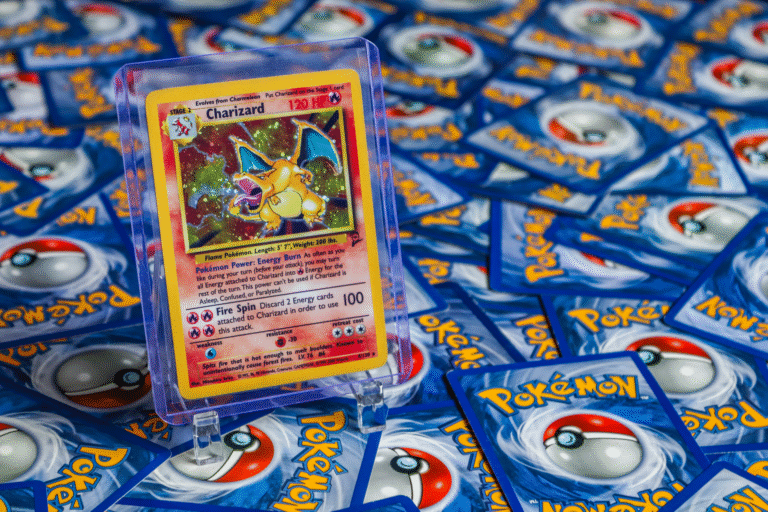
Buyers are paying closer attention to Pokemon card alt art crash risk in 2026 because the market has experienced substantial and visible price declines across multiple high-profile cards after reaching unsustainable peaks in late 2025. The Prismatic Evolutions Umbreon Special Illustration Rare, for instance, dropped from $1,600 to $832—a 48% decline—while the Obsidian Flames Charizard fell from $126 to $79. These aren’t isolated incidents but part of a broader market correction that has forced collectors and investors to fundamentally reassess their assumptions about alt art valuations and future demand. The 2026 downturn marks a departure from the uninterrupted appreciation that defined Pokemon cards through much of the 2020s.
What’s notable is not that prices fell, but that they’re falling faster than historical patterns suggest, and with greater distribution across multiple sets. Umbreon VMAX Alt Art cards that commanded $400+ in raw condition (ungraded) now trade in the $280-320 range. Even professionally graded copies (PSA 10) have retreated from $950+ peaks to $650-750 current levels. This shift has sparked legitimate questions about whether alt art cards—once treated as tier-one investments—are experiencing a temporary correction or a more permanent repricing. Understanding the mechanisms driving these declines and the market dynamics that follow is essential for anyone holding or considering alt art positions.
Table of Contents
- What’s Driving the 2026 Alt Art Market Decline?
- The Price Discovery Pattern Behind Alt Art Releases
- Specific Card Examples and Their Market Trajectories
- How Collectors Are Reassessing Alt Art Risk
- The Historical Longevity Question and Market Comparisons
- The Upcoming October 2026 Pokemon 30th Anniversary Catalyst
- Market Trajectory Forward and Collector Positioning
- Conclusion
What’s Driving the 2026 Alt Art Market Decline?
The 2026 crash stems from multiple overlapping factors that converated in early 2026. The Sword & Shield era alt arts reached what professional market analysts called a “definitive bottom” in February 2026 following a capitulation event where accumulated supply finally entered secondary markets at scale. This wasn’t a sudden announcement or unexpected news—it was the natural conclusion of a supply-demand imbalance that had been building since these cards peaked. The March 2026 launch of Ascended Heroes, Pokemon’s first Mega Evolution series set, fundamentally shifted collector psychology and capital allocation. Attention rotated away from Scarlet & Violet era cards, which had dominated collector focus through 2025.
When a new, mechanically distinct set captures the community’s imagination, it creates secondary market selling pressure on previous generation staples. This pattern is predictable but easily overlooked by buyers focused only on historical price data. April’s format rotation in competitive play eliminated another underestimated variable: sell pressure from competitive players liquidating cards that were no longer tournament-legal. Many Scarlet & Violet alt arts had practical value to players, creating a floor of demand. Once those cards rotated out, that entire demand segment evaporated overnight, exposing the market to pure collector-sentiment pricing.

The Price Discovery Pattern Behind Alt Art Releases
One of the most important lessons from 2026 is understanding how Special Art Rare and Special Illustration Rare cards actually price across time. Data from multiple market sources shows a consistent pattern: SAR/SIR cards spike on release day driven by initial demand and limited supply, then shed 20-30% within the first 60 days as secondary market supply floods in from box breaks, bulk sellers, and casual players liquidating pulls. Many buyers who purchased Scarlet & Violet alt arts within the first month of release believed they were capturing appreciation potential at “floor price.” What actually happened is they entered during the high-demand spike phase and didn’t account for the guaranteed supply increase that follows.
The Umbreon VMAX Alt Art is a textbook example: cards purchased at $300-350 in the first two weeks of the set hit that 20-30% shed phase, but few expected the decline to extend significantly beyond the typical 60-day window. The limitation here is timing predictability. While the 60-day pattern is reliable, knowing whether a card will find support at 70% of release prices, 50% of release prices, or lower depends on broader market factors that aren’t embedded in the release mechanics. The market reached capitulation in Sword & Shield alts in February 2026, but that capitulation took 12-15 months to occur after the January 2025 peak.
Specific Card Examples and Their Market Trajectories
The Obsidian Flames Charizard Alt Art serves as a useful case study in how “chase cards” can underperform relative to market hype. The card had multiple qualities that historically support premium pricing: featuring an iconic Pokemon, released in a popular set, and immediately recognized as chase-tier rarity. Yet it still declined 37% from $126 to $79. This card’s experience suggests that prestige and cultural weight are insufficient to overcome broader market sentiment and supply-demand mechanics. The Prismatic Evolutions Umbreon SIR represents an even more dramatic example of repricing.
This card achieved extraordinary peak pricing of $1,600, reflecting peak FOMO and limited initial supply. The 48% decline to $832 still places it at one of the highest secondary market prices for a modern Pokemon card, yet buyers who purchased within $200 of the peak are sitting on substantial losses. This card illustrates the risk of chasing highest-rarity superlatives without considering whether the secondary market can sustain stratospheric pricing. Raw Umbreon VMAX Alt Arts, which form a larger addressable pool than special illustration rares, show more moderate but persistent declines. The shift from $400+ to the $280-320 current range (a 25-30% decline) is less dramatic than headline numbers from chase cards, but represents the majority of cards actually moving in secondary markets. This data point matters because most collectors can’t access the Prismatic Evolutions Umbreon SIR, so their actual portfolio risk more closely mirrors the raw Umbreon VMAX trajectory.

How Collectors Are Reassessing Alt Art Risk
The market’s response to 2026 declines has been to implement tighter grading standards and lower entry price targets. Experienced collectors are no longer buying alt arts on release hype or within the first month window. Instead, they’re waiting for the 60-day supply floor to establish, then entering positions with larger margin of safety built in. This means waiting 2-3 months and expecting a 20-30% entry discount relative to release day pricing. Another strategic shift involves grading selectivity.
Raw card purchases are becoming more common as traders price PSA-graded copies at premiums that no longer feel justified given price volatility. A PSA 10 Umbreon VMAX Alt Art at $700 is a higher-risk proposition than a raw near-mint copy at $300 when the graded version’s premium could compress further. Some collectors are taking the deliberate choice to accept raw condition in exchange for lower absolute prices and optionality to grade only if prices recover. The tradeoff collectors face is between capital preservation and potential upside capture. Buying at capitulation-floor prices like we saw in February 2026 provides significant margin of safety, but requires patience and liquidity to execute. The window for recognizing capitulation often closes in retrospect; by the time an analyst declares a bottom has been reached, buyers capable of acting have typically already committed capital.
The Historical Longevity Question and Market Comparisons
A critical limitation of current 2026 market analysis is that we’re comparing modern (Scarlet & Violet era) alt arts to entirely different historical periods. The Pokemon card market has appreciated 3,821% since 2004 compared to the S&P 500’s 483% return over the same span. This long-term appreciation is real and significant. However, it encompasses decades of trends and doesn’t necessarily apply predictively to cards that have only existed for 2-3 years. The warning embedded in this comparison is that long-term historical appreciation doesn’t inoculate any individual card or set against near-term repricing.
Scarlet & Violet alt arts could still appreciate meaningfully over 10 years while experiencing further declines over the next 12 months. Buyers conflating “the Pokemon market always goes up eventually” with “this specific card won’t go lower” are making an unsupported logical leap. Seasoned collectors and market participants consistently note that the volatility of individual modern alt arts exceeds the stability of the broader market category. A portfolio of Scarlet & Violet alts behaves differently from the Pokemon market as a whole. Diversification across eras, sets, and card types is a more reliable risk management tool than betting on any single generation of cards reversing from 30-40% declines.

The Upcoming October 2026 Pokemon 30th Anniversary Catalyst
Collectors tracking the 2026 market landscape can’t ignore the approaching October 2026 Pokemon 30th Anniversary, which will create a significant demand and attention inflection point. Historical precedent matters here: the 20th Anniversary in 2016 drove 30-50% appreciation in vintage cards, while the 25th Anniversary in 2021 saw 80-120% gains in modern cards. Anniversary events create time-bound excitement and often trigger buying activity from casual collectors and returning players.
The October 2026 catalyst could provide meaningful support for Scarlet & Violet alt arts if the community’s attention and capital rotate back into modern sets during the anniversary window. However, this isn’t certain. Much will depend on what new products Pokemon releases to commemorate the anniversary and whether those new products create competing demand vectors. If the 30th Anniversary set features chase cards that capture attention, anniversary hype might further defer Scarlet & Violet recovery rather than accelerate it.
Market Trajectory Forward and Collector Positioning
The evidence from early 2026 suggests that the “crash risk” buyers are now monitoring isn’t limited to Scarlet & Violet cards. Format rotation, set launches, and the cyclical nature of collector attention appear to affect modern Pokemon cards more significantly than previously appreciated. Buyers who previously thought they were buying durable, long-term appreciating assets are learning that “long-term” may require patience through multiple near-term repricing cycles.
The market’s response in May-June 2026 is characterized by stabilization rather than recovery. Prices have stopped accelerating downward in most cases, suggesting that accumulated selling pressure has resolved. This creates a window for buyers willing to make positions without the fear of cascading declines, though it’s not yet clear whether this is a true capitulation floor or merely a pause before additional weakness. The October anniversary catalyst will provide substantial new information about whether modern alt art demand can sustain itself independent of the FOMO-driven peaks that characterized 2025.
Conclusion
Buyers are paying closer attention to Pokemon card alt art crash risk in 2026 because the market has clearly demonstrated that even premium, iconic cards can experience significant repricing within relatively short windows. The 37-48% declines observed across multiple high-profile Scarlet & Violet alt arts have made obvious something that was previously theoretical: modern Pokemon cards are subject to supply-demand mechanics, format rotations, and competitive psychology that can overwhelm long-term appreciation narratives. Understanding these mechanisms is the difference between reacting to price movements and anticipating them.
The path forward for collectors involves abandoning release-day FOMO buying, respecting the 60-day supply floor pattern, and maintaining realistic expectations about modern card volatility. Long-term appreciation is likely, but near-term repricing should be expected as a normal feature of the market rather than a warning sign. Building positions at capitulation phases with adequate margin of safety, diversifying across multiple sets and eras, and remaining alert to structural changes like format rotation and new set launches will define successful portfolio management through the remainder of 2026 and beyond.