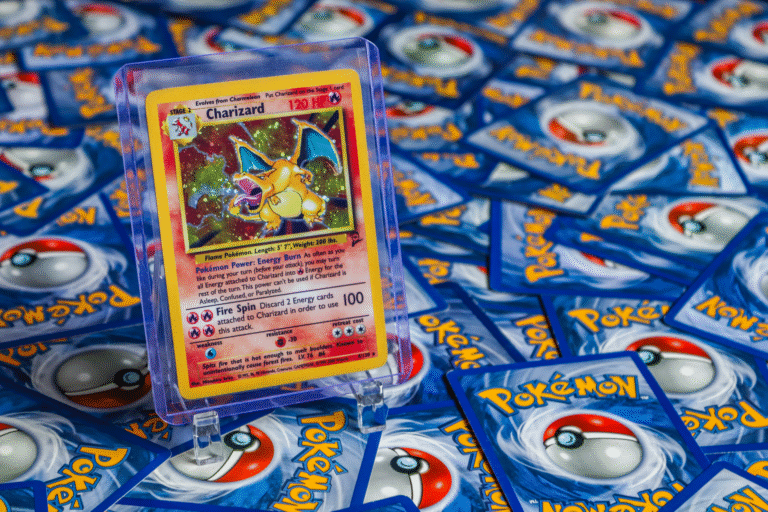
The cards worth watching before the next major price spike in the Base Set market are those with the scarcest high-grade populations combined with strong demand fundamentals—primarily Charizard #4, Blastoise, and Chansey in 1st Edition PSA 10 condition. A shadowless Charizard #4 PSA 10 just sold for $954,800 at Goldin in February 2026, while the same grade in standard 1st Edition examples command $168,000–$170,000, demonstrating how supply scarcity directly translates to exponential price premiums. With Pokemon’s 30th anniversary driving sustained collector interest throughout 2026, the window to accumulate underpriced high-grade copies is narrowing.
The market’s trajectory is already evident in recent months. Machamp experienced a dramatic October 2025 spike after a single buyer accumulated 47 copies in one day, betting on anniversary nostalgia. Gyarados Delta Species jumped from $130 in early March 2026 to several hundred dollars at the low end within weeks. These aren’t random price movements—they signal a market primed for the next wave of appreciation as the Celebration Collection launches in October 2026 and millennial collectors continue returning to their childhood hobby.
Table of Contents
- Which 1st Edition Base Set Cards Offer the Best Value Before Prices Climb Further?
- The Grading Population Effect—Why Fewer High-Grade Copies Equals Exponential Price Growth
- Pokemon’s 30th Anniversary Celebration—The Market Driver Behind 2026’s Sustained Demand
- Entry Points Across Different Budget Levels and Grades
- Separating Sustainable Appreciation from Speculative Spikes
- Using Market Data to Identify Undervalued Cards Before They Spike
- The Outlook Through Q4 2026 and Beyond
- Conclusion
Which 1st Edition Base Set Cards Offer the Best Value Before Prices Climb Further?
The highest-value cards—Charizard, Blastoise, and Chansey—represent the clearest opportunity, but each card tells a different story about scarcity and demand. Charizard #4 1st Edition shadowless PSA 10 commands $350,000–$420,000 in today’s market with annual appreciation of approximately 37.5%, making it the benchmark investment. However, fewer collectors can access half-million-dollar cards. Blastoise 1st Edition PSA 10 has roughly 100 known copies in gem condition, trading in the $88,000–$138,000 range—still substantial but more attainable than Charizard. Chansey, often overlooked, has only 48 known copies graded PSA 10 and recent sales around $55,000, representing exceptional value relative to its rarity.
The key difference: Charizard’s premium rests partially on cultural icon status, while Chansey’s value is purely driven by extreme scarcity. That distinction matters when predicting which card will spike hardest during the anniversary boom. Comparing these three directly reveals why Chansey might be the shrewdest play. All three cards are appreciating at strong rates, but Chansey’s population—just 48 copies in top grade versus Blastoise’s 100 and Charizard’s somewhat higher volume—means any uptick in collector demand hits a harder supply ceiling. Meanwhile, PSA 9 versions of these cards are climbing too, with Charizard PSA 9 examples near $168,000–$170,000. For investors with $50,000–$100,000 to deploy, mid-grade copies of low-population cards like Chansey offer better entry points than chasing Charizard at the peak of its demand cycle.
The Grading Population Effect—Why Fewer High-Grade Copies Equals Exponential Price Growth
The single most important factor determining Base Set card value is the number of copies graded as PSA 10, according to market tracking data. This isn’t subjective—it’s mathematical. Fewer authenticated gem-mint copies of a given card means each individual copy commands a higher price as collectors compete for the same finite inventory. Blastoise’s 100 known PSA 10 copies seem substantial until you consider that millions of Base Set packs were opened in the 1990s.
The ratio of original cards printed to high-grade survivors is extraordinarily low, which explains why even moderately rare cards like Blastoise can command six figures. The risk here is obvious but often overlooked: grading standards and population numbers can shift. If PSA were to unlock a previously hidden cache of unopened Base Set packs, or if grading standards changed, population numbers could spike and individual card values would compress. More pragmatically, grading times and costs have fluctuated significantly over the past two years, meaning some cards may be under-graded in the present market simply because collectors chose not to send them in for authentication. Chansey’s 48-copy population, while impressive in rarity terms, also means any sudden influx of previously ungraded copies could destabilize the price floor.
Pokemon’s 30th Anniversary Celebration—The Market Driver Behind 2026’s Sustained Demand
Pokemon is launching its Celebration Collection worldwide in October 2026, spanning all ten generations and expected to sustain demand through Q4 and beyond. This isn’t a minor product release—it’s the centerpiece of Pokemon’s millennial-focused marketing push, directly targeting the generation that bought Base Set cards in 1999–2001. Every major retailer will stock these products, social media will amplify nostalgia narratives, and casual collectors will re-enter the market. That influx of fresh demand, even if most of it targets sealed products, has a direct spillover effect on secondary market vintage cards.
Machamp’s October 2025 spike is the earliest proof of this trend. The single-buyer incident that accumulated 47 copies suggests some participants have already positioned themselves for the anniversary spike. Whether that was prescient or speculative remains to be seen, but the price gains through early 2026 suggest it was prescient. As October 2026 approaches and Celebration Collection hits shelves, expect compounding demand for iconic cards from the original set. The appreciation window is open now, but it will likely close once media coverage of anniversary nostalgia reaches peak saturation in Q4.

Entry Points Across Different Budget Levels and Grades
Investors should not assume that only PSA 10 cards are worth tracking. The market has created clear value tiers at each grading level. A Charizard #4 1st Edition PSA 9 trades near $168,000–$170,000—roughly 10–13% of the PSA 10 price, but still commanding five figures. For collectors with $10,000–$50,000 to invest, PSA 8 and PSA 9 versions of high-value cards, or PSA 10 copies of lower-population cards like Chansey, deliver better percentage upside than waiting for the perfect PSA 10 Charizard. The tradeoff is surface-level: PSA 8 cards show visible wear and are technically “second-grade,” but they can still appreciate 30–50% through 2026 if 1st Edition vintage base set appreciation projections hold.
The data supports this. Vintage 1st Edition Base Set cards are projected for 30–50% appreciation through the end of 2026, with broader base set (non-first edition) cards experiencing 15–25% gains. That’s a meaningful difference. A $10,000 PSA 8 card becomes $13,000–$15,000 by year-end if those projections materialize. A $50,000 PSA 9 Chansey might reach $65,000–$75,000. The entry point matters because November 2026 forward—after the Celebration Collection hype subsides—is when the market typically consolidates, meaning most appreciation will have already occurred by that point.
Separating Sustainable Appreciation from Speculative Spikes
Machamp’s rise is a cautionary tale about the difference between organic demand and coordinated buying. A 47-copy acquisition by a single buyer clearly isn’t representative of mass-market interest—it’s a speculative bet that enough other collectors will chase the same card to push prices higher. That strategy can work, but it carries obvious risks. Once the speculative buyers exit, cards without fundamental scarcity or collector appeal can drop sharply. Machamp does have some collector cachet as Muk’s foil and a powerful Blastoise combo piece from the TCG competitive era, but it’s not in the same cultural tier as Charizard.
Gyarados Delta Species presents a different case: its explosive growth from $130 to several hundreds of dollars reflects a genuine market shortage rather than coordinated buying. Delta Species cards are legitimately harder to find in high grades, and the card has both TCG viability and collector appeal. That type of appreciation tends to stick because it’s grounded in supply scarcity, not sentiment. When evaluating cards before the next spike, ask whether the scarcity is real (population data will confirm) or manufactured (single large buyer, low trading volume). Real scarcity is what sustains price gains through and beyond the anniversary cycle.

Using Market Data to Identify Undervalued Cards Before They Spike
The cards spiking now—Machamp, Gyarados—were likely undervalued 3–6 months ago. How do you find the next Gyarados before it jumps 200%? Track population reports, watch secondary market volume, and identify cards with extreme population scarcity but weak price positioning. Chansey at $55,000 with only 48 PSA 10 copies might still be one of those cards. So might other HP-heavy trainers or rare holos from the set that lack the brand recognition of Charizard but offer similar scarcity.
Population reports are public data—available through PSA, CGC, and market tracking sites. If a card has fewer than 50 copies in PSA 10, fewer than 150 in PSA 9, and a price well below comparable-rarity cards, it has asymmetric upside. The limitation: finding those diamonds requires consistent market research, not speculation. Many cards with low populations stay low-priced because they lack collector demand, regardless of rarity. Chansey works because it’s still a recognizable, playable card; a low-population bulk trainer might stay cheap forever.
The Outlook Through Q4 2026 and Beyond
The anniversary opportunity is compressed into a specific window. October 2026 marks the peak demand period for Base Set nostalgia, meaning most appreciation will occur from now through Q3. Q4 demand will remain elevated due to holiday gifting and the Celebration Collection launch, but any sharp price movements are likely to have already occurred. Smart accumulation happens in the next 3–4 months, not in October when media attention is at peak and prices have already adjusted upward.
For 2027 and beyond, expect Base Set prices to stabilize at their anniversary-inflated levels rather than collapse. Supply remains finite, grading populations remain fixed, and collector interest in Pokemon is no longer novelty-driven—it’s structural. Millennial buyers are now permanent participants in the market, and younger Gen Z collectors are discovering the hobby as well. That shifts the market from speculative to fundamental, meaning the appreciation you see by October 2026 will likely hold through 2027 and beyond, though the rate of growth will decelerate from today’s double-digit annual percentages to mid-single-digit appreciation.
Conclusion
Charizard #4, Blastoise, and Chansey represent the most important Base Set cards to monitor before the next price spike, with Chansey offering the steepest upside due to its extreme scarcity (48 copies PSA 10) and current undervaluation relative to peers. The 30th anniversary momentum is real—evidenced by Machamp’s October 2025 spike and Gyarados Delta Species’s explosive growth—and will likely sustain demand through Q4 2026. Entry points exist at multiple price tiers, with 1st Edition vintage cards projected for 30–50% appreciation through the end of the year.
Start your accumulation now rather than waiting for October; by then, media coverage will have repriced the most obvious cards. Focus on cards with verified population scarcity (under 50 PSA 10 copies), fundamental demand drivers (cultural relevance or TCG playability), and current market pricing that hasn’t yet adjusted for rarity. The anniversary cycle is the market’s gift to patient collectors—use the next 3–4 months to position before the final rally erases entry points.