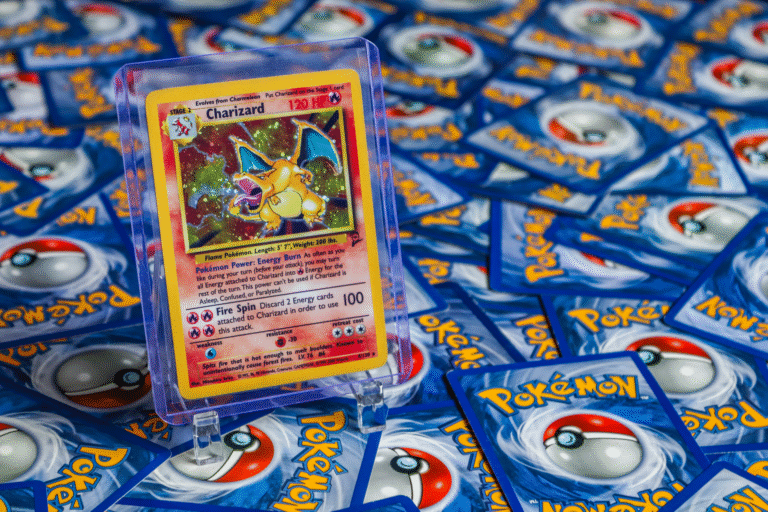
The hidden risk behind modern Pokémon card chase demand in 2026 is that the market has fundamentally corrected from unsustainable pricing driven by production excess and speculative fervor, not by declining collector interest. Cards that commanded premium prices during the 2020-2024 boom—like Prismatic Evolutions Umbreon SIR, which peaked at $1,600 and now trades around $832—have lost 40-50% of their value as the Pokémon Company’s massive production surge created market saturation that will continue depressing modern card prices throughout 2026. The real danger for collectors and investors is not that modern cards are worthless, but that the “get rich quick” era of flipping retail products for 2-3x markup has ended permanently, replaced by a market that rewards patience, selectivity, and understanding the difference between speculative chase cards and genuine long-term collectibles.
This correction caught many collectors off guard because it overlapped with a cascading trust crisis in the grading infrastructure itself. In December 2025, collectors discovered that PSA had secretly changed certification grades from PSA 9 to PSA 10 on identical modern cards without notification—causing secondary-market listings to drop 10-20% on eBay as trust eroded. Simultaneously, PSA’s operational capacity collapsed under the volume of modern cards submitted; the company now maintains a backlog of 10 million cards and temporarily shut down Value grading tiers as of June 2, 2026. For modern collectors chasing investment returns, this period represents a critical reset: prices are moving toward fundamental value rather than hype, and the winners will be those who understand which risks are temporary corrections and which are permanent structural changes.
Table of Contents
- Why Has Modern Pokémon Card Demand Created Such Extreme Price Risk?
- The Grading System Collapse and What It Means for Card Valuations
- The Rise of Grading Competition and the Collapse of PSA’s Price Premium
- The Retail Flip Model Is Dead—What Replaces It for Modern Card Investment?
- Rotated Competitive Cards and the Risk of Format Obsolescence
- Population Explosion and the Elimination of Scarcity Premiums
- The Long-Term Outlook—Is Modern a Buy, or a Trap?
- Conclusion
Why Has Modern Pokémon Card Demand Created Such Extreme Price Risk?
The core culprit is production scale. The Pokémon Company printed 9.7 to 10.2 billion cards in fiscal year 2025 alone—a volume so massive that popular modern chase cards now have excessive population counts that eliminate the scarcity premium collectors once paid. Pikachu ex, for example, has 9,907 graded copies already in circulation. When thousands of identical cards exist in the same grade, the laws of supply and demand collapse the price floor. There is no rarity markup possible when the market is flooded with the exact card you want, in the exact condition you want it, at any given moment.
This is the opposite of vintage collecting, where sealed product scarcity can drive sustained price appreciation of 15-25% annually; modern cards increasingly behave like commodities rather than collectibles. The demand itself remains strong—Pokémon TCG sales continue to grow worldwide—but that demand is being absorbed by the enormous supply. Obsidian Flames Charizard, a modern chase card that seemed like a stable investment, dropped from $126 to $79 in just months. The price collapse was not because collectors stopped wanting Charizard; it was because tens of thousands of new graded copies entered the market each week, and the supply-to-collector-demand ratio became grotesquely unfavorable. For investors who entered modern cards expecting vintage-like appreciation curves, this was a shock. The market is telling collectors that modern cards can appreciate over decades—but not while they’re being printed in billions annually.

The Grading System Collapse and What It Means for Card Valuations
The PSA scandal of December 2025 exposed a critical vulnerability in the infrastructure that modern collectors depend on for valuation. Discovering that a grading company secretly changed numerical certifications without consent isn’t a minor operational error; it’s a fraud allegation that undermines the entire premise of third-party grading. When a card certified as PSA 9 is actually PSA 10, or vice versa, the buyer has no reliable way to trust the market price that supposedly corresponds to that grade. Secondary-market listings dropped 10-20% on eBay as collectors realized they might own cards with inflated or deflated certifications, with modern Pokémon cards seeing the largest declines.
Meanwhile, PSA’s operational crisis—a 10 million card submission backlog and the temporary shutdown of Value grading tiers—has created a two-tiered market where grading speed itself affects investment viability. Modern collectors who submitted cards for grading 6-9 months ago are still waiting for returns while the market moves around them. This delay risk is a hidden cost that flippers never accounted for: you could buy retail product, pay grading fees, and wait half a year for grades to return, only to discover that market conditions have shifted and your card is now worth less than your total investment. The limitation of high-volume grading is that it inevitably sacrifices quality control for speed, and the backlog proves PSA chose volume over accuracy—a choice that has eroded trust in modern card valuations.
The Rise of Grading Competition and the Collapse of PSA’s Price Premium
PSA maintained a massive price premium for modern cards because it was the market leader—collectors accepted paying 25-30% more for a PSA-graded modern card than an equivalent CGC or Beckett card. That premium has collapsed to 5-10% in 2026 as CGC captured 25% market share in 2025, with collectors voluntarily shifting 15% of grading volume to alternative graders Beckett and SGC. This competitive pressure happened precisely when PSA’s reputation was most vulnerable, creating a perfect storm: collectors wanted faster grades, alternative graders offered them, and the December scandal gave collectors permission to stop paying the PSA premium.
The practical effect is that a PSA 10 modern Pokémon card no longer commands the price multiplier it did a year ago. Collectors who invested based on the assumption that PSA grades would maintain their valuation advantage are now holding assets worth 15-25% less than they paid. This is a permanent structural shift, not a temporary dip—the grading landscape has fractured, and PSA’s monopoly on modern card pricing authority is gone. For future investors, this means relying on PSA certification for upside potential is a losing strategy; future gains will come from the fundamentals of the card itself, not from grading company status.

The Retail Flip Model Is Dead—What Replaces It for Modern Card Investment?
The business model that fueled the 2020-2024 price explosion—buying retail booster boxes at MSRP, flipping singles on eBay at 2-3x markup—became unprofitable in 2026. When booster boxes cost $100-120 and the chase cards inside top out at $79-150 after grading and fees, the math no longer works. A Charizard that sold for $200 a year ago now sells for $79; a booster box that yielded $500-700 in pure chase cards now yields $200-300. The leverage is gone.
Modern collectors who want investment returns must now operate like vintage collectors: they need to hold cards for years rather than months, focus on population-rarity tiers (cards with fewer than 100 graded copies in a given grade), and accept that modern cards appreciate based on long-term set completion and vintage nostalgia, not speculative demand. The tradeoff is patience; the benefit is that these holdings are far less likely to suffer the catastrophic 50% corrections we’ve seen in 2026. Collectors chasing modern cards should ask themselves whether they’re investing based on genuine long-term conviction or on habit from the boom years. If it’s the latter, pivot to vintage or sealed product, where scarcity premiums are real.
Rotated Competitive Cards and the Risk of Format Obsolescence
One underappreciated risk for modern investment cards is that competitive format rotation destroys value rapidly. Recently rotated competitive cards often experience sharp price drops as tournament players exit the market and casual collectors see no reason to hold rotating cards. A card that was essential for competitive decks last year becomes legally unplayable the moment rotation happens—a permanent utility death sentence. This affects modern chase cards more severely than vintage because modern competitive cards are often chase cards: full art variants, secret rares, and alternate treatments that players want for their meta decks.
The moment rotation ends that utility, demand evaporates. Collectors who bought Obsidian Flames cards for play or investment should understand that Standard format rotation will eliminate any competitive demand by late 2026 or 2027, and investment returns will depend entirely on casual collection demand. This is a structural limitation of modern cards that vintage doesn’t face—vintage is already outside all competitive formats, so it has no rotation risk. Modern cards do.

Population Explosion and the Elimination of Scarcity Premiums
The flood of graded modern cards is unprecedented. High-volume modern chase cards now have populations exceeding 9,000-10,000 graded copies per card, per grade. This is not scarcity; this is saturation. In vintage collecting, a card with 100 graded copies in PSA 8 is considered rare.
In modern collecting, 10,000 graded copies in a single grade is standard. The psychological impact is that scarcity premiums—the markup buyers pay for cards that are hard to find—have been eliminated by supply. Collectors expecting scarcity-driven appreciation from modern chase cards should adjust expectations downward significantly. A card with 9,907 graded copies will never command the percentage premiums of a vintage card with 50 graded copies, because the supply-to-collector ratio is incomparably different. The era of “buy this card because it’s hard to find” is over for modern cards; they are easy to find, and the price reflects that reality.
The Long-Term Outlook—Is Modern a Buy, or a Trap?
Despite the 2026 correction, the Pokémon card market is projected to grow from USD 52.1 billion in 2026 to USD 90.2 billion by 2034, representing a 7.1% compound annual growth rate. This suggests the current price correction is not a crash or market death, but a structural reset from speculative overvaluation to more sustainable pricing.
For long-term collectors holding 5-10 year horizons, modern cards will likely appreciate from current levels—just not at the explosive rates of 2020-2024. The future of modern card investment is bifurcated: commodity-grade modern cards (common chase variants, high-population cards) will appreciate slowly if at all, while exceptional examples (low-population high-grade copies, vintage-adjacent modern sets like Evolving Skies, promotional cards with genuine scarcity) will be the real wealth creators. The collectors and investors winning in 2026 are those who stopped treating all modern cards as interchangeable and started viewing them like vintage—with selectivity, patience, and skepticism about production volumes.
Conclusion
The hidden risk behind modern Pokémon card chase demand in 2026 is not that the market is dying, but that it has matured from a speculative bubble into a fundamentally sound but slower-growth segment. The 9.7-10.2 billion cards printed in 2025, the PSA grading scandal, the collapse of the retail flip model, and the rise of grading competition have permanently altered the risk-reward profile of modern card investment. Cards that investors expected to appreciate 20-30% annually are now appreciating 5-10%, if at all, with many experiencing 20-50% corrections from 2024 peaks.
For collectors entering the modern market in 2026 and beyond, success requires abandoning the “buy retail, flip quick” mentality and adopting a vintage collector’s mindset: focus on cards with genuine scarcity, hold for years rather than months, accept lower annual returns, and remain skeptical of any modern card claiming investment-grade appreciation. The Pokémon card market will grow to USD 90.2 billion by 2034, but that growth will be driven by sustainable collection demand and vintage scarcity, not by modern card speculation. The risks are real and permanent; the rewards are still there, but only for those who understand which cards will hold value and which will become commodity products in a market saturated with billions of choices.