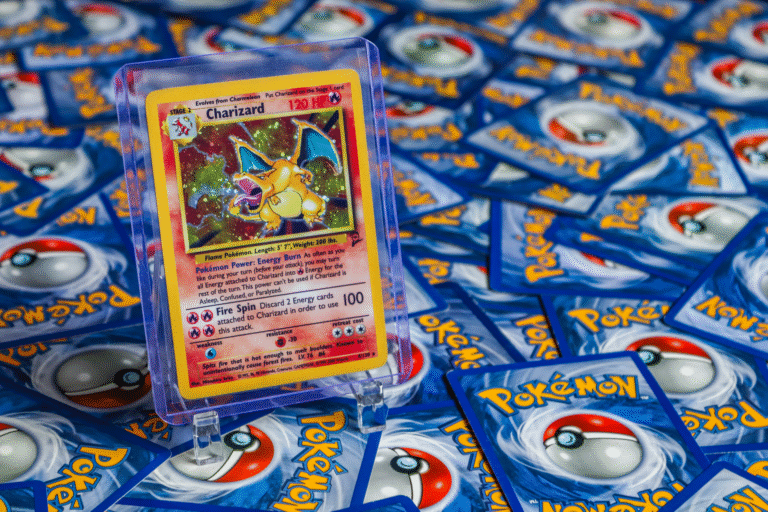
Inflation matters for vintage Pokémon card buyers because these cards have become a tangible asset that protects wealth against currency devaluation—and the numbers prove it. When the value of money decreases due to inflation, investors look for alternative stores of value that either maintain their purchasing power or appreciate faster than inflation erodes it. Vintage Pokémon cards have delivered exactly that hedge, appreciating by 3,800% from 2004 to 2025, vastly outpacing inflation rates throughout that period and making them a more attractive inflation hedge than traditional investments.
For example, a 1st Edition Base Set Charizard PSA 10 sold for $550,000 in December 2025—a record-breaking price that reflects not only the card’s rarity but also the purchasing power of serious collectors who view such assets as inflation-resistant stores of value. Beyond raw price appreciation, inflation directly influences the Pokémon card market in multiple ways: it affects production costs, shifts investor behavior toward collectibles, determines which collectors can afford entry into the market, and ultimately impacts which cards retain value over time. Understanding this relationship is essential whether you’re a casual collector looking to protect your hobby from inflation’s erosion or an investor evaluating Pokémon cards as a portfolio hedge.
Table of Contents
- How Inflation Drives Collectors Toward Vintage Pokémon Cards
- Appreciating Faster Than Inflation: The Real Numbers
- Record Sales and Market Signals in 2026
- Scarcity: Why Vintage Pokémon Cards Outpace Inflation
- Market Maturation and the New Collector Reality
- Production Costs, Supply Chains, and Inflation’s Impact on the Future
- Looking Forward: Inflation and Pokémon Card Values Through 2026 and Beyond
- Conclusion
How Inflation Drives Collectors Toward Vintage Pokémon Cards
inflation pushes investors toward alternative assets like collectible Pokémon cards as a hedge against currency devaluation and inflation, particularly when traditional savings accounts and bonds offer returns below inflation rates. When people lose confidence in the purchasing power of their cash, they seek tangible assets with limited supply—exactly what vintage Pokémon cards provide. A 1st Edition Base Set Charizard isn’t just a card; it’s a physical asset with fixed scarcity (there will never be more 1st Edition Base Set Charizards produced) that can’t be devalued by monetary policy decisions.
The PWCC Top 500 Index for Pokémon cards delivered a 10-year ROI that was 94% higher than the S&P 500, demonstrating that Pokémon cards have consistently outpaced both inflation and traditional stock market returns. This performance advantage becomes especially pronounced during periods of high inflation, when fixed-income investments lose value and stocks become volatile. The comparison illustrates a critical point: while most investors chase standard market returns, those who allocated capital to high-end vintage Pokémon cards received dramatically superior inflation-adjusted returns.

Appreciating Faster Than Inflation: The Real Numbers
Vintage cards are currently showing 30-50% year-over-year price increases as Pokémon celebrates its 30th anniversary, a growth rate that far exceeds typical inflation rates of 2-4% annually. Even more stable vintage cards—like PSA 10 graded examples—are appreciating at 5-10% annually in the mature market, still substantially outpacing inflation and providing genuine wealth preservation. For practical context, inflation in the U.S. averaged around 8% in 2022 and has moderated to roughly 3-4% in 2025-2026, meaning that vintage Pokémon cards have either matched or far exceeded inflation during periods of economic stress and continue to appreciate during normal economic conditions.
However, this appreciation story contains an important caveat: not all Pokémon cards appreciate equally. Lower-grade examples or common cards from later print runs may appreciate only modestly, and some could even lose value if the collector market cools. A Charizard PSA 9 sold for approximately $50,000, compared to $550,000 for a PSA 10 of the same card—a massive $500,000 gap that demonstrates how scarcity and condition compound value. The ceiling for appreciation exists, and reaching it requires owning genuinely rare, high-condition cards, not just any vintage Pokémon card.
Record Sales and Market Signals in 2026
The Pokémon card market has produced several record-breaking sales in recent months that signal strong collector demand despite inflationary economic conditions. The 1st Edition Base Set Charizard PSA 10 sold for $550,000 in December 2025, setting a new Heritage Auctions record and demonstrating that elite cards command prices that reflect their inflation-hedging properties. Similarly, a Gem Mint Blastoise sold for approximately $88,000 in July 2025, and these headline sales often lag behind what serious collectors are willing to pay in private transactions.
These prices reveal a bifurcated market where the rarest, highest-condition vintage cards are appreciating as genuine collectibles and inflation hedges, while the broader market has matured beyond the speculation bubble of 2020-2021. Buyers of $550,000 Charizards aren’t speculators betting on quick flips; they’re serious collectors and institutional investors who evaluate cards as long-term inflation-protected assets. The sustained high prices amid inflation concerns suggest the market is pricing in legitimate scarcity value rather than temporary hype.

Scarcity: Why Vintage Pokémon Cards Outpace Inflation
The extreme scarcity of high-grade vintage cards ensures they appreciate faster than inflation because supply is genuinely fixed. Only 121 PSA 10 grades exist out of 2,300+ submissions of 1st Edition Base Set Charizard—that’s roughly a 5% success rate, meaning 95% of submitted Charizards grade below a 10. This mathematical scarcity creates a permanent supply constraint that no printing, reproduction, or market correction can overcome. While inflation erodes the value of money, it cannot create additional 1st Edition Base Set Charizards in pristine condition, making these cards inherently superior inflation hedges compared to commodities or currencies.
Contrast this with common vintage cards, which exist in large quantities and may appreciate only modestly above inflation rates, if at all. The scarcity premium—the additional value a card commands purely because it’s extremely rare—is what drives cards like Charizard from a price of $50,000 (PSA 9) to $550,000 (PSA 10). This spread exists because scarcity matters more than inflation when determining value. A card that exists in only 121 graded copies has fundamentally different inflation dynamics than a card that exists in thousands of copies, even if both are vintage and collectible.
Market Maturation and the New Collector Reality
The vintage Pokémon card market has matured significantly since the 2020-2021 speculation bubble, with genuine collectors (not speculators) now driving prices based on scarcity and condition rather than hype. This maturation is actually positive for inflation protection because it means current prices reflect real value rather than unsustainable speculation. Collectors buying today are making long-term decisions, which creates more stable prices and more predictable appreciation curves. The market is pricing in the reality that these cards are inflation-resistant assets, not lottery tickets.
However, maturation also means the era of easy 100%+ annual returns has ended for most cards. Projected appreciation for 1st Edition cards through 2026 sits at 30-50% annually—strong by most standards but lower than the explosive growth of 2020-2022. Buyers entering the market today should expect more modest returns than early adopters enjoyed, meaning the inflation-hedging case for Pokémon cards rests on long-term appreciation (5-10 years or more) rather than quick profits. This shift from speculation to fundamental value makes Pokémon cards more reliable inflation hedges but less attractive for traders seeking rapid returns.

Production Costs, Supply Chains, and Inflation’s Impact on the Future
Japan’s rising inflation has increased production costs for Pokémon cards from printing to distribution, with higher consumer prices potentially deterring some buyers and affecting supply dynamics. When The Pokémon Company faces higher costs to produce cards—due to paper prices, labor costs, transportation, and energy expenses—those costs eventually get passed to retailers and consumers. This creates an interesting paradox: inflation that drives costs up for new card production simultaneously increases the scarcity value of vintage cards that exist in fixed quantities.
As new cards become more expensive to produce, vintage cards that were produced in a different economic era become relatively more valuable. The production cost reality also means that new card releases may experience different adoption patterns, potentially shifting collector interest back toward vintage cards as a more stable asset. If modern booster boxes become prohibitively expensive for casual collectors due to inflation in Japan, the relative appeal of vintage cards—which are already produced and priced into the market—increases. This supply-side pressure on modern production could inadvertently strengthen the inflation-hedging case for vintage cards over the next 3-5 years.
Looking Forward: Inflation and Pokémon Card Values Through 2026 and Beyond
As economies continue managing inflation and interest rates remain elevated, Pokémon cards are positioned to remain attractive inflation hedges for collectors who focus on genuinely scarce, high-condition examples. The 30th anniversary celebration driving current 30-50% year-over-year appreciation may moderate as the novelty period ends, but sustained 5-10% annual appreciation for vintage PSA 10 cards would provide real inflation protection and align with the long-term fundamentals of scarcity and collector demand. The market has shifted from speculation toward sustainable value, which means the best inflation hedge is a high-grade vintage card that will hold its value regardless of economic conditions.
The key insight for collectors going forward is that inflation protection comes from owning the right Pokémon cards—elite, rare, high-condition examples—not from simply owning any vintage cards and hoping for appreciation. The next five years will likely see further maturation and normalization of the market, with prices settling into patterns driven by genuine scarcity and collector demand rather than broader economic cycles. This maturity is actually good news for inflation hedging because it means Pokémon cards are transitioning from a speculative asset to a genuine store of value.
Conclusion
Inflation matters for vintage Pokémon card buyers because these assets provide both practical wealth protection and genuine appreciation that consistently outpaces inflation rates. The 3,800% appreciation from 2004 to 2025, the 94% outperformance against the S&P 500, and the sustained record-breaking sales in 2025-2026 all demonstrate that properly selected vintage Pokémon cards function as legitimate inflation hedges. For collectors and investors evaluating whether to allocate capital to this market, the evidence suggests that genuine scarcity (measured by grading frequencies like the 121 PSA 10 Charizards) and condition create value that inflation cannot erode.
Moving forward, success in the Pokémon card market as an inflation hedge depends on focusing on the rarest, highest-condition cards rather than speculating on broad market appreciation. The maturing market offers more stable, predictable returns than the boom years of 2020-2022, but that stability is precisely what makes these cards reliable stores of value during inflationary periods. For those looking to protect wealth and build a collection of lasting value, vintage Pokémon cards represent one of the most proven inflation-resistant asset classes available to collectors today.