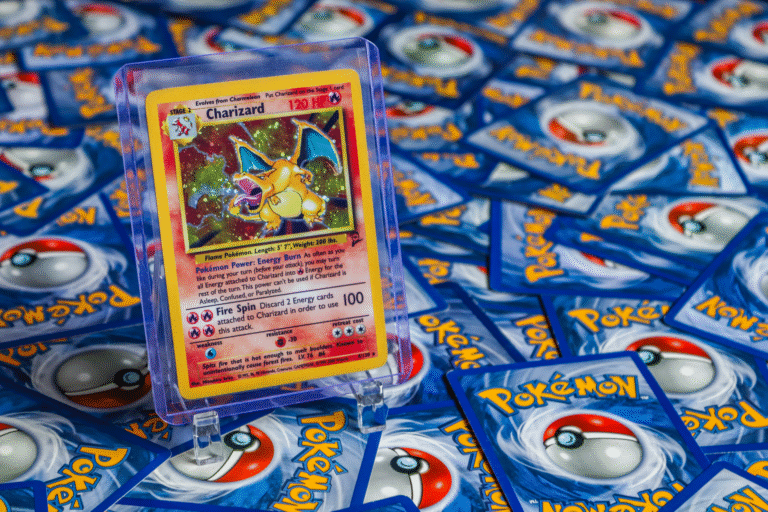
Ungraded holographic Pokemon cards from vintage Japanese sets are actively circulating in the collector market, offering an alternative to the professional grading route that has dominated serious collecting for the past decade. These cards—holograms from sets like the Japanese Base Set, Jungle, and Fossil released in the mid-1990s—come without third-party authentication, meaning their value and condition rest entirely on the buyer’s own assessment. A mint condition Japanese Base Set Charizard holo, for instance, might sell for a fraction of its graded equivalent, but that discount reflects not just the lack of a grade but also the absence of protected condition documentation.
The availability of ungraded vintage Japanese holos has grown as the grading backlog eased and market dynamics shifted. Sellers who prefer not to wait for or pay the fees associated with professional grading services have continued to move inventory through direct sales, auction platforms, and collector forums. For buyers, this creates an opportunity to acquire desirable cards at potentially lower price points, though it also demands more knowledge about card condition, authenticity verification, and realistic valuation.
Table of Contents
- What Makes Vintage Japanese Holographic Cards Different from Their Graded Counterparts?
- Evaluating Condition Without a Grade: The Practical Challenge
- Why Collectors Still Pursue Ungraded Vintage Japanese Holos
- Strategies for Buying Ungraded Cards Without Getting Burned
- The Authenticity Question and Hidden Risks
- Storage and Long-Term Preservation of Ungraded Cards
- Notable Japanese Sets and Realistic Expectations
- Frequently Asked Questions
What Makes Vintage Japanese Holographic Cards Different from Their Graded Counterparts?
Ungraded cards lack the third-party authentication and condition assessment that come with services like PSA, BGS, or CGC. This means there’s no independent confirmation of the card’s grade or authenticity, no protective slab, and no market-standardized reference point for pricing. A seller can claim a card is near-mint, but without grading documentation, a buyer must rely on photographs, seller reputation, and personal evaluation. This uncertainty is precisely why ungraded versions of the same card typically trade at discounts ranging from 20 to 50 percent compared to graded examples.
The japanese market and English market also diverge significantly in how grading and card conditions are perceived. Japanese cards from the 1990s often display different wear patterns, printing characteristics, and centering issues than their English counterparts, and they’re judged by somewhat different standards even within grading companies. A Japanese Base Set holo that shows light wear might still have excellent eye appeal, but an English card with identical wear might be perceived as lower grade. Ungraded Japanese cards require collectors to understand these nuances rather than defaulting to a numerical grade.
Evaluating Condition Without a Grade: The Practical Challenge
Without a grade, condition assessment becomes subjective and relies on the buyer’s ability to interpret photographs, ask detailed questions, and understand what “light play” or “mint condition” actually means. A card described as near-mint by one seller might be considered lightly played by another. This is where ungraded cards present a genuine risk: there’s no recourse with most sellers if you receive a card in different condition than expected, and return policies vary widely. Understanding the specific wear patterns to look for—edge wear, corner creasing, surface scratching, and centering—becomes essential before purchasing.
The practical limitation here is that photography quality directly impacts your ability to assess condition. A high-resolution photograph under consistent lighting will reveal far more than a blurry snapshot or a photo taken under flash. Asking sellers for multiple close-up images of corners, edges, and the holo surface itself is standard practice among serious collectors evaluating ungraded cards. Even then, some conditions are difficult to detect without holding the card in person. Japanese cards with particularly reflective or textured holo patterns can be especially tricky to photograph accurately.
Why Collectors Still Pursue Ungraded Vintage Japanese Holos
For budget-conscious collectors, ungraded vintage Japanese holos offer genuine value. You can complete a Japanese Base Set holo collection for substantially less than the cost of graded equivalents, assuming you’re comfortable with some variation in card condition across the set. Collectors who prioritize ownership and display over investment certification often find ungraded cards more practical.
A collector who simply wants to own a vintage holo Venusaur doesn’t necessarily need a $500 graded version when an ungraded copy in good condition costs a third of that. Some collectors also view ungraded cards as a way to avoid overpaying for grading premiums. The cost of grading itself—typically $15 to $50 per card depending on the service and turnaround time—can represent a significant percentage of a card’s total value if the card isn’t exceptionally rare or sought-after. For mid-range vintage holos, the grading fee might exceed the actual difference in market value between graded and ungraded versions, making the grading economically inefficient.
Strategies for Buying Ungraded Cards Without Getting Burned
Start by establishing a reliable baseline for pricing by checking sold listings on major platforms rather than asking prices. Sold listings show what collectors actually paid, not what sellers hope to receive. Cross-reference prices across multiple sources—auction sites, forums, Facebook groups, and collector networks—to build a sense of typical market value for the specific card in your target condition range. A Japanese Base Set holo Blastoise in light-play condition should have a reasonably consistent price range across these venues.
Buy from sellers with verifiable history and positive feedback whenever possible, and don’t hesitate to ask detailed questions before committing. Request photos of specific areas: front and back holo, corners, edges, and any spots that concern you. Some sellers are defensive about requests for additional information, which can itself be a warning sign. A legitimate seller with ungraded inventory understands that buyers need confidence and will accommodate reasonable requests. The trade-off is that this level of due diligence takes more time than simply purchasing a graded card with an assigned grade number.
The Authenticity Question and Hidden Risks
Counterfeit vintage Pokemon cards exist, though counterfeits of high-value Japanese holos remain relatively uncommon compared to fake modern cards. Without grading company authentication, you rely on print quality analysis, materials inspection, and knowledge of what genuine 1990s Japanese cards look and feel like. Slight variations in card stock, holo pattern depth, and text printing can indicate counterfeits, but these require either personal experience or reference materials to identify reliably. This is a genuine limitation of buying ungraded: if you lack expertise or don’t establish a relationship with a trusted seller, there’s a meaningful risk of acquiring a fake.
Another risk specific to ungraded cards is hidden damage that isn’t visible in photographs. Water damage, staining, or odor issues might not show clearly in images, and ungraded cards occasionally come from storage conditions that have affected their integrity in ways that aren’t immediately apparent. A card might look excellent in photos but have a musty smell or light staining that affects its long-term preservation. This is why personal inspection before purchase, when possible, or buying from sellers who offer detailed damage descriptions and return policies is important.
Storage and Long-Term Preservation of Ungraded Cards
Ungraded vintage cards lack the protective slabbing that graded cards receive, meaning they’re more vulnerable to environmental damage during storage and display. Proper storage requires acid-free sleeves, top-loaders or storage boxes, and climate control to prevent deterioration. A high-humidity environment can warp cards or promote fungal growth; excessive dryness can make cards brittle.
For collectors planning to keep ungraded vintage holos long-term, investing in proper storage materials and a climate-controlled storage space is more important than it would be for slabbed cards. The cost-benefit analysis here matters: if you’re saving money by buying ungraded cards at 30 to 50 percent discount compared to graded versions, investing $50 to $100 in proper storage materials and climate monitoring is still economically rational. However, this ongoing responsibility for preservation falls entirely on the owner rather than being delegated to a grading company that’s essentially maintaining the card’s condition in perpetuity through slabbing.
Notable Japanese Sets and Realistic Expectations
The Japanese Base Set, released in 1996, contains some of the most sought-after holos in all of Pokemon collecting—Charizard, Blastoise, and Venusaur chief among them. Ungraded versions of these cards command premium prices even without certification, with condition and availability being the primary pricing drivers. Japanese Jungle and Fossil sets are generally less expensive but still valuable, particularly first-edition printings.
Understanding which sets and which specific cards hold value is important because not all Japanese vintage holos are equally desirable; a common holo from Gym Heroes in perfect condition might not hold significant value compared to a played copy of a Base Set rare. First-edition Japanese printings typically carry higher premiums than unlimited printings, and this difference persists regardless of grading status. An ungraded Japanese Base Set First Edition holo will likely cost more than an unlimited version of the same card in identical condition. The print line visible on the bottom of first-edition cards is your key identifier when examining ungraded copies, and confirming this before purchase is essential for pricing accuracy.
Frequently Asked Questions
Are ungraded Japanese holographic Pokemon cards worth collecting?
Yes, particularly for collectors prioritizing affordability, set completion, or display over investment certification. The value depends on your goals: if you want to own the cards, ungraded versions make financial sense. If you’re primarily investing for resale, graded cards provide price documentation and market standardization.
How much less do ungraded cards typically cost compared to graded versions?
Ungraded cards generally sell for 20 to 50 percent less than their graded equivalents, depending on the specific card, grade level, and market conditions. The exact discount varies by rarity and demand.
How can I verify authenticity of an ungraded vintage Japanese card?
Examine the card’s print quality, holo pattern depth and consistency, card stock feel and weight, and text printing against reference images of known authentic examples. Buying from established sellers with positive feedback and requesting detailed photographs reduces counterfeiting risk.
What’s the best way to protect an ungraded vintage Japanese holo I’ve purchased?
Use acid-free sleeves, protect it in a top-loader or storage box, store it in a climate-controlled environment with stable humidity (around 45 to 55 percent), and keep it away from direct sunlight. Proper storage is more important for ungraded cards since they lack the protection of a grading slab.
Should I eventually grade an ungraded card I own?
That depends on the card’s potential grade and current market value. Grading costs money and takes time, so only pursue grading if the expected value increase justifies the expense. For common holos or lower grades, grading may not be economically worthwhile.
Which Japanese Pokemon sets should I focus on as an ungraded collector?
Base Set is the most sought-after and holds value well. Jungle and Fossil are solid secondary options. First-edition printings command higher prices across all sets. Gym series and later sets generally have lower demand for ungraded versions unless they’re specific rare hits.