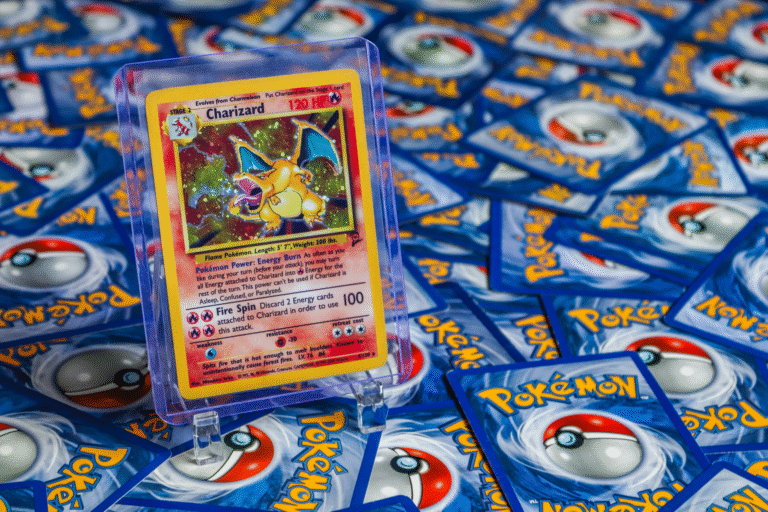
The discovery of a valuable Charizard Pokemon card inside a baseball player’s All-Star glove represents one of the more unusual convergences between two seemingly unrelated collectible worlds. While specific details about such a find have circulated in collecting communities, the scenario highlights an important reality: rare and valuable Pokemon cards can surface in unexpected places, sometimes tucked away in personal items for years without the owner realizing their worth.
A first edition Charizard card from the 1999 Base Set, depending on condition and certification, can be worth thousands of dollars to the right collector. Finding a high-value card in plain sight creates a particular kind of fortune—one that typically requires authentication, professional grading, and careful handling before any transaction can proceed. The intersection of sports memorabilia and Pokemon collectibles has become increasingly legitimate over the past decade, as both markets have matured and attracted serious collectors willing to pay premium prices for verified items in excellent condition.
Table of Contents
- How Rare Charizard Cards End Up in Unexpected Places
- Authentication and Grading: The Critical Step Before Value Is Realized
- Why the Charizard Commands Premium Prices
- Determining Card Condition and Quality
- Market Liquidity and Selling Challenges
- The Unexpected Value Intersection of Sports and Pokemon Collecting
- Preservation and Storage After Discovery
- Frequently Asked Questions
How Rare Charizard Cards End Up in Unexpected Places
Valuable pokemon cards often spend decades hidden in collections, attics, and personal items because their current owners may not recognize them as valuable. A card casually inserted into a glove, wallet, or scrapbook in 1999 or 2000—during the height of the original Pokemon trading card game craze—would have seemed commonplace at the time. The original Base Set run had millions of cards printed, yet production quality varied significantly, and most cards were played with rather than preserved, resulting in damage that dramatically reduced value.
The 1999 Charizard card from the Base Set has become legendary in the collecting world, though fewer Charizard cards exist in mint condition than in played or damaged condition. A card that has been stored in a glove for twenty years or more has likely been protected from the worst forms of damage—direct sunlight, moisture, and bending—that typically destroy cards kept in less ideal environments. This protection, combined with the low likelihood of the glove’s contents being disturbed, could theoretically result in a card in exceptional condition.
Authentication and Grading: The Critical Step Before Value Is Realized
Any claim of owning a valuable charizard card requires professional authentication and grading before it holds real value in the collecting market. Third-party grading services like PSA (Professional Sports Authenticator), BGS (Beckett Grading Services), and CGC Cards examine cards for authenticity, detect counterfeits, and assign grades based on condition on a scale from 1-10. Without this certification, even a card in objectively excellent condition has no verifiable value to serious collectors and is impossible to sell at premium prices.
Counterfeit Pokemon cards, particularly for the highly sought Charizard, are a significant problem in the collecting world. Reproductions range from obvious fakes to sophisticated counterfeits that can fool casual buyers. A card discovered in an old glove still requires submission to a grading service, a process that takes weeks to months and costs money upfront, with no guarantee the card will grade as high as hoped. If a Charizard card grades as a 6 or 7 instead of a 9 or 10, its value drops considerably—sometimes by thousands of dollars depending on the specific card’s market history.
Why the Charizard Commands Premium Prices
The Charizard card occupies a unique place in Pokemon trading card history for several reasons. First, it was featured on one of the most recognizable base set covers and represents the final evolution of one of the franchise’s most popular starter Pokemon. Second, production variations between early printings create tiers of value; cards from the very first print run command prices several times higher than later reprints.
Third, demand from both Pokemon fans and broader trading card collectors has remained remarkably consistent for over two decades. A mint condition Charizard card certified by a major grading service can sell at auction for significant five-figure or even six-figure amounts, though the highest prices are typically reserved for the rarest variations—shadowless printings, certain holo patterns, or first editions with pristine surfaces. More common versions in excellent condition still command prices in the thousands. This price structure creates an incentive for people to search through their childhood collections, which occasionally surfaces legitimate high-value cards that had been sitting in boxes, drawers, or, as this story suggests, inside sports equipment for years.
Determining Card Condition and Quality
Assessing whether a discovered card is actually worth professional grading requires understanding what graders look for. Key factors include surface wear (scratches on the holographic layer), corner and edge damage, centering (whether the image is properly centered on the card), and print defects. A card retrieved from a glove might have handled stress marks, crease lines, or surface damage that significantly impacts its grade, even if it was never played with actively. Decades of storage pressure, changes in humidity, or even the material of the glove itself can impart subtle damage invisible to casual inspection.
The difference between a card graded 8 (Very Fine-Mint) and a 9 (Mint) can represent a difference of 50-75% in market value for a Charizard. This makes condition assessment critically important before deciding to invest in professional grading services. Many collectors use LED light sources and magnification to inspect cards for holo wear, ink spots, or alignment issues before sending them in. However, grading services may catch defects not visible to untrained eyes, which is why their assessment is necessary for any serious sale.
Market Liquidity and Selling Challenges
Owning a valuable graded card does not automatically mean a quick or easy sale at the card’s listed price. The Pokemon card market has experienced significant volatility, with prices for high-end cards fluctuating based on collector interest, broader trading card trends, and economic conditions affecting discretionary spending. A Charizard card worth $10,000 in 2021 might have listed values of $6,000-8,000 in 2023-2024 as the market cooled from its pandemic peak, though rare variations and exceptional grades maintain stronger value.
Selling a high-value graded card requires either finding a direct buyer (which can take months or years), using specialized online marketplaces that charge significant fees, or working with dealers who offer below-market prices in exchange for quick liquidity. Authentication concerns persist even with professional grading; some sellers encounter resistance from cautious buyers who distrust grading services or suspect counterfeiting. A card worth $5,000-10,000 requires payment through secure methods (escrow, PayPal Goods and Services with buyer protection), which further complicates transactions and extends timelines.
The Unexpected Value Intersection of Sports and Pokemon Collecting
The convergence of a baseball player’s All-Star glove and a Pokemon card collectible reflects how the value of items has expanded beyond their intended purpose. Sports memorabilia has traditionally centered on equipment used by professional athletes, but the addition of non-sports collectibles—found within, stored near, or historically connected to athletic gear—creates a hybrid category that appeals to multiple collector bases simultaneously. A glove that was actually used by an All-Star player carries its own value to sports memorabilia collectors; if it contains a documented valuable Pokemon card, both audiences become interested.
This intersection has created opportunities for casual discoveries to become significant finds. Collectors searching through estate sales or inherited items may find themselves sitting on combined value they never expected. A $500 vintage glove becomes a $5,500 find if it contains an authenticated valuable card, but only if the discoverer recognizes the card’s potential and takes appropriate steps to verify and preserve it.
Preservation and Storage After Discovery
Once a valuable card is found and before it can be graded, proper handling becomes critical. Cards should be stored in archival-quality sleeves and hard cases, protected from direct sunlight, heat, and humidity fluctuations. Even brief exposure to a damp environment or careless handling can degrade a card’s grade by an entire point or more.
The time between discovery and professional grading represents a window where the card’s condition could be compromised, which is why collectors recommend moving valuable finds into proper storage immediately. Understanding the specific storage conditions that preserved the card inside a glove for years—whether it was protected by the leather’s barrier properties, stored in a climate-controlled environment, or exposed to temperature swings—provides context for what condition the card might be in. A card that survived decades in a cool, dry closet inside a glove has a much higher chance of being in exceptional condition than one that was stored in an attic or garage where temperature and humidity fluctuate seasonally.
Frequently Asked Questions
How can I tell if a Charizard card in my collection is from the first printing?
First edition cards carry a “1st Edition” stamp on the left side of the card below the card name. Cards without this stamp are unlimited printings, which typically sell for significantly less. Shadowless cards, which lack a shadow around the border, are even rarer.
What’s the cost of professional grading, and how long does it take?
Grading services charge between $20-$300+ per card depending on the declared value and turnaround speed. Standard grading takes 4-8 weeks; expedited services can reduce this to 1-2 weeks but at a premium. The cost is worth the investment for cards potentially worth thousands of dollars.
How do I know if my Charizard card is a counterfeit?
Examine the card stock weight and thickness, the quality of the print dot pattern under magnification, and the authenticity of the holographic layer. Compare your card to verified examples online. Professional graders reject counterfeits and can provide authentication, which is the most reliable way to confirm legitimacy.
Could a card stored in a baseball glove for decades actually be in mint condition?
Yes, it’s possible if the glove was stored in stable conditions without exposure to direct sunlight, extreme heat, or humidity. However, storage pressure, material contact from the leather, and normal aging can still cause subtle damage that impacts grading.
Should I clean a card I’ve found before grading it?
No. Professional graders examine cards as found; attempting to clean can damage the card’s surface or holographic layer. Submit the card in its discovered condition.
What’s the typical price range for a graded first edition Charizard?
Prices vary dramatically by grade and print variation. High-grade first editions (9-10) regularly sell for $5,000 to $50,000+, while lower grades (6-7) typically range from $1,000-$3,000. Shadowless and misprint variations command higher prices.