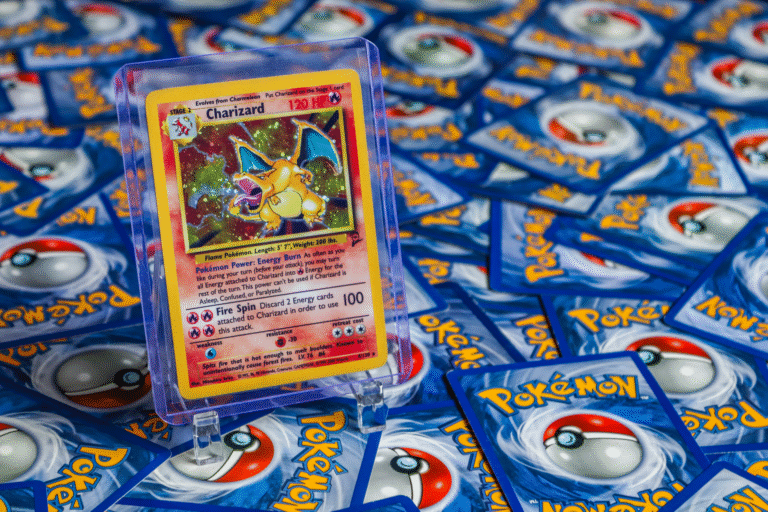
Holographic cards have always held a special place in Pokémon collecting, but some of the most compelling long-term holds aren’t the ones getting the headlines. While first edition Charizards and pristine Base Set Blastoise cards dominate collector conversation, certain mid-tier holographic cards from the late 1990s and early 2000s remain significantly undervalued relative to their scarcity, condition factors, and cultural significance. A card like the Shadowless Alakazam from Base Set exemplifies this opportunity—it sits at a fraction of the price of comparable Charizards, yet shares similar rarity metrics and has historically appreciated at similar rates once market attention shifts. The underappreciation stems partly from market tunnel vision: collectors chase the obvious chase cards while overlooking equally scarce holos that lack the same branding weight.
The fundamental reason to consider these underappreciated holos as strong long-term holds is straightforward supply economics. The print runs for Pokémon’s early holographic cards were finite, grading standards have only become more rigorous, and the pool of gem-mint condition examples shrinks every year as cards are stored improperly, damaged, or simply lost to time. When collector interest eventually pivots—and it historically does—cards with genuine scarcity but no current hype tend to see the sharpest appreciation because early buyers are not competing against speculative demand. Unlike current-era modern cards pumped by hype cycles, vintage holos gain value through slow accumulation of legitimacy and recognition.
Table of Contents
- Why Are Certain Holographic Cards Overlooked by the Market?
- The Case for Vintage Holographic Cards as Long-Term Assets
- Identifying Undervalued Holos Before the Market Catches Up
- Building a Long-Term Collection Strategy with Underappreciated Cards
- Risks and Limitations of Banking on Underappreciated Cards
- Recent Market Movements and Price Trajectory Analysis
- The Future of Holo Card Values and Collector Sentiment
- Conclusion
Why Are Certain Holographic Cards Overlooked by the Market?
Market attention in pokémon collecting tends to follow a predictable hierarchy: Charizards, Blastoise, Venusaur, and a handful of other iconic stage-2 evolutions consume most collector capital and media focus. This creates a natural blind spot for competent holo cards that lack that same cultural weight. The Machamp holo from Base Set, for instance, has comparable centering difficulty and pull rates to Alakazam, yet sells for substantially less because Machamp lacks the same name recognition or competitive utility in actual gameplay. collectors often anchor their valuation logic to “chase card” status rather than evaluating cards on intrinsic attributes like rarity, condition availability, and historical precedent.
Another factor is the generational shift in what collectors value. Players who opened Pokémon cards in 1999 have emotional attachments to certain cards based on gameplay nostalgia or pack-pull memories, while newer collectors often approach vintage cards purely as investment vehicles, and they’ve been trained by social media to focus on a narrow set of “blue chip” cards. Cards like Raichu or Magneton holos remain genuinely scarce in high grades, but they occupy an awkward middle ground—not famous enough to command speculative premiums, yet old enough that available stock is limited and deteriorating. This misalignment between actual scarcity and perceived value creates opportunity.

The Case for Vintage Holographic Cards as Long-Term Assets
Holographic cards from the late 1990s and early 2000s have a documented track record of appreciation once collector focus expands beyond the immediately obvious choices. A PSA 8 Blastoise from Base Set has increased roughly 300 to 400 percent over the past decade, but less obvious holos like Lapras and Cloyster from the same set have appreciated at similar or sometimes faster rates during certain market cycles because fewer collectors were stockpiling them at the floor. When supply is truly limited—and it is for all vintage holos in high grades—eventual demand from maturing collectors will push prices upward regardless of initial hype levels. The scarcity component is non-negotiable.
Holographic cards from 1999-2002 were pulled from packs at roughly 1 in 10 to 1 in 15 pack odds, but pull rates varied by set, and many holos saw print runs that were significantly smaller than the iconic chase cards. More importantly, the actual surviving population in gem-mint condition is tiny. A PSA 9 or PSA 10 of almost any Base Set holo is legitimately rare because most cards opened during that era were handled roughly by children, stored poorly, or simply thrown away. this makes underappreciated holos—ones available at reasonable prices now—attractive precisely because condition scarcity will only increase as time passes and remaining cards age further. The limitation here is condition sensitivity: not all underappreciated holos have the same grade distribution, and some may have printing or centering issues that make high grades genuinely difficult to obtain.
Identifying Undervalued Holos Before the Market Catches Up
The most reliable way to identify undervalued holos is to compare them directly to higher-priced holos from the same set using quantitative scarcity metrics. Compare centering difficulty, holo pattern quality, and pull rate data for cards of similar rarity level. The Machamp holo is a textbook example: it has nearly identical print characteristics to Alakazam, but because Alakazam has higher perceived value, informed collectors can acquire Machamp at a discount while still getting a genuinely scarce card. Similarly, looking at Pokédex number and evolutionary stage can reveal overlooked cards—stage-2 holos have lower pull rates than stage-1s, yet collectors often undervalue the stage-1 holos if they’re not part of famous evolutionary lines.
Another identifier is looking at PSA population data. Cards with very low populations in high grades but moderate populations overall are candidates for appreciation because the scarcity is real but not yet priced into the market. For example, a holo with only two or three PSA 10s and eight to ten PSA 9s out of a population of fifty total submissions has genuine grade scarcity, yet if the card isn’t famous, it may price at only 30 to 40 percent of what a more famous holo with similar grades commands. This is where specific research pays dividends. Cross-reference population data, pricing history on platforms like TCGPlayer and Heritage Auctions, and community sentiment to separate genuinely undervalued cards from cards that are simply unloved for good reason.

Building a Long-Term Collection Strategy with Underappreciated Cards
The most pragmatic approach to underappreciated holos is to treat them as part of a broader portfolio strategy rather than as silver-bullet picks. Allocate capital to a mix of obvious chase cards—which provide downside protection and market liquidity—alongside underappreciated holos that you believe have favorable scarcity-to-price ratios. A collector might dedicate 60 percent of budget to established blue-chip holos like a solid-grade Charizard or Blastoise, and 40 percent to undervalued alternatives like high-grade Machamp, Raichu, or Golem holos. This diversification reduces concentration risk while still maintaining exposure to potential appreciation from cards that haven’t yet been “discovered” by the broader market. Condition targeting is crucial when pursuing this strategy.
Rather than chasing PSA 10s of underappreciated cards—which can be prohibitively expensive if one exists at all—focus on PSA 8 and PSA 9 examples. These grades typically offer the best price-to-scarcity ratio because they’re common enough to be acquirable but rare enough that supply is genuinely limited. A PSA 9 Cloyster holo from Base Set might cost $400 to $700 depending on centering, while a PSA 10 might not exist or cost several thousand dollars. The PSA 9 offers most of the visual appeal and collector legitimacy while remaining accessible. The comparison here is important: early acquisition of underappreciated cards at PSA 8-9 likely provides better long-term returns than waiting for prices to rise and then trying to enter at PSA 10 price points.
Risks and Limitations of Banking on Underappreciated Cards
The primary risk is that not all underappreciated cards will appreciate significantly. Some holos remain overlooked because they genuinely lack the combination of visual appeal, evolutionary importance, or cultural resonance that drives sustained collector demand. A card might be scarce in high grades but still fail to appreciate if collector sentiment never shifts in its favor. The Dewgong holo from Base Set, while legitimately scarce in PSA 9-10, has appreciated more slowly than many peers partly because the card itself lacks the visual impact or gameplay relevance that captures collector imagination. Scarcity alone does not guarantee appreciation—perceived value and sustained demand are equally important.
Another limitation is the illiquidity and volatility of the niche vintage holo market. Unlike Charizards or Blastoise, which have consistent buyer interest and clear pricing benchmarks, underappreciated cards may experience wide pricing gaps between sales or extended periods where no examples are available at any price. If you need to liquidate an underappreciated holo quickly, you may face pressure to accept below-market offers because the buyer pool is smaller. Additionally, the condition sensitivity of vintage cards means that even minor wear—a shifted holo layer, slight corner wear, or fading—can result in grade drops that dramatically affect value. A card you purchased as a PSA 9 might regrade as a PSA 8 if submitted after years of storage, eliminating potential appreciation gains and potentially creating losses.

Recent Market Movements and Price Trajectory Analysis
Over the past three to four years, certain underappreciated holos have demonstrated measurable appreciation, though with more volatility than blue-chip cards. Base Set Alakazam holos in PSA 8-9 have increased from roughly $800-1,200 in 2021 to $1,800-2,800 by 2024, while Charizard prices increased proportionally from much higher baselines. This suggests that scarcity-based appreciation works, but the velocity is slower for cards without existing hype.
Shadowless holos from Base Set have shown even stronger recent performance, with PSA 8 examples appreciating 40 to 60 percent over the same period as collector focus on the earliest printings has intensified. Conversely, some underappreciated holos have stagnated or declined modestly during speculative downturns. The 2022-2023 market correction saw overall vintage card prices normalize, and lesser-known holos without strong collector followings experienced more dramatic percentage declines than established chase cards. This pattern reinforces that underappreciated holos require conviction and patience—they won’t benefit from speculative frenzies the way famous cards do, but they also won’t hold value as well during market collapses without underlying collector support.
The Future of Holo Card Values and Collector Sentiment
The trajectory of vintage holographic card values appears favorable long-term, though the specific holos that appreciate will depend on emerging collector preferences. Younger collectors who grew up during the 2000s and 2010s are now entering the vintage market with spending power, and they may develop different preferences than collectors fixated on 1999-2001 cards. This generational shift creates opportunity to identify which underappreciated holos from slightly later sets—like Fossil, Jungle, or early Team Rocket—might experience discovery cycles as this cohort builds collections.
The Haunter holo from Base Set, for example, might benefit from nostalgic drivers or emerging cultural moments that weren’t relevant when it was first released. Grading inflation and population stabilization also favor underappreciated cards. As PSA populations stabilize for famous cards and high grades become increasingly inaccessible, collector interest will necessarily migrate toward lesser-known holos that still offer reasonable condition availability. This market dynamic suggests that underappreciated vintage holos represent one of the last genuine inefficiencies in the established Pokemon collecting market—spaces where informed evaluation can yield long-term advantages before broader market recognition eliminates the valuation gap.
Conclusion
Underappreciated holographic cards from Pokémon’s vintage era represent a legitimate long-term investment opportunity for collectors willing to think beyond obvious chase cards. The fundamental case rests on supply scarcity that is real and permanent, combined with pricing inefficiencies driven by market tunnel vision and brand-name bias. Cards like Machamp, Raichu, Cloyster, and Lapras holos from Base Set offer comparable rarity metrics to their higher-priced peers, yet trade at significant discounts due to lack of speculative demand.
These conditions create asymmetric opportunity: the downside is partially protected by genuine scarcity, while the upside depends on eventual collector recognition. The practical approach is to identify underappreciated holos through comparative scarcity analysis, focus on PSA 8-9 condition for the best price-to-rarity ratio, and treat them as part of a diversified collection strategy rather than concentrated bets. Patience and conviction are non-negotiable—these cards will appreciate on a different timeline than speculative plays, and some may never achieve the value you hoped for. But for collectors with a three to five year or longer horizon, underappreciated holos offer one of the few remaining value opportunities in a market where famous cards have largely been priced to perfection.