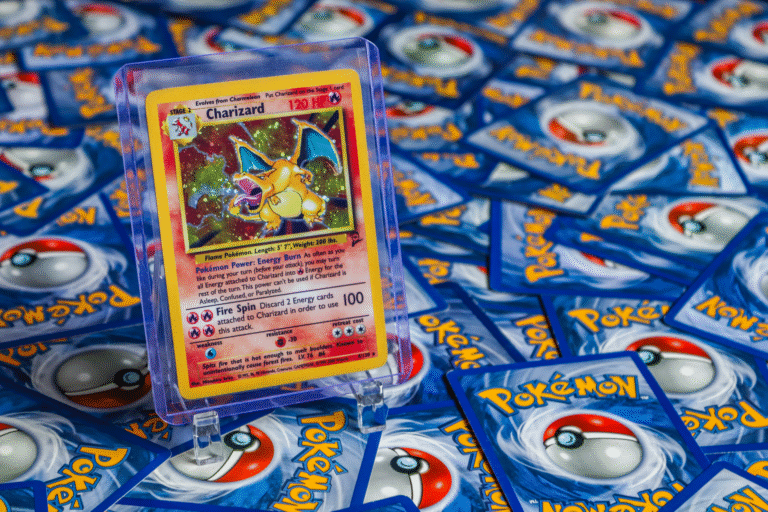
The most important Base Set Shadowless cards to watch before the next price spike are the three original holographic powerhouses—Charizard, Blastoise, and Venusaur—along with secondary-tier cards like Chansey, Mewtwo, and Alakazam. A 1st Edition Shadowless Charizard in PSA 10 condition commands $350,000 to $550,000, with one example reaching $550,000 at Heritage Auctions in late 2025, making it the obvious anchor of any serious collector’s watchlist.
The dramatic value gap between conditions—a PSA 9 Charizard trades for around $60,000, representing a 6x to 9x difference from the PSA 10 price—reveals that condition is now the primary driver of appreciation in this market segment. Shadowless cards from Base Set’s first print run in early 1999 command premiums because they predate even the stamped “1st Edition” versions, and the 1st Edition stamp itself adds tens of thousands of dollars compared to Unlimited prints. With projected appreciation of 30 to 50 percent through 2026 for vintage 1st Edition Shadowless cards, collectors and investors should focus their attention on three specific variables: the card itself (with Charizard and Chansey leading), the edition marking (1st Edition dramatically outperforms Unlimited), and the condition grade (where a single point of PSA grading can swing six figures).
Table of Contents
- Which Base Set Shadowless Cards Will Spike Next?
- Understanding the Shadowless vs. 1st Edition Price Premium
- Why Condition Grading Creates Exponential Value Differences
- Building a Watchlist Before the Next Price Spike
- Spotting Red Flags and Avoiding Counterfeit Cards
- Market Timing and the Psychology of Price Spikes
- The Long-Term Outlook for Shadowless Cards
- Conclusion
Which Base Set Shadowless Cards Will Spike Next?
Charizard’s dominance in the market is absolute and shows no signs of diminishing, but savvy collectors should also track Chansey, a card that has quietly commanded serious prices. Chansey reached approximately $55,000 in PSA 10 condition, yet only around 48 high-grade copies exist in the hobby, making it rarer at the top end than many assume. While Charizard commands headlines, Chansey’s scarcity at PSA 10 means it could see more dramatic appreciation percentage-wise if market attention shifts—a $55,000 card jumping 50 percent is far more achievable than a $500,000 Charizard appreciating at the same rate.
Mewtwo and Alakazam represent the next tier of value. The Shadowless Mewtwo, distinguished by its purple hue and the absence of the shadow trademark on the artwork, sold for nearly $20,000, while Alakazam ranks among the next most valuable cards after the primary trio of Charizard, Blastoise, and Venusaur. Individual holographic Blastoise commands $8,000 and above, and Venusaur trades in the $5,000-plus range, compared to common holographics that range from $500 to $2,000 each. The pricing tiers show clear separation: elite cards (Charizard, Chansey) operate in five and six figures, while secondary holos settle in the four-figure range.

Understanding the Shadowless vs. 1st Edition Price Premium
The distinction between Shadowless, 1st Edition, and Unlimited prints is fundamental to pricing but often misunderstood. Shadowless cards lack the shadow on the Pokémon’s artwork, indicating they were printed before the shadow trademark correction—a detail that only affected the earliest print run in 1999. 1st Edition cards have a printed stamp in the lower left corner, and when combined with the Shadowless feature, they represent the rarest versions of Base Set. The difference in value between a 1st Edition Shadowless card and an Unlimited (non-1st Edition) version of the same card can be tens of thousands of dollars, sometimes more than the Unlimited card’s total value.
This premium exists because the Shadowless print run was brief; once the shadow correction was made, future printings included it. First Edition Shadowless Charizards exist in far smaller quantities than their 1st Edition Unlimited counterparts, and even more dramatically fewer exist in high grades. However, the scarcity is also the limitation: fewer cards exist means fewer are likely to come to market for sale, which can also mean longer holding periods before finding a buyer. Collectors should understand that while rarity supports value, illiquidity can be a problem if you need to sell quickly, particularly for cards priced above $100,000.
Why Condition Grading Creates Exponential Value Differences
The condition gap between PSA 9 and PSA 10 has become the defining driver of Base Set Shadowless value, creating a 3x to 10x price multiplier depending on the card. A PSA 9 Charizard at $60,000 demonstrates the market’s obsession with perfection; the marginal improvement from a 9 to a 10 (representing just a single point on a 1-to-10 scale) routinely adds $200,000 to $490,000 to the price. This exponential relationship exists because PSA 10 cards are exceptionally rare—finding a card that meets PSA’s strict grading criteria for mint condition after 25-plus years of storage and handling is genuinely difficult.
The practical warning here is critical: a card graded PSA 8 or PSA 9 may look nearly identical to an ungraded eye, but it will trade for a fraction of the PSA 10 price. If you are purchasing Base Set Shadowless cards as an investment, expect to pay premium prices for high grades, and understand that a small subjective difference in condition assessment can dramatically affect resale value. Collectors should also consider that regrading—sending a card back to PSA to be regraded—is possible if the card’s condition improves (due to restoration, or a previous misgrade), and successful regrading can unlock significant value gains.

Building a Watchlist Before the Next Price Spike
Strategic collectors should create a prioritized watchlist that separates cards by both value tier and scarcity tier. Tier One should include any 1st Edition Shadowless Charizard (regardless of condition, though focus on PSA 8+ if possible), 1st Edition Shadowless Chansey in PSA 8 or better, and 1st Edition Shadowless Mewtwo. Tier Two includes 1st Edition Shadowless Blastoise, Venusaur, and Alakazam in high grades, along with 1st Edition Shadowless holo rare trainers like Weezing or Farfetch’d. Tier Three comprises 1st Edition Shadowless common holographics and Unlimited versions of Tier One and Tier Two cards, which serve as entry points if you cannot yet afford a Tier One card.
The tradeoff between waiting and buying is real: the 30 to 50 percent projected appreciation through 2026 suggests buying sooner rather than later, but buying too hastily at inflated asking prices means you may overpay relative to the eventual market price. Monitor TCGplayer, Heritage Auctions, and GoCollect for recent sales data on comparable cards in your target grade range. Set alerts on major auction sites so you receive notifications when specific cards sell, giving you real-time pricing data. Remember that prices listed on dealer websites can remain fixed longer than actual market-clearing prices, so auction results are typically more reliable indicators of true value.
Spotting Red Flags and Avoiding Counterfeit Cards
As prices have climbed into six figures, counterfeit Base Set Shadowless cards have become a genuine concern, particularly for cards sold through unofficial channels or below-market prices. A counterfeit Shadowless card is typically identified by examining the print quality, the cardstock texture, and the holo pattern. Authentic vintage cards from 1999 have a specific feel to the cardstock—slightly lighter and with different flexibility than modern reprints—and the dot pattern on the holo should be uniform and follow a specific pattern unique to early print runs. Counterfeiters have improved significantly, so buying ungraded cards below market price is a major red flag.
The practical solution is to insist on PSA, BGS, or CGC grading for any card above $5,000. Grading companies employ detailed authentication processes, including light microscopy and spectral analysis, that catch counterfeits that a naked-eye inspection might miss. The grading fee ($50 to $150 depending on the card’s value and the turnaround time) is worth the insurance when you are investing five or six figures. Additionally, purchase only from established dealers with verifiable transaction histories and return policies. If a deal seems too good to be true—a $400,000 Charizard listed for $200,000—it almost certainly is either counterfeit, misrepresented in condition, or carries other hidden defects.

Market Timing and the Psychology of Price Spikes
Price spikes in the Pokemon card market have historically been driven by media attention, celebrity purchases, or major auction results that reset the market’s perceived value ceiling. The $550,000 Charizard sale at Heritage Auctions in late 2025 is precisely such an event—when the highest-priced card sells for a new record, the prices of comparable cards often follow upward. Collectors who owned PSA 10 Shadowless Charizards at that moment saw their holdings’ paper value increase by $100,000 or more simply because the market recalibrated its expectations for the top end.
The challenge is predicting when the next spike will occur. Factors include Pokemon’s continued mainstream cultural prominence (boosted by new video games and trading card set releases), the generational wealth transfers occurring as older collectors liquidate collections to heirs, and macroeconomic conditions affecting high-net-worth individual spending on luxury collectibles. Watch for auction house announcements of major collection sales, celebrity endorsements, or notable Pokemon cultural moments that could trigger renewed interest.
The Long-Term Outlook for Shadowless Cards
Base Set Shadowless cards will likely continue appreciating as the Pokemon TCG becomes recognized as a legitimate collectible asset class rather than a speculative bubble. Unlike stocks or bonds, Pokemon cards have intrinsic cultural value tied to a 30-year franchise with an actively engaged fanbase and no expiration date. The Shadowless subset specifically benefits from being finite—no new Shadowless cards will ever be printed, and the existing population will only decline as cards are lost, damaged, or held in permanent collections.
The most important caveat is that appreciation is not guaranteed and is highly dependent on condition and card selection. A PSA 7 Shadowless Charizard may appreciate 15 to 25 percent by 2026, whereas a PSA 10 may appreciate 40 to 50 percent or more. The cards with the most room for appreciation percentage-wise are the secondary-tier holos like Chansey, Alakazam, and Blastoise, which remain relatively undervalued compared to their rarity and cultural significance. Collectors who enter the market now, focusing on high-grade 1st Edition Shadowless cards from Tier One and Tier Two, are positioning themselves for stable long-term appreciation and reduced downside risk.
Conclusion
The most important Base Set Shadowless cards to watch are Charizard (the market leader at $350,000 to $550,000 for PSA 10), Chansey (scarcity play at $55,000 for PSA 10 with only 48 high-grade copies), and the secondary holos Mewtwo, Blastoise, Venusaur, and Alakazam. Condition is the primary value driver—a single PSA grade point can swing $200,000 or more—and the 1st Edition stamp combined with Shadowless status commands tens of thousands in premium pricing.
With 30 to 50 percent appreciation projected through 2026, collectors should build a prioritized watchlist focusing on 1st Edition Shadowless cards in PSA 8 or higher grades, verify authenticity through professional grading, and monitor auction results to understand real-time market clearing prices. Your next action should be to identify which tier of Shadowless cards aligns with your budget and collecting goals, then set up alerts on major auction platforms and dealer sites to track pricing trends for your target cards. Whether you are investing six figures in a PSA 10 Charizard or building a collection of secondary-tier holos at $2,000 to $8,000 each, the market is positioned for continued appreciation, provided you acquire high-grade authenticated examples before the next price spike reshapes the market’s value ceiling.