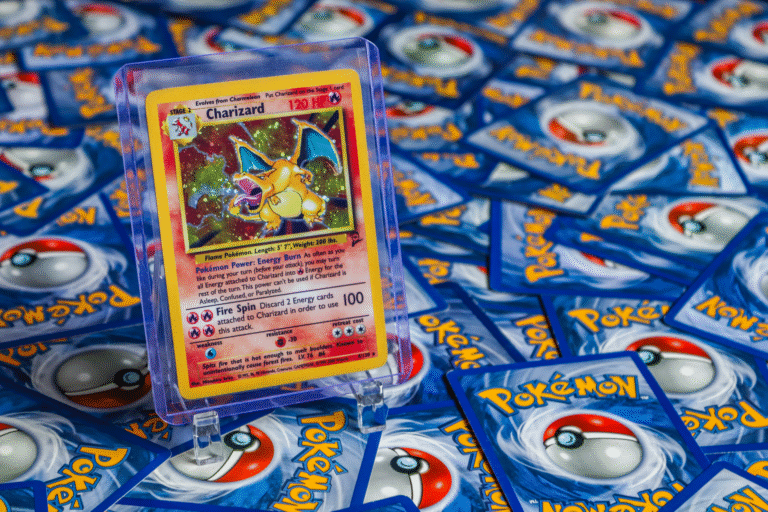
Yes, Italian First Edition Base Set cards have meaningfully outpaced the broader Pokémon vintage market during the current rebound, driven by a market-wide “rarity correction” that is only now recognizing the scarcity of non-English European cards. In late 2025, a graded 10 Italian 1st Edition Charizard sold for $449,377—a price point that signals a fundamental shift in how the collecting world values vintage Italian cards. While the overall vintage market experienced healthy 30-50% price increases through 2025 and is projected to appreciate another 15-25% throughout 2026, the Italian segment has accelerated beyond these benchmarks, with high-end Italian cards commanding mid-six-figure prices as collectors increasingly pursue complete world sets across every language variant. This outperformance is not random.
Italian Pokémon cards were produced in significantly smaller quantities than their U.S. counterparts because the brand did not achieve the same immediate popularity in Italy during the original 1999-2001 release window. For decades, the collecting market ignored this scarcity, focusing exclusively on Japanese and English cards. The shift began in earnest in 2025-2026 as sophisticated collectors recognized that completing true world sets requires Italian first editions—and that these cards remain extraordinarily difficult to locate in high grades.
Table of Contents
- How Did Italian Cards Gain Ground Against the Broader Vintage Market?
- The Rarity Correction and the Emergence of Linguistic Value
- The $449,377 Italian Charizard and What It Signals About Collector Psychology
- Italian Cards Versus English and Japanese Variants—A Comparative Analysis
- The Risks and Limitations of Italian Card Investment
- The 30th Anniversary Effect and Its Role in All Vintage Cards
- World-Set Completion and the Future of Italian Cards
- Conclusion
- Frequently Asked Questions
How Did Italian Cards Gain Ground Against the Broader Vintage Market?
The Italian card market’s outperformance reflects a basic supply-and-demand dynamic that was invisible until recently. When Pokémon launched in Italy in 1999, the brand was still building momentum. Wizards of the Coast allocated smaller print runs to Italian markets compared to the United States and Japan, where demand was immediate and sustained. This meant fewer Italian Base Set packs were opened, graded, and resold through modern auction channels.
As a result, high-grade Italian first editions now represent some of the scarcest cards in the entire vintage market—a fact that collectors and investors only began pricing in during 2025. The broader vintage market benefited from the Pokémon 30th anniversary in January 2026, which created sustained nostalgia-driven demand across all language variants and product categories. However, Italian cards have attracted an additional layer of demand from world-set collectors who are now actively competing to own at least one high-grade example of every language version of key cards. This incremental demand—on top of the baseline anniversary-driven rebound—has pushed Italian first editions significantly ahead of English and Japanese variants in terms of percentage gains. An Italian 1st Edition Blastoise, for example, has climbed into the five-figure range at higher grades, whereas comparable English-language versions are typically priced lower relative to their starting points two years ago.
The Rarity Correction and the Emergence of Linguistic Value
The concept of a “rarity correction” describes the market’s dawning recognition that linguistic variants carry real scarcity premiums. For the first two decades of Pokémon card collecting, the hobby assumed that English-language cards from the United States and japanese cards represented the sum of valuable vintage inventory. Italian, French, German, and Spanish first editions were treated as curiosities rather than strategic collectibles. This assumption was never justified by supply; it was simply a function of market attention and collector infrastructure. Starting in 2025, the infrastructure changed. Grading services began tagging language variants more explicitly in their databases.
Online price-tracking platforms like TCGPlayer and PSA began segmenting Italian cards into their own product categories, making it easier for collectors and investors to see price trends. Simultaneously, world-set completion became a status symbol among elite collectors with seven-figure budgets. The combination of these factors created a race to acquire Italian first editions before scarcity became undeniable and prices moved beyond reach. A collector attempting to buy a high-grade Italian 1st Edition Venusaur today faces substantially different market conditions than they would have faced in 2023, when the same card might have been overlooked at an estate sale. The limitation of this correction is that it may not yet be complete. Italian cards for lower-tier Pokémon or less iconic characters remain substantially underpriced relative to their English equivalents, suggesting that additional appreciation is likely as the collector base continues to educate itself on scarcity. However, this also means that recent buyers of top-tier Italian cards (like the $449,377 Charizard) may face a period of price consolidation before further gains materialize.
The $449,377 Italian Charizard and What It Signals About Collector Psychology
The sale of a graded 10 Italian 1st Edition Charizard for $449,377 in late 2025 functioned as a cultural moment for the collecting world. Charizard has always commanded premium prices due to its iconic status and perceived scarcity, but a price point in this range for an Italian-language variant would have been unthinkable as recently as 2023. The buyer—likely an institutional collector or a collector with a specific world-set mandate—signaled that the rarity premium for Italian cards has become non-negotiable at the highest levels of the market. What makes this sale significant is not merely the absolute price but the ratio it implies. A comparable English 1st Edition Charizard in a grade 10 might have sold in the $350,000-$400,000 range during the same period.
The Italian version commanding a higher price suggests that world-set completion is now driving marginal pricing at the top of the market. Collectors with $400,000+ budgets are increasingly willing to pay premiums for linguistic variants that complete their collections. This psychology cascades down the price curve, supporting stronger prices for high-grade Italian cards even at more accessible price points. The warning here is that this premium may not apply uniformly across the market. A graded 8 Italian 1st Edition Charizard, while still valuable, might not command the same premium over an English equivalent. The extreme scarcity of gem-mint Italian cards (grades 9-10) has created a two-tiered market where the rarest specimens are valued almost as category unto themselves, while more modestly graded examples benefit from the halo effect but remain more price-sensitive.
Italian Cards Versus English and Japanese Variants—A Comparative Analysis
The vintage Pokémon market is now organized around three primary linguistic categories: Japanese, English (primarily U.S.), and European non-English (Italian, French, German, Spanish, etc.). Japanese cards, particularly first editions, remain the gold standard in terms of total market valuation and perceived rarity—a 1st Edition Japanese Charizard in a high grade can still exceed $500,000. English first editions represent the largest absolute market by volume and have benefited enormously from the 30th anniversary push, with vintage WOTC prices climbing 30-50% through early 2026. Italian cards occupy an unusual middle position. They command lower absolute prices than Japanese gems because Japanese first editions are perceived as “original” in a way that Italian versions are not.
However, Italian cards now trade at significant premiums relative to their English equivalents when controlled for grade and condition. A graded 8 Italian 1st Edition Venusaur might fetch $8,000-$12,000, while the same English card would typically sell for $4,000-$6,000. This 100-150% premium did not exist in 2022; it emerged during the 2025-2026 rarity correction. The trade-off for Italian card collectors is that the overall supply of Italian cards remains truly scarce compared to English and Japanese variants. While an English 1st Edition Base Set Charizard appears at major auctions multiple times per year, Italian first editions of the same card might surface only once every 18-24 months. This illiquidity means that collectors buying Italian cards should do so with a multi-year holding horizon and a genuine commitment to world-set completion rather than speculation on short-term appreciation.
The Risks and Limitations of Italian Card Investment
Italian Pokémon cards have outperformed the broader market during the current vintage rebound, but several risks warrant consideration before collectors allocate significant capital to this segment. The first risk is authentication. Because Italian cards have historically been undervalued, far fewer specimens have been professionally graded and certified compared to English or Japanese variants. This means that the market contains more raw, ungraded Italian cards, some of which may be misrepresented in terms of condition. A collector purchasing a high-grade Italian card should demand professional grading and should be skeptical of exceptional prices on ungraded material. The second risk is liquidity and exit strategy.
While the market for Italian first editions has improved substantially since 2023, it remains narrow compared to the English and Japanese segments. A collector holding a high-grade Italian Venusaur in good condition should expect to find a buyer relatively quickly through major auction houses, but a collector holding unusual Italian variants or lower-grade examples might face extended holding periods. The $449,377 Italian Charizard sale signals that top-tier Italian cards have elite-level appeal, but this does not mean that all Italian cards will maintain appreciation during a market downturn. The third risk is over-concentration among a small number of collectors. The rarity correction and world-set completion trend have concentrated demand among a relatively small cohort of high-net-worth collectors. If this cohort shifts focus to another collecting category—as has happened multiple times in Pokémon history—Italian card prices could experience meaningful reversals. The broader vintage market is supported by millions of casual and serious collectors; the Italian segment relies on a much smaller pool of wealthy enthusiasts.

The 30th Anniversary Effect and Its Role in All Vintage Cards
Pokémon’s 30th anniversary on January 30, 2026, served as the primary catalyst for the broader vintage market rebound that provided the backdrop for Italian cards’ outperformance. The anniversary generated substantial media coverage, nostalgia-driven demand from lapsed collectors, and renewed institutional interest in vintage cards as collectible assets. Vintage WOTC cards experienced 30-50% price increases through early 2026, and the market is projecting an additional 15-25% appreciation throughout the remainder of 2026.
Italian cards rode this wave but added their own scarcity-driven momentum on top of it. While the anniversary boosted all vintage segments, Italian cards benefited from both the baseline anniversary effect and the accelerating recognition of their linguistic rarity. This distinction is important because it explains why Italian cards have not only participated in the broader rebound but have actually expanded their price premiums relative to English cards during the same period. The anniversary created rising water that lifted all vintage boats; Italian cards were uniquely positioned to benefit from additional structural tailwinds.
World-Set Completion and the Future of Italian Cards
The long-term demand driver for Italian Pokémon cards is the emerging world-set completion trend among elite collectors. Rather than building collections around a single language or market, collectors with substantial budgets are now pursuing complete sets across every language variant. This trend is still in its early stages, but it is already exerting measurable pressure on Italian card prices. As more high-net-worth collectors adopt world-set mandates, demand for Italian first editions will likely remain elevated even if the broader vintage market experiences a cooling period.
The forward outlook for Italian cards depends partly on whether this world-set trend continues to gain adoption among new collectors entering the market at six- and seven-figure budget levels. If world-set completion becomes the standard aspiration among elite collectors, Italian first editions will likely continue to appreciate faster than the broader market. However, if the trend remains confined to a small cohort of existing collectors, Italian card prices could stabilize at current premiums without experiencing additional dramatic gains. Either way, the market’s recognition of Italian scarcity appears to be permanent—meaning that future appreciation for Italian cards will likely exceed that of comparable English variants for the foreseeable future.
Conclusion
Italian First Edition Base Set cards have meaningfully beaten the broader Pokémon vintage market during the latest rebound, delivering appreciation rates that exceed the 30-50% gains posted by vintage WOTC cards more broadly. This outperformance reflects a market-wide rarity correction that is only now pricing in the genuine scarcity of Italian cards, which were produced in a fraction of the quantities of their U.S. counterparts. The sale of a graded 10 Italian 1st Edition Charizard for $449,377 exemplifies this shift, along with the emergence of world-set completion as a status-driving collecting mandate among elite collectors.
Collectors considering Italian Pokémon cards as part of a long-term collection strategy should approach the market with clear expectations about liquidity, authentication, and time horizon. High-grade Italian first editions represent genuinely scarce assets that have emerged from decades of market obscurity into a position of recognized value. The structural tailwinds supporting Italian card prices—linguistic rarity, world-set completion, and professional grading infrastructure—appear durable, suggesting that these cards will likely continue to appreciate faster than the broader market. However, recent buyers should be prepared for periods of price consolidation and should prioritize authentication and condition over chasing the latest price record.
Frequently Asked Questions
Why were Italian Pokémon cards undervalued for so long?
Italian Pokémon cards were produced in much smaller quantities than U.S. versions because the brand had lower market penetration in Italy during the 1999-2001 release window. The collecting world focused almost exclusively on English and Japanese cards, treating Italian variants as curiosities rather than scarce assets. This changed in 2025-2026 as collectors began pursuing world sets across multiple languages.
Is an Italian 1st Edition card worth significantly more than an English version?
It depends on the specific card and grade. At the highest grades (9-10), Italian first editions can command 50-100% premiums over English equivalents due to extreme scarcity. At more modest grades (6-8), premiums are typically 50-150%, though this varies by card. The most iconic cards like Charizard show larger premiums than lower-tier Pokémon.
Should I expect Italian cards to continue appreciating faster than the broader market?
The structural factors supporting Italian card scarcity appear durable, particularly the world-set completion trend. However, past performance does not guarantee future results. If world-set demand shifts or if the broader vintage market experiences a downturn, Italian cards could face pressures like any other segment. Collectors should treat Italian cards as long-term holdings rather than short-term speculation.
How can I verify the authenticity of a high-grade Italian Pokémon card?
Professional grading from services like PSA or BGS is the most reliable authentication method. Because Italian cards have been undergraded historically relative to English variants, ensure that any high-value purchase includes professional certification. Be skeptical of exceptional prices on raw, ungraded Italian cards, as authentication fraud is a risk in emerging market segments.
Are Italian cards from other sets (besides Base Set) also appreciating?
Base Set first editions remain the primary focus of the Italian card market due to their relative scarcity and status as the foundational set. Italian cards from later sets exist but have received less market attention and command lower prices. The rarity correction has focused primarily on Italian Base Set first editions, particularly on iconic Pokémon like Charizard, Blastoise, and Venusaur.
How does the current Italian card market compare to the broader WOTC vintage segment?
Italian cards are appreciating faster than the baseline vintage market (which is up 30-50% through early 2026 with 15-25% projected for the rest of 2026). However, Italian cards remain a smaller portion of the overall vintage market by volume. The outperformance reflects scarcity-driven premium recognition rather than a fundamental shift in collecting priorities away from English or Japanese cards.