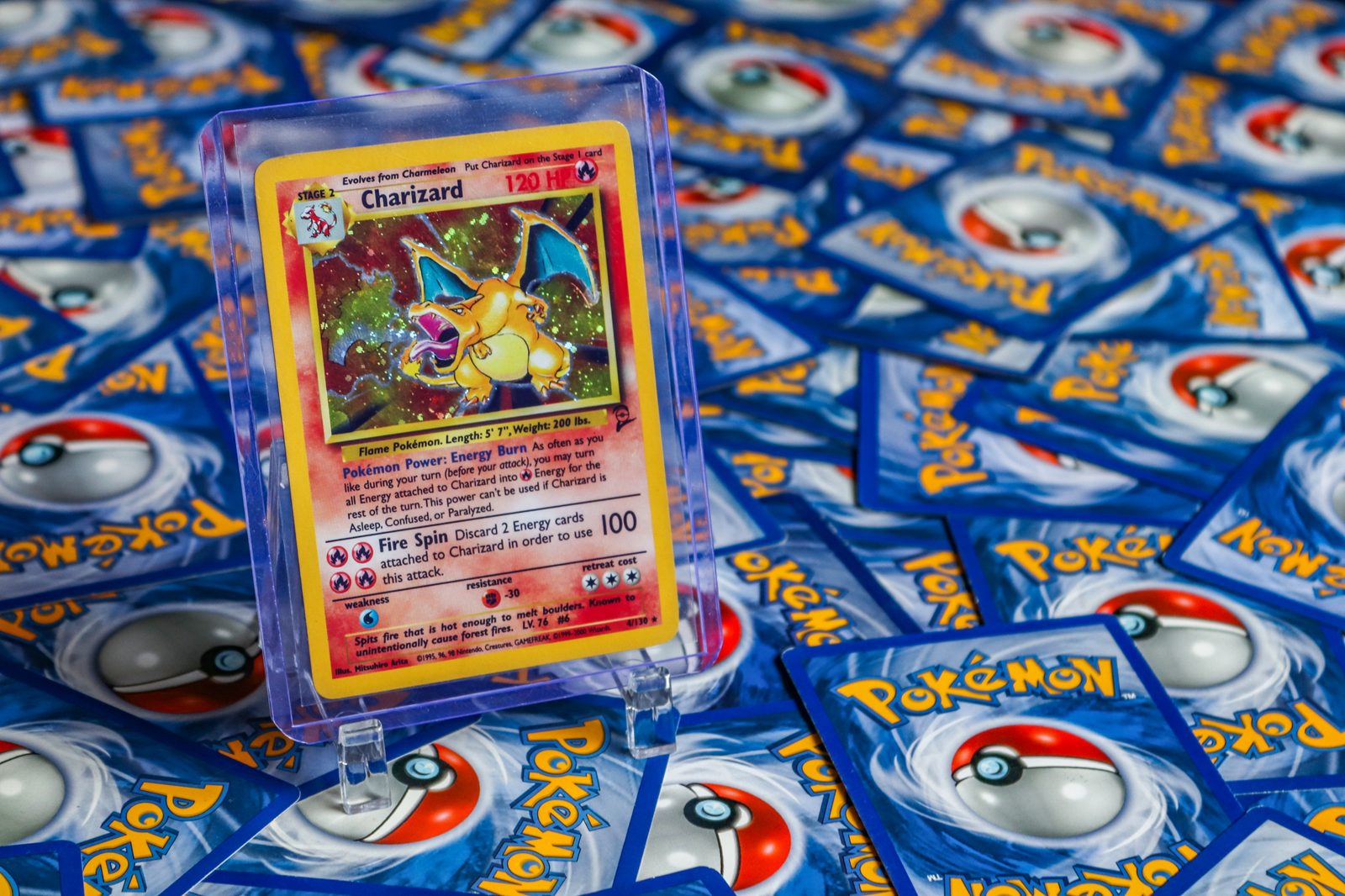
Pokemon Pricing estimates that about 3 million copies of each Unlimited Base Set booster holo were printed, with a plausible range of 2 to 4.5 million per card. Wizards of the Coast never released a print run, but it told players the holos were all equally rare, so the figure we built for Charizard applies to Blastoise, Venusaur, Mewtwo and the other eleven Base Set holos found in packs.
That makes about 45 million Unlimited booster holos across the 15 cards. The sixteenth holo, Machamp, came in the starter set rather than in boosters and has its own section below. By Unlimited we mean the common English cards dated 1999 that carry no 1st Edition stamp and do show a dark shadow on the right side of the art frame. 1st Edition, Shadowless and the 1999-2000 copyright print sit outside every number here.
As of October 19, 2026: CGC’s main Unlimited lines hold 92,406 slabs across the 15 booster holos and TAG’s hold 5,438. Charizard leads both graders and Clefairy trails at CGC, yet Wizards described the holos as printed alike. PSA’s report sits behind a login; Goldin lot text this month cites more than 105,365 PSA Charizards, more than 52,450 Blastoise and more than 31,635 Mewtwo.
Our Estimate: How Many Base Set Holos Were Printed
Nobody has an official count to cite. A player asked Wizards in a January 27, 2000 help-desk chat, “Does WOTC release print run statistics? If not, why not (You are a publicly held company now?)” The reply: “Though we are a publicly held company, we are not obligated to release that sort of information.” Neither Hasbro nor The Pokémon Company has put out per-card numbers since.
Every figure on this page is therefore one of three things: a number a source published, our arithmetic on those numbers (shown), or an input we chose ourselves and label as an Assumption.
Why one estimate fits every booster holo
Wizards was consistent on this point. Its 1999 FAQ said of the foils: “They are all equally rare, but depending on which ones are most popular, some might be harder to trade for.” When a player asked in a February 3, 2000 chat whether more Charizards came off the press, the help desk answered that “Charizard is no more rare than any other rare in the base set.” Its card FAQ gave one pull rate for all of them: “What’s the probability of getting any specific foil card in a booster pack? Roughly 1:48”.
Those statements are the whole basis for treating the cards alike. The same chat said foils came about once every three packs and admitted some buyers did better or worse than that. Spread across 15 booster holos, one foil per three packs works out to a given holo every 45 packs, close to Wizards’ rounded 1 in 48. Using 48 keeps the estimate on the cautious side.
Our Unlimited Charizard print estimate built the number two ways: down from Hasbro’s revenue figures (Method B) and up from Charizard’s graded copies (Method A). Only Method B is repeated here. Method A depends on how often collectors grade a card, and that differs enormously from one holo to the next, so it cannot be moved across cards.
Method B, re-run for any booster holo
Hasbro bought Wizards on September 30, 1999. In its fiscal 2000 annual report Hasbro restated its 1999 revenue as if the purchase had happened on January 1: $4,630,368 thousand, compared with the $4,232,263 thousand it actually booked. The difference, 398.1 in millions of dollars, is Wizards’ own revenue before the deal closed. ICv2 read the filing the same way in 2001, putting it at around $398 million. Hasbro’s February 8, 2000 release added that Wizards “contributed approximately $237 million of revenue” in the final quarter. Adding the two gives Wizards roughly $635 million of 1999 revenue, against roughly $155 million for 1998, a year with no English Pokémon product.
From there the funnel narrows to Unlimited Base Set packs, then divides by 48. Each narrowing step uses an Assumption at low, central and high values:
- Subtract other product lines. Wizards still sold Dungeons & Dragons, books and its original card game, and ran its own shops.
- Remove starter sets and theme decks. Both retailed at $9.99, and the holo question here is about booster packs.
- Keep English product, allowing for any other-language revenue in the total.
- Convert dollars to packs at Wizards’ selling price, a fraction of the $3.29 suggested retail price because stores and distributors took a margin. No Wizards wholesale price list has surfaced.
- Keep Base Set. Jungle reached stores from mid-June 1999 and Fossil from October, so Base Set shared shelf space for half the year.
- Keep Unlimited. 1st Edition was on the presses for just three days, per a February 2000 chat; PSA describes Unlimited as the far larger printing.
- Count January and February 2000. The help desk told players Base Set presses would run until Base Set 2 launched late that February, two months outside the 1999 revenue.
The inputs, all of them Assumptions, by case:
| Case | Non-Pokémon Wizards revenue | Booster share | English share | Wizards’ price as share of $3.29 | Base Set share of 1999 boosters | Unlimited share of Base Set | Jan-Feb 2000 tail |
|---|---|---|---|---|---|---|---|
| Low | $225 million | 70% | 85% | 55% | 40% | 85% | +0% |
| Central | $185 million | 80% | 95% | 50% | 50% | 90% | +10% |
| High | $150 million | 90% | 100% | 45% | 65% | 95% | +20% |
A lower price per pack means more packs for the same money, which is why 45% sits in the high case. Run through the funnel, in millions of dollars where marked (225, 185 and 150 being the non-Pokémon amounts subtracted from 635.1):
| Case | Pokémon card revenue, $ million | English booster revenue, $ million | Price per pack to Wizards | English booster packs, all sets | Unlimited Base Set packs, incl. early 2000 | Copies of any one booster holo (÷ 48) |
|---|---|---|---|---|---|---|
| Low | 410.1 | 244.0 | $1.81 | 134.9 million | 45.8 million | 955,193 |
| Central | 450.1 | 342.1 | $1.645 | 208.0 million | 102.9 million | 2,144,497 |
| High | 485.1 | 436.6 | $1.48 | 294.9 million | 218.5 million | 4,552,467 |
Sales revenue undercounts printing. Hasbro’s 2000 report booked “obsolescence costs associated with overproduction of certain trading card games, primarily POKEMON related”, meaning cards were made that never sold. Any error from that source pushes the true figure upward.
The Charizard article sets this funnel beside the graded-copy method, drops the low case of 955,193 as implausible for Charizard, and settles on roughly 3 million, plausibly anywhere from 2 to 4.5 million. Because Wizards printed the foils at one rate, that range is Pokemon Pricing’s estimate for each of the 15 booster holos.
All 15 booster holos together
Multiplying the per-card figure by 15 gives about 45 million Unlimited booster holos, with a likely range of 30 million to 67.5 million. A second route agrees on the order of size: Method B’s central count of Unlimited Base Set packs, divided by Wizards’ one foil in three packs, comes to about 34.3 million. Neither route is official, and neither counts the theme-deck copies covered further down.
| Figure | Low | Central | High |
|---|---|---|---|
| Our per-card figure (Pokemon Pricing estimate) | roughly 2 million | roughly 3 million | roughly 4.5 million |
| All 15 booster holos (× 15) | about 30 million | about 45 million | about 67.5 million |
Machamp: the holo that was not in boosters
Base Set has 16 holo rares, the count PSA uses for the 1st Edition series, but only 15 came in packs. Machamp 8/102 was the starter-set holo: a February 1999 Wizards release says “Each Starter Set contains two 30-card decks, one holographic card, 10 damage counters, a starter game guide and an advanced rulebook.” Wizards’ card FAQ later stated: “Nope, only 1st edition Base Set Machamp’s have ever been released in English.” As late as March 2000 the help desk confirmed “it is still a 1st edition Base set Machamp that comes in the Base Set 2 starter set.”
So the booster estimate does not apply to Machamp; its supply followed starter-set sales, and no figure for those exists. The graders reflect the split. CGC’s Unlimited set jumps from the 7/102 Hitmonchan lines straight to 9/102 Magneton, with no Machamp line at all. TAG does list an 8/102 Machamp Holo in its 1999 Base Set, with 18 slabs. We could not establish which printing those copies come from, so Machamp stays out of every Unlimited table on this page. Neither of the proof sheets below includes it either.
What the two holo proof sheets show
Uncut holo sheets are the only physical record of how the cards were laid out, and two have been described card by card, both by Hake’s Auctions. The first, a ten-by-ten sheet in the Unlimited layout, sold on November 3, 2021 for $45,559.80. The second, a Shadowless sheet of 99 holos signed off for color and fit by Wizards’ production director of the time, sold on June 30, 2021 for $234,171.00.
| Holo | Unlimited-layout proof (100 cards) | Shadowless proof (99 cards) |
|---|---|---|
| 1 Alakazam | 7 | 7 |
| 2 Blastoise | 6 | 7 |
| 3 Chansey | 7 | 7 |
| 4 Charizard | 6 | 7 |
| 5 Clefairy | 7 | 7 |
| 6 Gyarados | 6 | 5 |
| 7 Hitmonchan | 7 | 7 |
| 8 Machamp | not on sheet | not on sheet |
| 9 Magneton | 8 | 7 |
| 10 Mewtwo | 6 | 6 |
| 11 Nidoking | 7 | 6 |
| 12 Ninetales | 7 | 6 |
| 13 Poliwrath | 7 | 7 |
| 14 Raichu | 6 | 7 |
| 15 Venusaur | 6 | 7 |
| 16 Zapdos | 7 | 6 |
| Total | 100 | 99 |
The caveat matters more than the counts. Both are proof or test sheets, not sheets from a production run. Hake’s wrote of the 100-card sheet: “This sheet was most likely intended for the testing of different holographic patterns/styles.” It also said the sheet’s foil pattern “was changed before production and was not featured on published cards”, and that its cards are physically Shadowless even though the arrangement matches the few Unlimited sheets the auction house knew of.
Read with that in mind, the sheets fit what Wizards said. Each of the 15 booster holos appears five to eight times, none is missing and none is doubled. Fifteen cards cannot split 99 or 100 positions evenly, so some must get one extra slot, and the two sheets hand those extra slots to different cards: Blastoise and Venusaur have 6 on one and 7 on the other, Magneton 8 and 7. Nothing here shows any Unlimited holo was deliberately printed more than another. Hake’s also mentions an Unlimited proof sheet that sold for $116,000 earlier in 2021, but its layout has not been published.
Graded counts for all 15 Unlimited booster holos
CGC and TAG both publish full population reports without a login, and both were read on October 19, 2026. CGC’s figure below is the main (1999) Holo line of its Base Set – Unlimited – English set, and its 10s add Perfect, Pristine and Gem Mint together. TAG’s 1999 Base Set is its Unlimited set; it keeps 1st Edition and Shadowless separately, as CGC does.
| Holo | CGC main line | CGC 10s (all tiers) | CGC 1999-2000 line | TAG total | TAG 10s |
|---|---|---|---|---|---|
| Charizard | 14,931 | 297 | 61 | 1,456 | 2 |
| Blastoise | 8,957 | 151 | 42 | 706 | 0 |
| Venusaur | 8,569 | 166 | 23 | 611 | 3 |
| Mewtwo | 7,322 | 170 | 71 | 466 | 3 |
| Gyarados | 6,779 | 176 | 47 | 324 | 1 |
| Ninetales | 6,109 | 153 | 51 | 260 | 3 |
| Hitmonchan | 5,360 | 139 | 37 | 170 | 0 |
| Zapdos | 4,734 | 154 | 25 | 246 | 1 |
| Alakazam | 4,705 | 126 | 20 | 260 | 2 |
| Nidoking | 4,367 | 126 | 21 | 148 | 1 |
| Chansey | 4,352 | 108 | 14 | 187 | 1 |
| Poliwrath | 4,215 | 131 | 19 | 130 | 1 |
| Raichu | 4,155 | 116 | 19 | 214 | 0 |
| Magneton | 3,980 | 112 | 24 | 130 | 0 |
| Clefairy | 3,871 | 119 | 14 | 130 | 0 |
| All 15 | 92,406 | 2,244 | 488 | 5,438 | 18 |
The table is sorted by CGC count. Charizard’s main line is 3.9 times Clefairy’s at CGC and 11.2 times at TAG, for two cards Wizards said were printed alike. Grade mix moves the same way: 2.0% of CGC’s Charizards reached one of its three 10 tiers, against 3.3% for Zapdos, which fits owners submitting lower-grade Charizards they would not bother sending in for a less wanted card.
The other CGC lines
CGC keeps the 1999-2000 copyright print, nicknamed the 4th print, on its own line within the Unlimited set: 488 slabs across the 15 holos, shown in the table and left out of the main counts. Our 4th print Charizard estimate covers that printing. CGC also runs error and variant lines, none of them in the totals above: Blastoise has No Illus. (27), No Stage (162) and Red Dot (123) error lines, Charizard a Black Dot Error line of 127, Ninetales a Black Flame line of 182, and Clefairy two error lines of its own. TAG adds 4 Black Dot Charizards and 2 Missing Stage Blastoise.
PSA: three dated figures out of fifteen
Where PSA figures exist they dwarf CGC’s and TAG’s, but its population report now requires an account, and we did not get around that. Public, dated PSA numbers exist for only three Unlimited booster holos, all quoted in lot descriptions for Goldin’s open 30th Anniversary auction:
- Charizard: Goldin cites more than 105,365 in PSA’s census, with PSA 10s under one-half of one percent.
- Blastoise: PSA’s census holds more than 52,450, under 1 percent of them at PSA 10.
- Mewtwo: PSA’s census holds more than 31,635, and Goldin puts PSA 10s below 2 percent. PSA’s own CardFacts page, archived in June 2025, showed 22,840 graded with 587 PSA 10s, or 2.6%.
Goldin notes that census figures in a lot description are “accurate at the time a lot is posted for auction and is subject to change.” We found no dated public PSA total for Unlimited Venusaur or for the other eleven booster holos; the Wayback Machine never archived those CardFacts pages with data.
How much of each print has been graded
Dividing graded slabs by the print estimate shows what share of each card has ever passed through a grader. For each card below we add PSA’s Goldin-cited figure, CGC’s main and error lines and TAG’s lines, leaving out the 1999-2000 print. These totals count slabs at three companies, which is a floor of grading events and not a count of cards that exist; we add them only to compare cards on the same footing.
| Holo | Slabs counted | Share of about 3 million printed |
|---|---|---|
| Charizard | 121,883 | 4.1% |
| Blastoise | 62,427 | 2.1% |
| Mewtwo | 39,423 | 1.3% |
| Venusaur (CGC and TAG only; no PSA figure) | 9,180 | 0.3%, PSA missing |
| Clefairy (CGC main line only) | 3,871 | 0.13% |
If the holos were printed alike, as Wizards said, then Charizard has been graded about twice as often as Blastoise and about three times as often as Mewtwo. Population rank measures what owners choose to submit, which follows price. CGC’s own disclaimer makes the point: population reports are “not an indicator of value or rarity.” Our card-by-card estimates set out the numbers for Unlimited Blastoise, Unlimited Venusaur and Unlimited Mewtwo.
The shares are also floors in a second sense. PSA warns that cards get cracked out and resubmitted without the old label coming back, so one card can be counted twice, while BGS and SGC slabs are missing entirely. Most copies of every Base Set holo were never graded and never will be.
Four holos with a second source: the theme decks
The 3 million estimate counts booster copies. Four holos had another way into circulation. Wizards’ four Base Set theme decks each packed one holo card alongside the deck itself, and Wizards’ 1999 deck lists show one Ninetales in Brushfire, one Hitmonchan in Blackout, one Gyarados in Overgrowth and one Mewtwo in Zap!.
No source gives theme-deck sales, so we cannot say how many extra copies that added, and they are not in the estimate. For Ninetales, Hitmonchan, Gyarados and Mewtwo, about 3 million is best read as the booster share alone, with the true total somewhat higher. None of the four deck lists names Charizard or any of the other ten booster holos.
What new evidence would move these numbers
- A unit count from Hasbro or Wizards, whether packs, boxes or sheets, for 1999 and early 2000.
- A production holo sheet (not a proof) described card by card, which would show whether the slot counts above held in real runs.
- Sales splits between Base Set, Jungle and Fossil, and between boosters, starter sets and theme decks.
- Wizards’ 1999 wholesale price for a booster pack.
Each would swap an Assumption for a fact, and the change would apply to every booster holo at once.
Prices and individual cards
Prices move every week, so this page does not fix any. The Base Set Unlimited price guide tracks each holo from sales at major marketplaces and auction houses, and the Base Set checklist lists every holo, rare and error card. For Charizard in all its printings, see how many Base Set Charizards exist; for the full method behind the 3 million figure, the Unlimited Charizard estimate shows every step.
The last count we can date: on October 19, 2026, CGC showed 92,406 slabs on the main lines of the 15 Unlimited booster holos, and CGC’s whole Base Set – Unlimited – English set, every card and line included, stood at 214,070.
Frequently Asked Questions
How many copies were printed of each Base Set holo card?
Wizards of the Coast never published a print run for any Base Set card. Pokemon Pricing’s estimate is about 3 million copies of each Unlimited booster holo, within a plausible range of 2 to 4.5 million, because Wizards said every holo was equally rare and each specific foil turned up roughly once in 48 packs.
Is Charizard rarer than the other Base Set holos?
No. The 1999 Wizards FAQ called every holo equally rare, and a help-desk answer in early 2000 put Charizard on the same footing as the other rares. Charizard has far more graded copies than any other holo because collectors send it in more often, not because more were made.
How many Base Set holos are there?
Sixteen: Alakazam, Blastoise, Chansey, Charizard, Clefairy, Gyarados, Hitmonchan, Machamp, Magneton, Mewtwo, Nidoking, Ninetales, Poliwrath, Raichu, Venusaur and Zapdos. Fifteen came in booster packs. Machamp came one per 2-Player Starter Set and, according to Wizards in 2000, only as a 1st Edition card.
Which Unlimited Base Set holo has the most graded copies?
Charizard, by a wide margin. On October 19, 2026 CGC showed 14,931 on its main Unlimited Charizard line and TAG 1,456. Blastoise, Venusaur and Mewtwo come next at both graders. Clefairy had the fewest CGC slabs, 3,871.
Were some Base Set holos printed on more sheet positions than others?
The two holo proof sheets described card by card by Hake’s show each of the 15 booster holos between 5 and 8 times. Both are proof or test sheets, not production sheets, and their counts differ from each other, so they cannot settle a production ratio.
How many Unlimited Base Set holos were printed in total?
Applying Pokemon Pricing’s per-card estimate to all 15 booster holos gives about 45 million, most likely 30 million to 67.5 million. That counts booster copies only; four holos also came one per theme deck, in numbers no source gives.
Sources
- Pokemon TCG Frequently Asked Questions — Wizards of the Coast, archived by the Internet Archive, Wayback Machine capture of November 28, 1999
- Pokemon Online Help chat log (Wizards Customer Service) — Wizards of the Coast, archived by the Internet Archive, February 3, 2000
- Pokemon Cards FAQ (compiled from Wizards online-help chats) — Wizards of the Coast, archived by the Internet Archive, Wayback Machine capture of August 18, 2000
- Pokemon Online Help chat log (Wizards Customer Service) — Wizards of the Coast, archived by the Internet Archive, January 27, 2000
- Hasbro Inc. Form 10-K405, fiscal year 2000 — U.S. Securities and Exchange Commission (EDGAR), filed April 2, 2001
- Hasbro Inc. Form 8-K, Exhibit 99: fourth quarter and full-year 1999 results release — U.S. Securities and Exchange Commission (EDGAR), February 8, 2000
- Hasbro Results Cite Pokemon Decline: Pokemon Bigger than Star Wars — ICv2, May 8, 2001
- Pokemon Trading Card Game’s First Expansion Set To Be Released Early — Wizards of the Coast, archived by the Internet Archive, June 18, 1999
- Pokemon Trading Card Game Expansion Makes All 150 Pokemon Available — Wizards of the Coast, archived by the Internet Archive, October 8, 1999
- Pokemon Online Help chat log (Wizards Customer Service) — Wizards of the Coast, archived by the Internet Archive, January 20, 2000
- Pokemon Online Help chat log (Wizards Customer Service) — Wizards of the Coast, archived by the Internet Archive, February 17, 2000
- PSA Set Registry: Collecting the 1999 Pokemon 1st Edition Gaming Card Base Set, the Series that Started It All — PSA (Kevin Glew), archived by the Internet Archive, June 20, 2016
- Pokemon Trading Card Game a Monster Success; Stores Selling Out of Product within Hours of Restocking on Shelves — Business Wire (Wizards of the Coast release), archived by the Internet Archive, February 3, 1999
- Pokemon Online Help chat log (Wizards Customer Service) — Wizards of the Coast, archived by the Internet Archive, March 23, 2000
- Preconstructed Theme Decks — Wizards of the Coast, archived by the Internet Archive, Wayback Machine capture of November 29, 1999
- Brushfire Theme Deck card list — Wizards of the Coast, archived by the Internet Archive, Wayback Machine capture of November 28, 1999
- Blackout Theme Deck card list — Wizards of the Coast, archived by the Internet Archive, Wayback Machine capture of November 28, 1999
- Overgrowth Theme Deck card list — Wizards of the Coast, archived by the Internet Archive, Wayback Machine capture of November 29, 1999
- Zap! Theme Deck card list — Wizards of the Coast, archived by the Internet Archive, Wayback Machine capture of March 2, 2000
- CGC Cards Population Report: Base Set – Unlimited – English (cards 1 to 22) — CGC Cards, read October 19, 2026
- TAG Pop Report: 1999 WOTC Pokemon Base Set — TAG Grading, read October 19, 2026
- CGC Cards Population Report: Base Set – Unlimited – English (disclaimer) — CGC Cards, read October 6, 2026
- What is the POP Report and how do I use it? — PSA Knowledge Base, July 18, 2025
- 1999 Pokemon Base Set Holo #4 Charizard – PSA GEM MT 10 (open lot) — Goldin, current listing, read October 19, 2026
- 1999 Pokemon Base Set Holo #2 Blastoise – PSA GEM MT 10 (Lot #55, open) — Goldin, current listing, read October 19, 2026
- 1999 Pokemon Base Set Holo #10 Mewtwo – PSA GEM MT 10 (Lot #197, open) — Goldin, current listing, read October 19, 2026
- 1999 Nintendo Pokemon Game Mewtwo-Holo (CardFacts) — PSA, archived by the Internet Archive, Wayback Machine capture of June 9, 2025
- 1999 Pokemon Unlimited Base Set Holographic Uncut Proof Sheet with 100 Cards (Auction #233, item 2080) — Hake’s Auctions, archived by the Internet Archive, closed November 3, 2021
- 1999 Pokemon Shadowless Holographic Uncut Proof Sheet with 99 Cards (Auction #232, item 1977) — Hake’s Auctions, archived by the Internet Archive, closed June 30, 2021
Population figures are snapshots of each grading company’s public report on the date shown and change every week as new cards are graded. Print-run figures for the 1999 English Base Set were never published by Wizards of the Coast; anything described here as an estimate is labelled as one. This article is collector information, not investment advice. Pokémon and all card names are trademarks of Nintendo, Creatures Inc. and GAME FREAK inc.; Pokemon Pricing is not affiliated with them or with any grading company.