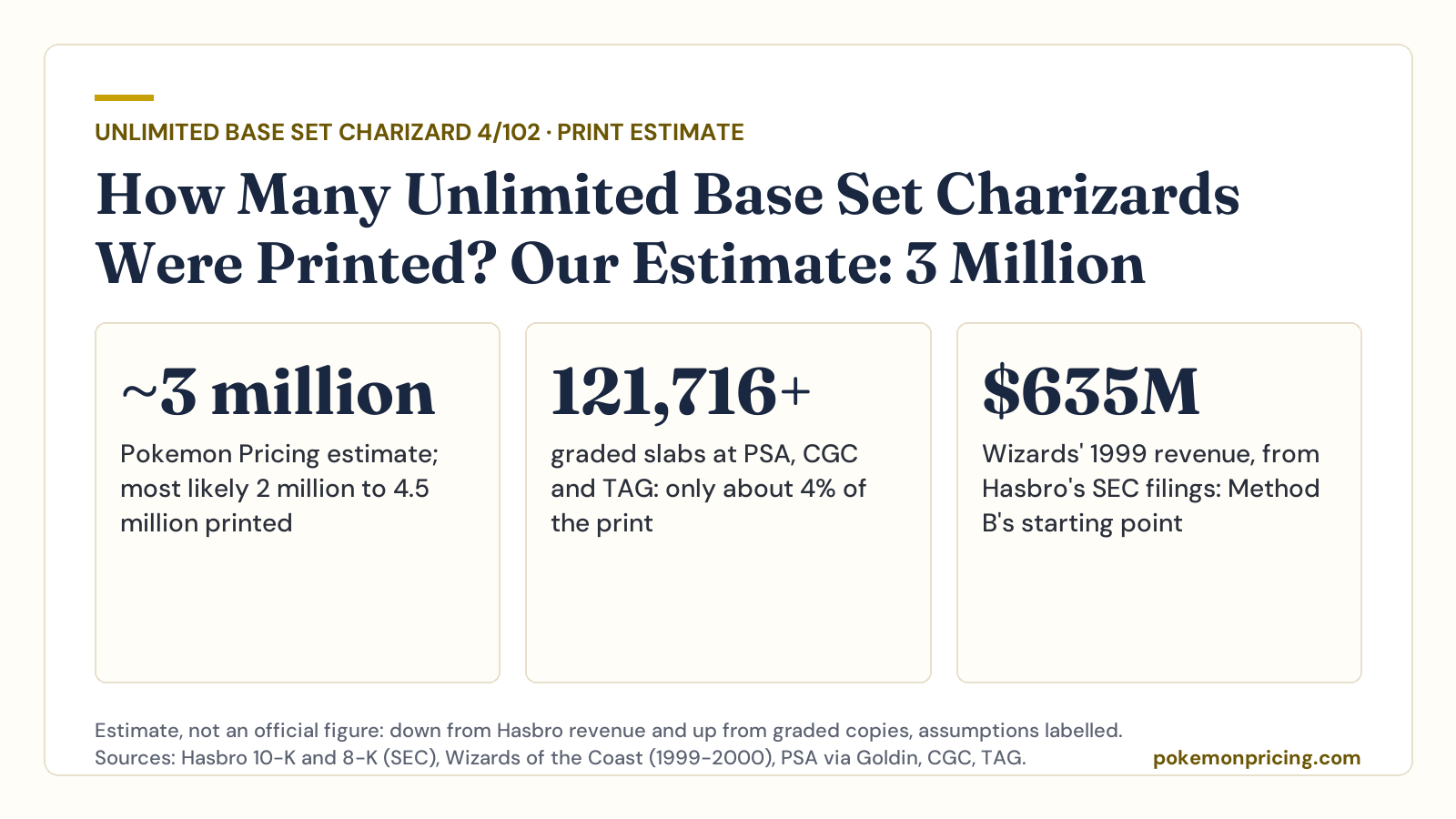
Pokemon Pricing’s estimate is that about 3 million Unlimited Base Set Charizards were printed, most likely between 2 million and 4.5 million. Wizards of the Coast never published the number, and the graded copies, more than 121,716 slabs at PSA, CGC and TAG, come to only about 4% of that: most Unlimited Charizards have never been graded.
Unlimited here means the standard 1999 English Charizard 4/102: no 1st Edition stamp, a drop shadow along the right edge of the art box, and a 1999 copyright line. Left out are 1st Edition (the first printing, with a black Edition 1 stamp), Shadowless (the unstamped early cards with no drop shadow) and the later 1999-2000 print that collectors call the 4th print. An earlier version of this page gave only graded counts, and the version before that carried an unsourced range of five to ten million. This version estimates the print itself, two ways, with every input either sourced or labelled as an Assumption.
As of October 6, 2026: Pokemon Pricing’s estimate is about 3 million Unlimited Charizards printed, most likely 2 million to 4.5 million. The graded floor is more than 121,716 slabs: PSA more than 105,365 (cited in a Goldin listing this month), CGC 14,926 and TAG 1,425, each including Black Dot Errors. Fewer than one-half of one percent of PSA’s copies are PSA 10.
Our Estimate: How Many Unlimited Base Set Charizards Were Printed
No official count exists. Asked in a January 27, 2000 chat whether it released print run statistics now that it was publicly held, Wizards answered: “Though we are a publicly held company, we are not obligated to release that sort of information.” Nothing from Wizards, Hasbro or The Pokémon Company has filled the gap since. Our piece on how many Base Set Charizards were printed walks through every first-hand production statement.
So we built an estimate two ways. Method B, the main one, works down from the revenue Hasbro reported for Wizards in 1999. Method A, the cross-check, works up from the graded population; the letters match our 4th print estimate, where Method A is also the graded-copy method. Every number below is sourced, computed from sourced numbers (our arithmetic, shown), or marked as an Assumption.
Method B: down from Hasbro’s filings
Hasbro bought Wizards on September 30, 1999. Its annual report for 2000 shows what 1999 revenue would have been with the purchase treated “as if it had taken place at the beginning of each period”: $4,630,368 thousand, against the $4,232,263 thousand Hasbro actually reported. The gap, 398,105 thousand dollars or about $398 million, is Wizards’ revenue for roughly January to September 1999, before Hasbro owned it. That subtraction is ours; the trade publication ICv2 made the same one in May 2001. Pro forma figures carry acquisition adjustments, which mostly fall on costs, so the gap is a close proxy rather than a line Hasbro printed.
For the last quarter, Hasbro’s February 8, 2000 results release said Wizards “contributed approximately $237 million of revenue”. Added together, Wizards’ 1999 revenue comes to about $635 million. The same pro forma note implies Wizards took in about $155 million in 1998, the year before Pokémon cards went on sale in English, so most of that jump was Pokémon.
Wizards’ own pull rate turns packs into Charizards. Charizard “is only found in booster packs”, per Wizards’ 1999 FAQ, never in a starter set or theme deck. Its help desk said “the number of foils is 1 in 3 packs” and that “Charizard is no more rare than any other rare in the base set”, and PSA counts 16 holo rares. Wizards’ card FAQ put the odds of any specific foil at roughly 1 in 48 packs.
From $635 million, eight steps reach the Charizards. Every step but the last rests on an Assumption, given as low, central and high values in that order; the $3.29 price and the pull rate are sourced.
- Take out everything that is not Pokémon: Magic: The Gathering, Dungeons & Dragons, books and Wizards’ own stores. The whole company took in about $155 million in 1998, and Hasbro said Magic and other staples accounted for “30% of the increase attributable to trading card games” in 2000, so that side was growing too. Assumption: $225 million, $185 million or $150 million of non-Pokémon revenue in 1999.
- Keep the boosters. The rest bought 2-Player Starter Sets and theme decks, $9.99 each at suggested retail, and neither held a Charizard. Assumption: boosters were 70%, 80% or 90% of Pokémon card revenue.
- Keep English cards. Assumption: 85%, 95% or 100% of that revenue was English-language product, allowing for any other-language cards in Wizards’ 1999 sales.
- Turn dollars into packs. A booster’s suggested retail price was $3.29, but Wizards sold to distributors and stores for less. We found no Wizards wholesale price, so this is an Assumption: Wizards received 55%, 50% or 45% of $3.29, which is $1.81, $1.645 or $1.48 a pack. A lower price means more packs, so 45% goes with the high case.
- Keep Base Set. Base Set boosters had the shelf to themselves until Jungle began shipping the week of June 18, 1999, per Wizards’ release, and Fossil followed in October 1999. No source gives the split. Assumption: Base Set was 40%, 50% or 65% of 1999 booster sales.
- Keep Unlimited. Wizards said 1st Edition was “printed for 3 days only”, and PSA calls Shadowless a rare version and says Unlimited “was produced in much higher quantities”. Assumption: Unlimited was 85%, 90% or 95% of Base Set packs.
- Add the 2000 tail. Wizards said Base Set would be “printed up until Base Set 2 comes out in the end of February” 2000, two months that 1999 revenue does not cover. Assumption: those months added 0%, 10% or 20% to the 1999 packs.
- Divide by 48, the packs per Charizard.
| Step | Low | Central | High |
|---|---|---|---|
| Wizards 1999 revenue, $ million (398.1 + 237) | 635.1 | 635.1 | 635.1 |
| minus non-Pokémon revenue, $ million | 225 | 185 | 150 |
| = Pokémon card revenue, $ million | 410.1 | 450.1 | 485.1 |
| × booster share (70% / 80% / 90%) | 287.1 | 360.1 | 436.6 |
| × English share (85% / 95% / 100%) | 244.0 | 342.1 | 436.6 |
| ÷ Wizards’ price per pack ($1.81 / $1.645 / $1.48) = English booster packs sold, all sets | 134.9 million | 208.0 million | 294.9 million |
| × Base Set share (40% / 50% / 65%) | 53.9 million | 104.0 million | 191.7 million |
| × Unlimited share (85% / 90% / 95%) | 45.8 million | 93.6 million | 182.1 million |
| + Jan-Feb 2000 tail (+0% / +10% / +20%) | 45.8 million | 102.9 million | 218.5 million |
| ÷ 48 = Unlimited Charizards | 955,193 | 2,144,497 | 4,552,467 |
Revenue counts cards sold, not cards printed, and Hasbro’s 2000 report booked “obsolescence costs associated with overproduction of certain trading card games, primarily POKEMON related”. More were printed than sold, so Method B runs low; the bias pushes the true number up.
Two outside checks fit. The central case comes to about 103 million Unlimited Base Set packs. By November 2000 Wizards said “more than six million children in the United States have played the game”, which makes about 17 packs a child, before counting Canada, the UK or adult buyers. And the Pokémon card revenue in the table, about $410 million to $485 million, sits just under ICv2’s own 2001 estimate that 1999 Pokémon card sales were about the same as Hasbro’s $508 million of Star Wars sales.
Method A: up from graded copies
Method A starts from the graded floor: more than 121,716 Unlimited Charizard slabs, adding PSA’s more than 105,365 (as cited in a Goldin listing), CGC’s 14,926 and TAG’s 1,425, Black Dot Errors included. Divide it by g, the share of all Unlimited Charizards that has ever been graded, and you have a print estimate.
No grader publishes g, so it is an Assumption: 3.5% central, with 6% and 2% at the ends, the same range our 4th print Charizard estimate uses. 121,716 divided by 6% is 2,028,600; by 3.5%, 3,477,600; by 2%, 6,085,800.
The caveats pull both ways. The floor counts slabs, not cards: a Charizard cracked out of one slab and regraded is counted twice, so Method A runs a little high. BGS and SGC are missing, which pulls the other way. And a chase card may be graded more often than an ordinary card, which would favour the low end. Raw copies are exactly what g has to stand in for.
Every input, sourced or assumed
| Input | Value used (low / central / high estimate) | Sourced or Assumption | Why |
|---|---|---|---|
| Hasbro 1999 revenue, pro forma and reported | $4,630,368 and $4,232,263 thousand | Sourced (Hasbro 10-K) | The gap is Wizards before September 30, 1999 |
| Wizards fourth-quarter 1999 revenue | $237 million | Sourced (Hasbro release) | Completes Wizards’ year |
| Non-Pokémon Wizards revenue | $225 million / $185 million / $150 million | Assumption | All of Wizards was about $155 million in 1998 |
| Booster share of Pokémon revenue | 70% / 80% / 90% | Assumption | Charizard came only in boosters |
| English-language share | 85% / 95% / 100% | Assumption | Some revenue may be other languages |
| Booster price | $3.29 suggested retail | Sourced (Wizards FAQ) | Turns dollars into packs |
| Wizards’ price as a share of $3.29 | 55% / 50% / 45% | Assumption | No wholesale price found |
| Base Set share of 1999 boosters | 40% / 50% / 65% | Assumption | Jungle from June 1999, Fossil from October |
| Unlimited share of Base Set packs | 85% / 90% / 95% | Assumption | 1st Edition 3 days; Shadowless rare |
| Jan-Feb 2000 tail | +0% / +10% / +20% | Assumption | Printing ran to the end of February 2000 |
| Packs per Charizard | 48 | Sourced (Wizards) | Same odds as every Base Set holo |
| Graded floor | more than 121,716 | Computed from sourced counts | A minimum; slabs, not cards |
| g, share of all copies ever graded | 6% / 3.5% / 2% | Assumption | No grader publishes grading rates |
The result
| Method | Low | Central | High |
|---|---|---|---|
| B: down from Hasbro’s 1999 revenue | 955,193 | 2,144,497 | 4,552,467 |
| A: graded floor ÷ g | 2,028,600 | 3,477,600 | 6,085,800 |
| Pokemon Pricing’s estimate | about 2 million | about 3 million | about 4.5 million |
The two methods start from different places, Hasbro’s revenue and the grading companies’ counts, and their ranges overlap from about 2 million to about 4.5 million. Their central cases, 2,144,497 and 3,477,600, sit either side of 3 million. Rounded, Pokemon Pricing’s estimate is about 3 million Unlimited Base Set Charizards printed, most likely between 2 million and 4.5 million.
We set aside Method B’s low case of 955,193. It would mean that 12.7% of every Unlimited Charizard ever printed, about 1 in 8, has already been graded, more than double our highest grading assumption. Method A’s high case of 6,085,800 is above anything Method B reaches, even with every input at its most generous.
As a consistency check, and not a third method: at 3 million, the more than 121,716 slabs are about 4% of the print, inside the 2% to 6% range for g. Our 4th print estimate of about 15,000 would be 0.5% of 3 million, in line with that print’s 0.41% to 0.78% share of graded Unlimited-era Charizards. Both rest on the same grading assumption, so the agreement only shows the site’s figures hang together.
Two older figures do not survive the arithmetic. The five to ten million an earlier version of this page carried sits entirely above our high end of 4.5 million and above every case of Method B. And the Christian Science Monitor reported in September 1999 that close to a hundred million cards had found their way into American classrooms and summer camps since late December, without naming a source. Hasbro’s figures imply many times that many cards sold in the first nine months of 1999 alone, even if every pack had gone at full retail price.
What would change the estimate
- A unit figure from Wizards or Hasbro: packs, boxes or cards printed or sold in 1999 and early 2000.
- The sales split between Base Set, Jungle and Fossil, the biggest single swing in Method B.
- A Wizards wholesale price list for 1999 boosters.
- PSA’s own live count, now behind a login, and any first-hand figure for what share of cards is ever graded.
Any of these would replace an Assumption with a fact. Until then, the figure is Pokemon Pricing’s estimate and nothing more official exists.
How to identify an Unlimited Base Set Charizard
Unlimited is the last of the three main 1999 Charizard 4/102 printings. PSA puts the order plainly: “Their price hierarchy echoes their release: 1st Edition being first, shadowless being second and unlimited being third”. Four checks place a card.
- No 1st Edition stamp. 1st Edition copies carry a small black Edition 1 stamp below the lower left of the art box.
- A drop shadow on the art box. Unlimited copies have a dark shadow along the right edge of the frame around Charizard’s picture; Shadowless copies do not, and look duller. Wizards said the shadow was added at Nintendo’s request: “After a while Nintendo asked us to make some changes in the cards (including adding that shadow) which we did.”
- The copyright line. As an auctioneer told the BBC, “Other base set cards are stamped 1999.” The 1999-2000 print reads 1999-2000 and, per CGC, tends to be a bit lighter in color.
- The Black Dot Error is still Unlimited: a small ink error over the t in Nintendo. CGC warns that its graders caught one example “that seems to have been altered with a Sharpie”.
Base Set 2 is the other common mix-up. Its Charizard reuses the art, but Wizards said the only changes were “a new card number and the Base Set 2 expansion symbol”, so a Base Set 2 copy reads 4/130 and has a set symbol.
| Printing | 1st Edition stamp | Art box drop shadow | Wizards copyright date | PSA line | CGC line |
|---|---|---|---|---|---|
| 1st Edition | Yes | No | 1999 | Charizard-Holo, 1st Edition | Base Set – 1st Edition |
| Shadowless | No | No | 1999 | Charizard-Holo, Shadowless | Base Set (Shadowless) |
| Unlimited | No | Yes | 1999 | Charizard-Holo, no variety | Base Set – Unlimited: Charizard (1999) Holo |
| Unlimited, Black Dot Error | No | Yes | 1999 | No separate line found | Charizard (1999) Black Dot Error Holo |
| 1999-2000 print (4th print) | No | Yes | 1999-2000 | No separate line found | Charizard (2000) 1999-2000 Holo |
One caveat on PSA’s plain line. In 2019 PSA warned that it “started recognizing certain varieties within specific sets long after the company began grading the issue”, so a Shadowless copy graded without its variety noted sits in the plain Unlimited line. If you own an older PSA slab labelled plain Charizard-Holo, check the art box edge yourself; a Shadowless copy is worth more, as the Shadowless Charizard price history shows.
How many Unlimited Charizards have been graded
PSA’s pop report now needs an account login, so the newest PSA-direct number is the CardFacts page as archived in August 2025. Auction houses quote PSA’s census in lot descriptions, which fills in the dates on either side.
| As of | PSA-graded Unlimited Charizards | PSA 10s | Source |
|---|---|---|---|
| November 2020 | 14,389 | 433 | PSA CardFacts (archived) |
| September 2024 | more than 62,400 | fewer than 1 percent | Goldin lot description |
| December 2024 | more than 67,000 | fewer than 1 percent | Goldin lot description |
| August 2025 | 82,564 | 489 | PSA CardFacts (archived) |
| October 2026 (open listing) | more than 105,365 | fewer than one-half of one percent | Goldin lot description |
Between the November 2020 snapshot and August 2025, PSA’s count grew 5.7 times; against the current Goldin listing, 7.3 times. That listing is still open, and Goldin says its population figures are “accurate at the time a lot is posted for auction and is subject to change.” The September 2024 and December 2024 figures come from closed lots.
CGC files the card on three lines inside its Base Set – Unlimited – English set. It reported 7,276 Charizards in that set in mid-November 2022; the plain line alone showed 14,801 on October 6, 2026, about 2.0 times as many.
| CGC line | Total | Perfect 10 | Pristine 10 | Gem Mint 10 | 9.5 | 9 | 8.5 | 8 | Authentic Altered |
|---|---|---|---|---|---|---|---|---|---|
| Charizard (1999) Holo | 14,801 | 1 | 11 | 284 | 147 | 1,000 | 1,654 | 1,717 | 143 |
| Black Dot Error Holo | 125 | 0 | 0 | 0 | 1 | 5 | 15 | 11 | 3 |
| 1999-2000 Holo | 60 | 0 | 0 | 2 | 1 | 3 | 6 | 1 | 2 |
Counting all three of CGC’s 10 tiers, 296 of the plain line’s 14,801 copies reached a 10, or 2.0%. CGC and PSA use different scales and see different submissions, so the rates do not compare directly. TAG lists 1,422 Charizards in its 1999 Base Set, two of them TAG 10, plus 3 Black Dot Errors, 1,425 in all.
That gives the floor Method A starts from: PSA’s more than 105,365, CGC’s 14,926 with the Black Dot line, and TAG’s 1,425, more than 121,716 slabs. For every printing combined, see our Base Set Charizard population report for all versions, and for 1st Edition and Shadowless, the overview of how many Base Set Charizards exist.
PSA grade breakdown: how scarce a PSA 10 Unlimited Charizard is
| PSA grade | November 2020 | August 2025 |
|---|---|---|
| GEM MT 10 | 433 | 489 |
| MINT 9 | 4,696 | 8,322 |
| NM-MT 8 | 3,530 | 14,388 |
| NM 7 | 1,994 | 14,072 |
| EX-MT 6 | 1,458 | 14,232 |
| EX 5 | 790 | 12,582 |
| VG-EX 4 | 470 | 7,522 |
| VG 3 | 301 | 4,161 |
| GOOD 2 | 152 | 2,685 |
| FR 1.5 | 11 | 85 |
| PR 1 | 273 | 3,058 |
| Authentic (no grade) | 12 | 73 |
| Total, half grades included | 14,389 | 82,564 |
CardFacts does not print a single total. Ours is the POP Higher figure on the Authentic row, which counts every copy with a numeric grade, plus the Authentic count: 82,491 + 73 = 82,564 for August 2025 and 14,377 + 12 = 14,389 for November 2020. The whole-grade rows add to 81,596; the other 895 copies carry half grades such as 8.5 that CardFacts has no row for.
The PSA 10 is where Unlimited stops being common. In August 2025, 489 of 82,564 copies were Gem Mint 10, or 0.59%; PSA 9 and 10 together came to 8,811, or 10.7%. In November 2020, PSA 10s were 3.0%. Since then PSA has added 56 PSA 10s while the total grew 5.7 times, and the most common grade in August 2025 was PSA 8, with 14,388 copies.
Where the 1999-2000 (4th print) Charizard sits
The 1999-2000 print is an Unlimited-style card with the later copyright line, nicknamed the 4th print. CGC says it “was a variant that was issued for the UK market”. It is not part of the estimate above. CGC grades it on its own line inside its Unlimited set, with 60 copies; TAG keeps it in a separate set of its own, with 9 Charizards. PSA’s public CardFacts pages show no separate 1999-2000 entry, and with the full report behind a login we could not confirm how PSA labels it. Our 4th print estimate puts that print at about 15,000 Charizards; our comparison of how rare the 4th print Charizard is next to Unlimited sets the two side by side.
What an Unlimited Charizard sells for
Prices move weekly, so this article does not fix them. The Unlimited Base Set Charizard price history tracks the card’s sales from verified sold listings across eBay, TCGPlayer, Goldin, and Fanatics Collect, and the Base Set Unlimited price guide covers the rest of the set.
For scale, the highest PSA 10 Unlimited Charizard sale we found is $48,000, in March 2026, from Fanatics Collect’s own sales history. We have not confirmed it as a record. Fanatics Collect’s later PSA 10 sales, from May to August 2026, ran from $23,400 to $27,500. Goldin sold PSA 10s for $10,065 in September 2024 and $10,371 in December 2024.
Why the graded count keeps climbing
A population report counts grading events. PSA says so itself: “Plenty of collectors will crack out their cards to have them signed, resubmit, or sell raw, and, unless we get that label back, there’s no way for us to know that the population needs to be updated.” A Charizard cracked from a PSA 8 slab and resubmitted in hope of a 9 can be counted twice. CGC’s disclaimer holds for every grader: population reports are “not an indicator of value or rarity.”
The grade mix shows what is being sent in. Between November 2020 and August 2025, PSA added 11,792 PSA 5s and 56 PSA 10s, which is why the PSA 10 share keeps falling as the total rises.
Raw copies, and copies long since lost, are the part no report sees, and on our estimate they are most of the print. What can be counted, as of October 6, 2026, is more than 121,716 slabs, about 4% of the roughly 3 million Unlimited Charizards Pokemon Pricing estimates Wizards printed.
Frequently Asked Questions
How many Unlimited Base Set Charizards were printed?
No official figure exists; Wizards of the Coast never published one. Pokemon Pricing’s estimate is about 3 million, most likely between 2 million and 4.5 million. It is built two ways, down from the revenue Hasbro reported for Wizards in 1999 and up from more than 121,716 graded slabs, and every assumption is shown in the article.
How many Unlimited Charizards have been graded?
More than 121,716 slabs as of October 2026: PSA more than 105,365 (cited in a Goldin listing), CGC 14,926 and TAG 1,425, Black Dot Errors included. PSA’s last public figure was 82,564 in August 2025. These count slabs, not unique cards, and BGS and SGC are not included.
Why is the graded population so much smaller than the print run?
Most Unlimited Charizards were never sent for grading. On Pokemon Pricing’s estimate of about 3 million printed, the more than 121,716 slabs are about 4%. The rest were played with, kept raw in binders and shoeboxes, or lost, and no population report counts them.
How many PSA 10 Unlimited Base Set Charizards are there?
PSA showed 489 in August 2025, which is 0.59% of the 82,564 it had graded. In November 2020 there were 433. A current Goldin listing says fewer than one-half of one percent of the more than 105,365 copies in PSA’s census are PSA 10.
How do I tell an Unlimited Charizard from a Shadowless one?
Look at the right edge of the frame around Charizard’s picture. Unlimited copies have a dark drop shadow there; Shadowless copies do not, and their colors look duller. Neither has the 1st Edition stamp.
Is a 4th print Charizard an Unlimited card?
4th print is the collector nickname for the 1999-2000 print, an Unlimited-style card with a 1999-2000 copyright line instead of 1999. It is not part of the Unlimited estimate here. CGC grades it on its own line inside its Unlimited set, with 60 graded, and TAG keeps it in a separate set.
What is the most an Unlimited Base Set Charizard has sold for?
The highest PSA 10 sale we found is $48,000 on Fanatics Collect in March 2026. We have not confirmed it as a record, and the later PSA 10 sales on Fanatics Collect from May to August 2026 ran $23,400 to $27,500.
Sources
- Hasbro Inc. Form 10-K405, fiscal year 2000 — U.S. Securities and Exchange Commission (EDGAR), filed April 2, 2001
- Hasbro Inc. Form 8-K, Exhibit 99: fourth quarter and full-year 1999 results release — U.S. Securities and Exchange Commission (EDGAR), February 8, 2000
- Hasbro Results Cite Pokemon Decline: Pokemon Bigger than Star Wars — ICv2, May 8, 2001
- Pokemon TCG Frequently Asked Questions — Wizards of the Coast, archived by the Internet Archive, Wayback Machine capture of November 28, 1999
- Pokemon Online Help chat log (Wizards Customer Service) — Wizards of the Coast, archived by the Internet Archive, February 3, 2000
- Pokemon Cards FAQ (compiled from Wizards online-help chats) — Wizards of the Coast, archived by the Internet Archive, Wayback Machine capture of August 18, 2000
- PSA Set Registry: Collecting the 1999 Pokemon 1st Edition Gaming Card Base Set, the Series that Started It All — PSA (Kevin Glew), archived by the Internet Archive, June 20, 2016
- Pokemon Trading Card Game’s First Expansion Set To Be Released Early — Wizards of the Coast, archived by the Internet Archive, June 18, 1999
- Pokemon Trading Card Game Expansion Makes All 150 Pokemon Available — Wizards of the Coast, archived by the Internet Archive, October 8, 1999
- Pokemon Online Help chat log (Wizards Customer Service) — Wizards of the Coast, archived by the Internet Archive, February 17, 2000
- Pokemon Online Help chat log (Wizards Customer Service) — Wizards of the Coast, archived by the Internet Archive, January 20, 2000
- Pokemon Online Help chat log (Wizards Customer Service) — Wizards of the Coast, archived by the Internet Archive, January 27, 2000
- Children Worldwide Gather At New Jersey Meadowlands Expo Center For Pokemon Trading Card Game Championship — Wizards of the Coast, archived by the Internet Archive, November 1, 2000
- Pokemon wins kids; Dreamcast next? — The Christian Science Monitor, September 10, 1999
- 1999 Pokemon Base Set Holo #4 Charizard – PSA GEM MT 10 (Lot #54, open) — Goldin, current listing, read October 6, 2026
- 1999 Pokemon Base Set Rare Holofoil #4 Charizard – PSA GEM MT 10 (Lot #52) — Goldin, closed September 21, 2024
- 1999 Pokemon Base Set Rare Holofoil #4 Charizard – PSA GEM MT 10 (Lot #359) — Goldin, closed December 28, 2024
- 1999 Nintendo Pokemon Game Charizard-Holo (CardFacts) — PSA, archived by the Internet Archive, Wayback Machine capture of August 28, 2025
- 1999 Nintendo Pokemon Game Charizard-Holo (CardFacts) — PSA, archived by the Internet Archive, Wayback Machine capture of November 1, 2020
- CGC Cards Population Report: Base Set – Unlimited – English — CGC Cards, read October 6, 2026
- CGC Trading Cards Featured Card of the Month: Base Set Shadowless Charizard — CGC, November 29, 2022
- TAG Pop Report: 1999 WOTC Pokemon Base Set — TAG Grading, read October 6, 2026
- Pokemon auction: Highest grade BGS fourth print Charizard in the world for sale in Lichfield, Staffordshire — Richard Winterton Auctioneers (quoting collector Jon Free), September 5, 2024
- CGC Trading Cards’ Favorite Pokemon Base Set Variants — CGC Trading Cards, undated, read October 6, 2026
- Rare Pokemon cards almost put in skip valued at £20k — BBC News, October 13, 2023
- 1999 Pokemon Game TCG Cards: PSA Population — PSA, archived by the Internet Archive, Wayback Machine capture of September 19, 2019
- What is the POP Report and how do I use it? — PSA Knowledge Base, July 18, 2025
- 1999 Pokemon Base Set Holo Charizard #4 PSA 10 GEM MINT: Sales History on Fanatics Collect — Fanatics Collect, read October 6, 2026
Population figures are snapshots of each grading company’s public report on the date shown and change every week as new cards are graded. Print-run figures for the 1999 English Base Set were never published by Wizards of the Coast; anything described here as an estimate is labelled as one. This article is collector information, not investment advice. Pokémon and Charizard are trademarks of Nintendo, Creatures Inc. and GAME FREAK inc.; Pokemon Pricing is not affiliated with them or with any grading company.