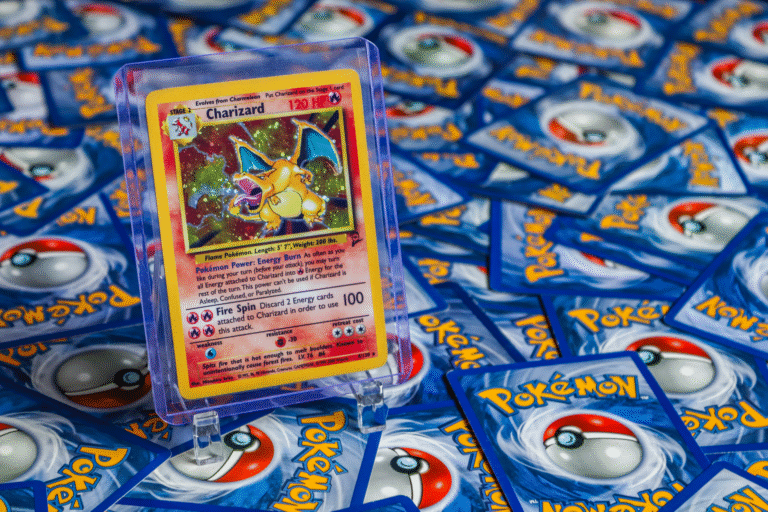
Recent sales data from early 2026 tells a compelling story about Base Set 1st Edition Charizard in PSA 7 condition: these cards remain extraordinarily expensive, commanding prices between $15,000 and $25,000 in the current market. This wide range reflects the reality of 1st Edition copies—they are rare enough that each sale carries significant weight, and condition variance at this grade level can swing valuations by thousands of dollars. The price point places PSA 7 1st Edition Charizards firmly in the luxury collectible category, accessible only to serious investors and wealthy enthusiasts with specialized knowledge of the market. What drives these prices is the dramatic scarcity of 1st Edition Base Set production compared to Unlimited printings.
A PSA 7 Unlimited Charizard, by contrast, sells for around $635–$645 as of early 2026, making the 1st Edition version roughly 25 to 40 times more expensive. This enormous premium isn’t just marketing—it reflects genuine rarity. The 1st Edition print run was a fraction of the Unlimited run, and most copies were played with, damaged, or lost to time. Finding one graded at PSA 7, which represents a well-preserved but not pristine card, is uncommon enough to trigger serious collector interest.
Table of Contents
- Why Is the 1st Edition Premium So Extreme Compared to Unlimited?
- What Does PSA 7 Condition Actually Mean for a 40-Year-Old Card?
- How Do Recent Sales Data Compare Across Grades?
- What Should Collectors Actually Consider Before Buying at This Price Point?
- What Are the Key Risks and Authentication Concerns at This Price Level?
- The Unlimited Alternative—A Practical Reality Check
- Market Outlook—What the 2026 Sales Data Suggests About Future Pricing
- Conclusion
Why Is the 1st Edition Premium So Extreme Compared to Unlimited?
The answer lies in production numbers and survival rates. Base Set 1st Edition was released in limited quantities in 1999 and 2000, while Unlimited printing ran for years with much higher volume. Most 1st Edition cards were kept in collections or played competitively, meaning high grades are genuinely scarce. When a PSA 7 1st Edition Charizard appears at auction, bidders understand they’re competing for something that may not come to market again soon—or perhaps not for months or years.
The PSA 10 1st Edition Charizard sale at Heritage Auctions in December 2025 for $550,000 sets a crucial benchmark for grade premiums. Industry analysis suggests that PSA 7 copies typically represent 20–30% of PSA 10 valuations, which would place them in the $110,000–$165,000 range theoretically. However, actual sales show lower prices, likely because the gap between a PSA 7 and a PSA 10 is visually significant and psychologically impactful for collectors—a card graded 7 has visible flaws and wear that concern preservationists. The $15,000–$25,000 range appears to reflect the actual demand ceiling for PSA 7 copies in today’s market.

What Does PSA 7 Condition Actually Mean for a 40-Year-Old Card?
PSA 7 represents “Near Mint” condition in the grading company’s terminology, meaning the card shows some wear but remains exceptionally well-preserved. For a Base Set 1st Edition Charizard from 1999–2000, this is genuinely impressive—the card has survived 25+ years without major damage, creasing, staining, or heavy play marks. However, “Near Mint” doesn’t mean “flawless.” A PSA 7 card will likely display minor edge wear, faint surface marks, or slight printing imperfections visible under close inspection. The limitation of PSA 7 is that it sits in an awkward middle ground.
collectors with unlimited budgets push toward PSA 8, 9, or 10, where the eye appeal is noticeably cleaner and the investment story is stronger. Collectors on a tighter budget hunt for PSA 6 copies, which cost dramatically less. PSA 7, in this context, appeals mainly to those seeking the best card they can afford within a specific budget, or collectors who value “solid condition” over pristine appearance. For a card worth tens of thousands of dollars, the difference between grades matters enormously—a PSA 8 unlimited charizard sold for $891–$1,078 in January 2026, while a PSA 9 sold for $1,725, showing how rapidly price accelerates with grades.
How Do Recent Sales Data Compare Across Grades?
Recent transactions provide a clear grade-by-grade roadmap for Unlimited cards, which is helpful for understanding how 1st Edition pricing might scale. A PSA 6 Unlimited charizard sold for $430 on January 19, 2026. Two weeks earlier, PSA 8 copies moved for $891 and $1,078. By December 2025, a PSA 9 Unlimited Charizard fetched $1,725. These data points show an accelerating price curve—the jump from PSA 6 to PSA 8 is roughly double, but the jump from PSA 8 to PSA 9 is another 60–90%, and the rise to PSA 10 would be even steeper.
For 1st Edition copies, this same curve applies but at a vastly higher baseline. If an Unlimited PSA 8 costs around $1,000, a 1st Edition PSA 8 might reasonably be expected to cost $25,000–$50,000 or more—the actual multiplier varies by market conditions and availability. The $15,000–$25,000 range for 1st Edition PSA 7 sits logically below that PSA 8 threshold, confirming that recent sales align with historical grade premiums. However, a practical warning: these comparisons assume consistent quality and provenance. A 1st Edition PSA 7 from a high-profile auction house with perfect provenance may command the upper end of that range, while a copy sold by an unknown seller without documentation might struggle to reach the floor.
What Should Collectors Actually Consider Before Buying at This Price Point?
Purchasing a $15,000–$25,000 Charizard requires strategy beyond just having cash available. First, provenance matters enormously. Cards sold through Heritage Auctions, PSA direct sales, or established high-end dealers carry the strongest historical records, making them far easier to resell later. A card with unclear origins or missing documentation—even if graded by PSA—can be significantly harder to move and may lose 20–30% of value in a quick sale.
Second, liquidity is a concern that many collectors underestimate. If you buy a 1st Edition PSA 7 Charizard for $20,000, selling it may take months or years if you need funds quickly. Unlimited Charizards in PSA 7 condition sell relatively frequently at $635–$645, but 1st Edition copies appear less often, meaning the market for resale is thinner. A comparison: selling a PSA 7 Unlimited might take a few weeks; selling a 1st Edition could take months or require a price reduction to attract serious buyers. This illiquidity is the tradeoff for owning one of the most iconic and scarce cards in the hobby—prestige comes with patience required.
What Are the Key Risks and Authentication Concerns at This Price Level?
Counterfeit and regrade concerns are legitimate at $15,000–$25,000 price points. High-value cards sometimes attract bad actors who attempt to crack graded cards out of their slabs and resubmit them, hoping for a higher grade. While PSA’s security features and database make this difficult, it’s not impossible. Always verify that the PSA hologram is authentic and matches the label details, and consider having any purchase authenticated independently by a trusted dealer or grader if you have doubts.
A second risk is grade inconsistency. PSA grading is subjective within defined parameters, and a single card might grade differently if resubmitted to a different grader or even the same grader on a different day. A card that looks like a solid PSA 7 to one evaluator might be seen as a PSA 6 or PSA 8 by another. This subjectivity affects resale value—if you pay $22,000 for what you believe is a strong PSA 7, but the market later values it closer to a weak PSA 7, you could face a 15–20% depreciation. Additionally, be cautious of heavily played or restored cards that have been chemically cleaned to hide wear—these can appear better than their actual grade warrants and may decline in value as the restoration degrades over time.
The Unlimited Alternative—A Practical Reality Check
For collectors who want a Base Set 1st Edition Charizard but cannot justify $15,000–$25,000, the Unlimited version at PSA 7 offers genuine appeal at $635–$645. While it lacks the prestige and rarity premium, an Unlimited PSA 7 is still a well-preserved copy of one of the most iconic cards in trading card history. It’s the same card, same artwork, same design—just from a larger print run. For educational purposes, display, or casual collection building, this is a meaningful and much more accessible entry point.
The limitation, of course, is that the Unlimited version will never appreciate at the rate or magnitude of a 1st Edition. An Unlimited PSA 7 purchased today at $640 might be worth $800–$1,000 five years from now, a decent but modest return. A 1st Edition PSA 7 at $20,000 could plausibly reach $30,000–$40,000 in the same timeframe if demand strengthens, though it could also stagnate or decline if the market cools. The choice between Unlimited and 1st Edition ultimately depends on whether you’re collecting for passion or primarily for investment.
Market Outlook—What the 2026 Sales Data Suggests About Future Pricing
The consistency of Unlimited pricing ($635–$645 across multiple sales in January–March 2026) suggests a stabilized market at this grade level. Prices aren’t spiking or crashing wildly, indicating that supply and demand are roughly in balance. For 1st Edition copies, the $15,000–$25,000 range likely reflects a similarly stable market, though each sale is significant enough that a single transaction can shift perception of the “market price.” Looking forward, the December 2025 PSA 10 sale for $550,000 is a bullish indicator for high-grade 1st Edition cards.
It suggests wealthy collectors and institutional buyers remain engaged with the premium end of the market, which may eventually lift demand for PSA 7–9 copies as those buyers “work down” the grade ladder due to availability. However, the Pokemon TCG market is cyclical and sensitive to broader trends in collectibles, trading, and youth engagement with the hobby. A major reprinting announcement, format changes, or economic downturn could dampen demand. For now, the recent sales data supports a “hold and wait” mentality for current owners rather than a “buy aggressively” signal.
Conclusion
Recent sales from early 2026 show that 1st Edition Base Set Charizard in PSA 7 condition remains a premium asset, valued between $15,000 and $25,000 in an active but selective market. These prices reflect genuine rarity—1st Edition copies are 25–40 times scarcer than Unlimited equivalents, and PSA 7 represents a meaningful achievement in preservation and condition for a 25+ year-old card. The grade occupies a logical position on the valuation curve, below PSA 8–10 where prices accelerate dramatically, and well above PSA 6 where collectors trade away hundreds of dollars in grade premium.
For collectors considering entry at this level, proceed with clear eyes about liquidity, provenance, and your personal investment thesis. If you’re buying purely for portfolio appreciation, understand that resale may take months or require price flexibility. If you’re buying for passion and display, a 1st Edition PSA 7 is an exceptional achievement—a card that survived decades, was well-kept, and represents a piece of trading card history. Either way, verify authenticity, confirm provenance, and consult recent comparable sales data before committing funds at this price point.