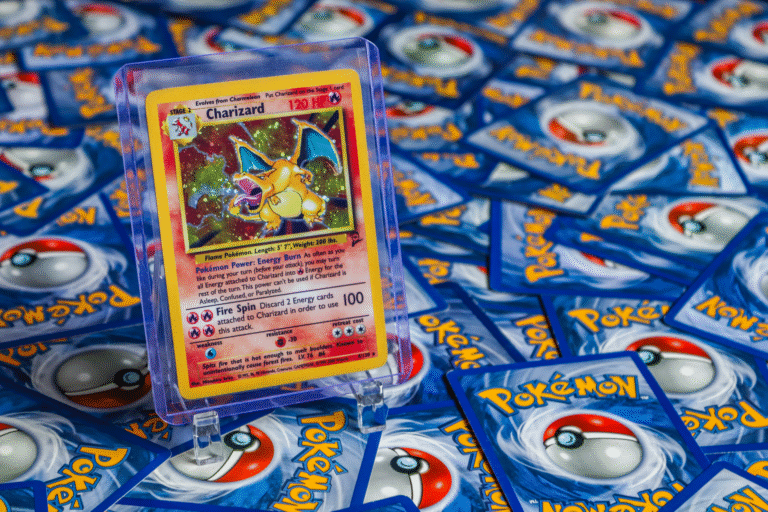
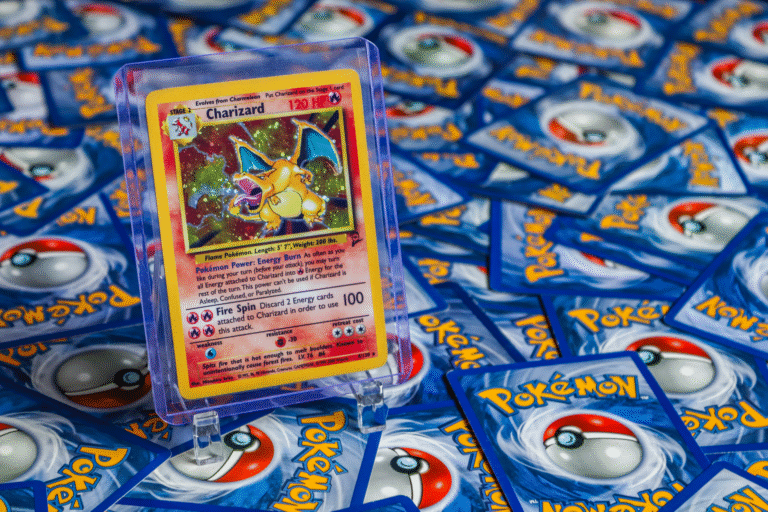
First edition Pokémon cards matter to investors, collectors, and financial planners who have never played the game or cared about catching ’em all. The market for vintage Pokémon cards—particularly first edition pieces from the original Base Set released in 1999—has evolved into a legitimate alternative asset class with documented price appreciation that routinely outpaces the stock market. A 1st Edition Shadowless Charizard purchased for $5,000 in 2013 sold for $390,000 in late 2023, representing a 7,500% return over a decade. This is not speculation or hype.
These are real transactions documented by major auction houses, tracked by market analysts, and driving portfolio decisions for people whose interest in Pokémon begins and ends with their balance sheet. The significance extends beyond individual card sales to the broader market dynamics that make sealed product and graded vintage cards potentially valuable regardless of whether the owner ever plans to use them. Pokémon card appreciation averaged 46% in a single year—substantially outpacing the S&P 500’s historical average annual return of 12%. The trading card market itself grew 350% between 2020 and 2025, driven largely by Pokémon TCG spending. This article explores why first edition cards maintain this value proposition, what drives their continued appreciation, and what potential buyers and observers should understand about this market before treating it as either an investment opportunity or a cultural footnote.
Table of Contents
- What Makes First Edition Cards Hold Value Beyond the Game Itself?
- Grading, Condition, and the Multiplier Effect on Value
- Historic Price Appreciation and Market Proof Points
- Current Market Access and Entry Points for Non-Players
- Risk Factors and Market Volatility to Consider
- The Historical Anchor: Why 1999 Base Set Matters Beyond Nostalgia
- Market Outlook and the Millennial Wealth Transfer
- Conclusion
What Makes First Edition Cards Hold Value Beyond the Game Itself?
First edition Pokémon cards from the original 1999 base Set represent a fixed asset with permanently constrained supply. The Pokémon Company and its licensees have not reprinted vintage WOTC-era (Wizards of the Coast era) cards, and they are not planning to. This creates a mathematical certainty: every first edition card in existence is all that will ever exist. Demand, however, continues to grow as millennial collectors enter their peak earning years and recognize Pokémon nostalgia as a legitimate store of value. A person who has never opened a Pokémon booster pack in their life can understand the basic supply-and-demand principle that limited, non-reproducible assets tend to appreciate when demand is stable or rising.
The market for first edition cards operates independently of gameplay relevance. You do not need to understand whether Charizard is strong in competitive play, what its attack costs are, or why collectors value it for nostalgic reasons. You only need to understand that a 1st Edition Shadowless Charizard in perfect condition (PSA 10 grade) sold for $550,000 in December 2025. The buyer may have been a collector, a financial advisor managing a client’s alternative assets, an institution building a portfolio of tangible collectibles, or an investor with no emotional attachment to Pokémon whatsoever. All of them participated in the same market because the supply constraint and demand growth made the purchase rational.

Grading, Condition, and the Multiplier Effect on Value
Condition grading creates a valuation pyramid where perfect-grade cards are worth 50 to 100 times more than the same card in heavily played condition. A 1st edition Shadowless Blastoise Holographic card in psa 10 condition sold for approximately $88,000 in July 2025. The same card in PSA 7 or PSA 8 condition might trade for $800 to $3,000. This is not a minor variance—it is a fundamental restructuring of the asset’s value based on a single factor: preservation. Professional grading (PSA, BGS, CGC) has standardized this assessment, making it possible for someone unfamiliar with trading cards to understand that a 10 is significantly more valuable than a 6, just as a 1945 penny in mint condition is worth more than the same coin heavily circulated.
The limitation and warning here: grading is not free, and vintage card grading has become expensive and slow. A single card sent to PSA for grading now costs $30 to $500+ depending on turnaround time, and the service maintains significant backlogs. This means that for moderately valuable cards (under $1,000), grading costs can consume 10% to 20% of the card’s market value. Additionally, graded cards can be controversial—some collectors dispute specific grades, and a single point difference in grade can swing a card’s value by tens of thousands of dollars. This introduces subjective risk into a market that otherwise appears objective.
Historic Price Appreciation and Market Proof Points
The most compelling evidence that first edition cards hold value independent of player interest is documented historical appreciation. A first edition Shadowless Charizard purchased for $5,000 in 2013 sold for $390,000 in late 2023—a 7,500% return over ten years. During the same period, the S&P 500 delivered approximately a 350% total return (including dividends). This is not an outlier. Pokémon card market performance has been sustained across product categories.
Out-of-print vintage WOTC-era and early Japanese exclusive sealed product appreciated 15% to 25% annually in the 12-month period leading to 2026, according to market tracking data. The Pikachu Illustrator card, arguably the most famous Pokémon card ever printed, sold for $16.5 million in 2026, making it the most expensive Pokémon card ever sold. This transaction occurred despite the card having no functional use in gameplay and despite Pikachu being a character some people find culturally dated or overwrought. The sale demonstrates that extreme valuations in this market are tied to scarcity, condition, and historical significance rather than to whether the buyer thinks the card is cool. A financial advisor or institutional investor looking at this data point sees proof that the asset class can support large valuations and command buyer competition.

Current Market Access and Entry Points for Non-Players
For someone interested in participating in this market without opening booster boxes or learning the trading card game, multiple entry points exist. As of March 2026, Perfect Order Booster Boxes traded at $197.42, while booster bundles traded at $1,260.56. These are sealed, unopened products that can be held as inventory or investment.
In May 2026, the Japanese market saw price increases—booster packs increased from ¥180 to ¥200, and booster boxes from ¥5,400 to ¥6,000, a 11.1% increase—signaling continued scarcity and demand pressure even for current-production items. The tradeoff to understand: current-production sealed product (modern booster boxes and packs) offers lower potential returns than vintage graded singles, but it also involves lower subjective risk, lower grading costs, and simpler storage. A first edition booster box appreciating 15% to 25% annually is a compelling return, but it requires no grading decision, no preservation expertise, and no authentication concerns. For someone who wants exposure to Pokémon card appreciation without becoming a collector or expert, sealed vintage product provides a middle ground between holding nothing and attempting to acquire and grade individual cards worth tens of thousands of dollars.
Risk Factors and Market Volatility to Consider
The first edition Pokémon card market can be volatile and is not guaranteed to appreciate indefinitely. The market is driven partly by nostalgia, millennial discretionary spending, and speculation. If the cultural narrative around Pokémon shifts, or if collecting trends pivot toward other properties (Magic: The Gathering, Yu-Gi-Oh, sports cards), demand could soften. Additionally, the market is relatively illiquid compared to equities—selling a $500,000 card requires finding a buyer willing to pay that price, and auction-house sales involve commissions of 10% to 20%.
A person holding a single high-value card cannot convert it to cash instantly the way they could sell 1,000 shares of a major corporation. Authentication fraud and counterfeit cards present an ongoing risk, particularly in the $1,000 to $10,000 range where counterfeiting can be profitable. While PSA and BGS grading provide some protection by encapsulating and authenticating cards, the market has experienced instances of internal fraud and, historically, grade disputes. Any investor considering significant capital allocation to first edition cards should source through established dealers, verified auction houses, and verified grading services. The cheapest listing for a rare card is frequently the most suspicious one.

The Historical Anchor: Why 1999 Base Set Matters Beyond Nostalgia
The first edition Base Set was released in 1999 and represents the genesis of the English-language Pokémon Trading Card Game. From a historical perspective, this matters. Just as 1952 Topps baseball cards have value because they were the first modern baseball cards, 1999 first edition Pokémon cards have value because they represent the beginning of a major entertainment property.
The first edition cards are distinguishable by a distinctive stamp on the left side of the card, making them easy to identify and authenticate. The historical significance creates a floor for valuation even if the Pokémon brand declines in popularity over the next decade. Museums and institutional collectors acquire these cards for their place in entertainment history. A person who believes Pokémon itself will fade from culture can still rationally hold first edition cards as historical artifacts—similar to how someone might own a Beatles record or a first edition book without being a devoted fan of that artist or author.
Market Outlook and the Millennial Wealth Transfer
The Pokémon card market is supported by a demographic wave that has not yet crested. Millennials—the generation that grew up with Pokémon in the late 1990s and 2000s—are now entering their peak earning years and have begun receiving inheritances from Baby Boomer parents. This wealth transfer, combined with the cultural nostalgia Pokémon represents for this cohort, suggests continued demand pressure on first edition cards through at least the next decade. The market is unlikely to collapse unless some systemic shock occurs (major counterfeiting discovery, market manipulation exposure, or cultural pivot).
Looking forward, first edition cards are likely to remain a legitimate alternative asset class for diversified portfolios. Institutional investors, pension funds, and family offices have begun acquiring vintage trading cards as inflation hedges and non-correlated assets. This institutional participation lends stability and liquidity to the market that did not exist five years ago. Whether first edition cards are part of your portfolio or you are simply observing the market, understanding their value proposition independent of gameplay or fandom is essential to understanding how modern collectibles work as financial assets.
Conclusion
First edition Pokémon cards matter to people who never opened them because they represent a finite asset with growing demand, documented historical appreciation, and institutional acceptance. The market is supported by clear supply constraints (no reprints of WOTC-era cards), strong demand from a large demographic cohort, and transparent pricing through professional grading and documented auction sales. A person with no interest in Pokémon gameplay can understand why a 1st Edition Shadowless Charizard in PSA 10 condition sold for $550,000 or why sealed vintage booster boxes appreciate 15% to 25% annually—these are asset appreciation mechanics, not collector sentiment.
For potential participants or observers, the key takeaway is this: the first edition Pokémon card market operates according to supply, demand, and scarcity principles that are independent of fandom. Whether you view these cards as an investment opportunity, a hedge against inflation, or simply an interesting case study in how modern collectibles derive value, understanding the market requires no emotional attachment to the property. The numbers speak for themselves, and the numbers say that some of the best-performing alternative assets of the past decade have never been removed from their sealed packaging or played with by human hands.