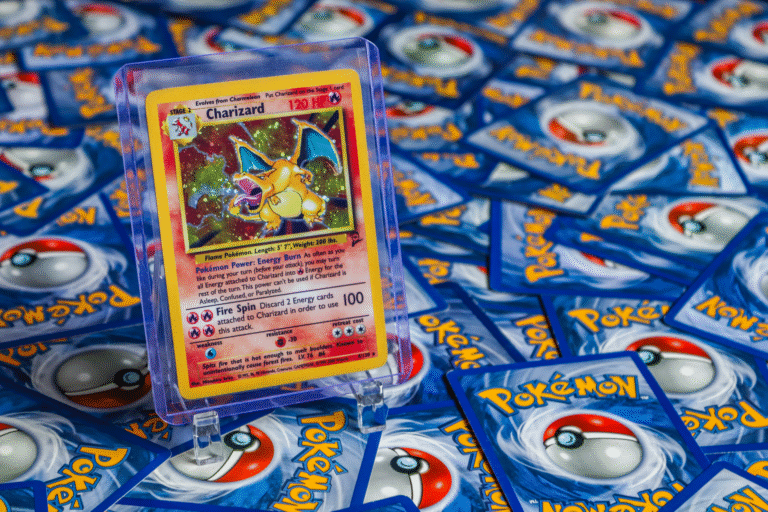
Recent sales data specifically for Base Set Unlimited Charizard graded PSA 4 is remarkably difficult to find in public market reports, which reveals an important truth about the Pokemon card market: the auction house spotlight rarely falls on mid-grade copies. When major sales are reported—particularly the record-setting $1.7 million Japanese Base Set Charizard in PSA 10 from March 2026—the focus is almost entirely on the highest grades.
A PSA 4 Base Set Unlimited Charizard, by contrast, occupies a different market segment entirely, where sales happen more quietly and pricing data remains scattered across private collections, niche marketplaces, and specialized grading databases rather than headline-grabbing auction results. What we do know about Base Set Unlimited Charizard pricing suggests that ungraded or general market copies typically range from $300 to $500, but this doesn’t tell us the specific trajectory of PSA 4 grades, which represent cards with visible wear—light to moderate creasing, corner wear, and surface marks. The gap between what a PSA 4 might sell for and what we see reported in mainstream Pokemon card sales data highlights a critical limitation: mid-grade vintage cards move through the market constantly, but their sales are rarely aggregated into the public narratives that dominate Pokemon collecting discourse.
Table of Contents
- WHERE PSA 4 FITS IN THE BASE SET CHARIZARD MARKET
- THE CHALLENGE OF FINDING PSA 4 SALES DATA
- CONTEXT FROM RECENT HIGH-GRADE SALES
- RESEARCHING VERIFIED PSA 4 PRICING
- UNDERSTANDING MARKET MOVEMENT FOR MID-GRADE CARDS
- THE ROLE OF AUTHENTICATION AND GRADING CONSISTENCY
- FUTURE OUTLOOK FOR BASE SET MID-GRADE CARDS
- Conclusion
- Frequently Asked Questions
WHERE PSA 4 FITS IN THE BASE SET CHARIZARD MARKET
The base set Unlimited Charizard market is deeply stratified by grade, with values fluctuating dramatically across the PSA scale. A PSA 9 copy of this same card sold for $1,406,250 in March 2026—a jaw-dropping figure that reflects the card’s iconic status and rarity in near-mint condition. Yet this comparison actually illustrates the problem: we have extensive public information about PSA 9 and PSA 10 sales, but very little about the PSA 4 market, which is several grades below. The grade difference between PSA 4 and PSA 9 represents five full points on a 10-point scale, each point carrying meaningful price implications based on collector demand.
PSA 4 cards are classified as “Very Good-Excellent” by PSA standards, meaning they show obvious handling and wear but remain intact and readable. For a card as old as the Base Set Unlimited Charizard—now over 25 years old—a PSA 4 represents a realistic preservation state for many vintage copies that were actually played with or casually collected. This grade sits comfortably above “Poor” and “Fair” categories but distinctly below the “Mint” range where exponential price increases occur. Understanding where PSA 4 sits in the broader market means recognizing that collectors pursuing this grade are typically seeking an authentic, verifiable vintage piece rather than an investment trophy or museum piece.

THE CHALLENGE OF FINDING PSA 4 SALES DATA
One of the most significant limitations when researching recent PSA 4 sales is that major auction platforms and Pokemon market reporting services rarely highlight mid-grade sales in their public reports. Sites like the price guide, PokeData.io, and PokeScope maintain detailed historical databases that can be filtered by specific grades, and PSAcard.com itself aggregates auction prices directly from completed sales—yet these records are scattered across multiple platforms and require active research rather than appearing in monthly market summaries. When Pokemon card media outlets publish “top sales” lists, they almost always feature PSA 9 and PSA 10 copies, creating a visibility gap where PSA 4 sales data exists but remains largely invisible to casual observers.
This creates a practical problem for collectors trying to understand current PSA 4 values: the data exists, but you must actively seek it out. Checking PSAcard.com’s auction price history directly, filtering by Charizard card #4 from the Base Set and PSA 4 grade specifically, will provide the most reliable window into actual recent sales. Similarly, PokeScope and the price guide allow filtering by grade and date, enabling you to see real transactions rather than asking dealer estimates. The lesson here is that mid-grade market research requires more effort than high-grade research—there are no headlines to read, only databases to search.
CONTEXT FROM RECENT HIGH-GRADE SALES
The March 2026 high-grade sales provide important context, even though they don’t directly answer the PSA 4 question. A Japanese Base Set Charizard in PSA 10 commanded $1.7 million, while a PSA 9 sold for $1,406,250 at the same time. These figures tell us that collector demand for this card remains intense and that condition premiums are substantial—the difference between PSA 9 and PSA 10 on a single card was nearly $300,000. However, extrapolating backward from PSA 10 to PSA 4 is dangerous; the pricing curve is not linear.
A PSA 4 is unlikely to fetch anywhere near proportionally less than these figures because the market dynamics are fundamentally different. High-grade Base Set Charizards function as collectible assets and investment pieces, attracting serious collectors and speculators willing to pay extraordinary premiums for rarity and condition. PSA 4 copies, by contrast, operate in a more practical collector market where buyers are often seeking the card for its historical significance or for collection completion rather than as a financial instrument. This explains why PSA 4 sales don’t make headlines—they’re real market activity, but they’re not the exceptional, record-breaking transactions that generate media coverage.

RESEARCHING VERIFIED PSA 4 PRICING
To find actual recent PSA 4 Base Set Unlimited Charizard sales, your best resources are the specialized Pokemon card databases that maintain transactional history. PSAcard.com offers an auction prices section where you can filter by card, grade, and sale date—this provides direct access to what copies have actually sold for. The price guide similarly allows you to track price history by grade, showing both current market listings and historical sales data. PokeData.io and PokeScope also provide grade-specific pricing databases, though their interfaces and data completeness vary. The advantage of these sources is that they’re updated regularly and reflect real-world sales rather than dealer asking prices.
When comparing prices across these platforms, remember that asking prices and actual sale prices often differ significantly. A PSA 4 Charizard might be listed for $1,200, but if it hasn’t sold recently, that price may reflect dealer optimism rather than market reality. Historical sales data is more reliable than current listings because it shows what buyers actually paid. Cross-referencing the same card across multiple platforms helps establish where the true market price sits. One practical limitation: sales data for older mid-grade cards can be sparse, particularly if the card wasn’t graded in recent years, so you may find monthly or even quarterly data gaps in some periods.
UNDERSTANDING MARKET MOVEMENT FOR MID-GRADE CARDS
The Pokemon card market overall has experienced significant volatility since its pandemic-era peak in 2021, and Base Set cards have been particularly affected by this correction. Mid-grade cards like PSA 4 copies often see more dramatic percentage swings than top-tier grades because they’re more sensitive to collector sentiment and casual market changes. When Pokemon card enthusiasm is high, PSA 4 copies may see increased demand as entry-level collectors purchase vintage cards; when enthusiasm cools, these mid-grade cards often see the steepest discounts. High-grade copies maintain value better during downturns because serious collectors continue to pursue them, but PSA 4 copies become less appealing when money is tight.
A critical warning: don’t assume that PSA 4 pricing will scale proportionally with high-grade sales. The $1.7 million Japanese PSA 10 Charizard is a one-of-one market phenomenon that reflects extraordinary rarity and collector psychology around the absolute finest example. A PSA 4 English Base Set Unlimited Charizard exists in far greater quantities and operates in a completely different market. While that high-grade sale does confirm that Base Set Charizard demand remains healthy, it provides little direct guidance for PSA 4 pricing.

THE ROLE OF AUTHENTICATION AND GRADING CONSISTENCY
One practical consideration specific to researching historical PSA 4 sales is that PSA’s grading standards have evolved over its 30-year history. A card graded PSA 4 in 2005 might receive a different grade if submitted today, which introduces historical comparison challenges. When examining older sales data, you should ideally focus on more recent transactions—sales from 2024 and 2025 represent cards graded under current PSA standards. This makes recent sales more reliable for establishing fair value than vintage sales data from 10 or 15 years ago.
If you’re considering purchasing a PSA 4 Charizard, comparing its asking price to PSA 4 sales from the past 6-12 months provides the most relevant market context. Another consideration: the market distinction between PSA and BGS (Beckett Grading Services) graded cards can affect pricing. Most reported Base Set Charizard sales focus on PSA grades, but some collectors prefer BGS for its subgrades and hologram preservation. A PSA 4 and a BGS 4 might price differently based on collector preference and supply of each grade. When researching PSA 4 specifically, ensure you’re not conflating PSA and BGS data.
FUTURE OUTLOOK FOR BASE SET MID-GRADE CARDS
The Pokemon card market’s maturation suggests that mid-grade vintage cards like PSA 4 Base Set Charizards will continue operating as stable, moderate-value collectibles rather than explosive growth opportunities. The extraordinary gains that occurred in 2020-2021 are unlikely to repeat, but that doesn’t mean PSA 4 copies will decline sharply. They occupy a useful market position: affordable enough for casual collectors to pursue, but authenticated and graded in a way that creates price transparency and resale liquidity.
As the market normalizes further, these mid-grade cards may actually become more attractive to practical collectors who value history and authenticity over investment potential. Looking ahead, the trend toward detailed sales data and market transparency should gradually improve the availability of PSA 4 pricing information. Blockchain-based marketplace records, expanded database coverage, and increased collector focus on mid-grade segments may eventually make it easier to find verified recent sales for specific grades. For now, though, PSA 4 Base Set Charizards remain in a data-poor market segment—real sales happen regularly, but finding them requires active research and familiarity with the specialized databases that aggregate this information.
Conclusion
Recent sales data specifically for Base Set Unlimited Charizard in PSA 4 grade is difficult to locate in mainstream Pokemon card market reporting, primarily because mid-grade sales lack the newsworthiness of record-setting high-grade transactions. The most recent headline sales—the $1.7 million PSA 10 and $1,406,250 PSA 9 from March 2026—confirm that Base Set Charizard demand remains strong, but they tell us little about PSA 4 pricing specifically. To find verified recent sales, you’ll need to consult specialized databases like PSAcard.com’s auction prices, the price guide, PokeData.io, or PokeScope, where you can filter by grade and review actual transaction history.
If you’re researching a specific PSA 4 Base Set Unlimited Charizard purchase or sale, focus your research on transactions from the past 6-12 months to ensure you’re working with data consistent with current grading standards. Cross-reference prices across multiple databases, distinguish between asking prices and actual sales prices, and remember that mid-grade cards operate in a fundamentally different market than the investment-tier pieces that generate headlines. The data exists—it’s simply a matter of knowing where to look and understanding the limitations of each source.
Frequently Asked Questions
What should a PSA 4 Base Set Unlimited Charizard typically cost?
Based on available market data, Base Set Unlimited Charizards in general range from $300–$500 for ungraded copies, but PSA 4 specific pricing requires checking databases like PSAcard.com or the price guide, as recent sales data for this grade is not widely reported in public market summaries.
Why is PSA 4 sales data harder to find than PSA 9 or PSA 10 data?
High-grade sales generate media coverage and auction house headlines, while mid-grade sales happen regularly but without publicity. PSA 4 transactions occur constantly but are only accessible through specialized databases rather than market reports.
Should I extrapolate backward from the $1.4 million PSA 9 sale to estimate PSA 4 value?
No. The pricing curve between PSA 9 and PSA 4 is not linear, and high-grade sales operate in a fundamentally different market segment driven by investment demand rather than collector interest in mid-grade pieces.
Where is the most reliable place to check PSA 4 sales history?
PSAcard.com’s auction prices section allows you to filter by card, grade, and date, providing direct access to completed sales. The price guide and PokeScope offer similar functionality with different interfaces.
Have PSA 4 Base Set Charizard prices increased or decreased recently?
The overall Pokemon card market has corrected from pandemic-era peaks, and mid-grade cards like PSA 4 copies typically experience larger percentage swings than high-grade cards, but recent specific pricing trends for PSA 4 require checking current database records.
Is a PSA 4 Base Set Charizard a good investment?
PSA 4 copies function primarily as collectible vintage cards rather than investment assets. They offer authentic historical access and stable value, but don’t expect the appreciation potential of PSA 9+ copies.