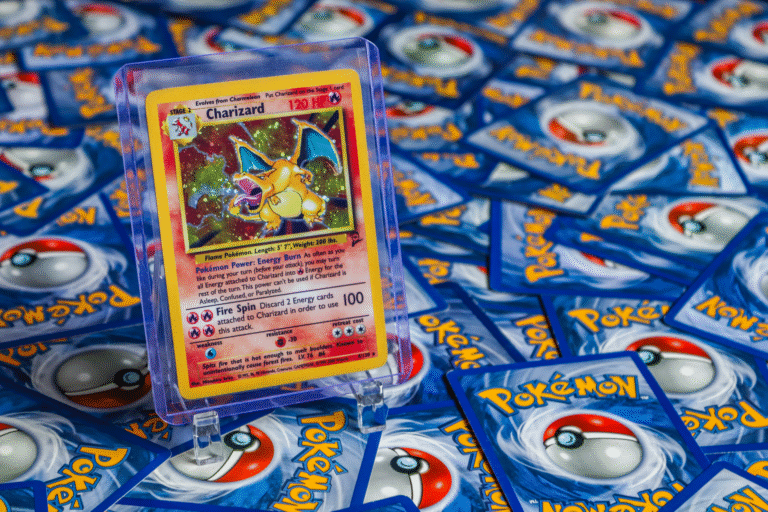
Base Set gray stamp cards have become a nuanced and often misunderstood segment of the vintage Pokémon collecting market, especially in the context of the dramatic price corrections that followed the 2021 peak. Buyers should know that gray stamp cards—Base Set first editions with lighter or faded stamp printing caused by insufficient ink on the First Edition stamp plate—remain genuinely scarce and do command a small premium over standard first editions when properly authenticated. However, the market has shifted dramatically since Logan Paul’s $5.25 million PSA 10 Charizard purchase in March 2021, which sent shock waves through collecting communities and inflated gray stamp values to unsustainable levels.
The reality today is that gray stamp Base Set cards are worth substantially less than they were at the market’s peak, but they have stabilized in a more sustainable range that reflects their actual rarity and collector demand. A PSA 10 Base Set Charizard that commanded £18,000-£22,000 in March 2021 dropped to £4,000-£6,000 by March 2023—a 70-75% decline—and prices have generally held or found modest support at these lower levels through 2026. Understanding the difference between genuine gray stamps and the increasingly common altered stamps that flood the market is now essential for buyers looking to avoid costly mistakes.
Table of Contents
- How Did Gray Stamp Cards Peak and Crash So Dramatically?
- Identifying Genuine Gray Stamps vs. Altered Stamps in Today’s Market
- What Is the Current Value of Gray Stamp Base Set Cards?
- Should You Buy Gray Stamp Cards Now, or Wait Further?
- Authentication Risk and the Cost of Grading
- Gray Stamps vs. Shadowless—Understanding the Variant Hierarchy
- Market Outlook—Is the Pokémon Card Market Recovering in 2026?
- Conclusion
How Did Gray Stamp Cards Peak and Crash So Dramatically?
The 2020-2021 buying frenzy was driven by celebrity attention, FOMO-fueled demand, and the broader cryptocurrency and stimulus-era retail speculation that inflated entire collectibles categories. Logan Paul’s public record-breaking purchase became the benchmark moment: when a single card sells for millions in media-covered transactions, it signals to less experienced buyers that all cards in that category must be worth proportionally more. PSA 10 base Set Charizards and Jungle Charizards benefited most from this halo effect, with the latter reaching $220,000 in a 2021 sale. Gray stamp variants, being rarer than standard first editions, attracted collectors willing to pay premiums they believed would only increase.
By July 2021—just four months after the peak—the market had already begun correcting sharply. PSA 10 prices fell 25%, and PSA 9 grades dropped 32% from their March highs. The correction continued accelerating through late 2023 and into 2024, driven by a combination of falling discretionary spending due to rising interest rates, Pokémon Company International’s decision to dramatically increase print runs for modern sets (which oversaturated the market for newer products and made vintage cards seem less scarce by comparison), and simple mean reversion as speculative money fled the category. By late 2023, PSA 10 Jungle Charizards had fallen to $70,000-$90,000—a 60-68% drop from their 2021 peak.

Identifying Genuine Gray Stamps vs. Altered Stamps in Today’s Market
The practical challenge buyers face is that altered gray stamps have become increasingly common in the secondary market, flooding auctions and online sales with cards that appear to have the gray stamp but were actually modified by sellers attempting to increase value. Legitimate gray stamps are the result of a manufacturing defect from the original print run where insufficient ink coverage created a noticeably lighter appearance on the “First Edition” stamp. Altered stamps are created after-market through abrasion, lightening, or ink removal techniques designed to mimic that appearance. The most reliable way to spot an altered stamp is to examine the precise positioning of the “T” in “EDITION” relative to the art box.
On a genuine gray stamp, the “T” should align correctly with the bottom left corner of the art box frame, maintaining consistent spacing with the other letters. On altered stamps, this positioning is often off—the result of imperfect mechanical or manual alteration. CGC Cards has issued specific authentication alerts about gray stamp fraud, noting that detection requires close physical examination under proper lighting, which is why submitting high-value cards to professional graders is essential. A common mistake among buyers is assuming that lighter-looking stamps are automatically more valuable; in fact, the lighter appearance must be accompanied by the correct positioning and appropriate aging characteristics to be considered legitimate.
What Is the Current Value of Gray Stamp Base Set Cards?
Gray stamp Base Set cards now occupy an interesting middle ground in the collecting market. The market has stabilized into what experts describe as a “correction” rather than a crash—prices are lower than 2021 peaks but they’re holding relatively steady rather than continuing to free-fall. For context, shadowless Base Set cards (an even rarer and earlier variant) command significant premiums: a shadowless Raichu trades for $300+, a shadowless Alakazam around $400, and shadowless Charizards remain the most expensive Base Set cards with no real competition for value.
Gray stamp first editions fall into a category below shadowless but above non-first-edition cards, commanding the “small premium” mentioned by professional graders when the cards are properly authenticated. The challenge is that 2024-2025 saw average sale prices for high-grade vintage cards drop an additional 25-40% compared to 2022 peaks, meaning a card that sold for $50,000 in 2022 might reasonably be valued at $30,000-$37,500 in 2025-2026. Patience matters here—individual sales vary widely depending on condition, specific card identity, buyer motivation, and whether the sale occurs at auction (typically lower prices) or through private collector networks (potentially higher prices). Buying gray stamp cards today requires accepting that you’re purchasing at a much lower price point than 2021, but with the understanding that these prices reflect genuine scarcity and decades of baseline collector demand rather than speculative bubble pricing.
Should You Buy Gray Stamp Cards Now, or Wait Further?
The practical decision facing buyers is whether current prices represent fair value or whether further declines are likely. The market indicators suggest that the major correction has already occurred: by late 2023, prices had already fallen 70-75% from peak, and additional declines from 2024-2025 averaged 25-40% rather than another 70% drop. This pattern suggests the market is finding a floor rather than continuing free-fall. However, this doesn’t mean prices will immediately rebound—inflation remains elevated, interest rates have discouraged luxury spending, and modern card overproduction by Pokémon Company International continues to remind collectors that rarity is relative.
The tradeoff is straightforward: buying now means paying substantially less than someone who bought in 2021, but potentially more than someone who waits another 12-24 months if the correction continues at a slower pace. Experienced collectors note that Base Set cards with proven scarcity—including authentic gray stamps—have weathered multiple market cycles over decades without ever returning to zero value, unlike speculative bubbles that sometimes do. The advantage of gray stamps specifically is that their rarity is genuinely scarce (caused by a manufacturing defect) rather than artificially limited by Pokémon Company decisions. A PSA 10 gray stamp Charizard remains statistically much rarer than a PSA 10 standard first edition, even if the premium is lower than in 2021.
Authentication Risk and the Cost of Grading
A critical buyer consideration is that ungraded gray stamp cards are extremely difficult to verify without professional examination, and even buyers experienced with card authentication can be fooled by high-quality alterations. Submitting a card to CGC or PSA for authentication adds $20-$50 to the cost for economy grading services and significantly more for expedited processing, which cuts into your margin when buying lower-grade or modestly valued cards. This creates a practical floor for gray stamp card value: cards that might be “worth” $200-$300 ungraded become impractical to grade, since the authentication cost eats the entire value.
The warning here is that buying ungraded gray stamps from private sellers or less-reputable auction sites carries substantial risk. A seller might genuinely believe their card is a gray stamp without understanding alteration techniques, or they might be deliberately misrepresenting an altered card. The only reliable way to purchase high-value gray stamps is to buy already-graded cards from reputable dealers or auction houses that provide guarantees of authenticity, even though those cards will carry the grading premium in their price. CGC’s case-by-case recognition of gray stamps on 1st Edition Base Set cards means that a CGC-graded gray stamp carries explicit authentication—the grader has examined it in person and confirmed legitimacy, which is worth the additional cost.

Gray Stamps vs. Shadowless—Understanding the Variant Hierarchy
Gray stamp variants occupy a specific rarity tier within Base Set variants that’s important to understand for pricing context. Shadowless cards (where the drop shadow around artwork is absent or minimal) are even rarer than gray stamps, requiring buyers to pay significantly more—for example, a shadowless Charizard is the most expensive Base Set card in the entire ecosystem, commanding substantially higher premiums. This hierarchy matters because it affects how gray stamp cards are valued relative to the market overall.
A gray stamp first edition is rarer and typically more expensive than a non-first-edition shadowless card, but less expensive than a genuine shadowless first edition of the same card. The practical implication is that if your budget allows for a shadowless card, that’s generally the more reliable long-term hold due to its even greater scarcity. If you’re looking to maximize scarcity within the gray stamp category specifically, focus on cards known to have lower gray stamp populations (determined by PSA population reports) rather than cards with high gray stamp populations, which suggests the variant occurred more frequently during that print run.
Market Outlook—Is the Pokémon Card Market Recovering in 2026?
The 2026 market remains in correction mode rather than recovery mode, but the pace of decline has moderated considerably from 2021-2023. Pokémon Company International’s dramatic print increases have flooded the market with modern products, which paradoxically supports vintage card demand by reminding collectors that 25-year-old cards are genuinely scarce by comparison. Base Set cards continue to benefit from decades-long collector demand that extends beyond any single market cycle.
The Pokémon Trading Card Game remains substantially more popular than it was before 2020, meaning baseline collector interest supports vintage prices even without speculative bubble pricing. Gray stamp cards specifically may see modest appreciation over the next 2-3 years if the current correction period ends and the market stabilizes, but expectations should be modest—returns are more likely to align with long-term collectibles appreciation (3-5% annually) rather than explosive bubble gains. The advantage of buying gray stamps today is that you’re purchasing at a rational price point that reflects their genuine scarcity without speculative premium, which positions them better for long-term holding than equivalent cards purchased at peak prices.
Conclusion
Base Set gray stamp cards are authentic rarities that deserve a place in serious collections, but buyers purchasing in 2025-2026 should understand that they’re benefiting from a 70-75% price correction from 2021 peaks while still paying meaningful premiums over standard first edition variants. The key to successful purchasing is distinguishing genuine gray stamps from the increasingly common altered stamps in the market—a distinction that requires professional grading for high-value purchases.
Prices have stabilized in a sustainable range that reflects genuine scarcity rather than speculative bubble pricing, making current valuations reasonable for buyers with long-term collecting horizons. The practical path forward is to purchase only graded cards from reputable sources, to understand gray stamps’ position in the broader variant hierarchy relative to shadowless and other rare forms, and to recognize that any appreciation from current levels will likely be measured in years rather than months. The days of 100%+ annual returns on these cards have passed, but the days of total value destruction have also passed—gray stamps represent a middle ground between speculative bubble pricing and fundamentally worthless collectibles, supporting their appeal to serious collectors willing to accept modest long-term appreciation in exchange for owning genuinely scarce pieces of collectible history.