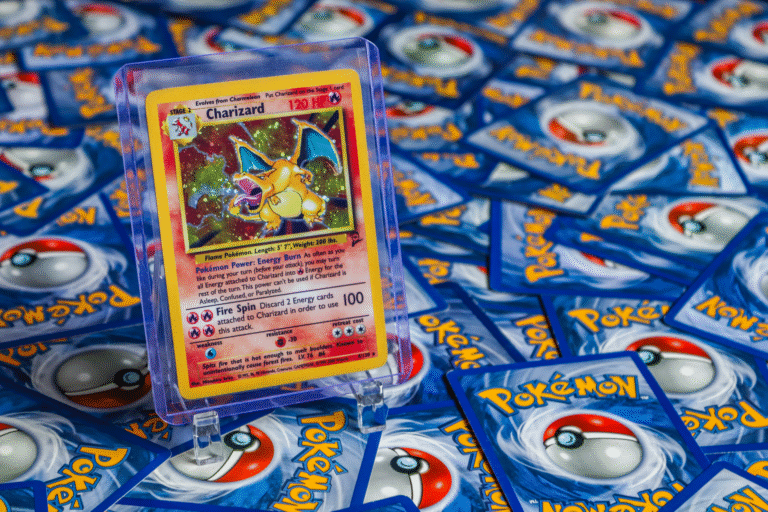
Base Set Bill cards have experienced significant momentum over the last twelve months, with the Pokemon 30th anniversary celebration in February 2026 triggering a 30-50% price increase across vintage Base Set inventory. For buyers entering this market, the critical takeaway is that Bill’s condition and grading now directly determine value in ways that would have seemed extreme just a few years ago—a PSA 10 graded copy can sell for dramatically more than an ungraded version of the same card.
For example, a PSA 10 1st Edition Base Set Bill card would command prices far exceeding a lightly played raw copy, reflecting both nostalgia-driven demand and the collector community’s shift toward professionally graded inventory. The broader context matters too: the secondary Pokemon card market reached $2.1 billion in total resale volume by mid-2026, and this growth is pulling vintage cards like Bill into active trading channels. If you’re considering purchasing a Base Set Bill card right now, you’re entering a market that’s fundamentally different from twelve months ago—more expensive, more graded, and more price-conscious about condition.
Table of Contents
- How the 30th Anniversary Reshaped Base Set Bill Card Pricing
- The Condition Reality That Separates Expensive Bill Cards from Cheap Ones
- Raw Bill Cards Versus Graded Copies in Today’s Market
- Where to Check Current Bill Card Prices and Negotiate Fair Value
- Authentication and the Hidden Risk of Counterfeit Base Set Cards
- Long-Term Investment Outlook for Base Set Bill Cards
- The Role of Nostalgia and Generational Demand in 2026 and Beyond
- Conclusion
How the 30th Anniversary Reshaped Base Set Bill Card Pricing
The February 27, 2026 Pokemon 30th anniversary celebration wasn’t just a nostalgia moment—it was a pricing inflection point for vintage base Set cards including Bill. Price increases of 30-50% began appearing across the market in advance of the anniversary, driven by collectors returning to the original 1999 Base Set and competitive buyers seeking investment positions before supply tightened. Bill, as a utility card from that era, benefited directly from this wave, with PSA submissions climbing 22% in February 2026 alone as collectors sent raw cards for professional grading in hopes of capturing higher realized prices.
This anniversary spike created a distinct buyer challenge: prices that spiked in February have largely held their ground through mid-2026, meaning buyers can no longer time purchases around the anniversary event itself. The market is now “baked in” to the new higher baseline. Sellers who held inventory before February realized substantial gains, but new entrants at current prices are betting that further appreciation will continue rather than a correction occurring.

The Condition Reality That Separates Expensive Bill Cards from Cheap Ones
Condition has become the dominant price variable for Base Set Bill cards, and the magnitude of the spread is worth understanding before you buy. A perfect-grade copy of Bill (PSA 10) can be worth 50 to 100 times more than a heavily played version—this is not a 2x or 3x difference, but a genuine ten-fold to one-hundred-fold variance. The reason is that PSA 10 premium multipliers on vintage WOTC holofoils reach 20x relative to lower grades, reflecting both the scarcity of pristine copies and collector willingness to pay for unblemished examples.
This creates a critical buying limitation: unless you’re buying for gameplay or casual collection, a raw or lightly played Bill card is economically vulnerable. The moment you consider selling, condition becomes the knife that cuts the price. Furthermore, restoring condition is impossible—a creased or heavily played Bill card will never achieve high grades regardless of future market conditions. If you’re purchasing as an investment rather than casual use, condition assessment must be your first filtering step, and PSA or BGS grading is often the only credible way to assess condition across mail sales or online purchases.
Raw Bill Cards Versus Graded Copies in Today’s Market
The market has bifurcated sharply between raw and graded inventory, and Bill cards reflect this divide distinctly. A raw Base Set Bill in near-mint condition might sell for 40-50% of what a PSA 8 graded copy commands, because buyers have no third-party verification of condition and therefore apply a discount for uncertainty. For the seller, this discount becomes a real cost: you leave money on the table unless you invest in grading, but grading costs $15-50+ per card depending on turnaround time. The practical calculation breaks like this: if your raw Bill card might sell for $300 ungraded but $500+ when PSA 8 graded, a $30 grading fee is economically rational.
However, if your card is played or only lightly played with visible wear, grading might not improve the realized price enough to justify the cost and time. This creates a decision point that many new collectors skip—the assumption that all old cards benefit from grading. They don’t. A played Bill card might receive a PSA 5 or PSA 6, which nets you only a modest premium over raw pricing and leaves the grading fee as a direct loss.
Where to Check Current Bill Card Prices and Negotiate Fair Value
Real-time pricing data is essential for avoiding overpayment, and fortunately, two primary sources now track Base Set Bill cards with reliable data: the price guide aggregates secondary market sales and displays real-time pricing for Bill #91 and other Base Set commons, while PSA Auction Prices provides the database of realized prices from actual graded card sales at auction. Neither source is perfect—the price guide may lag auctions by days, and PSA Auction Prices reflects only professional auction results, not private sales—but together they give you a pricing envelope. The comparison between these sources reveals a critical limitation: most Bill cards are commons, so they sell at lower absolute prices than charizard or blastoise, which means fewer auction results exist and pricing can be more volatile.
If you find a Bill card listed for what seems like a reasonable $50-150 depending on grade, cross-reference that price against both sources before committing. A Bill card that’s unusually cheap might reflect a rushed seller, damage not disclosed in the listing, or simply thinner demand on that particular platform at that moment. Conversely, premium pricing sometimes reflects buyer enthusiasm rather than rational market value—collector emotion is real, and Bill’s status as a utility card means it won’t sustain bubble pricing as robustly as a first-edition charizard would.
Authentication and the Hidden Risk of Counterfeit Base Set Cards
Counterfeit Base Set cards have increased in circulation over the past year as prices have risen, and Bill cards—though less premium than chase cards—have become targets. New buyers often underestimate this risk because Bill is “just a common,” but the profit margin on a $200 counterfeit Bill card (if sold to an unknowing collector) is substantial enough to attract forgers. Telltale signs of counterfeits include fuzzy or misaligned text on the holofoil pattern, inconsistent card stock weight, and printer marks that differ from legitimate WOTC production standards, though none of these signs are infallible without expert examination.
The practical warning: if you’re buying a Bill card sight-unseen from an unfamiliar seller, PSA grading becomes a de facto authentication service rather than merely a condition assessment. A counterfeit will not pass PSA screening, so a PSA 8 Bill is 100% authentic by definition. Raw cards from reputable dealers with documented track records are acceptable, but buying raw from individuals or high-turnover online marketplaces carries real authentication risk. The cost of discovering you’ve paid $200 for a counterfeit far exceeds the cost of insisting on graded copies or purchasing from established dealers.

Long-Term Investment Outlook for Base Set Bill Cards
Industry analysts project 15-25% compound annual growth rate (CAGR) for graded Pokemon cards through 2035, and vintage holofoils like Base Set Bill fall squarely into this category. However, this projection assumes stable demand from collectors and continued scarcity of high-grade copies, neither of which is guaranteed. If the Pokemon Company releases significant new product tied to Base Set nostalgia, or if new generations of collectors move toward modern cards instead, the CAGR could underperform or even decline.
For practical investment decisions, the 15-25% outlook matters because it suggests Bill cards should outpace inflation but lag behind some alternative investments like stocks or real estate. A Bill card worth $250 today might reasonably reach $300-375 by 2030 if the CAGR holds, but that’s a modest return if holding costs (insurance, storage, insurance retrieval) are factored in. Bill is appropriate as a collection piece with the hope of appreciation, but not as a portfolio replacement asset.
The Role of Nostalgia and Generational Demand in 2026 and Beyond
The 30th anniversary spike revealed that nostalgia remains the true pricing engine for Base Set cards, with millennial collectors who grew up in the late 1990s now possessing disposable income to revisit childhood cards. Bill benefits from this dynamic because it’s a recognizable card from the original set, but less dramatic than artwork-heavy cards like charizard. This means Bill’s upside is real but capped—it will appreciate with the broader vintage market, but it won’t generate the same speculative enthusiasm as the holographic powerhouses.
Looking forward, the sustaining question is whether Gen-Z and younger collectors will develop similar nostalgic attachment to Base Set, or whether their nostalgia will anchor to more recent sets like VMAX or Sword & Shield eras. If nostalgia is generational and Base Set’s primary buyers are aging millennials, demand could soften in 10-15 years as these collectors move away from the hobby. Bill cards today are effectively betting on millennial enthusiasm sustaining or being replaced by new collector cohorts with similar attachment to vintage WOTC.
Conclusion
Base Set Bill cards have appreciated 30-50% over the last twelve months, driven by the Pokemon 30th anniversary celebration and the broader shift toward graded vintage inventory. The key insight for buyers is that condition and grading now determine price far more than they did a year ago—a PSA 10 copy is worth dramatically more than an ungraded version, and heavily played copies can be worth 50-100x less than pristine examples.
Before purchasing, verify pricing through the price guide and PSA Auction Prices, authenticate graded copies for peace of mind, and recognize that Bill cards are appreciating modestly as collectibles but should not be treated as investment portfolio assets. Your next step depends on your purchase intent: if buying for a casual collection, a lightly played raw copy is economically sensible; if buying as an investment or long-term hold, graded copies provide authentication certainty and pricing support. The market is now 12+ months into a post-anniversary baseline, so historical pricing from early 2025 is no longer relevant—expect current prices to persist as the new floor.