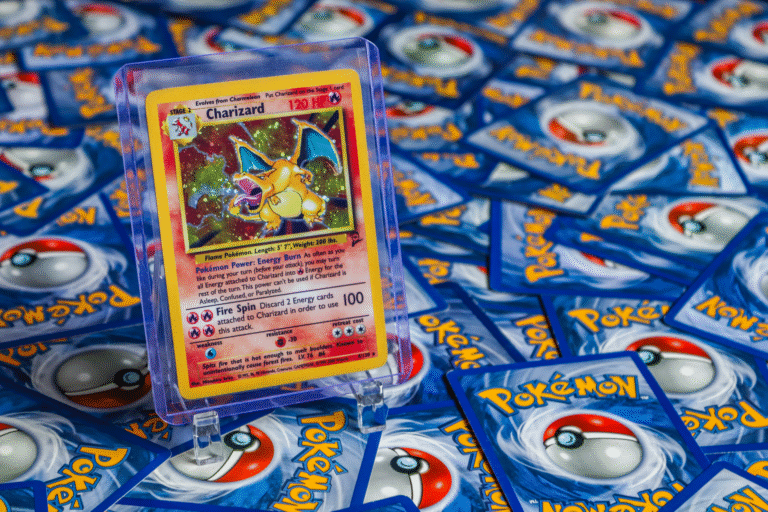
The most important Legendary Collection cards to watch are Charizard, Venusaur, and Gengar—the set’s three rarest reverse holograms that have demonstrated explosive growth over the past two years. Raw copies of Charizard trade around $175, but graded PSA 10 copies sell for approximately $5,000, while Gengar commands $600 to $700 in raw condition and reaches $7,500 as a PSA 10. These specific cards represent the core of what collectors are targeting before the next major price spike, driven by increasing mainstream interest in Pokémon collectibles and institutional investment entering the trading card market.
The Legendary Collection set, released in May 2002, consists of reprints from the earliest Pokémon TCG sets—Base Set, Jungle, Fossil, and Team Rocket—with an exclusive “fireworks” reverse holographic foil pattern that was never reproduced. This unique visual characteristic, combined with the set’s age and the limiting factor that these cards are reprints of already-classic releases, creates a compound scarcity effect. Understanding which cards in this set are positioned for the next price surge requires examining their current valuation, grading potential, and the market forces that have pushed similar cards to record prices.
Table of Contents
- Which Legendary Collection Cards Offer the Highest Growth Potential Before the Next Spike?
- Understanding the Legendary Collection’s Scarcity and Historical Context
- Market Dynamics and the Trading Card Boom Thesis
- Grading and Condition—The Primary Driver of Value Differentiation
- Supply-Side Constraints and Realistic Limitations
- Entry Strategy and Timing Considerations for the Next Spike
- Forward Outlook and Factors That Could Trigger the Next Legendary Collection Spike
- Conclusion
Which Legendary Collection Cards Offer the Highest Growth Potential Before the Next Spike?
The trio of Charizard, Venusaur, and Gengar represents the core investment thesis for Legendary Collection appreciation. Gengar stands out as the most undervalued relative to its rarity—at $600 to $700 raw, it trades at roughly three times the price of raw Charizard, yet market sentiment suggests Charizard has broader appeal and stronger buy-side pressure. This creates an asymmetry that often precedes price normalization, where Gengar could experience a sharper percentage gain if broader collector interest shifts toward completing full sets rather than chasing individual character favorites.
Supporting characters like Blastoise, Venomoth, and Dragonite also merit attention, though they trade at substantially lower price points and show less consistent market activity. The secondary tier cards in Legendary Collection typically range from $30 to $150 raw, but they lack the same institutional interest and crossover appeal that drives spikes in the marquee cards. Collectors aiming to catch the next spike should focus capital on the big three, where liquidity and price discovery mechanisms are most mature.

Understanding the Legendary Collection’s Scarcity and Historical Context
The May 2002 release date positions Legendary Collection as a bridge between the earliest trading card era and the modern collecting period. These are reprints—which normally diminishes value—but the exclusive fireworks foil pattern and the 24-year vintage means original printings were exceptionally limited. This is critical: a Charizard reverse holo from Legendary Collection is not equivalent to a Base Set Charizard, but it commands premium pricing relative to modern Charizards because it was printed in far smaller quantities than any recent set.
One major limitation collectors must understand is that high-grade examples are genuinely scarce. PSA has graded fewer Legendary Collection cards overall compared to Base Set equivalents, which means finding PSA 9 or PSA 10 copies involves substantial legwork. Market data shows PSA 10 Charizards from this set trade consistently in the $4,500 to $5,500 range, but supply is sporadic—sales occur monthly rather than weekly. This inconsistent supply schedule actually supports the case for a price spike; when demand outpaces the trickle of graded inventory, prices accelerate quickly.
Market Dynamics and the Trading Card Boom Thesis
The broader trading card market is valued at $13 billion and projected to double by 2034, according to major market analysis. This expansion is not theoretical—it reflects actual capital flowing from institutional investors, celebrity collectors, and mainstream media coverage of record-setting sales. The Pikachu Illustrator card, sold for $16.492 million in February 2026, established a new price ceiling that raised awareness across all Pokémon collectibles, not just the card that sold.
This rising tide effect means that even cards without specific catalysts often see valuation increases as new money enters the hobby and searches for entry points. Legendary Collection cards benefit from being recognized as vintage and rare while remaining significantly less expensive than first-edition base Set equivalents. A collector unable to afford a $400,000-plus 1st Edition Shadowless Charizard may pivot to Legendary Collection as an alternative path to owning a premium Charizard, which creates buy-side pressure that translates to upward price movement.

Grading and Condition—The Primary Driver of Value Differentiation
The gap between raw Legendary Collection cards and professionally graded copies reveals the power of condition certification in the modern market. Raw Charizard at $175 versus PSA 10 at $5,000 represents a 28x multiplier—higher than almost any other collectible asset class. This extreme spread exists because collectors are willing to pay premiums for authenticated, encapsulated high-grade copies that can be resold without negotiation over condition.
The practical tradeoff is that submitting raw cards for grading involves upfront costs ($10 to $100 per card depending on service level and turnaround), turnaround times of weeks to months, and risk: if a card grades lower than expected, the holder bears the loss. A $175 Charizard that grades PSA 7 becomes a $600 to $800 card—a gain, but not transformative. However, the upside is real: cards that grade PSA 9 jump to $3,500 to $4,000, and PSA 10s reach the $5,000 benchmark. For Legendary Collection collectors positioning for a spike, submitting borderline candidates for grading now positions them to capitalize when prices accelerate.
Supply-Side Constraints and Realistic Limitations
A critical limitation in predicting Legendary Collection spikes is that the set’s total population is finite, and PSA has already graded a significant percentage of the cards that were submitted. Unlike modern sets where new inventory constantly enters circulation, Legendary Collection supply is declining as cards are removed from the market by collectors holding for appreciation. This sounds positive, but it also means that if a spike occurs, supply cannot respond—prices will rise sharply and then plateau once buy-side demand exhausts available inventory. Additionally, condition variance in Legendary Collection is pronounced because these 24-year-old cards experienced decades of storage in varied conditions.
Off-center printing, light staining, edge wear, and corner bending are commonplace. High-grade examples are genuinely rare, not just scarce. A collector evaluating their collection should be realistic about grading potential; a card that looks “near mint” in hand may grade PSA 8 or lower. Setting expectations correctly prevents disappointment and prevents holding cards too long hoping for a grade that will never materialize.

Entry Strategy and Timing Considerations for the Next Spike
The optimal time to acquire Legendary Collection cards before a spike is during periods of low media coverage and institutional attention. Currently, the market is active but not euphoric—PSA 10 Charizards sell regularly at $5,000, but there is no shortage of listings. This is the window for accumulation.
Once mainstream outlets begin covering Legendary Collection specifically, or once comparable cards experience sharp price increases, entry costs will escalate dramatically. A practical strategy is to target raw cards currently undervalued relative to their grading potential, particularly in the $200 to $400 range where supply is decent but future demand is likely. Venusaur raw at $250+ is an example—if you’re confident in its aesthetic quality and willing to grade it, the expected value of a PSA 8 ($1,200 to $1,500) or PSA 9 ($2,500 to $3,500) justifies the submission cost and risk. Gengar offers an even wider margin, with raw cards at $600 to $700 potentially hitting $5,000 as PSA 10, suggesting that grading-cost risk is minimal relative to upside.
Forward Outlook and Factors That Could Trigger the Next Legendary Collection Spike
Several catalysts could trigger a Legendary Collection spike within the next 12 to 24 months. Continued institutional investment in Pokémon collectibles is the primary lever—if venture capital or corporate investors begin building Pokémon collections as diversified holdings, they will search for rare vintage cards, and Legendary Collection will benefit from increased competition for supply. A spike in adjacent cards (other 2002-era reprints or premium reverse holos) would likely follow.
A secondary catalyst is nostalgia-driven demand from millennial collectors who were present during Pokémon’s earliest boom. As this demographic’s disposable income continues to grow and interest in childhood collectibles persists, Legendary Collection cards—which were part of that formative era—will see sustained buy pressure. The market has proven it will pay substantial premiums for authentic pieces of early Pokémon history. Legendary Collection fits that definition precisely.
Conclusion
The most important Legendary Collection cards to watch before the next price spike are Charizard, Venusaur, and Gengar, which currently trade at accessible price points ($175 to $700 raw) while demonstrating clear pathways to 5x to 10x multiples if graded successfully and if market demand accelerates. The set’s unique fireworks reverse holo pattern, combined with its 24-year vintage status and extreme condition variance, creates an environment where informed collectors can identify undervalued inventory and position themselves ahead of broader market recognition.
Your next step should be to audit your existing Legendary Collection cards, grade realistic candidates that meet quality thresholds, and establish a watchlist for acquisitions during the quiet period before the next spike. Monitor activity in adjacent vintage card categories—when those begin accelerating, begin building positions in Legendary Collection in anticipation of follow-on demand. The window for entry at current prices will not remain open indefinitely.