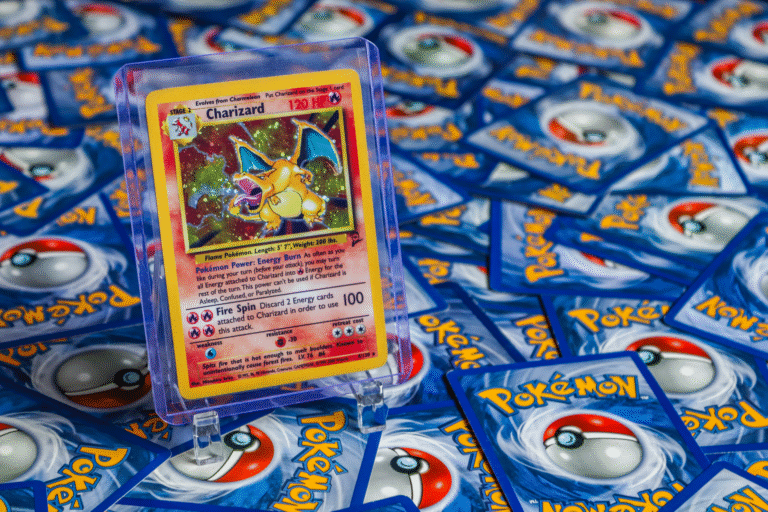
The most important Expedition cards to watch before the next price spike are Mewtwo #20, Charizard #40, and Mew #19—the three cards that have historically driven bulk set appreciation and currently command the highest market values. These holographic rares from the September 2002 release represent the intersection of scarcity, nostalgia, and competitive demand among collectors. When one of these anchor cards appreciates significantly, it often signals broader market movement across the entire set, making them critical indicators of whether an Expedition investment is about to become more expensive.
The current market presents an interesting window. Mewtwo #20 sits at approximately $405 for raw copies but reaches $62,500 for gem-mint graded specimens, while Charizard #40 trades around $2,475 raw and $28,000 for PSA 10 examples. Mew #19 follows a similar pattern at $2,300 raw with PSA 10 copies valued near $36,000. These price tiers reflect not just card desirability but the severe scarcity of near-mint examples—a reality that hasn’t changed since 2002 and that directly influences whether prices spike or stagnate.
Table of Contents
- Why Expedition’s Holographic Rares Command Premium Pricing
- The Master Set Value Context and Its Limitations
- Grading as a Price Catalyst for the Next Spike
- Monitoring Print Run Insights from Recent Sales Data
- The Condition Grade Dependency and Its Hidden Risks
- Secondary Market Supply and Recent Collection Dumps
- Forward-Looking Outlook and the E-Reader Nostalgia Cycle
- Conclusion
Why Expedition’s Holographic Rares Command Premium Pricing
The Expedition Set’s holographic rare cards exist in fundamentally different supply conditions than modern releases. Low initial print runs combined with the e-Reader technology that made cards susceptible to wear and damage means that finding a single near-mint copy without grading is increasingly rare. Charizard #40 exemplifies this: the raw price of $2,475 reflects legitimate scarcity, but the jump to $28,000 for a PSA 10 tells the real story—collectors will pay a premium precisely because there are so few pristine examples available.
This scarcity pattern applies across the set’s most valuable cards. Alakazam #1 trades at $1,520, and Dragonite #43 sits around $200 raw, but a PSA 10 Dragonite reaches approximately $8,000. The spread between raw and graded prices is wider for these cards than it is for modern releases, which means that any disruption to the grading supply chain or a sudden influx of old collections hitting the market can trigger sharp movements in either direction.

The Master Set Value Context and Its Limitations
To understand individual card movements, collectors need to recognize that the complete Expedition Master set currently values around $58,005, encompassing all 514 variants across holos, non-holos, and reverse holos. This aggregate figure is useful as a baseline, but it masks the reality that most of that value concentrates in fewer than twenty cards. The majority of Expedition’s utility cards and common holos trade for under $100, meaning that a price spike affecting the top tier doesn’t equally lift the entire set.
The limitation here is critical: buying Expedition on the assumption that “the whole set will go up” is speculative reasoning. Historical evidence shows that market spikes have disproportionately benefited the cards already valued highest—Mewtwo, Charizard, and Mew have driven outsized returns while mid-tier cards like Lapras or Tentacruel have moved modestly. A collector betting on appreciation should expect uneven gains, not a rising tide that lifts all cards equally.
Grading as a Price Catalyst for the Next Spike
Grading presents a paradox in the current Expedition market. On one hand, submitting raw cards for certification is the primary mechanism that converts a $400 card into a $60,000 card. On the other, the turnaround time and cost of grading services mean that timing matters enormously. If PSA, Beckett, or CGC experiences a service backlog or price increase, the economics of grading marginal cards changes overnight.
A concrete example illustrates the tension: if you own a raw Mew #19 in approximately mint condition, you might realistically expect a PSA 9 or 10 grade. That raw card trades around $2,300, but a PSA 10 copy is valued near $36,000. The grading cost is roughly $100-$300 depending on the service tier. However, the timeline to receive that grade might be three to twelve months depending on current demand, which means price movements could work for or against you before the graded card even returns. collectors holding raw Expedition cards are essentially taking a bet on timing as much as condition.

Monitoring Print Run Insights from Recent Sales Data
The most actionable approach to predicting the next price spike is tracking the frequency and price variance in recent public sales. When PSA 10 examples of Charizard #40 consistently sell at $28,000 with minimal negotiation, that signals stable demand at that tier. If those same cards suddenly trade at $32,000-$35,000 across multiple sales in a short window, the spike is beginning. Conversely, if asking prices exceed recent sales by 20% or more, that’s a warning sign of unrealistic expectations rather than genuine appreciation.
The tradeoff with this approach is that it requires active monitoring of sales across TCGplayer, Cardrake, Heritage Auctions, and specialty Pokémon retailers. Casual collectors tracking prices monthly will miss the early signals. Serious collectors watching sales multiple times per week are positioned to recognize momentum shifts, but they’re also more prone to FOMO-driven buying at market tops. A practical middle ground involves setting price alerts at key thresholds—say, $25,000 for Charizard #40 PSA 10—rather than assuming you can time the market perfectly.
The Condition Grade Dependency and Its Hidden Risks
One substantial limitation to understand before betting on Expedition appreciation is the extreme condition sensitivity of these cards. A Mewtwo #20 graded PSA 9 might trade at $15,000-$20,000, while a PSA 10 of the same card reaches $62,500. That isn’t a linear relationship—it’s exponential. The difference between a card that grades 8 or 9 versus 10 can mean tens of thousands of dollars.
This creates a hidden risk for collectors acquiring raw cards they plan to grade. If you pay $2,300 for a Mew #19 expecting a PSA 10, but the grading company returns a PSA 9, you’ve immediately created a paper loss on the grading fee and turnaround time cost. Worse, if a 9 is worth $10,000 and you paid $2,300, you still own an appreciating asset—but you’ve foregone the maximum upside and can’t easily reverse the grading decision. This is why serious Expedition collectors often work with professional condition assessors before submitting cards to grading services.

Secondary Market Supply and Recent Collection Dumps
The Expedition market has experienced periodic disruptions when large old collections enter the secondary market unexpectedly. These dumps don’t necessarily crash prices for the rarest cards—a PSA 10 Mewtwo is always scarce—but they can create temporary price suppression for mid-grade raw copies. If you own a Charizard #40 in good condition and news breaks that a private collection of 200+ Expedition cards is being liquidated, you might see local pricing pressure.
Conversely, these collection releases sometimes include rare finds that trigger broader interest in the set. For instance, if a dump includes an exceptionally high-grade Alakazam #1 or an unusual variant, hobby discussion spikes, and general attention to Expedition increases. Collectors watching for the next price spike should monitor online communities and auction house announcements for signs of major collections entering the market.
Forward-Looking Outlook and the E-Reader Nostalgia Cycle
The Expedition Set’s next significant price spike will likely correlate with broader Pokémon TCG nostalgia cycles and potential format innovations in the official game. The e-Reader mechanic was central to Expedition’s original identity, and any revival of that mechanic in the modern TCG or speculation about it would reignite collector interest. Additionally, as the original Pokémon TCG audience ages into higher disposable income, demand for premium vintage cards tends to increase.
Looking forward, the most important metric to track is whether Mewtwo #20, Charizard #40, and Mew #19 experience sustained price appreciation over a multi-month period. When the anchor cards move up, the entire set tends to follow within one to three months. Collectors positioned with a mix of raw mid-grade copies and a clear grading strategy are best prepared to benefit when that next spike arrives.
Conclusion
The most important Expedition cards to watch remain the same ones that have driven set appreciation historically: Mewtwo #20, Charizard #40, Mew #19, and the secondary tier including Alakazam #1 and Dragonite #43. These cards exhibit supply characteristics that haven’t changed since 2002—low print runs, high condition sensitivity, and strong nostalgia appeal—making them reliable leading indicators of broader market movement.
For collectors positioning before the next price spike, the strategy should balance opportunistic acquisition of raw mid-grade copies with a clear timeline and budget for professional grading. Monitor recent sales data across multiple platforms rather than relying on asking prices, be aware of potential collection dumps that might create temporary supply pressure, and recognize that timing the exact spike is less important than being positioned with quality cards when broader market interest accelerates. The Expedition Set has demonstrated consistent long-term appreciation, and the structural scarcity of near-mint copies ensures that patient collectors are rewarded over time.