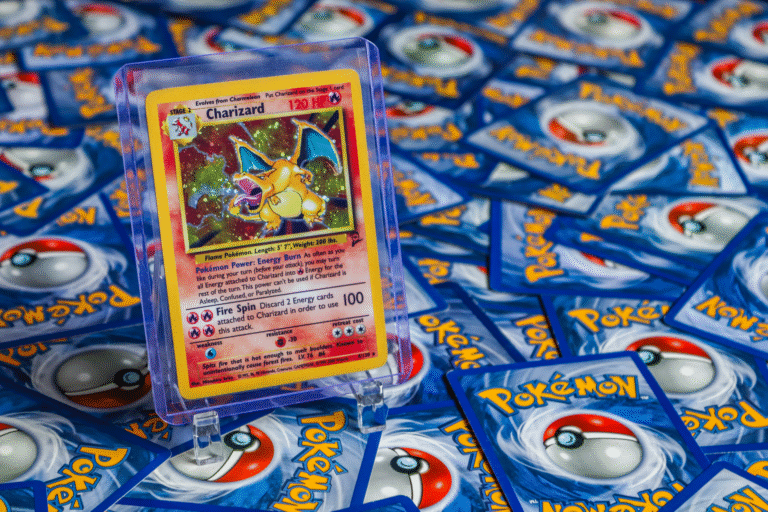
The Base Set Charizard 1st Edition represents the apex of modern Pokémon card collecting, commanding prices that dwarf most other collectibles in the category. A professionally graded PSA 10 specimen typically ranges between $200,000 and $400,000, with exceptional sales pushing well beyond these figures—most notably, a PSA 10 example fetched $550,000 at Heritage Auctions in December 2025. This dramatic price range reflects the card’s status as arguably the most coveted Pokémon card ever printed, a combination of scarcity, cultural significance, and the grading premium that defines high-end collectible markets.
Understanding where your Charizard sits within the pricing spectrum requires knowing not just the card’s grade, but the broader market context that determines value. The price difference between a PSA 9 and a PSA 10 is not incremental—it’s a multiplication factor of six to ten times, meaning the gap between near-mint and gem-mint can easily be $170,000 or more. This article walks through the factors that drive Charizard pricing, how to interpret the price guide and similar data sources, and what collectors need to know about the current market as of March 2026.
Table of Contents
- How Does Grading Determine Charizard 1st Edition Values?
- The Grading Bottleneck and Authentication Risk
- Market Data Sources and Price Interpretation
- Building a Pricing Strategy for Your Collection
- The Counterfeit and Altered Card Problem
- Comparing 1st Edition to Unlimited Base Set Pricing
- The 30th Anniversary Tailwind and Future Market Outlook
- Conclusion
How Does Grading Determine Charizard 1st Edition Values?
Professional grading is the single most critical factor in determining Charizard pricing, and the relationship is decidedly non-linear. A PSA 9 (Mint condition) card ranges from $30,000 to $60,000, while a PSA 8 (Very Fine-Mint) drops to the $15,000 to $25,000 range—already showing the steep cliff that quality commands. The jump from PSA 8 to PSA 9 can represent a 50 to 100 percent increase in value, and the jump from PSA 9 to PSA 10 multiplies the price by another factor of 3 to 7, depending on market momentum and individual sale circumstances. This grading premium exists because the PSA 10 population is extremely restricted.
Only 122 PSA 10 examples of the 1st Edition Base set charizard have been graded across the entire PSA population—a minuscule figure considering millions of these cards were printed in 1999. By comparison, thousands of PSA 9 cards exist. The rarity of gem-mint specimens, combined with collector demand, creates the outsized pricing you see at auction. An ungraded card or one graded PSA 7 or lower typically costs $3,000 to $6,000, illustrating how dramatic the value collapse becomes once the card dips below near-mint condition.

The Grading Bottleneck and Authentication Risk
One critical limitation collectors face is PSA’s current grading turnaround and the cost of authentication itself. While recent pricing data (as of March 2026) reflects professionally graded examples, submitting a raw Charizard to PSA for grading can take weeks or months depending on service tier, and the cost ranges from $25 for standard service to $300+ for expedited options. For a card potentially worth $50,000, the submission cost is negligible; for a mid-grade example worth $15,000, it becomes more meaningful. More importantly, grading results are never guaranteed—a card you expect to grade PSA 9 might come back PSA 8, and that single point difference could cost $15,000 to $30,000 in realized value.
Authentication fraud remains a persistent concern in the Charizard market. Counterfeit cards exist, and even more common are altered or restored cards that slip past casual inspection. PSA grading mitigates this risk substantially, but ungraded cards carry authentication uncertainty that drives prices down. If you purchase an ungraded Charizard for $5,000 from a private seller and it fails to grade PSA 8 or higher, you’ve potentially overpaid significantly or acquired a problematic card. This risk is why virtually all high-value sales occur with professional grading already in place.
Market Data Sources and Price Interpretation
The price guide, PokeScope, PokemonPriceTracker, and CardGrader.AI each track Charizard pricing differently, and understanding their methodologies is essential to avoiding misleading conclusions. PokeScope and PokemonPriceTracker aggregate recent sales from eBay, TCGPlayer, and major auction houses (with data current as of March 2026), providing real transaction data rather than ask prices. The price guide similarly focuses on completed sales, making these sources more reliable than listing prices you might see on secondary markets where sellers often ask unrealistic numbers. The challenge is that pricing data for the highest-grade examples becomes sparse.
There may only be a handful of PSA 10 sales in any given month, so a single outlier transaction can skew reported averages. The $550,000 Heritage Auctions sale, for example, was exceptional—possibly driven by a record-chasing bidder or collector completing a set. Most PSA 10 examples sell in the $200,000 to $400,000 range, but that $550,000 result may artificially elevate reported average prices on some platforms. When shopping or pricing your own card, it’s important to examine the actual comps—the recent sales at your card’s specific grade level—rather than relying on a single “market average” figure.

Building a Pricing Strategy for Your Collection
If you own a Base Set Charizard 1st Edition, the decision between keeping and selling hinges partly on price predictions. Expert forecasts suggest 30 to 50 percent appreciation for high-grade specimens throughout 2026, driven largely by 30th anniversary interest in the Pokémon brand. This optimistic outlook assumes continued market strength, stable collector demand, and no major market corrections—assumptions that can shift rapidly in speculative markets.
For a PSA 10 worth $300,000 today, a 40 percent gain would add $120,000 in value by year-end, but that projection is not guaranteed and carries risk. The practical tradeoff is between holding for appreciation and locking in current value. A PSA 10 specimen you own today could reasonably sell within weeks at $300,000 without much negotiation, whereas waiting for a 40 percent gain introduces timing risk—you might sell during a market dip, or the buyer pool might shrink if Pokémon collecting trends cool. For collectors holding for personal enjoyment, these price projections matter less; for investors treating Charizards as financial assets, the holding period and expected return should be weighed against the carrying costs (insurance, potential grading resubmission, storage) and liquidity needs.
The Counterfeit and Altered Card Problem
A warning that bears repeating: the Base Set Charizard market has attracted sophisticated counterfeiters, especially as prices have climbed. Some fakes are crude and easily spotted; others are remarkably convincing to untrained eyes. Red flags include slight text misalignment, incorrect font weights, paper stock that feels wrong, and ink color that doesn’t quite match known authentic examples. However, detecting fakes without professional expertise is unreliable, which is precisely why PSA grading commands such high premiums and why paying for authentication is not optional for five-figure purchases.
An even subtler problem is restored or altered cards that pass casual inspection but are flagged (or should be flagged) by professional graders. Restoration can include paint touch-ups on worn spots, light ironing to flatten creases, or color restoration. PSA explicitly notes restoration on its slabs, which dramatically reduces value—a restored PSA 9 might be worth only $8,000 to $12,000 compared to $30,000 to $60,000 for an unrestored example. Always verify the PSA label details when buying, not just the grade number.

Comparing 1st Edition to Unlimited Base Set Pricing
To contextualize the Charizard market, it’s worth noting that Unlimited editions of the same card (from the second printing of Base Set) sell for a fraction of 1st Edition prices. An Unlimited Charizard in PSA 10 typically ranges from $15,000 to $30,000—roughly 10 percent of what a 1st Edition PSA 10 commands. This massive premium exists because 1st Edition cards were produced in far fewer quantities and carry more prestige in collector hierarchies. For budget-conscious collectors, an Unlimited Charizard offers similar aesthetics and gameplay history at a dramatically lower entry point, though it lacks the rarity cachet that drives investment demand.
This comparison also highlights the importance of edition verification when shopping. Misidentifying an Unlimited as a 1st Edition (or vice versa) is a costly mistake that directly impacts valuation. Authentic 1st Edition cards bear a distinctive stamp on the bottom left of the card face, and PSA’s grading report explicitly notes the edition. When evaluating a Charizard, confirming the edition is your first step, before even considering grade.
The 30th Anniversary Tailwind and Future Market Outlook
The Pokémon franchise’s 30th anniversary in 2026 has reignited collector interest and driven mainstream media coverage of card values. This attention supports the expert forecast of 30 to 50 percent appreciation for high-grade Charizards, but it also introduces volatility. Anniversary booms are historically temporary; once the 30th anniversary moment passes, some of the speculative demand may evaporate. Collectors banking on these projections should consider whether the appreciation is genuine value creation or speculative bubble inflation.
Looking forward, the sustainability of Charizard pricing depends on the health of Pokémon card collecting more broadly. New releases, competitive play formats, and cultural trends all influence collector sentiment. A significant decline in Pokémon TCG interest or a supply shock (such as major reprints of Base Set Charizard, which Pokémon has hinted at for anniversary releases) could pressure prices downward. Conversely, if collecting continues to grow and authenticated high-grade examples remain scarce, current pricing could prove conservative. The safest approach is to view the Charizard market as subject to both fundamental demand factors and speculative sentiment.
Conclusion
Base Set Charizard 1st Edition pricing is driven primarily by professional grading, with PSA 10 specimens commanding $200,000 to $400,000 in current markets, while PSA 9 examples range from $30,000 to $60,000. The dramatic grade-based pricing multiplier reflects extreme scarcity at the high end—only 122 PSA 10 examples exist in the entire grading population—combined with the card’s status as the most iconic Pokémon card ever produced. Understanding these price tiers and consulting transaction data from sources like PokeScope and PokemonPriceTracker is essential for any collector or investor evaluating a Charizard’s value.
The path forward for a Charizard owner or prospective buyer depends on your goals. If investing, weigh the expert 30 to 50 percent appreciation forecast against timing risk and market volatility. If collecting for enjoyment, focus on securing an authenticated example at a grade you’re comfortable affording and holding it as a centerpiece of your collection. Regardless of your approach, never skip professional grading, verify edition and condition carefully, and stay informed via recent sales data rather than relying on old pricing benchmarks.
You Might Also Like
- verified sold listings across major TCG marketplaces for Base Set Charizard Shadowless
- verified sold listings across major TCG marketplaces for Base Set Zapdos Shadowless
- verified sold listings across major TCG marketplaces for Base Set Water Energy Unlimited
Frequently Asked Questions
How much is a PSA 10 Base Set Charizard 1st Edition worth?
Base Set Charizard 1st Edition PSA 10 value is tracked from verified sold listings across eBay, TCGplayer, Goldin, and Fanatics Collect. Recent sales determine the current market price, which shifts month to month based on supply, condition, and demand.
Is Base Set Charizard 1st Edition a good investment?
Long-term trend data for Base Set Charizard 1st Edition is on this page. Vintage Pokemon cards in PSA 10 condition have historically appreciated, but performance varies by set, popularity, and grading population. Compare the monthly trend on this chart to similar cards before deciding.
Where can I see Base Set Charizard 1st Edition sold listings?
We aggregate verified sales from eBay, TCGplayer, Goldin Auctions, and Fanatics Collect. The recent-sales section on this page shows individual transactions with date and price.