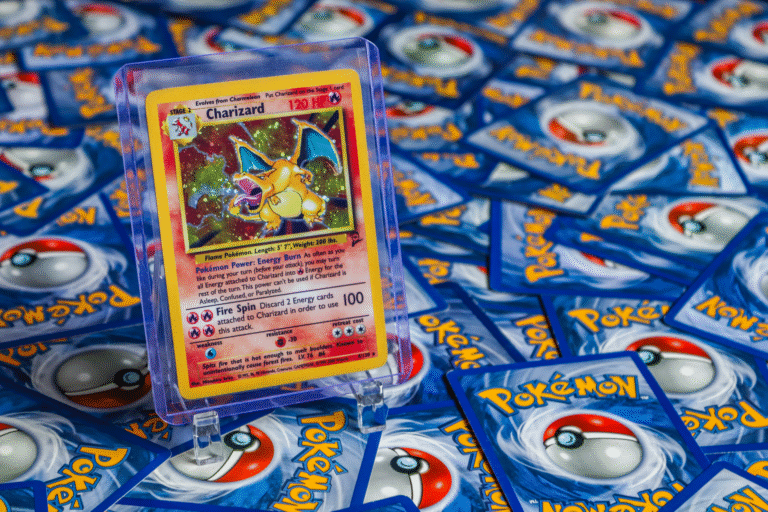
Charmander cards are graded on a professional 1–10 scale, and the pricing differences between grades are dramatic. A Base Set Charmander #46 1st Edition in PSA 10 condition sold for $2,475 in early 2026, while an ungraded copy in decent condition trades for around $99—meaning a single grade level improvement multiplies value by up to 23 to 25 times. This exponential relationship between grade and price is the core dynamic shaping how collectors evaluate and price Charmander cards today.
Most collectors buying Charmander are not pursuing gem mint specimens; the average eBay transaction hovers around $33.21, reflecting a market dominated by lower-grade and modern variants, not premium 1st Edition investment pieces. The grading system—administered by professional services like PSA and Beckett—applies consistent standards that make pricing transparent and predictable across different cards and eras. Yet beneath those numbers lies a collector’s puzzle: should you pay for grading, chase specific grades, or accept ungraded cards that cost a fraction of their certified counterparts? Understanding how collectors price Charmander at each grade level reveals both the logical economics of the hobby and the psychological factors that drive demand.
Table of Contents
- What Does Each Charmander Grade Actually Mean for Value?
- The Grade Premium: Why a Single Grade Difference Costs Thousands
- Current Charmander Market Prices Across Grades
- How to Evaluate Charmander Condition Before You Pay for Grading
- The Hidden Costs of Grading: Turnaround Time and Holder Preference
- Shadowless and Other Variants: How Print Runs Affect Pricing
- Market Trends and the Future of Charmander Grading
- Conclusion
What Does Each Charmander Grade Actually Mean for Value?
The PSA grading scale runs from 1 (Poor condition) to 10 (Gem Mint), and each grade correlates to a defined set of observable defects—centering issues, print lines, corner wear, surface scratches, and fading. For Base Set charmander #46 1st Edition, the tiers break down starkly: a PSA 10 commands $2,300–$2,475, a PSA 9 trades for $255–$485, and a PSA 8 sits around $142.50. The difference between a 9 and a 10 is roughly $2,000 on a single card, driven by the rarity of true gem mint condition and the collectibility premium investors place on near-perfect specimens. A PSA 8 to PSA 9 jump cuts the gap but still represents a 2–3x price swing, showing that each grade increment becomes progressively harder to justify economically once cards drop below near-mint range.
What makes this hierarchy counterintuitive is that a PSA 9 is still objectively excellent—it has only minor imperfections visible to the naked eye. Yet collectors consistently undervalue it relative to a 10, because PSA 10 carries cultural cachet and is the acknowledged threshold for “collection-grade” cards. A PSA 9 feels like the bridesmaid compared to a 10, even though the visual difference is subtle. This psychological factor, combined with the rarity of gem mint copies, creates the pricing cliff that every collector encounters when shopping for premium Charmander.

The Grade Premium: Why a Single Grade Difference Costs Thousands
The 23–25x multiplier between an ungraded Charmander in decent condition and a PSA 10 is the most eye-catching statistic in modern Pokemon pricing, yet it obscures a second, equally important dynamic: the bulk of that value is concentrated in the top grades. Moving from ungraded to PSA 8 roughly triples value, but moving from PSA 9 to PSA 10 nearly sextuples it. This non-linear relationship exists because gem mint Charmander 1st Edition copies are genuinely scarce—decades of play, casual storage in shoeboxes, and exposure to sunlight and humidity have winnowed the population to a small number of pristine survivors.
The premium also reflects an expectation among high-end collectors that a PSA 10 will hold or appreciate in value, whereas lower grades are often viewed as consumable purchases for casual collectors or players building playsets. Dealers and sellers price PSA 10 cards accordingly, knowing there is a subset of investors willing to pay for rarity and condition. A warning: this also means that a card graded PSA 9 or lower can be a poor grading investment if you’re hoping to cover the grading cost through resale. Submitting a card worth $100 for professional grading (which costs $50–$200 depending on turnaround) often erases profit margins unless the card is already in the higher grades or has significant upside from authentication alone.
Current Charmander Market Prices Across Grades
As of June 2026, real pricing data from eBay, auction sites, and specialty retailers shows the following recent prices for base Set Charmander #46 1st Edition: PSA 10 at $2,300–$2,475 (with a confirmed February 2026 sale at $2,475), PSA 9 at $255–$485, PSA 8 at $142.50, and ungraded decent-condition copies averaging around $99. These numbers come from active market transactions, not asking prices—they represent actual sales volume, which is critical because sellers sometimes overprice cards that never move. The eBay market for all Charmander variants combined shows an average transaction price of $33.21 over the past 30 days, a figure that reflects the trading volume dominated by modern cards, reprints, and lower-grade copies from various sets.
The most actively traded Charmander variant right now is the 2023 Pokémon Scarlet & Violet 151 #168/165, averaging $25.60 per transaction, with roughly 58 Charmander cards trading on eBay every 30 days. This trading volume shows that the broader Charmander market is driven by accessibility and novelty, not by investments in vintage 1st Edition gem mint copies. Collectors chasing the explosive grade-to-price multiplier represent a small, specialized segment of the hobby. If you’re buying Charmander for under $50, you’re likely participating in a different market than someone hunting PSA 10 trophies.

How to Evaluate Charmander Condition Before You Pay for Grading
Before submitting a card to PSA or Beckett, collectors should inspect it under bright light for visible centering, corner wear, surface wear, and any printing defects. A card that appears “near mint” to the naked eye might receive a PSA 7 or 8 due to light surface scratches or off-center printing not immediately obvious to casual inspection—a reality that surprises many first-time graders. The practical workflow is to research comparable sales, estimate a likely grade range based on the card’s visible defects, and calculate whether the grading cost can be offset by the price bump. A Charmander ungraded at $99 that you believe will grade PSA 9 ($350 midpoint) may seem profitable until you subtract the $100+ turnaround cost, leaving minimal margin and upside uncertainty.
A key limitation many collectors overlook: even professional graders occasionally assign unexpected grades due to manufacturing defects, alignment issues, or surface wear that photos cannot fully capture. Submitting a card you estimate as PSA 9 and receiving a PSA 8 is a realistic downside scenario, especially with cards from older sets that have minor production variations. Set realistic expectations, factor in the full cost of grading including shipping and insurance, and only grade cards you believe justify the investment. For Charmander, that generally means cards in truly exceptional condition or cards with such high individual value (like first editions) that a one-grade difference significantly impacts sellability.
The Hidden Costs of Grading: Turnaround Time and Holder Preference
Professional grading services like PSA and Beckett operate on a turnaround timeline measured in weeks to months, depending on service tier selected. A collector hoping to quickly grade and resell a Charmander may find that even expedited grading delays inventory, and market conditions can shift during that window—prices fluctuate based on broader trading interest and new set releases that capture collector attention. Additionally, not all markets value graded cards equally; some regional or casual collectors actually prefer ungraded cards because they can play with them without worrying about slab condition, whereas a graded card in a plastic holder is a display-only asset by convention. Another hidden cost: grading authenticity.
While professional grading services like PSA are trusted, the slab itself becomes part of the card’s narrative. A PSA 8 Charmander carries an implicit warranty that PSA authenticated it as genuine—valuable if you’re buying sight unseen online, but less valuable to someone buying in person from a trusted local source. The slab adds shipping risk, holder degradation over decades, and visibility (some collectors dislike displaying graded cards because they prefer to view card art unobstructed). For lower-grade Charmander cards, the downsides of slabbing often outweigh the minor price premium you’d gain.

Shadowless and Other Variants: How Print Runs Affect Pricing
Charmander has multiple print variants across different eras, and rarity directly influences pricing. Shadowless Charmander cards, a transitional print run between 1st Edition and Unlimited, lack the faint drop shadow on card edges that later printings include. These shadowless variants are more scarce than Unlimited copies but less rare than true 1st Edition cards, positioning them as a middle tier in both desirability and value. A shadowless Charmander in PSA 9 might trade for $100–$150, compared to $255–$485 for a true 1st Edition PSA 9, illustrating how print-run differences create meaningful price segmentation within the same card.
Modern variants like the 2023 Pokémon Scarlet & Violet 151 Charmander represent the opposite dynamic—abundant supply and minimal variance in pricing by grade, since most modern printings are relatively uniform in quality. A modern Charmander graded PSA 9 trades closer to the $20–$40 range because the pool of gem mint modern cards is deep and supply easily outpaces collector demand. This comparison shows collectors that vintage = scarcity = grade premium, while modern = abundance = flat pricing across grades. Understanding your target print run and era is the first step to realistic pricing expectations.
Market Trends and the Future of Charmander Grading
The Charmander market in 2026 reflects broader Pokemon card trends: renewed interest in accessible vintage cards from sets like 2023 Scarlet & Violet 151, which brought forward reprints of classic Pokemon including Charmander at modern print quality. This influx of high-supply modern Charmander has not diminished 1st Edition prices—if anything, it has concentrated demand and premium pricing onto the original rare prints, creating a bifurcated market. Collectors can either chase the ultra-premium 1st Edition PSA 10 ($2,475 and climbing) or engage with modern, affordable variants at $25–$35 without a middle ground.
The trading volume data (58 cards monthly) shows both camps are active, though modern buyers substantially outnumber vintage hunters. Looking ahead, grading inflation—the tendency for population reports to increase as more copies are submitted over time—may gradually shift pricing as PSA 10 Charmander populations grow. Conversely, the cultural weight of 1st Edition and the documented rarity of gem mint survivors suggest that top-tier pricing has more support than lower grades, which are vulnerable to market saturation as more ungraded cards enter circulation and receive professional grades. Collectors should monitor population reports and recent comp sales rather than relying on static price guides, as the market for graded Charmander is small enough that individual sales can move the needle significantly.
Conclusion
Charmander cards follow a clear grading-to-price progression, with grade premium multiplying dramatically at the top end: a PSA 10 1st Edition can command over $2,400, while PSA 9 drops to $300–$500 and PSA 8 to under $150. The exponential nature of these price differences reflects both the rarity of gem mint copies and collector psychology that assigns outsized value to pristine specimens. However, the broader Charmander market is dominated by lower-priced transactions averaging $33 across all variants, showing that most collectors engage with the hobby at an accessible price point far below the premium end.
To price Charmander accurately, assess the card’s era (1st Edition, shadowless, unlimited, or modern), evaluate its condition honestly against grading standards, calculate whether professional grading will add real value after costs, and research recent comparable sales from reputable sources like Sports Card Investor, TCGFish, and the price guide. Use this data-driven approach rather than pricing guides alone, since the Charmander market is active and prices shift with trading trends. Whether you’re building a collection, seeking investment upside, or simply hunting a card to enjoy, understanding how grading influences price will help you make decisions aligned with your goals and budget.