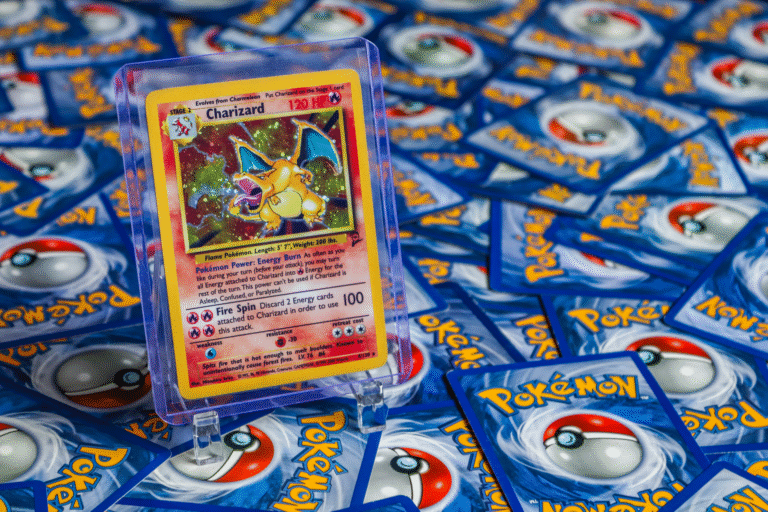
Collectors increasingly view vintage Pokémon cards from the 1990s and early 2000s as more financially stable than modern releases, citing lower production volumes, established market pricing, and reduced exposure to market manipulation. A 1st Edition Base Set Charizard, for example, has maintained consistent value around $5,000-$10,000 for graded copies over the past five years, while many modern chase cards have experienced sharp price swings from $300 to near worthless within months.
This shift in collector confidence reflects growing skepticism about speculative trends that have driven modern card values to unsustainable levels. The appeal of vintage cards lies partly in their scarcity by accident rather than design—Nintendo never anticipated the secondary market boom and produced limited quantities compared to today’s intentionally constrained modern releases. Serious collectors describe vintage cards as “investment grade” due to their historical significance, rarity, and the fact that fewer new copies will ever enter circulation.
Table of Contents
- Why Are Vintage Cards Considered More Stable Than Modern Releases?
- The Grading and Authentication Challenge in Vintage Card Valuation
- Market Comparisons—Vintage Cards Versus Other Tangible Collectibles
- How to Build a Stable Vintage Collection Without Getting Trapped by Hype
- The Risk of Overvaluation Even in Vintage Cards
- Vintage Cards as Portfolio Diversification Versus Concentrated Bets
- The Shifting Market and Future Outlook for Vintage Pokémon Cards
- Conclusion
Why Are Vintage Cards Considered More Stable Than Modern Releases?
The primary reason vintage cards feel safer is supply certainty. Cards printed in 1999 are largely accounted for; damaged copies have been destroyed, and graded specimens in high conditions are genuinely scarce. Modern pokémon TCG, by contrast, experienced unprecedented print runs during 2020-2023, with Scarlet & Violet set products distributed globally in quantities that dwarfed Base Set production. A modern booster box might include thousands of identical cards worldwide, while a 1st Edition Shadowless Blastoise exists in perhaps only a few hundred near-mint copies. Vintage cards also benefit from established price discovery through decades of sales data.
PSA, Beckett, and CGC have graded millions of cards over 25+ years, creating transparent pricing benchmarks. When a near-mint Base Set Pikachu sells, collectors can reference hundreds of comparable sales. Modern cards, particularly newer variants and secret rares, often have only a handful of graded sales, making prices volatile and subject to hype cycles rather than historical precedent. The collectorship itself differs fundamentally. Vintage card buyers tend to be long-term collectors seeking historical pieces, while modern card speculation often attracts short-term traders betting on price spikes. this behavioral difference stabilizes vintage markets by reducing panic selling when hype fades.

The Grading and Authentication Challenge in Vintage Card Valuation
The legitimacy of vintage card value depends entirely on accurate grading, which introduces a significant vulnerability. Counterfeit vintage cards circulate in the market—particularly high-value cards like 1st Edition Charizards—and spotting forgeries requires expertise that not all collectors possess. A card graded as PSA 8 might actually be a PSA 5 or counterfeit, which could cost a collector thousands of dollars if discovered later. Grading standards have also shifted over time; cards graded PSA 8 in 2005 might receive only a PSA 6-7 under today’s stricter standards, a phenomenon collectors call “grade compression.” There’s also the risk of authentication becoming politically contentious.
If a major grading company (like PSA) faces significant scandals or loses market trust, the resale value of cards graded by that company could collapse. This nearly happened during the 2021-2022 PSA backlog crisis, when turnaround times exceeded two years, forcing collectors to question whether they should hold graded cards or crack them open and resubmit elsewhere. New collectors often underestimate how condition sensitive vintage pricing is. A PSA 7 copy of a card might be worth 40-60% of a PSA 8 copy, not because the difference in appearance is proportional, but because of established market precedent. This means even “safe” vintage cards require strict storage and handling to maintain value.
Market Comparisons—Vintage Cards Versus Other Tangible Collectibles
Compared to modern Pokemon cards, vintage cards behave more like fine art or rare books in terms of market stability. A first edition copy of “The Great Gatsby” published in 1925 has maintained its status and price range ($20,000-$50,000 for good condition copies) for decades. Similarly, a 1st Edition Shadowless Venusaur from 1999 holds its $3,000-$8,000 range predictably. Neither experiences the 80% price crashes common in speculative modern cards like a 2023 Scarlet & Violet holographic Charizard that sold for $400 at release and dropped to $30 by mid-2024.
However, vintage Pokémon cards are volatile compared to other collectible card games like Magic: The Gathering, where Lotus Black from 1993 maintains stable value precisely because of strict supply controls and a more mature collector base with less speculation. The Pokémon market still experiences surges during periods of renewed media interest (like a new anime season or movie), which can temporarily inflate vintage prices by 20-30%. Vintage cards also outperform housing market-adjacent investments for small-dollar amounts. A collector who spent $5,000 on a graded Base Set Charizard in 2015 has likely seen modest gains (perhaps 8-12% annually), while the same $5,000 in stock index funds would have outpaced that return significantly. Vintage cards primarily appeal to collectors who value possession and historical significance alongside financial preservation.
How to Build a Stable Vintage Collection Without Getting Trapped by Hype
Experienced collectors recommend focusing on specific, well-documented cards rather than chasing the latest “hot” grade. A strategy that has proven stable is assembling a complete first-edition Base Set, which provides both diversification and historical coherence—the value of the set as a whole tends to be more predictable than individual chase cards. This approach costs $20,000-$50,000 for a mid-grade complete set but spreads risk across 102 cards rather than betting on a single card’s market movements. Another practical approach is buying raw (ungraded) vintage cards and holding them long-term, avoiding the grading costs and re-grading risks that plague heavily speculated cards.
A raw near-mint Blastoise from a collection you inspect yourself might cost half what a graded equivalent commands, and you avoid the scenario where future grading standards compression erodes value. The downside is liquidity—raw cards take longer to sell and appeal to a smaller buyer pool than graded, authenticated cards. Collectors also emphasize buying cards you actually want to own, not just as financial plays. This diversifies emotional rewards with financial ones; if the market softens, you still derive enjoyment from the collection, reducing the psychological and financial pressure to sell at losses.
The Risk of Overvaluation Even in Vintage Cards
Even veteran collectors acknowledge that vintage card prices aren’t immune to correction. The 1999-2001 Base Set boom already experienced significant pullback periods; cards that peaked at $15,000 in 2021-2022 for high grades have since stabilized at $8,000-$12,000 as market enthusiasm cooled. A serious concern is that the entire vintage card market could experience a 30-50% correction if a major authentication scandal emerges or if cultural interest in Pokémon significantly declines across multiple years. There’s also a liquidity trap that novice collectors overlook. While vintage cards feel stable in price, finding a buyer willing to pay full market value can take weeks or months, especially for less iconic cards.
A PSA 8 Raichu might list at $2,500, but the actual sale price could be $2,000 or lower depending on how urgently you need to liquidate. This bid-ask spread isn’t captured in price guides, making the actual returns on vintage cards less attractive than advertised when accounting for selling friction. Additionally, storage costs and insurance are often underestimated. Collectors maintaining climate-controlled storage and insurance for a $50,000+ collection might spend $100-200 monthly, which erodes returns by 2-4% annually. Modern cards stored in standard conditions don’t carry similar overhead, making the “safety” argument for vintage cards partially offset by these hidden costs.
Vintage Cards as Portfolio Diversification Versus Concentrated Bets
Some collectors frame vintage Pokémon cards as a hedge against currency devaluation or stock market volatility, similar to how people might hold gold or rare watches. A card collection denominated in physical objects with historical significance theoretically maintains value even if currency weakens, though this benefit is marginal for most hobbyist collectors. A practical benefit is psychological diversification—owning assets you can physically inspect and handle provides reassurance that some financial stores exist outside of digital accounts.
The risk is treating vintage cards as a true diversification strategy when they actually function as a concentrated bet on Pokémon collectibility. If interest in Pokémon TCG evaporates, vintage card value collapses alongside everything else. A more prudent approach is limiting vintage card investments to 5-10% of total investments, not as a primary hedge strategy.
The Shifting Market and Future Outlook for Vintage Pokémon Cards
The vintage card market is gradually maturing as the generation that collected in 1999 reaches peak earnings and views these cards as nostalgia-driven purchases. This demographic shift supports stable or gradually rising prices for authentic high-grade cards, as older collectors have less interest in speculative flipping and more interest in preservation. However, this also means future price growth will likely be modest—3-6% annually rather than the 15-25% spikes seen during 2020-2022.
Looking forward, authentication technology (including blockchain verification and advanced counterfeit detection) may eventually increase collector confidence and support higher valuations for vintage cards. Simultaneously, the continued expansion of the modern card market might cannibalize interest in older cards among younger collectors, creating a ceiling on vintage price appreciation. Collectors positioning themselves now for the next decade should expect steady, modest returns rather than windfalls, while enjoying the tangible asset and historical significance that accompany authentic vintage Pokémon cards.
Conclusion
Vintage Pokémon cards genuinely offer more stability than modern speculative releases due to supply certainty, established pricing precedent, and a collector base driven by long-term appreciation rather than hype-cycle flipping. Cards from the 1999-2003 era have proven their staying power through multiple market cycles and economic shifts, providing peace of mind that a graded Base Set classic won’t suddenly collapse to 10% of its peak value overnight.
However, “safe” is relative and shouldn’t be confused with “guaranteed appreciation” or “risk-free.” Vintage card investments still face authentication vulnerabilities, liquidity constraints, hidden overhead costs, and the possibility of market corrections if cultural interest in Pokémon wanes. Collectors should approach vintage cards as long-term holdings combined with genuine enjoyment of the collection, with realistic expectations for modest annual returns and full awareness that past performance—even across decades—doesn’t guarantee future results.