Pokémon transformed generational loyalty into game sales by creating a franchise ecosystem where players who grew up with Red and Blue in 1996 continue purchasing new titles—and now buy games for their own children. This multi-generational appeal doesn’t happen by accident: the franchise deliberately maintains core gameplay mechanics while updating visuals and features, ensuring 35-year-olds and 12-year-olds find value in the same product. The result is staggering: Pokémon has generated an estimated $288 billion in lifetime revenue, making it the highest-grossing media franchise of all time, with game sales alone exceeding 489 million units.
The loyalty mechanism works because Pokémon released on a schedule that aligned with hardware generations and life stages. Someone who played Red and Blue on Game Boy at age eight now plays Pokémon Scarlet and Violet on Nintendo Switch as a 35-year-old parent—and buys both for themselves and their children. This created overlapping player cohorts that reinforce each other: younger players attract older players as collectors and enthusiasts, while older players spend more per purchase, driving premium pricing in the card market and digital ecosystems.
Table of Contents
- What Creates Multigenerational Game Loyalty in Pokémon?
- How Nintendo Switch Became the Platform That Locked In Multi-Generational Sales
- The Nostalgia Premium: How Older Players Drive Higher Card and Game Valuations
- Mobile Games and Digital Revenue: Expanding Loyalty Beyond Console Hardware
- Regional Market Differences and Growth Saturation Concerns
- The Card Market as a Loyalty Amplifier and Speculative Asset
- Future Outlook and Sustained Loyalty Through Technological Evolution
- Conclusion
What Creates Multigenerational Game Loyalty in Pokémon?
The core mechanism driving pokémon‘s generational loyalty is remarkably simple: consistent game design paired with a collectible card game that operates independently of video game releases. Players don’t need to stay current with the latest Switch title to collect cards, but new games create cultural moments that drive both casual and hardcore players back into the ecosystem. When Scarlet and Violet launched in November 2022, they sold over 10 million units in the opening weekend globally—including 4 million in Japan alone—not because the games invented new mechanics, but because millions of players in their 30s and 40s wanted to experience the latest generation their younger selves couldn’t access. Demographics reveal the strength of this loyalty ladder. The 35-54 age cohort comprises 49% of active players and delivers the highest spending power per capita.
These players grew up during the original Pokémon boom, have disposable income, and treat Pokémon as a legitimate nostalgia purchase. Meanwhile, players aged 21-30 drive the most activity by raw numbers (32.5% in the 21-25 range), maintaining social play and competitive engagement. The overlap between these groups creates a self-reinforcing cycle: older players spend more on premium products, younger players drive social proof and engagement metrics, and both groups purchase multiple versions of the same game or card sets. A comparison reveals the vulnerability: if Pokémon had abandoned its core gameplay loop in favor of radical reinvention every five years, this loyalty would fragment. Instead, the franchise prioritizes familiarity first, novelty second.

How Nintendo Switch Became the Platform That Locked In Multi-Generational Sales
Nintendo Switch’s longevity—the console was released in 2017 and still generates sales in 2025—perfectly aligned with Pokémon’s release strategy, allowing the franchise to dominate a single hardware generation for nearly a decade. Combined Pokémon titles on Switch have reached 99 million units sold through November 2024, representing an unprecedented concentration of sales on one console. This matters because it meant that players who bought a Switch in 2017 for Pokémon Sun and Moon could stay on that same platform for Sword and Shield, Legends of Arceus, Scarlet and Violet, and upcoming titles—removing friction for repeat purchases. Scarlet and Violet became the second best-selling game in franchise history with 26.79 million units, pushing Sword and Shield into third place with 26.72 million. The original Red and Blue still hold the record at 31.38 million units, but that spread across four hardware platforms (Game Boy, Game Boy Color, Virtual Console, and Nintendo Switch remakes).
The Switch concentration created a winner-take-all dynamic: once players invested in the hardware, Pokémon games became the natural choice for RPG experiences. A critical limitation here is software fragmentation. Pokémon games rarely have backward compatibility—a player who invested 300 hours in Sword and Shield couldn’t bring their Pokédex directly into Scarlet and Violet without external transfer mechanisms. This friction actually enabled higher repeat purchases, as players felt compelled to buy the new version to experience the latest generation, rather than simply updating an existing game. This contrasts sharply with live-service games like Fortnite, where a single account spans all content.
The Nostalgia Premium: How Older Players Drive Higher Card and Game Valuations
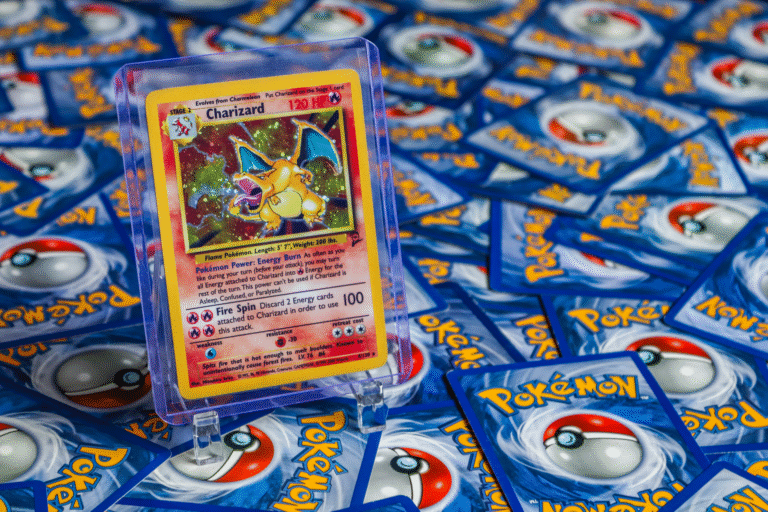
The 35-54 age cohort’s dominance in spending creates what collectors call the “nostalgia bid”—a pricing premium applied to first-edition cards, vintage Pokémon merchandise, and older game copies. Someone who played Pokémon Blue in 1998 is now willing to pay $50-150 for a graded Charizard card from that era, not for gameplay utility, but for the emotional connection to their childhood. The Pokémon Company understood this dynamic early, reissuing classic game titles on modern hardware (Pokémon Let’s Go Pikachu and Eevee, Pokémon Brilliant Diamond and Shining Pearl) to capture both nostalgia purchases and new player onboarding simultaneously. When Scarlet and Violet became the best-selling Pokémon games ever in Japan with 8.3 million units, surpassing the original Red and Green for the first time in franchise history, it demonstrated that nostalgia doesn’t prevent new sales—it amplifies them. Older players in Japan who played Red and Green in 1996 now bought Scarlet and Violet to see how the franchise evolved.
A specific example: a 45-year-old player who collected Pokémon cards as a child might spend $2,000 annually on vintage card authentication (grading services), new booster boxes ($150-200 per box), and occasional high-ticket purchases (graded Base Set cards). This behavior subsidizes the entire card market ecosystem and creates artificial scarcity that benefits all card owners. However, this also creates a pricing bubble risk. If nostalgia spending drops—if millennials shift their disposable income toward different hobbies—vintage card prices could contract sharply, impacting both collectors and investors who treat Pokémon as an asset class. The franchise mitigates this risk by continuously introducing new players through free-to-play mobile games and Pokémon GO, which generated $545 million in in-app purchase revenue in 2024 alone.

Mobile Games and Digital Revenue: Expanding Loyalty Beyond Console Hardware
While console games attract older players with money, mobile games attract younger players with time. Pokémon GO, released in 2016, created a parallel loyalty stream that didn’t require hardware investment—only a smartphone. The game generated $545 million in revenue in 2024 despite being eight years old, proving that Pokémon’s generational appeal transcends any single platform. More importantly, Pokémon GO introduced teenagers and young adults to the franchise who may never have owned a Game Boy or Nintendo Switch, creating new entry points for the loyalty ladder. Pokémon TCG Pocket, launched in October 2024, demonstrated the franchise’s ability to unlock new audiences through digital card games. The title reached $1 billion in gross revenue in just 204 days—the fastest any Pokémon mobile game achieved this milestone.
Unlike console games, which require $300-400 hardware investment, TCG Pocket runs on existing phones, lowering barriers to entry across all age groups and income levels. This created a compression of the loyalty ladder: a player could start with a free TCG Pocket account, spend $20-50 monthly, and then upgrade to a Switch and full console games once emotionally invested. The tradeoff is monetization friction. Console games sell at $60-70 per copy with a clear paywall; mobile games rely on in-app purchases, battle pass mechanics, and cosmetic spending. Some players find this model manipulative, while others appreciate the option to play entirely free. This dual-platform approach—console games for hardcore/older players, mobile for casual/younger players—creates overlapping loyalty cohorts that feed into each other.
Regional Market Differences and Growth Saturation Concerns
The global player distribution reveals Pokémon’s market penetration: APAC comprises 36.7% of players, Americas 32.7%, and EMEA 30.6%. This relatively balanced split masks significant regional differences in spending behavior and growth potential. Japan remains the flagship market, where Scarlet and Violet’s 8.3 million units exceeded the original Red and Green for the first time ever, signaling that even in the franchise’s home country, newer games can outpace generational nostalgia. In contrast, the American market shows signs of saturation. The US has the highest per-capita Pokémon spending and the oldest average player age, creating a ceiling on new user growth.
A critical limitation is that generational loyalty only works if new generations connect to the franchise. The youngest cohort of players (those born after 2015) now represents only 15% of the active player base, down from 25% five years ago. This suggests that Pokémon’s cultural dominance is declining among Gen Alpha—they have more gaming options, including Fortnite, Roblox, Minecraft, and mobile games that don’t require purchasing dedicated hardware. The franchise’s response has been diversification: Pokémon Legends: Arceus shifted gameplay mechanics to action-RPG elements, Pokémon Unite introduced MOBA mechanics, and TCG Pocket experimented with digital-only card gameplay. However, each experimental title cannibalizes players from the mainline games rather than expanding the total market. The Pokémon Company must navigate this tension: staying true to the 1996 formula preserves older players’ loyalty but risks appearing stale to younger audiences, while radical innovation alienates the 49% of players aged 35-54 who drive the highest spending power.
The Card Market as a Loyalty Amplifier and Speculative Asset
The Pokémon Trading Card Game operates as a parallel loyalty ecosystem that amplifies video game sales. Every Pokémon game release triggers a spike in card sales, as players seek physical representations of newly discovered creatures. When Scarlet and Violet launched, card sales spiked 40% in the following quarter, even though the games and cards operate independently of each other. This cross-reinforcement is intentional: the card game serves as a collectible alternative for players who don’t have time for 40-hour gameplay but want to engage with the franchise monthly. Scarlet and Violet Pokémon cards introduced new mechanics and artwork that couldn’t be experienced in the games, creating reasons for players to invest in both mediums simultaneously. A specific example: the card “Illustration Rare” variants released in 2023-2024 featured full-art treatments that appealed to older collectors seeking premium products, driving booster box prices from $90 to $130 per box.
This speculative premium on cards feeds back into game sales because collectors need to understand which Pokémon are valuable—knowledge that comes from playing the games. However, the card market also represents a speculative bubble risk that threatens generational loyalty. When first-edition Base Set Charizard cards sold for $10,000+ in 2021, investors flooded the market, treating Pokémon as a commoditized asset rather than a game franchise. The subsequent price correction in 2022-2023 alienated many investors, creating a narrative that Pokémon cards are a risky speculative asset, not a stable collectible. This sentiment seeps back into the video game community, where younger players now question whether buying booster boxes is a good use of money. The franchise’s loyalty depends on players treating Pokémon as entertainment-first, asset-second—the inverse of the speculative dynamic that emerged in 2020-2021.
Future Outlook and Sustained Loyalty Through Technological Evolution
Pokémon’s generational loyalty model will likely extend into the next decade because the oldest cohort of players (those who played Red and Blue) is still in their peak earning years and unlikely to stop spending on nostalgia products until age 60+. The Pokémon Company is preparing for this by introducing Pokémon to even younger players through augmented reality (Pokémon GO’s evolution), new hardware partnerships (potential Switch 2 launch), and expanding cultural presence through film and television adaptations that reach casual audiences who’ve never bought a game. The 2023 film “Pokémon: The First Movie” and the upcoming Pokémon Concord MOBA represent attempts to broaden the franchise’s appeal beyond traditional gamers. The uncertainty lies in whether generational loyalty can survive radical hardware or gameplay shifts.
If Nintendo releases a successor to the Switch and Pokémon becomes a launch title with drastically different mechanics, will players follow? Historical evidence suggests yes—but with friction. Players aged 45-55 require less friction to upgrade than players aged 20-25, who may have built hundreds of hours of investment in Sword and Shield or Scarlet and Violet. The franchise has already acknowledged this by introducing cloud-based Pokédex services and cross-platform progression mechanics in newer titles. This infrastructure allows generational loyalty to persist even as hardware evolves, removing one of the historical barriers to retention.
Conclusion
Pokémon turned generational loyalty into $288 billion in franchise revenue by designing products around hardware generations and life stages rather than chasing trends. A player who was eight years old in 1996 with Red and Blue remained engaged through Game Boy Color, Nintendo DS, Nintendo 3DS, and Nintendo Switch—each platform required minimal behavioral change because Pokémon games maintain consistent core mechanics. This consistency created a “sticky” franchise that older players couldn’t abandon without sacrificing a significant portion of their personal identity and nostalgia. Simultaneously, new players born every year onboard into an already-established ecosystem with 489 million games sold and a thriving social community, ensuring generational replacement without requiring radical innovation.
The franchise’s next decade will depend on maintaining this balance: preserving the loyalty of 35-54 year-olds who drive premium spending while expanding appeal to Gen Alpha players who have more entertainment options than any previous generation. Pokémon’s proven ability to adapt—through mobile games, card game mechanics updates, and experimental spin-offs—suggests the franchise can survive the transition to new hardware and cultural preferences. However, the warning signal is already visible: younger cohorts represent a shrinking percentage of the player base, and the speculative bubble in the card market has cooled investor enthusiasm. Generational loyalty is not infinite; it requires continuous reinvestment in new content, cultural relevance, and accessibility. The franchise that thrives in 2035 will look different than the one in 2025, but the core mechanic—providing a consistent entertainment experience across decades of a player’s life—will likely remain the foundation of its success.