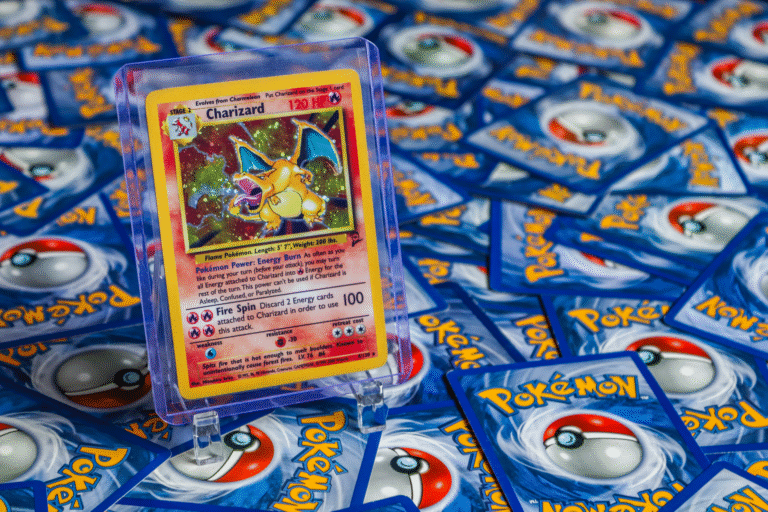
The best way to start collecting rare Pokémon variants on a budget is to focus on modern set chase cards with lower print runs and condition-flexible targets rather than vintage holographics. By understanding which recent variants hold value—like special illustration rares and alternate art cards from sets released in the past three years—you can build a meaningful collection without paying five-figure prices. For example, a special illustration rare Umbreon from the Evolving Skies set cost around $15–30 in near-mint condition during 2023, making it an accessible entry point for collectors interested in modern rarity.
The core strategy involves buying raw (ungraded) cards instead of PSA or BGS slabs, hunting for played-condition copies rather than pristine ones, and timing purchases during post-release price dips when market enthusiasm fades. Variant collecting specifically—pursuing the dozens of artwork versions and special treatments within a single generation—gives you more collecting paths per dollar than chasing the single “best” card. A raw near-mint alternate art card typically costs 40–60% less than the same card in a PSA 9 slab.
Table of Contents
- Which Rare Pokémon Variants Offer the Best Value for New Budget Collectors?
- The Crucial Drawback of Raw Cards and Condition Grading
- Building a Focused Collection Strategy Around Print Run Variants
- Where to Source Budget Variants and Timing Purchases Strategically
- Authentication and Counterfeiting Risks in Budget Markets
- Leveraging Japanese-Exclusive Variants for Rarity Without Premium Pricing
- Looking Ahead—How Budget Collecting Evolves with New Set Releases
- Conclusion
Which Rare Pokémon Variants Offer the Best Value for New Budget Collectors?
Not all rare variants are created equal when you’re managing a tight budget. Modern special illustration rares, character rares, and full-art trainer cards from sets released after 2020 are significantly more affordable than their vintage counterparts and still represent genuine rarity. The 2022–2023 era of expanded special print variants means you can find legitimate chase cards at $10–50 price points, while equivalent vintage cards command $100–1000+.
For context, a raw special illustration rare Lugia from the Lugia VSTAR box release cost around $20–40 in lightly played condition, whereas a vintage holographic Lugia from Base Set costs a minimum of $300 even in poor condition. Focusing on Japanese cards also stretches your budget further—Japanese print runs are typically smaller than English releases, creating rarity with lower secondhand prices. Attack Pokemon and mid-stage evolution variants tend to cost less than final-stage pokémon simply because fewer collectors chase them, giving you an opportunity to build a compelling collection around less-hyped characters. The lesson here is that rarity and collectibility don’t always track together, and learning which variants are undervalued relative to their print scarcity is where budget collectors gain an edge.
The Crucial Drawback of Raw Cards and Condition Grading
One major limitation of buying raw cards to save money is that you’re assuming significant condition risk without professional assessment. A card you believe is near-mint based on photos might grade PSA 6 or 7 when submitted to authenticators, and you have no recourse—once you own a raw card, its condition is your responsibility. this risk compounds if you plan to sell; ungraded cards almost always command lower prices than graded ones, and some buyers require grading for high-value purchases, meaning your $20 raw card might only fetch $12–15 on the secondary market even if it’s genuinely mint.
Additionally, modern printing defects—whitened edges, centering issues, and surface wear from pack friction—are endemic to recent sets and difficult to spot without specialized lighting or magnification. A special illustration rare that looks flawless under normal lighting often shows edge wear under a loupe, pushing it from near-mint into lightly played territory and reducing its value by 30–50%. Budget collectors must invest in a jeweler’s loupe, proper lighting, and card sleeves for protection, adding $30–50 in startup costs. The tradeoff is that this approach saves money long-term but requires more expertise and carries more uncertainty than buying pre-graded cards.
Building a Focused Collection Strategy Around Print Run Variants
Rather than trying to collect every variant of a popular Pokémon, successful budget collectors narrow their focus to specific set variants or Pokémon with lower print runs. Print runs vary dramatically even within a single set—special sets like Pokémon GO Elite Trainer Boxes and themed collection boxes contain exclusive variants that never appeared in standard booster packs, immediately making them scarcer. A special illustration rare from an Elite Trainer Box exclusive variant is often 30–50% cheaper than the same card’s standard special illustration rare from booster boxes, simply because fewer people bought those products.
The Japanese Shiny Star V set (2020) remains a textbook example: it contained full-art variants of random older Pokémon with print runs far smaller than contemporary English releases. Collectors who focused on acquiring one or two characters from Shiny Star V built impressive, distinctive collections for $300–500 total, whereas chasing the same cards’ English equivalents would have cost $1500+. This strategy works because you’re leveraging asymmetric information—understanding which regional releases, box exclusives, and limited products contain the rarest variants lets you find value that general collectors overlook.

Where to Source Budget Variants and Timing Purchases Strategically
The most reliable budget sources are Facebook Marketplace, local card shops, and discord communities dedicated to Pokémon trading, where private sellers often price cards below market rate and shipping is eliminated entirely. Japanese import sites like TCGPlayer’s Japanese division and local Japanese trading sites move inventory faster and price lower than English retailers, particularly for variants that haven’t gained Western collector awareness. A near-mint alternate art from a Japanese set might list for $15 on a Japanese site while the identical English version costs $35 on TCGPlayer’s English division.
Timing is critical: buy immediately after set release when print fatigue drives prices down, and avoid the 4–6 week period when new sets first launch. A special illustration rare costs 20–40% more in week two of a set’s release than in week six, once the market stabilizes. Alternatively, wait for rotation announcements in the Pokémon TCG format calendar—cards leaving standard rotation often drop 15–25% in price as competitive players liquidate holdings, even though casual collecting demand remains unchanged. The comparison here matters: buying a chase card two weeks after release instead of launch saves $5–15 per card, and that compounds across a collection.
Authentication and Counterfeiting Risks in Budget Markets
Counterfeit cards are concentrated in budget price ranges, particularly on platforms where verification is weak. Facebook Marketplace and Chinese e-commerce sites contain significant volumes of high-quality fakes of popular variants, and budget collectors are prime targets because they often lack the knowledge to spot reproductions. The warning here is straightforward: never buy variants under $5 from unknown sellers, and be skeptical of any deal more than 40% below market price. Legitimate sellers with rare inventory know its value.
Red flags include misaligned holofoil patterns, incorrect font weights on text, and slightly oversized or undersized cards compared to authentic copies—these require in-hand inspection or high-quality close-up photos from trusted sellers. PSA grading offers authentication as part of the service, which is why some budget collectors submit cards worth $20–30 to PSA just for the 1–2 week turnaround authentication, accepting the $15 grading fee to gain confidence. The limitation is that PSA submission fees can exceed the card’s value, making this approach uneconomical for bulk raw collections under $50. For your own collection, learn the authentication markers specific to the sets you collect—holofoil patterns, text alignment, and weight differences are set-specific and worth studying.

Leveraging Japanese-Exclusive Variants for Rarity Without Premium Pricing
Japanese Pokémon TCG sets are released annually in spring and autumn, creating a two-year window before cards are reprinted or rotated. Japanese full-art supporters, illustration rares, and special arts cards are printed in smaller quantities than their English counterparts and rarely spike in price, even when they become harder to find. A Japanese full-art supporter card that cost $10 in 2022 might cost $15–20 in 2024, compared to English equivalents that quadruple in price.
This creates a compounding advantage: you can assemble a complete set of Japanese variants from a given year for less than a single English premium variant from an older set. The catch is language—owning Japanese cards means you’ll need to learn the text and numbering system, and some collectors and resellers specifically want English versions. However, if you’re building for personal enjoyment rather than pure resale, Japanese cards offer exceptional value. A collection of 30–40 Japanese full-art supporters and illustration rares costs $200–400 total, whereas assembling the same collection in English would cost $800–1200, giving you access to rarity and variety at a fraction of the cost.
Looking Ahead—How Budget Collecting Evolves with New Set Releases
The Pokémon TCG continues expanding variant counts with each set, and recent releases in 2024–2025 have introduced even more special treatments—crown rare cards, promo variants, and set-specific texture patterns. This proliferation actually benefits budget collectors because more variants mean more distribution of rarity; fewer collectors are chasing any single card when there are 50 variants per set instead of 10.
Prices for individual variants will likely continue soft pressure downward as the total supply of variants increases. The forward outlook suggests that modern variant collecting will remain accessible for budget collectors, but successful collectors will increasingly need to specialize—focusing on specific Pokémon, specific years, or specific set types—to avoid the psychological trap of trying to complete everything. Early adopters who focused on 2020–2023 variants are already seeing appreciation, with cards purchased at $10–20 now listing for $25–40, suggesting that budget variants do build value over 2–3 year timescales if you choose widely available, well-liked variants rather than obscure print-run oddities.
Conclusion
Starting a rare Pokémon variant collection on a budget requires three core decisions: prioritizing modern special illustration rares over vintage cards, buying raw ungraded cards and learning condition assessment yourself, and timing purchases during post-release price dips or focusing on undervalued regional variants. By leveraging Japanese imports, focusing your collection on specific Pokémon or sets rather than attempting completionism, and sourcing from private sellers and local communities, you can build a collection of 50–100 genuine rare variants for $300–600. The variants you collect today will likely appreciate 2–3x over the next five years as print runs age out, turning your budget initial investment into a defensible personal collection.
Your next step is to choose a single set or Pokémon as your starting point—pick something released in the past two years that genuinely interests you—and begin with five to ten cards sourced from local players or Japanese import sites. This approach minimizes decision fatigue and lets you develop expertise in a narrow area before expanding your collection. The barrier to entry is low enough that you can start this week with a $50 purchase and a basic magnifying glass.