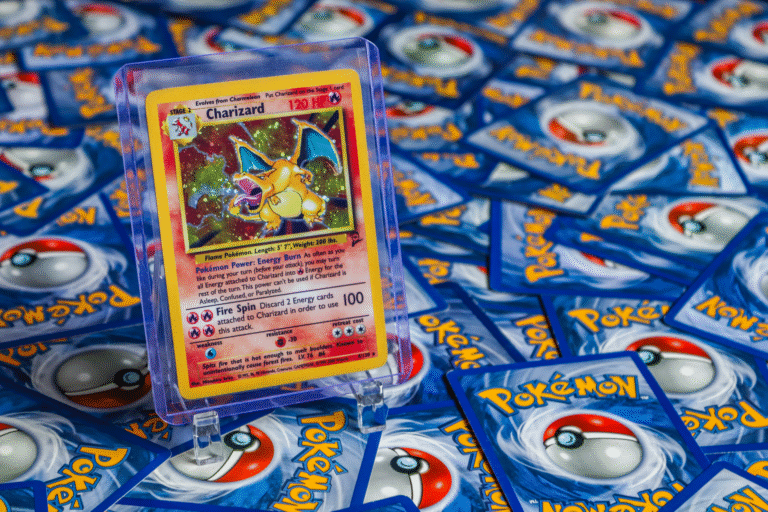
Pinpointing a precise $1,000 value for a 1999 Pokémon Charizard Holo PSA 6 in June 2026 is difficult because pricing varies significantly depending on the card variant, market conditions, and specific buyer demand. However, this grade level represents an important inflection point in the Charizard market: ungraded 1999 Charizards typically sell for $300–$6,000 depending on edition, while PSA-graded versions command substantially higher premiums. A PSA 6 Charizard sits in a middle territory where condition matters tremendously—better than heavily played copies, but below the pristine PSA 9–10 specimens that command five-figure prices. The $1,000 question hinges on which 1999 Charizard variant we’re discussing.
A 1st Edition Base Set Charizard can reach $1,000 in PSA 6, given that ungraded 1st Edition examples fetch $3,000–$6,000. An Unlimited Base Set Charizard in PSA 6 is less likely to hit that threshold, though exceptional examples occasionally do. The grading premium for vintage Charizards is substantial: PSA-graded cards account for 67% of the graded card market in 2026, and the authentication alone adds significant value to any vintage specimen. Understanding the nuances of these variants is essential before determining whether $1,000 is a realistic asking price or an outlier.
Table of Contents
- How Much Does a 1999 Charizard Holo Actually Cost Right Now?
- The Challenge of Variant Identification and Pricing
- Understanding PSA 6 as a Market Segment
- Comparing 1999 Charizard Values Across PSA Grades
- Market Volatility and Timing Considerations
- Practical Steps to Find Current PSA 6 Pricing
- The Future of 1999 Charizard Values in a Stabilizing Market
- Conclusion
How Much Does a 1999 Charizard Holo Actually Cost Right Now?
The Charizard market has stabilized considerably after the volatile period of 2022–2024, when prices dropped 30–50% from peak levels. Since early 2025, prices have climbed steadily but cautiously, reflecting a market that values authenticity and condition more than speculative fervor. For ungraded 1999 Charizards, realistic prices fall into three categories: Unlimited Base Set versions ($300–$500), 1st Edition Base Set versions ($3,000–$6,000), and the rare Shadowless variants worth 4–6 times the Unlimited price. These ranges account for visible wear and natural aging—a lightly played copy differs dramatically from a heavily played one.
PSA-graded Charizards command different pricing structures altogether. At the top end, a pristine PSA 10 first edition can exceed $15,000, representing an 8.5x multiplier over its ungraded equivalent. A PSA 6 occupies the realistic middle market where collectors with serious budgets but limited resources can acquire authenticated, condition-stable examples. Real-time pricing requires checking current eBay sold listings, the price guide, or the PSA auction database, as single cards can fluctuate by hundreds of dollars based on weekly buyer activity.

The Challenge of Variant Identification and Pricing
The critical limitation in valuing a “1999 charizard holo PSA 6″ is that this description alone doesn’t specify which variant you’re holding. A Shadowless Base Set Charizard differs fundamentally from a 1st Edition or Unlimited version, and these distinctions directly correlate to market price. Shadowless cards (printed before the shadow printing technique was introduced) are rarer and worth dramatically more. A Shadowless PSA 6 could easily exceed $1,000, while an Unlimited PSA 6 might trade for $400–$700.
Without knowing which variant you possess, any specific price claim is unreliable. The market also reflects broader condition realities: a PSA 6 represents “Excellent-Mint” condition with minor wear visible primarily on the edges and corners. Cards at this grade level typically spent decades in moderate storage—not mint on card (MOC) fresh, but far better than played copies. Grading decisions between PSA 5 and PSA 7 can swing values by 40–60%, making the difference between a $600 card and a $1,200 card hinge on subtle details like centering, corner sharpness, and surface wear.
Understanding PSA 6 as a Market Segment
PSA 6 represents the highest grade where collectors can still acquire 1999 Charizards without paying premium prices reserved for PSA 8+. This grade level has become increasingly popular because it offers authentication (eliminating counterfeiting risk), visible condition preservation, and affordability relative to near-mint examples. In 2026, 584 PSA 6 Charizard listings exist on eBay alone, though prices vary significantly based on seller pricing strategy, auction vs. fixed-price format, and supply fluctuations.
The psychological valuation of PSA 6 differs from lower or higher grades. A PSA 5 buyer typically accepted visible flaws and lower price expectation. A PSA 7 buyer expects near-perfect condition and pays accordingly. A PSA 6 buyer navigates middle ground—they want authentication and some condition assurance, but they’re not pursuing the showpiece quality that justifies $3,000+ spending. This positioning makes PSA 6 a volume grade where pricing reflects broader market sentiment about the card’s desirability rather than scarcity-driven outlier pricing.

Comparing 1999 Charizard Values Across PSA Grades
To contextualize whether $1,000 represents fair value for a PSA 6, consider the price progression across grades. An ungraded 1st Edition 1999 Charizard might fetch $3,500. The same card in PSA 5 would likely reach $600–$800. PSA 6 typically commands $800–$1,400 for 1st Edition variants. PSA 7 jumps to $1,800–$2,800. PSA 8 reaches $4,000–$6,500. PSA 9 approaches $8,000–$12,000.
PSA 10 exceeds $15,000. The increases accelerate sharply at higher grades because condition rarity compounds exponentially—far fewer cards achieve PSA 9–10 status. For Unlimited variants, the same grade progression is compressed downward. An ungraded Unlimited Charizard might sell for $400. PSA 6 Unlimited examples typically range $500–$900, below the $1,000 threshold for most transactions. This difference explains why framing matters: if you’re selling an Unlimited PSA 6, claiming $1,000 is likely overpriced unless it’s an exceptional outlier with extraordinary eye appeal. If you’re selling a 1st Edition PSA 6, $1,000 sits within realistic market range, though high-end examples at that grade.
Market Volatility and Timing Considerations
A critical warning: Charizard prices are subject to seasonal demand fluctuations, notable grade releases (when multiple high-grade examples hit market simultaneously, supply temporarily exceeds demand), and broader Pokémon card market sentiment. The 2022–2024 crash taught collectors that peak prices don’t represent stable baselines. A $1,000 PSA 6 that seemed reasonable in 2021 would have been an overreach by 2023. Current market (June 2026) shows stabilization, but this doesn’t guarantee prices won’t shift in coming months.
The specific risk for buyers: don’t overpay assuming flat or upward-only price movement. The most reliable price indicators come from examining the last 30–60 days of completed eBay auctions (sold listings, not asking prices) and checking PSA’s auction price database, which tracks actual transaction values. A single high-price outlier (perhaps from an emotional bidder or bundled lot) can inflate market perception. Always verify that your comparison sales are recent, completed transactions for the exact grade and variant you’re evaluating.
Practical Steps to Find Current PSA 6 Pricing
Real-time pricing information requires checking three primary sources. eBay sold listings for “1999 Charizard PSA 6” show what actual buyers paid in the last 30 days—this is your most reliable current-market snapshot. Filter by completed auctions to exclude optimistic asking prices. The price guide aggregates market data and displays historical price trends, allowing you to identify whether a card is rising or falling in value.
PSA’s official auction price database provides transaction history for graded cards, though the database can lag behind current market activity by several weeks. Before listing or purchasing, identify your specific card’s variant (Shadowless, 1st Edition, or Unlimited) by examining the card’s border printing and edition symbol. Cross-reference your variant with recent sold prices for that specific edition. A $1,000 asking price is justified only if recent comparable sales support it—not because the grade theoretically “should” be worth that amount. Market reality trumps grade-based estimates every time.
The Future of 1999 Charizard Values in a Stabilizing Market
The 2026 Charizard market reflects maturation: prices have settled after the speculative excess of 2020–2021, buyer demographics have shifted from speculators to collectors, and authentication services like PSA provide genuine value through condition standardization. This stabilization suggests prices are more defensible going forward, though dramatic appreciation is unlikely. A PSA 6 Charizard purchased at fair market value today has reasonable probability of holding its value, though rapid 20–30% gains that characterized earlier decades seem unlikely.
One forward-looking factor: as graded Charizards age and wear, PSA 6–7 examples may gradually increase in relative scarcity compared to lower grades. This scarcity premium could support modest price appreciation. However, the Pokémon Company has shown willingness to reprint and re-release Charizard cards frequently, potentially limiting nostalgia-driven premiums for vintage copies. Long-term holders should view a 1999 Charizard PSA 6 as a stable collectible, not a speculative asset expected to triple in five years.
Conclusion
The $1,000 value for a 1999 Pokémon Charizard Holo PSA 6 is plausible but contingent on specific factors: the card’s variant (1st Edition reaching this price more readily than Unlimited), current market conditions (which have stabilized as of June 2026), and individual card eye appeal (exceptional examples commanding premium pricing). Rather than accepting $1,000 as a fixed benchmark, view it as the upper-realistic range for 1st Edition variants and a ceiling for most Unlimited examples.
Your next step is verifying your card’s exact variant and condition context, then checking recent eBay sold listings and PSA’s auction database for comparable recent transactions. These primary market sources will reveal whether $1,000 represents fair pricing, an overask, or a potential bargain—context matters far more than the grade alone.