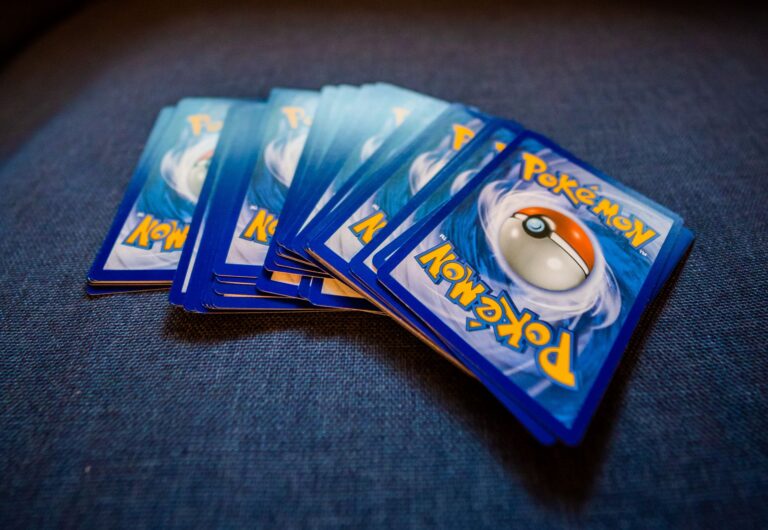
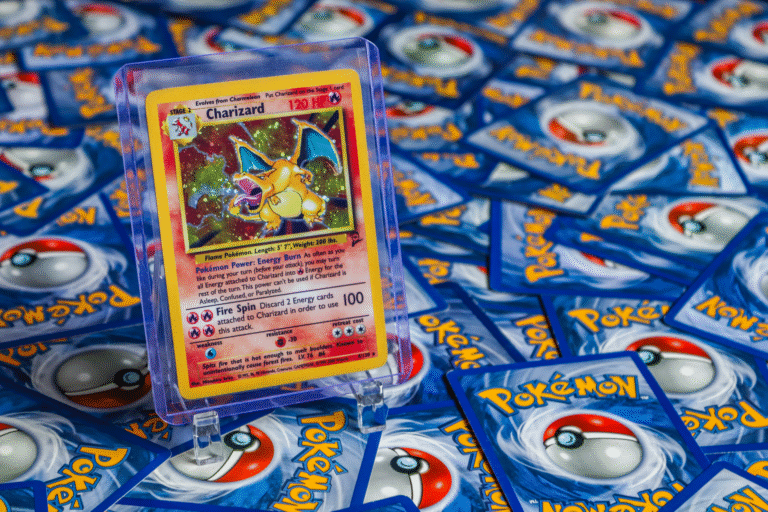
French First Edition Base Set Pokémon cards have fundamentally shifted the landscape for vintage buyers since 2021 by offering a rare combination of legitimacy and accessibility that didn’t previously exist at scale. The limited French print run—significantly smaller than English production—created a supply constraint that paradoxically made these cards more attainable than their English counterparts for collectors with moderate budgets. Unlike English First Edition Base Set cards, which command astronomical prices even in lower grades, French First Edition versions provide multiple entry points: buyers can acquire legitimate vintage Pokémon cards with the prestigious first edition stamp for anywhere from under $50 for non-holographic trainers to $2,000 for high-quality holographic commons, compared to English versions where even damaged holos frequently exceed those price floors.
The scarcity that defines French Base Set has become the market’s great equalizer for new collectors entering vintage Pokémon. Since the broader market stabilization in 2024, collectors have increasingly turned to French editions specifically because they offer the aesthetic and historical authenticity of first edition vintage cards without requiring five or six-figure budgets to participate meaningfully. This shift represents a genuine democratization of the vintage Pokémon market—not a settling for second-best, but rather the discovery of a parallel ecosystem where scarcity translates into opportunity rather than exclusion.
Table of Contents
- Why Did French First Edition Base Set Cards Become Affordable Entry Points?
- The Supply Scarcity That Creates Value and Collector Opportunity
- Budget Entry Points: Non-Holographic Cards and Energy Cards as Gateways
- The Sweet Spot: Mid-Grade Holographic Rares and the $200-$2,000 Price Corridor
- Elite Market: Charizard and the Exception That Proves the Rule
- Market Dynamics Supporting French First Edition Growth Since 2021
- Forward-Looking Perspective for French First Edition Collectors
- Conclusion
Why Did French First Edition Base Set Cards Become Affordable Entry Points?
The fundamental answer lies in production volume and American market dominance. When the Pokémon Company released the Base Set in 1999, the French market represented a fraction of total worldwide demand. Hasbro, the English-language distributor, produced millions of Base Set boosters and theme decks for North America and English-speaking markets globally. Conversely, the French run was deliberately conservative—a regional product for a smaller collector base. This created a paradox: French Base Set cards are technically rarer and more historically limited than English versions, yet they trade for less because collector demand has historically been US-centric. That dynamic began shifting around 2021 as serious collectors exhausted accessible English options and discovered the French market still had cards in better conditions available at fraction-of-the-price costs.
A concrete example illustrates this: an English First Edition Base Set Hitmonchan PSA 7 might sell for $3,000 to $4,500. The same card in French First Edition at the same PSA 7 grade typically ranges from $400 to $800. Neither card is common—both represent legitimate vintage first editions from the same product generation—but the English version’s premium reflects decades of American collector focus. New collectors who entered the market in 2022-2023 recognized this arbitrage opportunity: they could build a diverse vintage collection with French cards that would have been financially impossible with English versions, and they’d own legitimately scarce products in the process. The market hasn’t treated this as a compromise. Rather, serious collectors now view French First Edition Base Set as a distinct and preferable alternative—not a downgrade. You’re buying the same game mechanics, the same artwork, the same historical provenance, just from a print run that was never designed to flood the market.

The Supply Scarcity That Creates Value and Collector Opportunity
French Base Set’s limited production run means that even common-by-rarity-standard cards are difficult to find in good condition. A French First Edition Base Set Magikarp or Pidgeot—cards that are essentially bulk commons in English—becomes a collectible item when you add “French” and “First Edition” to the description. This isn’t artificial scarcity created by modern manipulation; it’s the natural consequence of production decisions made 25 years ago. The French print run was scaled for a regional market that was never as large or as engaged as the American market. Over two and a half decades, cards have been lost to water damage, bent in shoeboxes, pulled by children who actually played with them, or discarded during moves. What remains in collectible condition represents a smaller percentage of an already smaller original pool. The market data confirms this: according to collector reports and sales tracking, PSA-graded French First Edition Base Set cards appear in auction and resale channels far less frequently than English versions. When they do appear, they tend to move quickly—a signal of robust underlying demand.
This scarcity applies across the entire set, not just chase cards. You can find English Base Set First Edition Clefairy in PSA 8 for under $100. Finding a French First Edition Clefairy in PSA 8 is substantially harder and will cost $200-$400. The difference is pure supply: the English card had higher production and higher survival rates across decades. However, collectors need to understand a critical limitation: this supply scarcity is not uniformly distributed. The holographic rares were produced in lower quantities than the non-holographics, which means some specific cards remain exceptionally scarce while others are merely scarce. Additionally, authentication and grading present real challenges. French cards can be harder for some grading services to consistently assess, and not all cards have equivalent collector tracking. When buying French First Edition, condition assessment and grading legitimacy become even more important than with English versions because the resale market is smaller and buyers will demand absolute confidence in the card’s status.
Budget Entry Points: Non-Holographic Cards and Energy Cards as Gateways
For collectors with limited budgets, the true entry point to French First edition Base Set lies in the non-holographic trainers, supporters, and energy cards. These cards were printed in larger quantities than the holographics—a standard TCG production decision—and survive in higher absolute numbers. A French First Edition Base Set energy card in good condition might cost $15-$50 depending on grade. A French First Edition non-holographic trainer like Bill or Gust of Wind in PSA 6-7 condition runs $30-$100. These are not bargain-basement prices, but they represent legitimate, verifiable, first-edition vintage Pokémon cards at price points that don’t require significant financial commitment. Many new collectors follow a deliberate progression: start with a handful of non-holographic cards to familiarize themselves with grading standards, condition assessment, and the actual feel of 25-year-old cardboard.
Then, once they understand what they’re looking for, they graduate to holographic commons and uncommons. A French First Edition Base Set holographic non-rare—say, a Magneton—in PSA 6 might cost $200-$300, putting it squarely within reach of collectors who saved for a single meaningful acquisition. This creates a genuine pathway that didn’t exist before: you can spend $50 on entry-level cards, $300 on your first holographic, and then decide whether to pursue higher-grade rares based on actual experience rather than abstract theory. The warning here is straightforward: condition is everything at these price points. An ungraded French First Edition energy card that looks nice to the naked eye but has a slight bend or printing flaw can be worth $5, while the same card in verified PSA 6 condition is worth $30-$50. New collectors often underestimate how condition assessment works and how dramatically it affects value. Before spending serious money on French First Edition Base Set, educate yourself on grading standards or plan to use professional grading services.

The Sweet Spot: Mid-Grade Holographic Rares and the $200-$2,000 Price Corridor
The most active market for French First Edition Base Set exists in the PSA 6-8 range for holographic cards, where prices cluster between $200 and $2,000 depending on the specific card. This price corridor represents the true entry point for serious vintage buyers—people who want to own legitimately scarce first edition Pokémon from the foundational set but recognize that pristine gem-mint copies are either financially inaccessible or don’t exist in meaningful numbers. Cards like Hitmonchan, Alakazam, and Magneton in PSA 6-8 condition exemplify this market. A French First Edition Hitmonchan PSA 7 currently trades in the $400-$600 range—a card with obvious vintage character and legitimacy that was produced in tiny numbers 25 years ago. The same card in English First Edition costs $2,000-$3,000. For collectors who want the card, the history, and the scarcity without mortgaging other priorities, French First Edition offers a direct solution.
You can assemble a diverse collection of legitimate vintage rares across this price corridor that would be mathematically impossible with English cards. The tradeoff is collector perception and potential future value. English Base Set First Edition cards have deep liquidity and consistent demand because they represent the “canonical” vintage market—what collectors learned to want. French editions are catching up, but the resale market is smaller and potentially more volatile. If you buy a French First Edition Alakazam PSA 7 for $500 expecting to sell it for $1,000 in five years based on English comps, you might be disappointed. But if you buy it as a keeper piece—a legitimate, scarce, beautiful vintage card that you actually want to own—the pricing makes immediate sense. The distinction between speculative positioning and actual collecting becomes important here.
Elite Market: Charizard and the Exception That Proves the Rule
Every conversation about Base Set Pokémon eventually reaches Charizard #4/102, and French First Edition doesn’t escape this gravity. French First Edition Base Set Charizard in PSA 10 condition can reach five-figure prices—not quite the six-figure territory of English versions, but still an elite market reserved for collectors with substantial resources. Even at lower grades, Charizard dominates pricing: a French First Edition Charizard in PSA 7 ranges from $3,000-$6,000, making it exponentially more expensive than other rares in the same grade range. This represents an important reality check: while French First Edition democratizes most of the Base Set, it does not democratize the chase card. Charizard remains the canonical pinnacle of 1999 Pokémon collectibility, regardless of language.
The French version offers some accessibility improvement over English—a PSA 7 English Charizard costs $8,000-$12,000—but calling it “budget-friendly entry” would be misleading. Charizard is still a multi-thousand-dollar commitment, and acquiring one represents a major collecting milestone, not an casual purchase. The limitation here is important: if your goal is to own a first edition Charizard eventually, French First Edition helps but doesn’t fundamentally change the financial reality. It reduces the cost by 40-50% versus English, which is meaningful but not transformative. For all other cards in the Base Set, French First Edition creates genuine new entry points. Charizard remains the exception—the rare card where English and French pricing still commands serious premium consideration regardless of how you approach collecting.
Market Dynamics Supporting French First Edition Growth Since 2021
The broader vintage Pokémon market’s stabilization since mid-2024 has directly benefited French First Edition Base Set. Cards produced before 2003—including Base Set from 1999—remain the most robust segment of the market, driven by limited supply and nostalgia demand. This foundational strength applies equally to English and French versions, but French editions have grown disproportionately as collectors discovered them during market upheaval. When English Base Set prices became inaccessible to mid-tier buyers in 2020-2022, French versions still had reasonable availability at accessible price points. That market education stuck; collectors who discovered French editions during that window often remain French advocates because they’ve experienced the scarcity, condition, and value proposition directly.
The psychological factor matters too. Newer collectors entering in 2023-2025 don’t carry the same “English is default” assumption that characterized collectors from earlier decades. To a 35-year-old who collected Pokémon in 1999 and is re-entering now, French First Edition might feel like a compromise. To a 25-year-old entering for the first time, it feels like discovering an alternative ecosystem with better accessibility—which, objectively, it is. This generational difference in collector mindset has accelerated French First Edition adoption and liquidity. The market has reached a point where French First Edition Base Set cards trade with confidence, and sellers no longer face automatic resistance based on language alone.
Forward-Looking Perspective for French First Edition Collectors
As of 2026, French First Edition Base Set has established itself as a legitimate permanent segment of the vintage Pokémon market rather than a temporary arbitrage opportunity. The supply constraint is real and permanent—more cards will not be produced, and existing cards will continue deteriorating naturally. This structural scarcity supports long-term collector confidence. While pricing is unlikely to match English First Edition gains exactly, the pricing differential itself creates opportunity: French First Edition will likely appreciate in line with or potentially exceed English rates if collector demand continues shifting toward accessibility and value.
For collectors building collections now, French First Edition Base Set represents the last meaningful window to acquire diverse first-edition Base Set holdings at reasonable prices. As years pass and cards deteriorate further, the available supply in desirable condition will only decrease. The entry points that exist today at $200-$2,000 for solid mid-grade holographics may look like bargains in another five years if market demand continues deepening. Whether French editions will ever fully close the gap with English pricing is uncertain, but the direction is clear—French First Edition is appreciating faster than it was in 2021, and scarcity will continue driving that trajectory.
Conclusion
French First Edition Base Set Pokémon cards have created genuine entry points for vintage buyers specifically because of a paradox: they are more scarce than English versions but more affordable due to American market dominance and collector tradition. Since 2021, the market has recognized this arbitrage opportunity, and by 2025, French First Edition had transitioned from a niche alternative to a legitimate parallel ecosystem where collectors can acquire diverse first-edition holdings at accessible prices. The price corridor from $200-$2,000 for mid-grade holographics represents the sweet spot where scarcity, legitimacy, and affordability intersect. If you’re considering entry into vintage Base Set collecting, understand what French First Edition offers and what it doesn’t.
It provides genuine scarcity and historical authenticity at prices that make sense for most collectors’ budgets. It doesn’t include an easy path to chase cards like Charizard, nor does it guarantee future value matching English comparables. But for building a meaningful vintage collection with cards you can actually afford to own, French First Edition Base Set remains the most realistic opportunity available in 2026. Start with entry-level non-holographics, assess your interest and commitment, then pursue the mid-grade holographics that capture the essence of vintage Pokémon collecting without requiring elite-level financial resources.