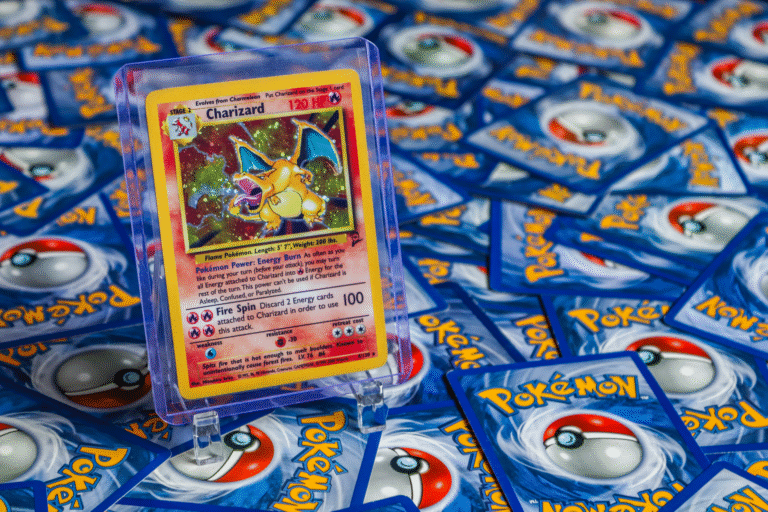
Japanese No Rarity Pokémon cards from 1996 are the original first-wave prints released in Japan on October 20, 1996, by Media Factory via Star Corporation. These cards are identified by the complete absence of a rarity symbol—no circle, diamond, or star—in the bottom-right corner, which distinguishes them from all subsequent printings and marks them as historically authentic first editions. Understanding these cards matters significantly because they represent Japan’s true genesis of the Pokémon Trading Card Game and have become some of the most valuable and sought-after collectibles in the hobby, with authenticated examples commanding prices that rival the rarest cards from any era.
The key thing buyers need to know is that No Rarity cards are inherently scarce. They were only produced during the first printing run of the Japanese Base Set, before the rarity symbol system was implemented as standard. The most famous example—a signed Holo Charizard with No Rarity markings by artist Mitsuhiro Arita—sold for approximately $324,000, making it one of the highest-verified sales in Pokémon card history. These cards also tend to feature printing quirks and errors that modern, tightly controlled manufacturing cannot replicate, which adds to their historical appeal and premium valuation.
Table of Contents
- What Makes Japanese No Rarity Cards Different from Other Base Set Prints?
- The Rarity Symbol System and Why Its Absence Is Significant
- Notable No Rarity Cards and Their Market Performance
- How to Verify and Authenticate Japanese No Rarity Cards
- Common Misconceptions and Market Traps
- The Printing Quirks That Make No Rarity Cards Distinctive
- Future Market Outlook and Collecting Strategy
- Conclusion
What Makes Japanese No Rarity Cards Different from Other Base Set Prints?
The defining characteristic of No Rarity cards is straightforward but crucial: they lack the rarity indicator symbol that appears on every other Pokémon card ever produced. Standard japanese base Set cards have a small circle (common), diamond (uncommon), or star (rare) symbol in the bottom-right corner next to the card number. The absence of this symbol is not a defect—it’s the opposite. It indicates the card comes from the original October 1996 printing before rarity categorization became the standard practice.
This absence is so consistent and recognizable that it serves as the primary authentication method for collectors and graders. The practical implication for buyers is that every No Rarity card is automatically a first-wave print, but not every first-wave print is necessarily a No Rarity card. Media Factory’s initial distribution included some variation in production, and collectors often debate the exact parameters of what qualifies as “true” No Rarity versus early prints with minimal rarity symbols. This distinction matters for valuation: a pristine Venusaur or Charizard with completely absent rarity symbol commands a premium, while cards from the same era with faint or partially visible symbols trade at lower prices. The safest approach for new buyers is to study reference images from reputable grading companies and to examine high-resolution scans of any potential purchase before committing funds.

The Rarity Symbol System and Why Its Absence Is Significant
When Pokémon cards were first conceived in Japan, the production team had not yet settled on using rarity symbols as a universal system. The October 1996 release therefore went out without these indicators, and by the time Media Factory ramped up subsequent printings and Star Corporation distributed cards more widely, the rarity symbol became standard. This historical accident created a natural dividing line between first-generation and second-generation Japanese Base Set cards. Every single No Rarity card from this window is now over 25 years old and has survived in a market that has dramatically changed in scale and preservation consciousness since then.
The limitation that buyers should understand is that the absence of a rarity symbol makes authentication harder, not easier. While the symbol’s presence can indicate a later print, its absence alone does not guarantee authenticity—it requires evaluation of paper quality, printing clarity, centering, and other production characteristics typical of 1996 manufacturing. Counterfeiters have learned to remove or bleach out rarity symbols, and some altered cards exist in the market. Professional grading services like PSA, BGS, and Japanese-specific graders provide the most reliable verification. A No Rarity card without third-party certification carries significant risk for buyers, particularly at price points above $500, because the burden of authentication falls entirely on the purchaser and their ability to identify historical printing variations.
Notable No Rarity Cards and Their Market Performance
The most famous No Rarity card is the Holo Charizard from the 1996 Japanese Base Set. When a signed version by original illustrator Mitsuhiro Arita came to market, it sold for approximately $324,000, setting a benchmark for the entire category. This price reflects not only the card’s rarity and condition but also the cultural significance of Charizard in Pokémon’s history and the provenance value of the artist’s signature. Even unsigned Holo Charizards with No Rarity have sold at auction for mid-five-figure prices when graded in gem condition. The second most famous example is the “Kairiki Charizard,” an error card where the wrong Pokémon name or artwork combination appeared, which trades consistently at over ¥1,500,000 (approximately $10,100 USD) in the Japanese market.
Beyond Charizard, common No Rarity cards that frequently command premiums include Venusaur, Raichu, and Gastly—all of which appear regularly in sales databases but at prices substantially above their 2000s valuations. A near-mint, correctly centered Venusaur with No Rarity might fetch $8,000 to $15,000 depending on condition. The important caveat here is that market prices for these cards are highly dependent on grade, centering, surface quality, and overall condition. Two Venusaurs graded identically can trade at different prices based on collector preference and market momentum. Resources like PokemonPriceTracker.com, TCGCollector.com, and price guide sites provide daily-updated pricing and historical sales data, though even these sources can lag behind active auctions for exceptionally rare examples.

How to Verify and Authenticate Japanese No Rarity Cards
The most reliable way to authenticate a Japanese No Rarity card is to submit it to a professional grading service that specializes in vintage Japanese cards. PSA, BGS, and Japanese-specific graders all maintain databases of previously graded No Rarity cards and understand the specific characteristics of 1996 Media Factory printing. When you submit a card, the grader examines paper thickness, ink viscosity, centering accuracy, and print clarity against known reference samples from authenticated collections. This process typically costs $15 to $100 per card depending on the service and turnaround time, but for cards valued above $1,000, professional authentication is essentially mandatory. An ungraded No Rarity card, no matter how beautiful, will trade at a significant discount relative to an identical card with a certified grade from a reputable service.
The practical limitation to understand is that grading services are not infallible, and slabbing (grading and encasing) adds both security and cost. A PSA 8 No Rarity Charizard will cost more to purchase than the raw card alone, but it comes with verified authenticity and condition assessment. For buyers new to this market, purchasing graded cards from reputable dealers or auction sites is safer than buying raw cards, even if the price premium feels steep. Compare the cost of a graded card ($15,000 for a PSA 8 Charizard) against the risk of purchasing an ungraded card for $12,000 that might later be discovered as a cleaned example or reprinted copy. The $3,000 difference is often insurance against much larger loss.
Common Misconceptions and Market Traps
One frequent misconception is that all Japanese Base Set cards without visible rarity symbols are automatically No Rarity cards from 1996. In reality, some reprints and regional variants also lack clear rarity indicators, and some cards from the first printing have symbols that are simply faint or poorly centered and therefore easily missed. Another trap is assuming that a card’s age alone guarantees its No Rarity status—documentation, provenance, and expert examination are required. The hobby has seen a significant influx of altered cards over the past decade, particularly high-value examples, where sellers have artificially removed rarity symbols or applied restoration work to enhance apparent condition. The warning that bears emphasis is that authentication fraud in the Japanese card market has become increasingly sophisticated.
Sellers on international platforms sometimes misrepresent condition or rarity status, either through ignorance or intent. A card listed as “No Rarity, Gem Mint condition” without third-party grading should raise immediate skepticism. Additionally, the market for No Rarity cards is illiquid compared to modern cards—meaning you might own a $10,000 Venusaur but struggle to find a buyer quickly if circumstances require fast liquidation. This illiquidity is why understanding true market value through pricing services matters: a card worth $8,000 in an active auction might only attract offers of $4,000 to $6,000 if you need to sell privately within a week. Purchase these cards as long-term holdings or as part of a collection you genuinely value, not as speculative investments expecting quick returns.

The Printing Quirks That Make No Rarity Cards Distinctive
One of the reasons collectors prize No Rarity cards beyond their historical significance is that they feature printing characteristics that are simply impossible to find on modern cards. Early Media Factory production involved different ink formulations, slightly inconsistent centering parameters, and paper quality variations that give each card a tactile, authentic feel distinct from today’s mass-produced releases. Some No Rarity Holo Charizards display what collectors call “dark print” quality, where the ink appears richer and more saturated than later printings.
Others show light print variations or subtle off-center productions that, while technically manufacturing “flaws,” are now viewed as proof of origin authenticity. These quirks cannot be artificially replicated without a working 1996 printing press and Media Factory’s original specifications—something that makes counterfeiting extremely difficult at the card level, though grading certification remains essential. A collector examining a No Rarity card under magnification can often spot these historical peculiarities and gain confidence in its authenticity. The example that illustrates this best is comparing a No Rarity Charizard side by side with a 1997 printing of the same card: the difference in paper sheen, ink depth, and overall aesthetic becomes immediately apparent.
Future Market Outlook and Collecting Strategy
The market for Japanese No Rarity cards has stabilized somewhat after the speculative bubble of 2021-2022, when prices for high-grade examples reached unsustainable levels. Current valuations reflect genuine scarcity and historical importance rather than pure speculation, which suggests the category will retain value as long as the Pokémon TCG remains culturally relevant. However, collectors should recognize that future supply shocks could occur if large hoards of previously unknown graded examples emerge from estate collections or institutional holdings. This has happened before in vintage card markets and is always a possibility with cards from a 25-year-old print run. The forward-looking strategy for buyers is to focus on cards that combine multiple value drivers: rarity, condition, artistic significance, or historical record.
A No Rarity Charizard in PSA 8 condition checks all these boxes. A No Rarity common in excellent condition has rarity and age but less cultural weight. Both are legitimate collectibles, but they appeal to different buyers and carry different risk profiles. As you consider purchasing No Rarity cards, establish a budget based on the value these cards bring to your personal collection rather than on expectations of price appreciation. This mindset protects against the emotional decision-making that often accompanies high-value purchases and keeps the hobby enjoyable rather than stressful.
Conclusion
Japanese No Rarity Pokémon cards from 1996 represent an important moment in the TCG’s history and offer collectors a tangible connection to the game’s origins. The combination of historical significance, production scarcity, and distinctive printing characteristics makes these cards valuable and worthy of study. The highest-verified examples, like the signed Mitsuhiro Arita Charizard that sold for $324,000, demonstrate the substantial premiums these cards can command when condition and provenance are excellent.
If you’re interested in acquiring No Rarity cards, prioritize professional grading and authentication, understand the specific characteristics of 1996 Media Factory production, and use current pricing resources like PokemonPriceTracker.com and TCGCollector.com to stay informed on market values. Purchase these cards with the expectation that they will be long-term holdings in your collection, and focus on examples that combine rarity with personal interest or historical significance. The market for these cards is established and stable, making them a legitimate category for serious collectors willing to invest in proper authentication and patient acquisition.