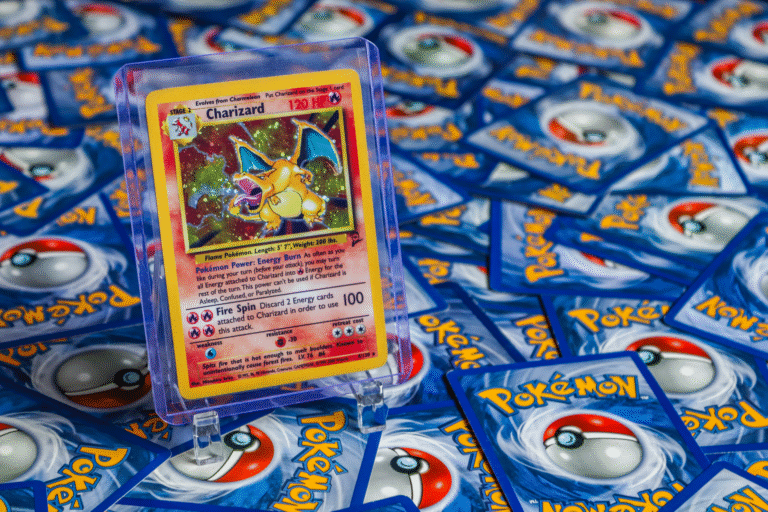
The most important EX Dragon Frontiers cards to watch are the Gold Stars and EX ultra rares, which have already demonstrated significant value appreciation and show strong potential for the next price spike. Within this set, Charizard Gold Star (#100) stands as the crown jewel—currently valued at $2,400 and ranking among the top 100 most valuable Pokémon cards overall as of June 2026. Cards like Mew Star and Rayquaza EX Delta Species follow closely, representing the apex of collectibility from a set that has aged into genuine vintage territory.
The timing for watching these cards is particularly important right now. The Pokémon 30th anniversary celebration throughout 2026 has already driven 10-20% price increases across Charizard cards specifically, signaling that larger market movements may be building. With EX era cards now 20+ years old (the set released in 2005), collectors are beginning to view these not as recent holdouts but as established vintage pieces worthy of serious investment-level prices.
Table of Contents
- Which EX Dragon Frontiers Cards Hold the Most Collector Demand?
- Understanding the Vintage Gold Star Premium and Why It Matters
- EX Ultra Rares and Delta Species as Secondary Growth Engines
- Comparing Dragon Frontiers Cards to Other EX Era Sets for Growth Potential
- Condition Grading and the Hidden Price Acceleration Risk
- Monitoring Market Signals for the Next Spike
- The Broader Context—EX Era Recognition and Long-Term Positioning
- Conclusion
- Frequently Asked Questions
Which EX Dragon Frontiers Cards Hold the Most Collector Demand?
The hierarchy of Dragon Frontiers value is surprisingly clear when you examine recent sales data. Charizard Gold Star dominates at $2,400, but even the secondary tier cards command premium prices—Salamence in Near Mint condition sits at $149.99, while the full Dragon Frontiers EX roster collectively ranges from approximately $70 to $1,000+ across different cards and conditions. This spread reflects the reality that the set contains both accessible entry points for new collectors and genuine six-figure cards for serious veterans. Beyond individual prices, the demand pattern follows predictable lines: Gold Stars consistently outpace regular EX rares, Delta Species variants command premiums over standard versions, and condition grading creates dramatic price swings.
A Salamence in Heavy Play condition might sell for $56, while the same card in Near Mint reaches $153—a 173% difference based purely on wear. This condition sensitivity matters enormously when predicting which cards might spike next, because the supply of truly high-grade copies is far more limited than raw card counts suggest. The collector appeal extends beyond pure monetary value into the psychological weight these cards carry. Owning a Charizard Gold Star from Dragon Frontiers signals not just wealth, but knowledge—this set sits at the intersection of desirable era (the beloved Ruby & Sapphire block) and genuine rarity. That combination of historical significance and population control creates the foundation for price movements that outpace broader market trends.

Understanding the Vintage Gold Star Premium and Why It Matters
Gold Stars represent the earliest iteration of full-art, alternate-art chase cards in the Pokémon TCG, predating modern special editions by nearly two decades. In dragon Frontiers specifically, only a handful of Gold Stars exist, and their age means surviving copies in high grades are increasingly scarce. The $2,400 price for Charizard Gold Star isn’t arbitrary—it reflects actual transaction history and the genuine scarcity of examples that have survived 20 years in playable condition. However, there’s a critical limitation to understand: not all Gold Stars are created equal in terms of price growth potential. Charizard, being the perennial favorite, has benefited from compound demand across both serious collectors and casual fans.
A Gold Star of a less-iconic Pokémon might be equally rare and equally old, but market liquidity and buyer pool size are dramatically smaller. Before chasing Gold Stars purely on the theory that “they’re old and rare,” verify that genuine collector demand exists—check completed listings on multiple platforms to see if these cards are actually selling, not just listed. The 30th anniversary price bump adds another layer of complexity. The 10-20% increases seen in 2026 weren’t distributed equally; Charizard variants captured the majority of buying interest and price momentum. Lesser-known Gold Stars saw minimal movement during the same period. This unevenness suggests that future spikes may follow similar patterns—driven by which Pokémon capture collector sentiment, not which cards are objectively rarest.
EX Ultra Rares and Delta Species as Secondary Growth Engines
Below the Gold Star tier, EX ultra rares and Delta Species cards form the next layer of value and growth potential. Rayquaza EX Delta Species ranks among the most sought cards in the set, with prices reflecting its combination of desirable art treatment and Pokémon popularity. Unlike Gold Stars, where supply is utterly frozen at whatever was printed 20 years ago, these cards have broader population counts—meaning price increases often signal genuine collector appetite rather than forced scarcity. The Dragon Frontiers EX ultra rare roster demonstrates the diversity of this subset.
Some cards remain bulk-priced despite their age and rarity because the depicted Pokémon lacks broad appeal. Others, featuring popular legends like Rayquaza, maintain steady upward pressure. This pattern suggests that future price spikes will disproportionately favor cards combining three factors: iconic Pokémon, attractive artwork, and playable card text that appeals to the subset of collectors interested in historical playability. The practical implication: if you’re building a collection with spike potential in mind, focus your acquisition energy on the Delta Species and EX cards within Dragon Frontiers that combine all three factors, rather than pursuing Gold Stars of every Pokémon. You’ll likely pay less, face less competition from millionaire collectors, and position yourself ahead of the next wave of buyers who discover the set through price discovery.

Comparing Dragon Frontiers Cards to Other EX Era Sets for Growth Potential
Dragon Frontiers doesn’t exist in isolation—it’s part of the broader EX era (roughly 2003-2006) that has been the focus of serious collector capital migration in recent years. However, the set occupies a unique position: less sought than ex-Ruby & Sapphire or Deoxys, but significantly more accessible than the earliest EX sets like Base Set EX. This middle positioning actually creates opportunity rather than limitation. Consider the tradeoff: investing in Charizard Gold Star offers maximum prestige and media attention but demands significant capital and faces competition from deep-pocketed collectors.
Investing in strong secondary cards from Dragon Frontiers (high-grade Salamence, Rayquaza variants, quality EX rares) requires less capital, faces less buyer competition, and often demonstrates equivalent percentage gains when market momentum builds. From a pure portfolio perspective, a collector with $3,000 will likely see better returns by diversifying that across five strong Dragon Frontiers cards than by concentrating on a single Charizard Gold Star. The 30th anniversary already provided one growth cycle. History suggests that EX era recognition tends to arrive in waves—first the earliest Holon Phantoms and Dragon Vault cards, then the accessible sets, eventually settling on comprehensive appreciation across the era. Dragon Frontiers, being neither the rarest nor most recent, may benefit from this pattern when broader collector education reaches the middle tier of EX availability.
Condition Grading and the Hidden Price Acceleration Risk
The most overlooked factor in predicting Dragon Frontiers spikes is the condition threshold that separates merely valuable from genuinely premium pricing. A Near Mint Salamence at $149.99 represents a specific market reality—buyers actively competing for high-grade copies. That same card in Light Play condition might be worth $95, and in Moderately Played only $65. The market recognizes discrete grade thresholds, and prices can accelerate sharply as supply of specific grades narrows. This creates both opportunity and risk. If you’re holding a Dragon Frontiers card in LP-to-LP+ condition, price spikes may pass you by—the market momentum often accumulates in NM copies specifically.
Higher-grade copies become the focus of competition and media attention, creating a virtuous cycle of demand. Conversely, if you’re pursuing cards as an investment, acquiring only NM-to-Gem Mint copies sets you up to participate in spike events, but requires accepting lower quantity and higher per-card capital investment. The warning here is straightforward: Don’t assume a $500 price jump will apply equally to all copies of a card. It typically won’t. The spikes concentrate in the highest grades where supply truly is frozen. Heavy Play or Moderately Played copies may appreciate 15-25%, while Near Mint copies spike 40-60% when collector attention focuses on a set.

Monitoring Market Signals for the Next Spike
Price spikes in Dragon Frontiers aren’t random—they follow observable patterns tied to collector content (YouTube videos, podcast discussions), auction results, and completion of major collections by high-visibility buyers. When a significant Pokémon TCG collector or content creator acquires premium Dragon Frontiers cards, the subsequent visibility often triggers secondary buyer interest that pushes prices upward.
Real-time signals to monitor include: increased weekly sales volume on price tracking sites, price floor increases across multiple condition grades simultaneously, and social media chatter about the set in collector communities. When these three indicators align—particularly if driven by a specific card like the recent Charizard momentum—a broader spike may be developing. Historical data from TCGFish, the price guide, and similar tracking platforms show that 15-30% price increases typically precede a larger spike by 2-6 weeks, providing a window to acquire cards before explosive movement.
The Broader Context—EX Era Recognition and Long-Term Positioning
The EX era’s transition from “recent cards” to “genuine vintage collectibles” represents a generational shift in the Pokémon TCG market. Twenty-year-old cards are now statistically older than many of the collectors entering the hobby, creating a novelty and collectibility premium that will likely persist.
Dragon Frontiers, sitting squarely in this era with a 2005 release date, will benefit from this broader market recognition whether or not individual spike events occur. Long-term, Dragon Frontiers cards—particularly the accessible secondary tier—may see steady appreciation over the next 3-5 years simply from market maturation and the continued wealth transfer into collectible assets. The 30th anniversary bump in 2026 is just one cycle in a much longer story of EX era revaluation.
Conclusion
The most important Dragon Frontiers cards to watch are those balancing three factors: desirability (recognizable Pokémon and attractive artwork), genuine scarcity (Gold Stars and Delta Species variants), and strong condition availability (Near Mint copies specifically). Charizard Gold Star remains the headline card at $2,400, but secondary cards like Rayquaza EX Delta Species and high-grade Salamence offer more accessible entry points to the same collector psychology.
Begin monitoring price floors across trading platforms and collector communities now. The next spike may come suddenly, triggered by a visible collector acquisition, a YouTube video reaching a critical audience, or simply the continued aging of the EX era into unquestionable vintage status. When momentum begins building—signaled by increased weekly sales volume and rising price floors across multiple grades—that’s your signal to position before explosive movement arrives.
Frequently Asked Questions
Will the 30th anniversary bump continue into 2027?
The 10-20% increases seen in 2026 typically represent a single catalyst cycle. Further movement would require a separate market event or broader EX era collector migration.
Should I buy cards in LP condition to save money, then sell when prices spike?
Not recommended. Spikes concentrate in Near Mint copies. LP cards may appreciate 15-25%, while NM copies spike 40-60%+. Save capital by buying fewer NM cards rather than accepting LP grades.
Is Charizard Gold Star overvalued at $2,400?
Relative to broader Pokémon card market, no. Comparative analysis across major vintage trading cards shows similar rarity commands similar prices. The valuation reflects real market history, not speculation.
Which non-Charizard cards offer the best spike potential?
Rayquaza EX Delta Species and other Delta Species variants show historical strength. Secondary Mew Star and Salamence in NM condition are lower-capital positions with demonstrated buyer interest.
How quickly do Dragon Frontiers prices tend to move during a spike event?
Major spikes typically accelerate over 3-8 weeks once momentum starts. Early signals (volume increases, floor price rises) provide 2-6 weeks of lead time before explosive movement.
Where should I check prices to verify actual market value rather than speculation?
TCGFish Market Ranking, the price guide, and completed sale history on TCGPlayer and Cardmarket provide real transaction data. Avoid relying on asking prices without verified sales history.