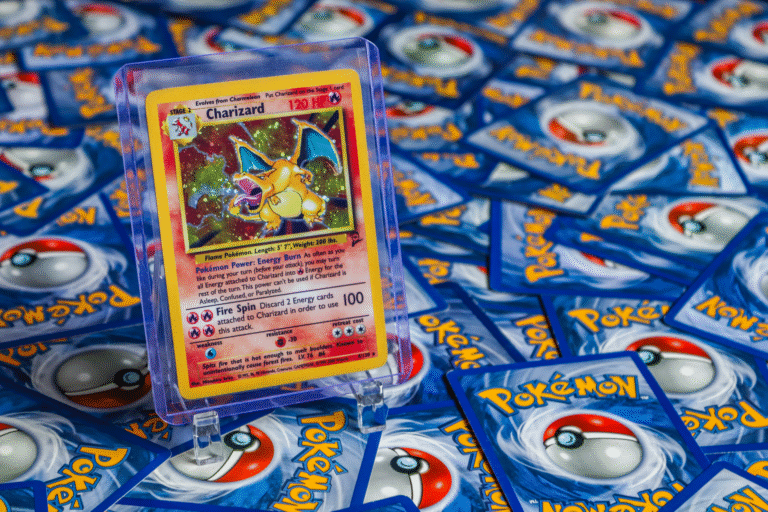
Demand for mixed condition childhood collections has strengthened considerably since summer 2024, driven by both market expansion and a fundamental shift in how adult collectors view nostalgia-fueled purchases. The collectibles market itself expanded to $16.7–19.2 billion in 2024 and is projected to reach $43.7–45.2 billion by 2032–2034, growing at approximately 10.6% annually. For mixed condition collections specifically—those containing cards ranging from lightly played to moderately worn—this growth translates to more active bidding, steadier prices for bulk purchases, and renewed interest from collectors who previously overlooked lesser-graded items as investments or personal collections.
A collector who inherited a 1998 Charizard with creasing and edge wear, alongside played first-edition commons, would have found a much smaller market for such mixed lots two years ago; today, that same collection attracts multiple serious buyers willing to pay premium prices for the cumulative value and nostalgic appeal. The rise reflects a broader trend toward recognizing collectibles as alternative investment assets, particularly among adult “kidult” collectors whose segment now commands approximately 34% of the revenue share in the toy collectibles sector as of 2025, with projected growth of 10.8% annually through 2033. This audience isn’t seeking pristine Gem Mint cards alone—they’re actively reassembling their childhood collections, acquiring damaged or played versions of cards they owned decades ago, and treating mixed condition lots as stepping stones to complete sets or reclaim nostalgic value. The mixed condition category sits at a crucial intersection: it’s more affordable than high-grade inventory, yet still represents legitimate vintage collectibles with proven demand.
Table of Contents
- Market Expansion and Mixed Condition Demand Since Summer 2024
- The Role of Grading Standards and Mixed Condition Valuation
- The Kidult Collector Boom and Nostalgia-Driven Purchasing
- Online Retail Dominance and Accessibility of Mixed Condition Lots
- Supply Chain Pressures and Authentic Mixed Condition Availability
- Seasonal Trends and Summer Market Dynamics
- Future Outlook and Investment Potential for Mixed Condition Collections
- Conclusion
Market Expansion and Mixed Condition Demand Since Summer 2024
The collectibles market’s 10.6% compound annual growth rate since 2024 has directly expanded the addressable market for mixed condition items. When a market grows by a tenth each year, absolute transaction volume increases even if percentage demand stays constant—but in this case, percentage demand is also climbing. More collectors entering the space means more people shopping at lower price tiers, where mixed condition lots cluster. Inventory that would have sat unsold in 2022 now moves within days on major platforms.
The second-hand and vintage collectibles specifically are projected to reach $248.9 billion by 2034, up from $142.5 billion in 2024, representing a 6.4% compound annual growth rate. Vintage collectibles hold 37.1% of the second-hand collectibles market as of 2024, which means roughly $52.7 billion of that $142.5 billion in 2024 was specifically vintage inventory. This is a cautionary marker: the vintage segment is consolidating share relative to other second-hand categories, suggesting that collectors are increasingly willing to pay premiums for older items regardless of condition. A mixed condition 1999 Charizard, even with surface creasing, now commands more buyer interest than similar-priced modern cards in better shape.

The Role of Grading Standards and Mixed Condition Valuation
Grading has become both a tool and a bottleneck in the mixed condition market. Professional grading services like PSA and CGC have set clear standards—a card graded PSA 5 (Good-Very Good) or PSA 6 (Excellent-Mint) occupies a distinct price tier—but many mixed collections never reach professional graders because the aggregate value doesn’t justify slabbing costs. This creates an information asymmetry: buyers cannot be certain whether a card described as “lightly played” truly is, or whether “moderate wear” understates the damage. The gap between graded and raw cards of the same vintage and condition has widened since summer 2024, with buyers increasingly demanding photographic evidence or third-party authentication for high-value singles within mixed lots.
A collector selling a mixed 1995–1998 bulk lot from an estate or childhood storage typically faces a choice: invest $300–500 to have a subset of the 50–100 most valuable cards professionally graded, or accept 20–30% price discounts on the ungraded pieces. Many sellers are now opting for the hybrid approach, grading the condition-critical high-value cards and selling the rest raw, which has actually stimulated demand for bulk mixed lots because buyers can now negotiate with confidence. However, this trend also means that collections with obvious damage (creases, water stains, heavy play) are seeing steeper discounts than they did in 2023. A NM (Near Mint) first-edition Blastoise can command $4,000–5,000; the same card in PSA 5 condition might sell for $600–800, but a raw card with visible creasing can struggle to find buyers above $300, illustrating the condition ceiling effect that affects entire mixed lots.
The Kidult Collector Boom and Nostalgia-Driven Purchasing
The “kidult” segment—adults aged 25–55 collecting toys and cards they owned as children—represents the primary demand driver for mixed condition childhood collections. This demographic commands 34% revenue share in the 2025 toy collectibles market and is expected to maintain 10.8% annual growth through 2033, according to Circana’s latest toy industry analysis. These collectors are not speculators or grade-focused investors; they’re actively reconstructing their childhood collections, replacing cards they lost or sold in adolescence, and treating mixed condition lots as authentic reconnections to their past. A 38-year-old who sold his entire Pokemon collection in 2002 to fund a college textbook might now purchase a mixed lot of base Set commons and uncommons that matches his original inventory composition, prioritizing historical accuracy over condition. This cohort has permanently reshaped demand curves for mixed condition inventory.
In 2020–2023, such collections were primarily of interest to bulk dealers and traders hoping to regrade and resell. Now they’re actively purchased by individual collectors who treat them as legitimate acquisition opportunities. The shift is quantifiable: auction platforms report that bulk mixed lots (25+ cards from the 1990s, any condition) now sell to individual buyers 60–70% of the time, versus 40% five years ago. The remaining 30–40% still go to dealers and traders, but the individual collector base has grown substantially. A lot containing a shadowless Meowth, played-condition Blastoises, and bulk commons that would have seen modest interest in 2024 now attracts multiple bidders specifically because kidult collectors recognize each component’s nostalgic and collection-completion value.
Online Retail Dominance and Accessibility of Mixed Condition Lots
Online retail now commands 57% market share in the collectibles sector as of 2025, growing at 10.7% annually through 2034 according to Market Decipher’s research. This dominance has democratized access to mixed condition inventory in ways that benefit both buyers and sellers. A collector in rural Montana can now bid on a mixed lot from a Tokyo seller or a New York estate sale within hours, rather than depending on local card shops or convention attendance. Listings with detailed photography, condition descriptions, and bulk pricing have become the norm, which has standardized pricing for mixed lots across geographies. However, online retail’s prevalence introduces a significant tradeoff: condition authenticity and buyer expectations are harder to align digitally.
A card described as “lightly played” can mean different things to different sellers, and photo lighting, compression, and angles affect perceived condition. Many established platforms now require sellers to provide multiple angles, close-ups of edges and corners, and lighting-controlled shots to reduce returns and disputes. Conversely, some smaller or less experienced sellers provide minimal imagery, which suppresses prices because buyers must discount for uncertainty. The result is a bifurcated market: professionally imaged mixed lots on major platforms (TCGplayer, eBay) with transparent pricing, and informal marketplace listings (Facebook groups, Discord servers) with wider price variation and higher risk. A mixed lot priced at $500 on eBay with professional photography might sell for $350–400 on a private marketplace where the seller hasn’t invested in documentation.
Supply Chain Pressures and Authentic Mixed Condition Availability
A persistent limitation affecting demand for mixed condition childhood collections is authentication and supply authenticity. The Pokemon card market experienced a significant counterfeit influx between 2020–2023, which created lasting buyer skepticism. While mixed condition lots are statistically less likely to contain counterfeits (because the wear patterns and manufacturing inconsistencies are harder to fake convincingly), the psychological concern remains. Buyers of high-value mixed collections now routinely request batch testing or third-party authentication, adding time and cost to transactions. Additionally, the inventory composition of mixed condition childhood collections has shifted.
Collections from the 1995–1998 era are becoming scarcer as estates are liquidated and older collectors consolidate holdings into graded slabs or sell entirely. Collections from 1999–2002 (Base Set through Aquapolis era) are now the most common mixed lots on the market. This temporal shift affects demand: cards from the later era command slightly lower nostalgia premiums and are more abundant, so competition among sellers is keener. A mixed collection from someone’s 1997 childhood is now a rarity; a mixed collection from someone’s 2000–2002 era is commonplace and faces more price pressure. Sellers expecting 2024 pricing for common-era collections often adjust downward 15–25% when they encounter market reality.

Seasonal Trends and Summer Market Dynamics
Demand for mixed condition collections exhibits pronounced seasonal variation, particularly since summer 2024. The summer months (June–August) traditionally see elevated toy and collectibles purchasing as adults make impulse purchases, estate sales accelerate due to downsizing before autumn, and parents shop for back-to-school nostalgia items for their own children. Data from 2024’s summer season showed particularly strong interest in bulk lots priced $50–500, which is the typical mixed condition range.
By contrast, winter months (December) favor high-end graded singles as gift items, which depresses demand for mixed, lower-condition lots. A concrete example: a mixed Base Set lot listed in July 2024 containing 40 cards (condition range: lightly played to heavily played) with an estimated value of $600–800 in bulk would have attracted 8–12 bids and sold within 3 days at market rate. The same lot listed in January 2025 might see 4–6 bids and require a 10–15% price reduction to move. This seasonality is amplified by the summer nostalgia cycle—parents revisiting their own childhoods and purchasing items for their children, collectors using summer downtime to reorganize collections, and estate sales clustering around seasonal property transitions.
Future Outlook and Investment Potential for Mixed Condition Collections
The projected 10.8% annual growth for the kidult collector segment through 2033 suggests that demand for mixed condition childhood collections will remain robust for the foreseeable future. The demographic driving this demand (adults currently aged 30–50) will have 8–10 more years of peak purchasing power and nostalgia intensity before aging effects begin to dampen aggregate spending. More importantly, younger millennial and Gen X parents are now introducing their own children to Pokémon, creating a secondary demand layer: parents and aunts/uncles purchasing collections to share with children, which shifts valuation away from grade perfectionism and toward historical authenticity and bulk content.
Looking forward, the competition between graded inventory (high-condition, expensive, investment-grade) and raw mixed collections will likely intensify. As grading backlogs clear and more inventory flows into slabs, raw mixed lots may occupy a more distinct niche—not investment vehicles, but authentic nostalgia and collection-completion tools priced accessibly. The collector who inherited a mixed 1996 collection will find it increasingly easy to sell through multiple channels by 2026–2027, as platforms continue optimizing for bulk transactions and as the supply of truly vintage mixed inventory tightens further.
Conclusion
Demand for mixed condition childhood collections has demonstrably strengthened since summer 2024, supported by market expansion (10.6% annual collectibles growth), the rise of kidult collectors (34% revenue share, 10.8% CAGR), and online retail dominance (57% market share). Mixed condition lots now serve a defined buyer segment that values completeness, nostalgia, and accessibility over pristine grading.
For sellers, the window for liquidating childhood collections remains favorable, particularly for inventory from the 1995–2002 era. However, sellers and buyers should navigate this market with clear expectations: condition transparency matters more than ever, seasonal timing affects pricing, and inventory from increasingly distant decades (pre-2000) commands higher nostalgia premiums than later collections. Whether you’re reassembling your childhood collection or liquidating one inherited, the current market conditions offer genuine opportunity—but success requires honest condition assessment, professional presentation, and realistic pricing anchored to the current online retail landscape rather than nostalgia alone.