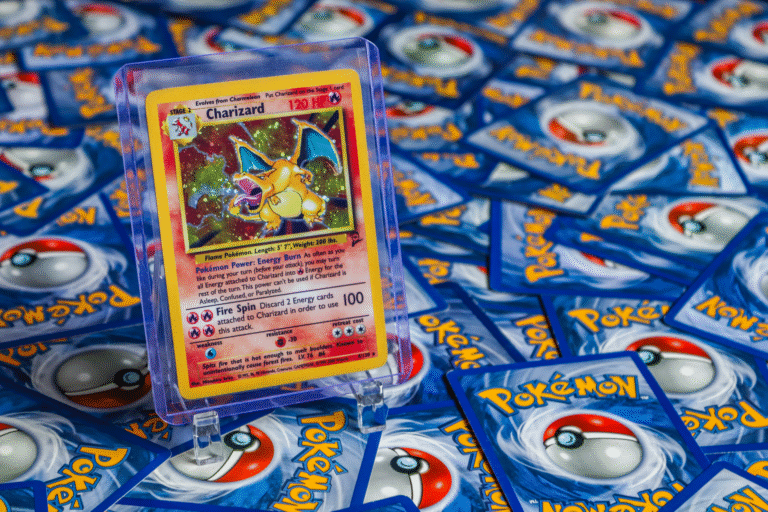
Yes, mixed condition childhood collections remain undervalued compared to their mint or professionally graded counterparts, though the overall collectibles market has cooled significantly since the 2021-2023 peak. A 1999 Base Set Charizard in mixed condition might trade for $200-400 today, while an equivalent PSA 10 example commands $2,000-4,000 or more—a premium that reflects not just the superior condition, but also the absence of standardized grading that haunts mixed condition lots. The lack of uniform valuation standards for mixed condition pieces has persisted despite five years of market maturation, creating what researchers call “significant uncertainty” in pricing for items that fall outside professional grading channels.
The global trading card market reached $13-15.8 billion in 2024 and continues expanding toward a projected $23.5 billion by 2030, yet this growth masks a deeper reality: mixed condition items have become a secondary market tier. They’re easier to acquire than pristine examples, cheaper than certified grades, but harder to move and bundle—creating a valuation gap that hasn’t substantially narrowed since 2021. For collectors sitting on childhood collections of mixed condition cards, this presents both an opportunity and a warning: the market has grown, but standardization has favored graded cards, leaving raw mixed condition lots in a perpetual discount.
Table of Contents
- Why Do Mixed Condition Collections Still Command Lower Prices Than Graded Cards?
- The Standardization Gap That Still Exists Five Years Later
- How the 2021-2023 Collectibles Boom Changed—and Why Mixed Condition Suffered More
- The Adult Collector Premium and Why It Doesn’t Help Mixed Condition Items
- Risks and Limitations of Holding Mixed Condition Collections Long-Term
- Real-World Example: A 1999 Base Set Collection
- Future Outlook for Mixed Condition Valuations
- Conclusion
Why Do Mixed Condition Collections Still Command Lower Prices Than Graded Cards?
Professional grading services like PSA, BGS, and CGC have created a clear hierarchy in the market, with graded items consistently commanding 5-10x premiums over raw, ungraded counterparts with identical visual condition. A PSA 10 Pokemon card becomes a liquid asset with transparent pricing; a mixed condition card—perhaps played with as a child, stored inconsistently, and showing signs of wear across different surfaces—enters a murky territory where pricing depends on a buyer’s subjective assessment of what “mixed condition” actually means. One collector’s “lightly played” is another’s “heavy play,” creating friction that discourages bulk purchases and keeps prices depressed. The grading standardization problem extends beyond terminology.
Mixed condition lots require individual inspection and negotiation, while a PSA-graded card comes with a certificate and a established market baseline. This friction alone depresses valuations by 30-50% relative to comparable graded cards, regardless of actual condition quality. For someone with a collection of 100 cards spanning multiple conditions, the transaction costs of getting each piece evaluated, photographed, and listed individually can exceed the marginal revenue from selling at premium prices. This economic reality keeps mixed condition collections stuck in the low-valuation zone.

The Standardization Gap That Still Exists Five Years Later
The absence of a universal grading scale for mixed condition items has been a persistent market drag since 2021. While professional grading services have refined their standards and expanded into new areas, there is no equivalent standardized framework for selling collections where some cards are mint, others are heavily played, and the rest occupy the murky middle ground. This means that a collector trying to sell a childhood collection must either invest heavily in getting individual cards graded (which only makes economic sense for high-value pieces) or accept discount pricing that reflects the buyer’s risk of overpaying for a mixed lot.
The collectibles market research from Grand View Research in 2024 highlighted that this standardization gap continues to create “significant uncertainty” in valuation. For mixed condition Pokemon collections specifically, this translates into real dollars lost. A 1995 Jungle Holo Venusaur in mixed condition might legitimately be graded anywhere from PSA 5 to PSA 7, but without that certificate, a potential buyer assumes the worst-case scenario and prices accordingly. The lack of standardized assessment means buyers apply a default discount of 40-60% to ensure they’re not overpaying—a penalty that’s largely unchanged from 2021.
How the 2021-2023 Collectibles Boom Changed—and Why Mixed Condition Suffered More
The collectibles market experienced a dramatic peak from 2021 through 2023, driven by pandemic-era nostalgia and speculative buying. During this period, even mixed condition cards appreciated noticeably as collectors competed for supply. Since the market correction, however, auction results have fallen 50% or more from those recent highs, though major auction houses have maintained relatively stable overall volumes of $2.0-2.46 million per sale from 2021 through 2025. Mixed condition collections have suffered disproportionately from this correction because they were always the most vulnerable to buyers’ risk aversion.
When prices were rising and collectors were eager to complete collections at any quality level, mixed condition lots moved readily. In today’s cooler market, buyers have regained discretion and are more selective, preferring to either chase certified graded examples or purchase at minimal cost. This creates a squeeze for mixed condition collections: they’re too expensive to flip quickly as bulk lots, but too inconsistent to command premium individual pricing. A collector who held a $3,000 mixed condition collection in 2022 might find it valued at $1,200-1,500 today—a steeper decline than the market average, reflecting the collapse in demand for non-standardized inventory.
The Adult Collector Premium and Why It Doesn’t Help Mixed Condition Items
One bright spot in the market is the growth of adult collectors, or “kidults,” who now represent 28-34% of global toy sales. Q1 2025 spending by this demographic hit $1.8 billion, up 12% year-over-year, suggesting durable demand for collectible cards and nostalgic items. However, this spending is heavily skewed toward new product releases, graded vintage cards, and complete sets—not toward mixed condition childhood collections.
Adult collectors with disposable income tend to prefer either sealed products (which preserve investment potential) or high-grade certified pieces (which signal status and protect against fraud). Mixed condition collections appeal primarily to budget-conscious collectors and casual enthusiasts who lack the disposable income to chase graded examples or sealed booster boxes. While the “kidult” growth story is genuinely positive for the overall market, it has actually widened the valuation gap between mixed condition and graded items. Serious adult collectors willing to pay premiums are segregating themselves into a graded-only market, leaving mixed condition items to compete in a lower-tier segment where price competition is intense and margins are thin.
Risks and Limitations of Holding Mixed Condition Collections Long-Term
Storing a mixed condition childhood collection creates ongoing risks that mint or graded collections don’t face. Mixed condition cards are typically not slabbed, meaning they remain vulnerable to deterioration from humidity, light exposure, and handling. A card that was in “excellent” condition when stored five years ago may have faded, warped, or developed corner creases from environmental factors—essentially becoming worse without any change in your stewardship. This decay risk is invisible to buyers, but it’s real, which is why they discount mixed condition lots as a hedge against unknown storage history.
Grading prices have also become a practical barrier. Getting a mixed condition childhood collection professionally graded costs $5-20 per card depending on the service, turnaround time, and card value threshold. For a 200-card collection, that’s a $1,000-4,000 upfront investment before you’ve sold a single card. Many collectors find that grading costs exceed the premium they’d gain on lower-value cards (anything under $50 raw), making selective grading impossible without creating a fragmented lot that’s even harder to move. This economic trap—where the cost of improving marketability exceeds the revenue gain for average cards—disproportionately affects mixed condition collections and keeps them undervalued by design.

Real-World Example: A 1999 Base Set Collection
Consider a concrete example: someone discovers their childhood Pokemon Base Set collection in the attic—150 cards ranging from commons to a holographic Charizard. Some cards are still in excellent condition, never played with. Others show edge wear, corner bends, and creases from being shuffled in a deck. The Charizard is lightly played at best, possibly PSA 7-8 quality. Without grading, a bulk buyer might offer $800-1,200 for the entire lot based on a conservative assessment of mixed conditions.
If the owner invests $2,000 in grading the 20-30 most valuable cards individually, the Charizard alone might sell for $1,500, the next tier for another $500, and commons would still move as a graded bulk lot for $300-400. Total proceeds: $2,300-2,400 against a $2,000 grading investment—a slim 15-20% gain that barely covers the time cost of logistics and listing. This scenario is typical, and it’s why most mixed condition collections remain ungraded. The economics of selective grading simply don’t work for average collections, and the lack of standardization means buyers default to discount pricing knowing that the seller faces this exact economic trap. A collector with 50 cards worth $50+ each might justify grading, but the typical childhood collection—heavy on commons, light on trophy pieces—gets stuck in the undervalued tier.
Future Outlook for Mixed Condition Valuations
The collectibles market is projected to grow at 10-24.6% compound annual growth rate through 2034, reaching $13.9-26.4 billion, suggesting long-term tailwinds for the hobby overall. However, there’s no indication that standardization for mixed condition items is improving. Instead, the market structure is likely to deepen: more cards will be graded, creating a larger premium-tier market; more collectors will embrace sealed or complete graded sets; and mixed condition collections will occupy an increasingly marginal position.
The adult collector boom driving current growth shows no signs of preferring mixed condition lots, which suggests the valuation gap may actually widen rather than narrow. For collectors holding mixed condition childhood collections, the strategic option remains unchanged: either commit to selective grading of high-value pieces, sell the entire lot at discount to a bulk buyer, or hold indefinitely as a nostalgia asset rather than an investment. The market has matured, but in a direction that disadvantages mixed condition inventory. Until—or unless—a standardized grading option emerges for lower-value cards (potentially through lower-cost services or machine learning-assisted assessment), mixed condition collections are likely to remain undervalued relative to graded counterparts.
Conclusion
Mixed condition childhood collections remain undervalued in 2026, not because the broader collectibles market hasn’t grown, but because market structure has evolved to favor graded and sealed inventory. The trading card market is genuinely healthy, projected to reach $23.5 billion by 2030, and adult collectors represent a substantial and growing segment. However, this growth has accrued to professional grading services, new product releases, and high-quality vintage cards—not to the mixed condition lots that most people actually have sitting in attics and storage boxes.
The standardization gap that existed in 2021 remains, creating persistent friction and discount pricing. For collectors evaluating a mixed condition collection, the realistic options remain modest: accept 40-60% discount pricing for bulk sales, invest in selective grading of the 10-20% of cards that justify the cost, or treat the collection as a long-term nostalgia hold. The market has matured substantially since 2021, but maturation has meant specialization and professionalization—trends that have deepened rather than closed the valuation gap for mixed condition collections.