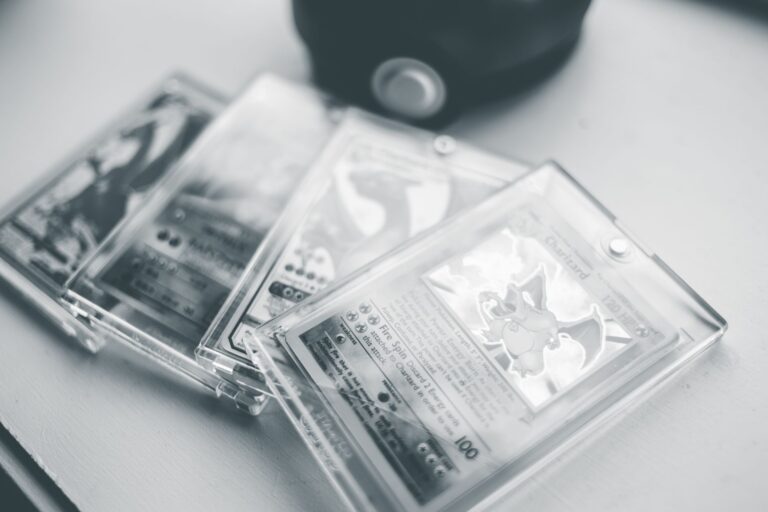
Yes, PSA 7 Base Set holo cards remain undervalued as of May 2026, nearly a year after the fall 2024 market correction began. While premium grades like PSA 9 and PSA 10 have largely recovered, mid-grade Base Set holos continue to trade below their historical value benchmarks. For example, a PSA 7 Alakazam from Base Set Unlimited currently trades around $500, while the same card in PSA 9 condition commands significantly higher premiums—reflecting a persistent gap that suggests opportunity in the mid-grade market.
The data is clear: mid-grade cards suffered disproportionately during the 2024-2025 market downturn. High-end copies have bounced back as collectors and investors chase trophy cards and limited populations, but the psychological appeal of PSA 7 hasn’t recovered with the same momentum. This creates a disconnect where collectors can acquire solid, presentation-quality Base Set holos at discount prices compared to where they traded just 18 months ago.
Table of Contents
- What Happened to PSA 7 Base Set Holos During the 2024-2025 Market Correction?
- How Do PSA 7 Cards Compare to Higher Grades in Today’s Market?
- Specific Base Set Holo Examples: Which Cards Offer the Best Value at PSA 7?
- Is Buying PSA 7 Base Set Holos a Smart Investment Strategy Right Now?
- The Grade Premium Problem: Why PSA 9 and PSA 10 Recovered While PSA 7 Hasn’t
- Neo-Era Cards as an Alternative to Base Set Holo Investments
- What’s the Outlook for PSA 7 Base Set Holos Through 2026 and Beyond?
- Conclusion
What Happened to PSA 7 Base Set Holos During the 2024-2025 Market Correction?
The Pokemon TCG market experienced a significant reset starting in fall 2024, triggered by oversaturation in modern products, speculation-driven buying in 2023-2024, and broader economic uncertainty. Mid-grade vintage cards—particularly psa 6-8 copies—took the sharpest losses. PSA 7 base set holos fell into this category, experiencing price declines of 30-50% depending on the specific card and initial valuation. Common Base Set holos like Chansey illustrate this pattern clearly.
These cards now typically sell for $60-$94 in PSA 7 condition as of 2025-2026, significantly below the $120-$180 range they commanded at the market’s 2023-2024 peak. The decline reflected a correction away from speculative buying toward more measured demand based on actual collector interest and scarcity. What made this period particularly harsh for mid-grades was that both mass-produced modern cards and mid-tier vintage copies faced simultaneous selling pressure, while truly rare high-grade specimens remained more resilient. The distinction matters: PSA 9 and PSA 10 cards recovered relatively quickly because there are fewer of them in circulation, and collectors who actually want trophy-quality copies were willing to buy the dips. PSA 7 cards, by contrast, competed with a larger supply and faced psychological resistance—collectors either wanted the budget-friendly graded copies at PSA 6 prices or preferred to reach for PSA 8-9 quality if they were spending meaningful money.

How Do PSA 7 Cards Compare to Higher Grades in Today’s Market?
The grade premium structure reveals why PSA 7 appears undervalued relative to PSA 9 and PSA 10. Research from 2026 pricing guides shows that the jump from PSA 9 to PSA 10 can represent a 50-70% price premium on high-value cards—sometimes much more on truly iconic pieces like first Edition Charizard. The jump from PSA 7 to PSA 9, however, typically represents only a 20-35% premium, suggesting that PSA 7 is pricing in disproportionate discount relative to its tangible quality improvement over PSA 6. This creates a valuation anomaly. A First Edition Charizard in PSA 9 sells for $23,000-$25,000 as of May 2026, while PSA 10 “Gem Mint” copies routinely exceed $260,000. The same card in PSA 7 would trade somewhere in the $3,000-$5,000 range—a dramatic drop.
Yet in terms of actual eye appeal and playability for high-level collectors, the jump from PSA 7 to PSA 9 is meaningful but not transformative in the way that PSA 9 to PSA 10 is. The market is effectively penalizing PSA 7 more harshly than the grade difference alone would justify. A limitation worth noting: not all PSA 7 cards are equally undervalued. Star holos like Charizard, Blastoise, and Alakazam have attracted enough collector attention that their discounts are smaller. Common holos like Chansey or Nidoqueen remain more severely undervalued, partly because fewer collectors specifically hunt for them, even at attractive prices. Understanding this variance is critical before committing capital.
Specific Base Set Holo Examples: Which Cards Offer the Best Value at PSA 7?
Alakazam stands out as one of the cleaner examples of relative undervaluation in PSA 7. The card currently prices around $500 for unlimited copies, making it accessible to collectors with modest budgets while still representing genuine vintage cardboard from the early Pokemon TCG era. The card has solid demand due to its portrayal and historical significance, but mid-grade copies aren’t commanding the kind of premium recovery seen in PSA 9-10 versions. Common holos represent another angle. Chansey and other utility cards now trade for $60-$94 in PSA 7 condition, which is low enough that accumulating a graded collection of first-print holos becomes feasible.
These cards carry less psychological prestige than star holos, but they offer genuine vintage condition verification at accessible prices. The downside: they lack the demand profile that would drive appreciation, making them suitable primarily for collection-building rather than speculation. First Edition versions and star holos introduce additional complexity. A PSA 7 First Edition Charizard would represent substantial value if one could be sourced at appropriate pricing, but such copies are rare and tend to attract collector premiums whenever they surface. Most PSA 7 Base Set holos available in the current market are unlimited prints, which affects both availability and long-term upside.
Is Buying PSA 7 Base Set Holos a Smart Investment Strategy Right Now?
The case for PSA 7 purchases hinges on personal objectives. If your goal is building a display-quality Base Set collection, current pricing offers genuine value. A complete set of PSA 7 Base Set holos would be attainable at a fraction of what it cost 18 months ago, and the cards are presentable enough for most display purposes. The investment in certified condition is justified by the preservation and authentication benefits grading provides. The investment case is weaker. Mid-grade cards historically recover more slowly than high-grade specimens after market corrections, and the current data supports this pattern.
While PSA 7 cards are undervalued relative to their quality, that doesn’t guarantee appreciation. You’re betting on a recovery that may take years and could be partially offset by inflation and opportunity cost elsewhere in the market. Compare this to PSA 9-10 cards, which have already bounced back and are less likely to appreciate further—a classic risk-reward tradeoff. Liquidity is another limitation. PSA 7 cards sell, but not with the velocity of PSA 9-10 copies. If you need to liquidate quickly, expect longer wait times and potentially steeper discounts to move inventory. This makes PSA 7 suitable for long-term holds rather than trading vehicles, which reduces its appeal for active collectors or investors.
The Grade Premium Problem: Why PSA 9 and PSA 10 Recovered While PSA 7 Hasn’t
The psychological and structural reasons for disparate recovery are worth understanding. High-grade cards attract institutional and serious collector attention—the kinds of buyers with large budgets who drove demand during the 2023-2024 bubble and returned to buy dips when valuations fell. These buyers have specific targets: First Edition or shadowless versions, star holos in near-mint condition, and rare holographic error cards. PSA 9 and PSA 10 cards are filtered purchases for this cohort. PSA 7 cards, by contrast, occupy an ambiguous position. They’re too expensive for casual buyers seeking graded copies on a budget, and they’re not impressive enough for serious collectors who’d prefer to stretch for PSA 8-9 if they’re spending four-figure sums.
This “in-between” positioning created a vacuum during the correction. PSA 7 cards weren’t wanted badly enough by any single collector category to drive aggressive buying, while PSA 10 cards—limited in supply and highly desired—commanded firm bid-ask spreads. A warning: this dynamic could reverse if the market environment shifts. If PSA 9-10 cards become too expensive for most collectors and buying pressure moves down the grade spectrum, PSA 7 could experience sharp appreciation. However, this scenario is not guaranteed, and timing such a shift is speculative. The safer assumption is that mid-grades recover gradually over time, not dramatically.
Neo-Era Cards as an Alternative to Base Set Holo Investments
It’s worth noting that while PSA 7 Base Set holos remain undervalued, the fastest-growing segment in the Pokemon card market as of May 2026 is neo-era vintage holos from 1999-2002. Cards like Lugia, Ho-Oh, and crystal-type holos are appreciating rapidly, driven partly by tiny PSA 10 populations and renewed collector nostalgia for that era. If you’re considering mid-grade vintage purchases, neo-era cards offer a growth narrative that Base Set mid-grades currently lack.
The comparison is instructive: neo-era cards haven’t experienced the same degree of correction as Base Set holos because they were less inflated during the 2023-2024 bubble. They’re appreciating because supply is tighter and demand is rising. Base Set cards, by contrast, still carry the weight of overvaluation from the bubble. If your goal is finding undervalued vintage at PSA 7, neo-era holos may offer better risk-adjusted upside than Base Set commons and uncommons.
What’s the Outlook for PSA 7 Base Set Holos Through 2026 and Beyond?
Expect gradual recovery rather than sharp appreciation. Market corrections typically take 18-24 months to fully digest, meaning mid-grade cards should begin normalizing around late 2026 or early 2027. However, “normalizing” doesn’t mean returning to 2023-2024 peak prices—it means finding a new equilibrium that accounts for genuine demand rather than speculative fervor. PSA 7 Base Set holos will likely trade 15-25% above current levels by end of 2026 if this pattern holds.
The near-term catalyst would be renewed collector enthusiasm and tighter liquidity. If key players re-enter the market and speculative excess is fully purged, mid-grades could see faster appreciation. However, competing segments like neo-era holos, PSA 9-10 trophy cards, and sealed product investments are all positioned to attract buying capital. PSA 7 Base Set holos will recover, but they’re unlikely to be the market’s strongest performers over the next 12-18 months.
Conclusion
PSA 7 Base Set holo cards remain undervalued as of May 2026 relative to their historical pricing and their quality compared to higher grades. The data supports this across multiple card types: common holos trade at $60-$94, Alakazam sits around $500, and the gap between PSA 7 and PSA 9 pricing has widened beyond what tangible quality differences would justify. This represents genuine value for collectors building mid-grade sets, though investors should temper expectations about near-term appreciation. If you’re interested in PSA 7 Base Set holos, the time is favorable for accumulation.
Prices are reasonable, and long-term recovery is likely. However, understand the limitations: these cards will recover slowly compared to PSA 9-10 copies, liquidity is lower, and competing segments may offer better near-term upside. Focus on star holos and cards with genuine collector appeal rather than bulk commons if you’re seeking potential appreciation. For pure collection-building at reasonable cost, PSA 7 Base Set holos are a smart choice in the current market environment.