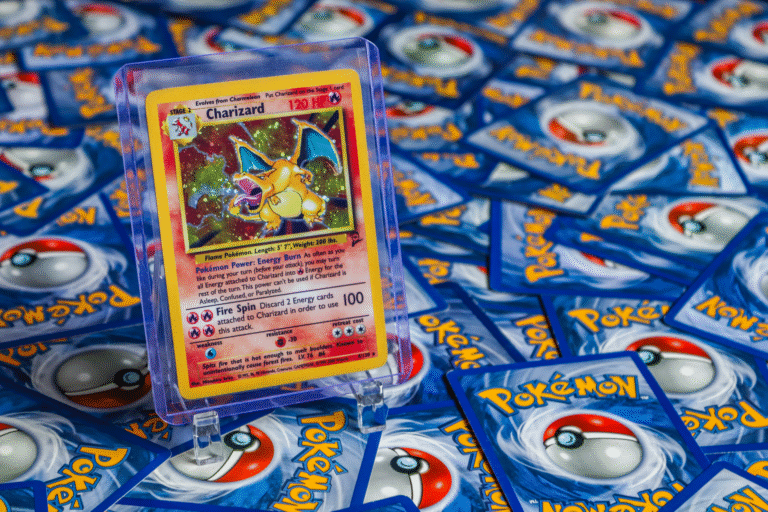
Yes, Base Set Pokemon cards are receiving significantly more collector attention than EX Unseen Forces cards, driven by nostalgia, iconic artwork, and proven investment value. Base Set remains the most sought-after Pokemon Trading Card Game release since 1999, with cards like Charizard and Blastoise commanding premium prices that continue to climb. Meanwhile, EX Unseen Forces (released in 2006) attracts a smaller but dedicated subset of collectors focused on the EX era’s unique mechanics and artwork, but lacks the cultural impact and liquidity that Base Set cards maintain.
The difference in attention is measurable across market activity. Base Set cards consistently dominate sales data on major platforms, with regular graded card sales occurring multiple times per week for popular holos like the Venusaur and Machamp. EX Unseen Forces cards see steady trading activity but at lower volume and price points, with most collector interest concentrated on a handful of rare holos and secret rares rather than the entire set.
Table of Contents
- Why Do Base Set Cards Command More Collector Interest Than EX-Era Releases?
- Market Supply and Grading Infrastructure Supporting Base Set Demand
- Collector Demographics and Investment Narrative
- Price Trends and Market Volatility Comparison
- Condition Sensitivity and Grading Premiums in Both Sets
- Secondary Market Platforms and Price Discovery
- Future Outlook and Emerging Collector Patterns
- Conclusion
- Frequently Asked Questions
Why Do Base Set Cards Command More Collector Interest Than EX-Era Releases?
base Set cards represent the original foundation of the Pokemon TCG, making them inherently more accessible to collectors who started with the game during its 1999 launch window. These first-edition and unlimited versions carry historical significance that newer releases cannot replicate, even if those newer sets offer superior card quality or gameplay design. A first-edition Base Set Charizard graded PSA 8 regularly sells for $8,000–$12,000, while even the most coveted EX Unseen Forces Espeon-EX might fetch $1,500–$3,000 in comparable condition, illustrating the generational value gap.
The nostalgia factor also creates sustained demand that transcends collector sophistication. Players who grew up opening Base Set booster packs in the late 1990s have spending power and emotional attachment that drives prices upward across the entire set’s catalog. EX Unseen Forces appeals mainly to collectors who entered the hobby during the 2000s mid-range era, a smaller demographic with less accumulated wealth than millennial Base Set veterans. This generational cohort difference explains why Base Set maintains consistent auction activity while EX Unseen Forces sees seasonal fluctuations tied to specific collector interests or player nostalgia events.

Market Supply and Grading Infrastructure Supporting Base Set Demand
Base Set’s supply dynamics have become increasingly favorable for collectors seeking graded examples, as many mid-to-high-grade copies have entered professional grading services like PSA and BGS over the past 15 years. This creates a clear market price history and confidence in authentication, whereas EX Unseen Forces has fewer graded examples in circulation, making price discovery more difficult and transaction costs higher for buyers seeking certified cards. A Base Set holographic Charizard has thousands of graded examples tracked on platforms like TCGPlayer and eBay, while EX Unseen Forces Espeon-EX might have only a few hundred graded copies across all PSA grades.
One limitation of the EX Unseen Forces market is the lack of deep liquidity outside the top-tier holos and secret rares. Common and uncommon EX Unseen Forces cards trade at bulk prices, and even some rare holos sell slowly at $20–$50, reflecting limited collector demand beyond set completion goals. Base Set commons and uncommons also trade at lower prices, but the volume of transactions is substantially higher, meaning collectors can quickly locate and purchase cards with confidence in fair pricing. This difference compounds for serious collectors trying to build complete EX Unseen Forces sets, where finding the last 10–15 cards might require weeks of searching and negotiating with scattered sellers.
Collector Demographics and Investment Narrative
The investment narrative surrounding Base Set cards has solidified over two decades, with professional and retail market participants actively promoting graded copies as alternative assets comparable to fine art or vintage sports cards. Major auction houses like Heritage Auctions run dedicated Pokemon card auctions where Base Set cards consistently achieve record prices, generating media coverage that reinforces their status as blue-chip collectibles. EX Unseen Forces lacks this institutional validation and media coverage, positioning it as a niche collector set rather than a recognized investment vehicle.
Younger collectors entering the hobby in 2022–2026 often prioritize Base Set cards as their primary acquisition target, even if they find EX Unseen Forces artwork or mechanics more appealing personally. This social proof effect means Base Set cards receive disproportionate attention from emerging collectors with limited budgets, who allocate available spending toward the most universally recognized and liquid cards. A new collector with $500 to spend will almost certainly purchase a Base Set card rather than multiple EX Unseen Forces holos, understanding that Base Set retains value more reliably. EX Unseen Forces becomes a secondary focus only after Base Set collecting goals are partially satisfied.

Price Trends and Market Volatility Comparison
Over the past five years, Base Set card prices have shown consistent upward trajectory interrupted only by temporary market corrections, while EX Unseen Forces prices have experienced more volatility with periods of stagnation followed by sharp appreciation tied to specific collector interests or prominent sales. Base Set Charizard first-edition prices increased from roughly $5,000 in 2018 to $10,000+ in 2024, reflecting steady demand growth, whereas EX Unseen Forces Espeon-EX prices fluctuated between $800 and $2,500 during the same period without clear directional trend.
For collectors prioritizing price stability and resale confidence, Base Set cards represent a safer allocation of capital despite their higher entry price. A collector purchasing a Base Set Blastoise holographic first-edition for $3,000 can reasonably expect to recover 80–90% of that investment within five years, whereas an EX Unseen Forces card at the same price point might appreciate, depreciate, or hold flat depending on market sentiment shifts that are difficult to predict. This asymmetry in price stability incentivizes collectors to focus attention on Base Set cards when deciding between comparable collections, further concentrating collector interest on the original set.
Condition Sensitivity and Grading Premiums in Both Sets
Base Set cards exhibit extreme sensitivity to grading results, with the difference between PSA 7 and PSA 8 often representing a 50–100% price increase for popular holos like Charizard. This grading sensitivity drives collector attention toward the raw card markets where opportunities exist to identify undergraded copies and submit them to PSA for potential profit, creating ongoing collector engagement with Base Set inventory. EX Unseen Forces cards show less dramatic grading premiums, meaning a PSA 7 Espeon-EX might only cost 20–30% less than a PSA 8 copy, reducing the financial incentive to engage in the grading and resale cycle.
One limitation of this dynamic is that Base Set collectors can become overly focused on grading outcomes rather than the actual card experience or gameplay value. High-grade Base Set cards are often kept sealed in protective cases and never viewed for enjoyment, whereas EX Unseen Forces cards are more likely to be handled, played with, or displayed in collection binders because their lower prices justify actual use. For collectors seeking cards to appreciate in grade and value rather than simply enjoy, Base Set remains the superior choice, but this mentality explains some of the attentional bias toward Base Set and away from the equally beautiful and historically interesting EX Unseen Forces artwork and design.

Secondary Market Platforms and Price Discovery
TCGPlayer, Cardmarket, and similar platforms display Base Set cards with hundreds of active listings and price history spanning years, enabling collectors to make informed decisions based on transparent market data. EX Unseen Forces cards appear on these platforms with far fewer listings and shorter price history, making it easier for sellers to set arbitrary prices without risk of comparison shopping by buyers.
A Base Set Charizard holographic first-edition can be price-compared across 30+ active listings with updated prices, while some EX Unseen Forces holos might have only 2–3 listings, allowing sellers to price inefficiently and potentially overcharge unsuspecting buyers. This difference in market transparency has created a feedback loop where savvy collectors trust Base Set pricing and focus their attention there, while EX Unseen Forces remains fragmented across multiple smaller sellers with less uniform pricing. Collectors seeking the best value now prioritize Base Set cards despite their higher absolute price, because the market transparency provides confidence that they’re paying fair prices rather than overpaying for unverified cards in illiquid markets.
Future Outlook and Emerging Collector Patterns
The gap between Base Set and EX Unseen Forces attention will likely persist as long as Base Set maintains superior price stability and media coverage, but emerging opportunities exist for collectors to acquire valuable EX Unseen Forces cards before the next wave of nostalgia-driven price increases. Collectors who entered the hobby during the mid-2000s are now reaching peak earning years, and as they accumulate disposable income, EX Unseen Forces cards may experience renewed appreciation similar to what Base Set experienced starting around 2018.
This generational wealth effect suggests that patient EX Unseen Forces collectors may achieve excellent returns over the next decade. The hobby is also seeing increased interest in set completion as a collecting goal, which could boost EX Unseen Forces attention if more collectors pursue complete collection projects that require these cards. As the pool of pristine graded Base Set cards becomes increasingly exhausted, the high price required for near-mint examples may push collectors toward exploring alternative sets with more accessible price points and supply, potentially lifting EX Unseen Forces into greater prominence than it currently enjoys.
Conclusion
Base Set Pokemon cards receive substantially more collector attention than EX Unseen Forces cards due to foundational historical significance, superior price stability, greater market transparency, and stronger institutional validation through media coverage and professional auctions. The attention gap is measurable across all major metrics including transaction volume, price appreciation, graded card availability, and collector focus, with Base Set dominating collector interest across demographics and investment time horizons.
However, this attention imbalance presents both advantages and disadvantages depending on your collecting goals—Base Set cards offer safer appreciation and easier resale, while EX Unseen Forces cards offer more affordable entry points and potential future appreciation as younger collectors age into peak earning years. For collectors deciding where to allocate limited capital, Base Set cards represent the more practical choice if stability and liquidity matter most, while EX Unseen Forces cards appeal to collectors willing to accept short-term volatility in exchange for lower entry costs and potential long-term appreciation. Understanding these attention dynamics helps collectors make informed decisions about which sets align with their collecting philosophy and financial objectives, rather than simply following the collector masses toward Base Set cards without considering alternative opportunities.
Frequently Asked Questions
Can EX Unseen Forces cards ever match Base Set prices?
Individual EX Unseen Forces cards will unlikely match Base Set prices for popular holos due to supply and collector nostalgia differences, but certain secret rares and condition-sensitive cards could appreciate significantly as the mid-2000s collector cohort ages. The most valuable EX Unseen Forces cards might reach $5,000–$10,000 in the coming decade, but this remains substantially below peak Base Set Charizard prices.
Is it too late to invest in Base Set cards?
Base Set cards remain appreciating assets despite high entry prices, but newer collectors should realistically expect 5–10% annual appreciation rather than the 30–50% annual gains seen from 2018–2021. Focusing on lower-population grades (PSA 6–7) or less popular holos provides better value than chasing iconic cards already trading at record highs.
Why isn’t EX Unseen Forces getting more attention from investors?
EX Unseen Forces lacks institutional media coverage, transparent price history, and sufficient graded card supply to support investment-grade confidence. Collectors perceive higher risk and fewer exit opportunities, which depresses investor interest compared to Base Set cards with established auction markets.
Should I collect EX Unseen Forces instead of Base Set?
If your primary goal is appreciation and resale confidence, Base Set remains superior. If you genuinely prefer the artwork and mechanics of EX Unseen Forces, collect it without expecting rapid price appreciation—you’ll avoid overpaying and enjoy cards you actually like.
How many EX Unseen Forces cards exist in high grades compared to Base Set?
EX Unseen Forces cards were produced in higher quantities than Base Set, but fewer copies were preserved in high grades (PSA 8+) due to less awareness about card grading during the 2006 release period. This creates interesting opportunities for collectors finding well-preserved raw copies that might grade highly.
Will Base Set card prices ever decrease?
Temporary corrections occur during broader market downturns, but long-term downward pressure remains unlikely due to limited supply, consistent collector demand, and institutional validation through auction markets. Prices may grow more slowly than historically, but sustained declines would require fundamental shifts in collector preferences or the hobby’s viability.