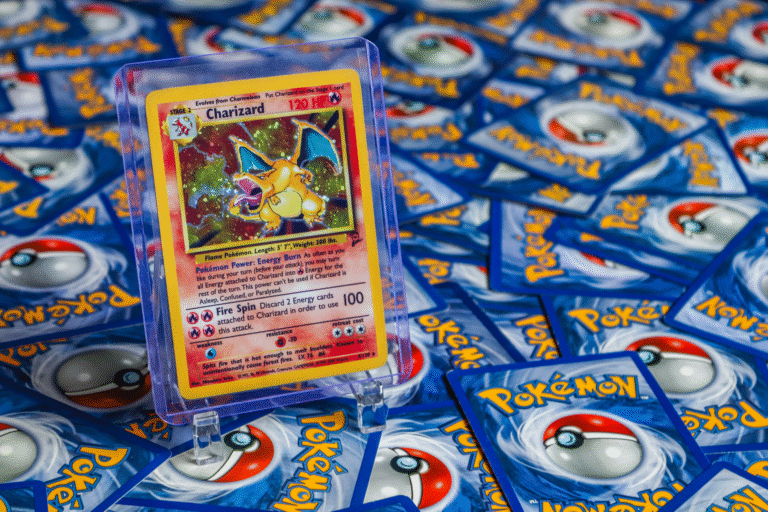
The Charizard (Delta Species) from EX Crystal Guardians (card 4/100) currently trades between $99 and $248 depending on condition, with ungraded near-mint copies averaging around $223–$248. A heavily played raw card sold for $120 in April 2026, while higher-grade certified copies command $450 to $3,800+ depending on the PSA rating.
For collectors trying to find a specific price point right now, TCGPlayer lists the card at $144.27, making it accessible to intermediate collectors but still positioned as a premium EX-era Charizard behind the Base Set and Shadowless versions. This card occupies a middle tier in Charizard pricing—expensive enough to matter, but not in the stratosphere of the original Base Set Charizard or PSA 10 gems. The price variation is steep because condition dominates the valuation more than most other factors.
Table of Contents
- What Drives EX Crystal Guardians Charizard Prices?
- Condition’s Heavy Impact on Raw Card Value
- Grading Premiums and the PSA Tier System
- Finding the Best Price: Raw vs. Graded Purchase Strategy
- The Delta Species Mechanic’s Limited Impact on Collector Demand
- Market Volatility and Sales History Patterns
- Comparing EX Crystal Guardians Charizard to Other Premium Holos from the Set
What Drives EX Crystal Guardians Charizard Prices?
The EX Crystal Guardians Charizard is a legitimate collectible from 2006, making it nearly 20 years old, but it lacks the nostalgia pull or scarcity of earlier Charizards. The delta species mechanical gimmick—where Charizard is dual-type Fire/Metal instead of pure Fire—appealed to a specific audience at the time but has limited appeal for investors chasing “best Charizards.” Grading is the single largest price multiplier: a PSA 9 example might command $800–$1,200, while the same card raw and in good condition pulls $200–$250. This represents a 4x to 6x premium for certification alone, driven by collector perception that graded cards are easier to resell and carry proof of condition.
Market depth also affects pricing. The card is common enough that ungraded copies are available at any moment, preventing it from spiking dramatically. However, PSA-graded high-condition copies are rarer and fewer, creating the price ceiling for serious investors.
Condition’s Heavy Impact on Raw Card Value
Condition is not a minor factor in the EX Crystal Guardians Charizard price—it’s the dominant factor for ungraded cards. A near-mint copy at $248 is the same card as a heavily played copy at $149, a 66% difference for visible wear alone. This is a real risk for buyers: if you purchase a card graded as “lightly played” and receive it in worse condition than expected, your resale value collapses immediately. The market data shows a clear price decay curve.
Near Mint ($248) → Lightly Played ($223) → Moderately Played ($198) → Heavily Played ($149) → Damaged ($99). That step from near-mint to lightly played costs you $25, but the jump from lightly played to heavily played is $74. The pricing algorithm weights major visible flaws—creases, edge wear, surface scratches—more heavily than minor ones. A warning here: when buying raw copies online, request detailed photos and expect to pay a premium for documented near-mint examples, because dealers know the condition-to-price conversion and price accordingly.
Grading Premiums and the PSA Tier System
Getting your copy professionally graded by PSA (Professional Sports Authenticators) is the fastest way to unlock higher prices, but it also locks you into the grading company’s ecosystem. A PSA 8 version of this card typically sells for $350–$600, while a PSA 9 jumps to $800–$1,500+. The difference between a PSA 8 and PSA 9 is subjective—corners and centering need to be near-flawless on the 9—but the market treats it as a hard line.
PSA 10 examples (gem mint) have only been seen at $1,500–$3,808 in recent 2026 sales, indicating they are genuinely rare and represent cards that survived 20 years in perfect condition. One limitation: grading takes 20–60 days depending on the service tier, and you pay $15–$200 per card for the privilege. If you grade 10 cards and only 3 hit PSA 8 or higher, you’ve sunk $150–$2,000 in grading fees across the batch with no guarantee of profit. Many collectors grade only their strongest candidates.
Finding the Best Price: Raw vs. Graded Purchase Strategy
If you’re buying to keep the card, purchasing a raw copy in good-plus condition for $200–$230 is rational and avoids the grading fee. If you’re buying to resell within 6–12 months, the math changes: a PSA 8 or 9 is more liquid, because institutional buyers and serious collectors will bid on certified copies when they won’t on raw cards. The tradeoff is immediate: spend $50–$100 on grading, wait 1–2 months, and hope your card hits PSA 8 to recoup the cost.
TCGPlayer’s listing at $144.27 undercuts the market average ($223–$248 for raw near-mint), signaling either weaker condition or a motivated seller. Comparing across platforms, eBay current listings and Pokemon Wizard typically show $200–$280 for near-mint raw copies, so that $144 listing is either a deal or a red flag. Always verify the seller’s return policy and request photos before buying at the low end of the range.
The Delta Species Mechanic’s Limited Impact on Collector Demand
The Delta Species gimmick—where Charizard gains a Metal weakness alongside its Fire typing—was mechanically interesting in 2006 but is now a historical oddity. Competitive players have no use for a 20-year-old card, and casual collectors tend to prefer the “classic” Charizard designs from earlier sets. This limits the pool of potential buyers compared to a Base Set or 1st Edition Charizard, which appeals to both vintage collectors and players seeking iconic imagery.
The price reflects this: it’s valuable, but it’s a middle-ground collectible rather than a unicorn. A warning for investors banking on nostalgia: Delta Species Charizard may never achieve the price multiplier that Base Set Charizard has commanded over the past decade. Nostalgia works backward, not forward. Cards released in 2006 hit peak nostalgia around 2020–2024; newer collectors (those aged 15–25 today) are more interested in modern Pokémon cards and won’t chase EX-era copies at premium prices unless they already collected them at age 10.
Market Volatility and Sales History Patterns
Sales data from 2026 shows that heavily played raw copies move at $100–$120, suggesting a steady floor. Graded copies have sold at $450–$3,800 depending on grade, but the gaps between sales are often weeks or months, indicating that certified high-grade copies are not being flipped constantly. Most collector-held copies are held, not traded, which actually supports pricing by reducing supply on the secondary market.
A specific example: Sports Card Investor recorded a heavily played raw sale at $120 on April 19, 2026. By contrast, an ungraded copy sold for $100 on April 9, 2026, and another for $126 on September 2, 2025. The price variance within “ungraded/raw” copies is tight—$100–$126 across the year—suggesting the market has settled on a stable valuation for playable condition copies.
Comparing EX Crystal Guardians Charizard to Other Premium Holos from the Set
The EX Crystal Guardians set (released 2006) includes other holo rares, but Charizard is the de facto chase card. A Blastoise from the same set, for comparison, typically sells for $40–$80 raw depending on condition, and graded copies reach $150–$300.
The Charizard commands 2x to 3x the price of similarly graded Blastoise, driven purely by species demand and artistic appeal. This is a real collector dynamic: Charizard is overvalued relative to mechanical power or scarcity because Charizard itself is a cultural icon from the original TCG era. In raw near-mint condition, the EX Crystal Guardians Charizard at $223–$248 slots between the modern-era Charizard bulk holos (which sell for $30–$80) and the PSA 8 graded copies at $350+, making it an accessible entry point for collectors who want an older Charizard without spending four figures.