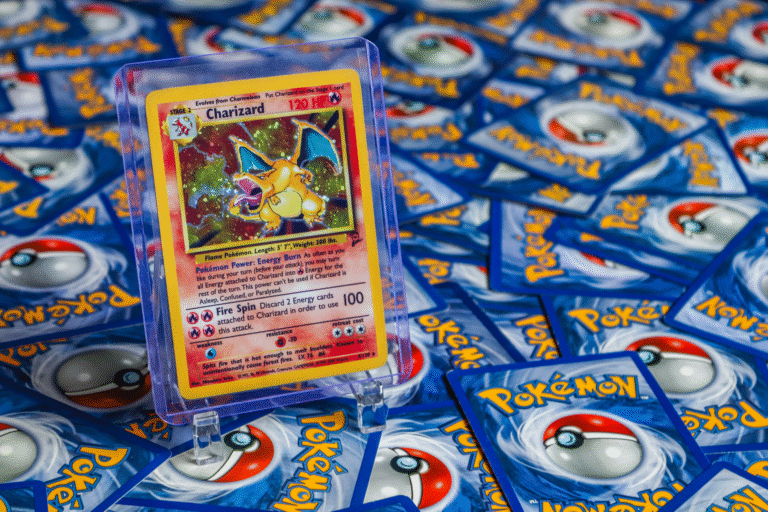
The Registeel ☆ (Gold Star) card from the 2006 EX Legend Maker set currently trades at around $500 in raw condition, with Near Mint copies reaching $650 and Lightly Played examples at $265. This makes it one of the more expensive cards in the entire EX Legend Maker expansion—a set known for its powerful Pokémon and valuable holos.
If you’ve pulled one from a pack or are considering buying, you’re holding or pursuing a card that represents the upper tier of EX-era pricing. The March 2026 auction market confirmed this valuation when a CGC 10 copy sold for $2,074, validating the $500–$650 range for raw ungraded copies. That gap between raw and graded prices matters significantly when calculating your investment, especially if you’re deciding whether to grade a copy you already own.
Table of Contents
- What’s the Current Market Price for Registeel ☆ Gold Star?
- How Condition Affects Registeel Gold Star Values
- Why EX Legend Maker Registeel Commands Premium Prices
- Grading and Authentication Impact on Price
- Market Volatility and Price Trends for Gold Star Cards
- Finding Accurate Price Data for Registeel ☆
- Buying vs. Selling Registeel Gold Star—The Price Gap
- Frequently Asked Questions
What’s the Current Market Price for Registeel ☆ Gold Star?
The Registeel ☆ from EX Legend Maker (#92/92) sits firmly in the $500 tier for standard holo copies. Most pricing sources track this card at $500 for average to good condition, but Near Mint examples consistently command $650, reflecting the condition premium that serious collectors expect to pay. A secondary pricing source lists NM copies at $300, showing that even within the “Near Mint” range, variation exists based on exact condition standards and the source’s methodology.
This $500 base price matters because it immediately positions Registeel ☆ as one of the pricier Gold Star cards from the 2006 era. For comparison, other Gold Star Pokémon from EX sets tend to cluster between $250 and $600, so Registeel occupies the higher end without being exceptional by historical standards. However, the jump from $650 NM to $2,074 for a CGC 10 reveals how grading dramatically reshapes the market value—graded copies can command 3–4x the raw price if the card achieves a high numerical grade.
How Condition Affects Registeel Gold Star Values
Condition is the primary price driver for Registeel ☆, and the gap between LP and NM copies ($265 vs. $650) demonstrates this starkly. A card played with in a deck or stored casually will lose roughly 60% of its Near Mint value, dropping from the $650 tier to the $265 range. This isn’t unique to Registeel—all high-value EX-era cards experience similar condition-based depreciation—but it means your storage method directly affects the card’s resale value.
The real danger lies in condition creep. Cards graded as “Near Mint” by casual assessment might be “Lightly Played” by third-party graders like CGC or PSA, especially if they’ve been handled, shuffled, or stored without sleeves. Registeel ☆’s metallic holofoil is particularly susceptible to surface scratches and wear, since Gold Star cards feature a textured holo pattern that catches light and shows micro-scratches more visibly than standard holos. If you own an ungraded copy you believe is NM, having it professionally graded might reveal it sits in the LP range, costing you $400+ in perceived value.
Why EX Legend Maker Registeel Commands Premium Prices
The EX Legend Maker set itself has become increasingly collectible, and Registeel ☆ is recognized as one of the set’s most valuable cards. This set, released in 2006, featured rare Gold Star Pokémon (indicated by the ☆ symbol) that were chase cards even at release. Registeel, along with other legendary Steel-types, appealed to both casual collectors and competitive players, driving demand for decades after the set’s rotation out of Standard format.
Gold Star cards represent a subset of holos within EX-era sets, making them inherently scarcer than non-Gold Star holos. The full-art treatment, the ☆ designation, and the metallic holofoil treatment all combine to make Registeel ☆ more difficult to pull from a booster box compared to common holos or non-holo rares. Scarcity plus enduring collector interest equals sustained high pricing. The March 2026 CGC 10 sale at $2,074 reflects the market’s willingness to pay grading premiums for cards in exceptional condition, proving that Registeel ☆ retains strong demand among high-end collectors.
Grading and Authentication Impact on Price
If you’re considering professional grading for your Registeel ☆, expect the cost of grading (typically $20–$100 depending on the service and turnaround) to eat into profit unless your card grades 8 or higher. A CGC 8 or PSA 8 copy might fetch $800–$1,200, while a CGC 9 could reach $1,500–$1,800, and a CGC 10 commands $2,000+. The threshold where grading becomes profitable sits around CGC 7.5 or PSA 7, where the grading fee is offset by the price increase. The real tradeoff involves timing and certainty.
Submitting an ungraded $650 NM copy to CGC carries risk: if it grades a 7, you’ve paid $40–$100 to downgrade a card that’s worth $650 raw to perhaps $900–$1,100 graded. You’ve spent money to potentially lose flexibility. Conversely, if it grades a 9, you’ve multiplied your value by holding the card for several weeks and paying a fee. Many collectors hold ungraded copies specifically to preserve optionality—a raw NM Registeel ☆ is liquid and easy to sell, while a CGC 8 is a specific product with a narrower buyer pool.
Market Volatility and Price Trends for Gold Star Cards
EX-era Gold Star prices have shown resilience but also volatility tied to broader Pokémon tcg market cycles. The $2,074 March 2026 auction result sits within the expected range for a CGC 10, but Gold Star prices can fluctuate 10–20% annually depending on set nostalgia, content featuring the card (like Pokémon anniversaries), and overall collector appetite. Registeel ☆ hasn’t experienced the explosive price growth of some rarer cards—it isn’t climbing toward $5,000 like the rarest first-edition holos—but it also hasn’t collapsed, indicating stable long-term demand. A warning: using a single recent auction as a pricing anchor is risky.
The $2,074 sale is a high-end comp for a perfect CGC 10, not a typical price. Most Registeel ☆ sales cluster in the $400–$700 raw range, and if you’re selling quickly, you may need to discount to $450–$550 to attract buyers. Likewise, if you’re buying, vendors citing the $2,074 CGC 10 auction as justification for a $700 asking price on an ungraded copy are inflating expectations. Verify prices against multiple recent sales, not individual high-value auctions.
Finding Accurate Price Data for Registeel ☆
Multiple sources provide pricing data for Registeel ☆, and checking at least two is essential to avoid overpaying or underestimating value. Pikawiz’s EX Legend Maker price list, CardTrader’s inventory, and specialized Pokémon pricing sites like Pokémon Wizard aggregate data from sales and listings. However, not all sources update at the same frequency—some reflect 30-day averages, others list asking prices from current inventory, and a few track only sold comps.
A $500 price on one site might represent the average raw NM price, while a $300 listing on another reflects quick-sale pricing for LP copies. The Landry Pop auction data from March 2026 provides hard evidence of what collectors paid for a verified CGC 10 copy, making it the most reliable ceiling for the card’s maximum value. Using this alongside the $500–$650 range for raw copies gives you a complete picture: most copies sell in the $400–$700 range, exceptional graded copies can reach $2,000+, and anything listed significantly above or below this range warrants skepticism.
Buying vs. Selling Registeel Gold Star—The Price Gap
When buying, expect to pay at the high end of the quoted range ($600–$700 for NM) because sellers price in their profit margin and the cost of listing. When selling, be prepared to accept offers 10–20% below listed prices unless your copy is graded or authenticated, in which case the discount shrinks. An ungraded Registeel ☆ that lists for $650 might sell for $550–$580 once negotiations happen, while a CGC 8 listed at $1,200 may sell closer to $1,100.
This bid-ask spread reflects the reality of trading cards as an illiquid asset compared to stocks or bonds. You own Registeel ☆ in isolation; there’s no continuous market maker, so each sale requires finding a willing buyer at the time you want to sell. If market sentiment shifts against EX-era cards or interest in Registeel specifically wanes, that $650 copy might sit listed for weeks at $550 before finding a buyer. Conversely, rare Gold Star cards in exceptional graded condition (CGC 9 and above) move faster because the pool of high-end collectors pursuing these cards is smaller but more committed to owning them.
Frequently Asked Questions
Should I grade my Registeel ☆ Gold Star if it’s in Near Mint condition?
Only if you’re confident it grades 8 or higher. Grading costs $20–$100 and only becomes profitable if the card grades well enough to offset that fee with increased value. A raw NM Registeel ☆ at $650 is already fairly valued; grading carries risk if the card doesn’t achieve a high numerical grade.
Why is the March 2026 CGC 10 auction price ($2,074) so much higher than the $500 raw price?
Graded copies in pristine condition command significant premiums because they’re authenticated and their condition is guaranteed by a third party. A CGC 10 means perfect or near-perfect centering, corners, edges, and surface—far exceeding the typical Near Mint raw copy. The $2,074 reflects both rarity in that condition tier and collector demand for gem copies.
How liquid is the Registeel ☆ Gold Star market? Will I be able to sell it quickly?
Raw NM copies are reasonably liquid and typically sell within 1–4 weeks at fair market prices ($500–$650). Graded copies (CGC 8+) move faster among serious collectors. LP copies take longer because the $265 price point attracts fewer buyers. Expect to discount 10–20% below asking price if you want a quick sale.
Is Registeel ☆ a good investment compared to other EX Legend Maker cards?
Registeel ☆ is among the pricier cards in the set, so it’s less likely to appreciate rapidly than rarer cards that already command $1,000+. However, it’s stable and in-demand, making it less risky than speculating on lower-priced cards. Treat it as a collectible first and an investment second.
What should I look for when buying an ungraded Registeel ☆?
Check centering (how evenly the image sits within the borders), corners for whitening or damage, edges for wear, and the holo surface for scratches or dents. Gold Star cards are especially prone to showing surface wear. Request high-resolution photos under light to assess holo condition before committing to a purchase.